
Customer experience (CX) is the sum of every interaction a person has with a business, from first seeing an ad to buying, getting help and coming back. It covers how easy, fast and pleasant each step feels, and what the customer thinks of the brand as a result. It matters because people who have a good experience tend to stay, buy again and recommend you, while a bad one can send them to a competitor.
Key Takeaways
- CX is wider than customer service. It includes marketing, the website, buying, delivery and support.
- In a PwC survey of 15,000 people, 32% said they would walk away from a brand they love after just one bad experience.
- The same research found speed and efficiency mattered most to consumers, followed by knowledgeable and helpful staff.
- Common CX metrics include Net Promoter Score, satisfaction surveys and repeat purchase rates.
- Marketers shape CX through clear messages, honest offers, easy journeys and useful follow-ups.
What Is Customer Experience?
Think about the last time you bought something online. You saw an ad, visited the site, compared options, paid, waited for delivery and maybe asked a question. Each of those moments left an impression. Together, they make up your customer experience with that brand.
That’s why CX is not one team’s job. Marketing sets expectations, the website and checkout either meet them or don’t, and support fixes problems. If any step fails, the whole experience suffers. In other words, a great ad can’t make up for a slow delivery or a rude reply.
Good CX also links closely to loyalty. For more on that side, see our glossary entry on customer retention.
How Customer Experience Works
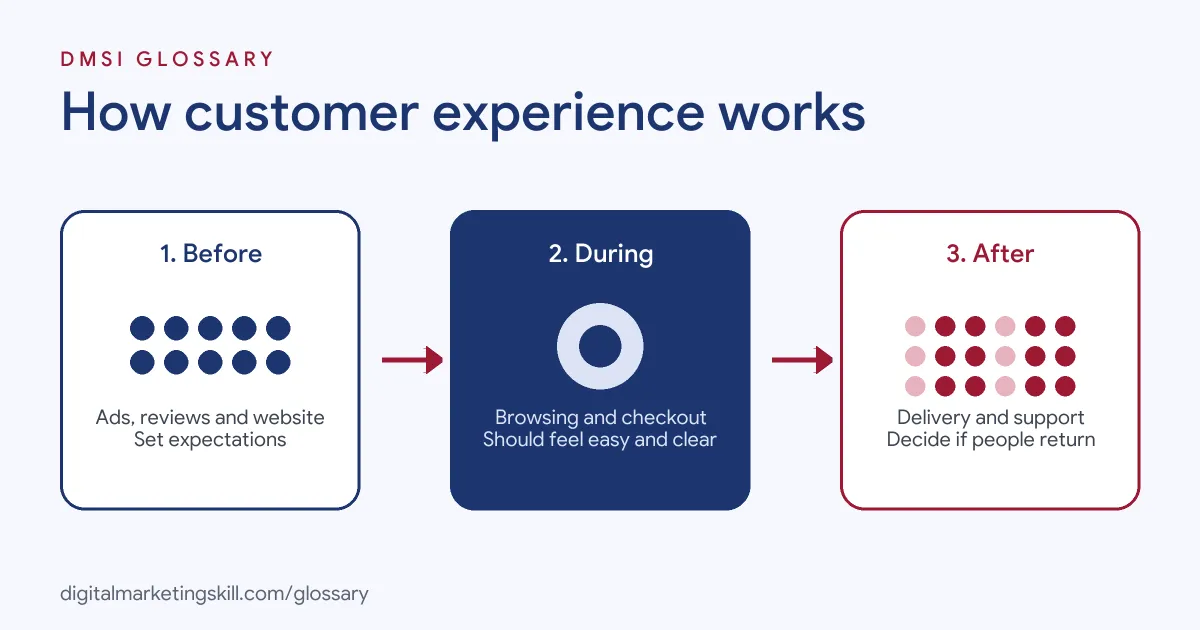
CX builds up across three broad stages. First, before buying, people form expectations from ads, reviews and your website. Next, during the purchase, they judge how easy and clear the process is. Finally, after buying, delivery, support and follow-up decide whether they come back.
Touchpoints
A touchpoint is any moment a customer meets your brand. It might be a social post, a search result, a product page, a delivery email or a support chat. Mapping these touchpoints helps you see where people get stuck or frustrated.
What Customers Value
Research gives useful clues. PwC’s “Experience Is Everything” study, as reported by Adobe, found that “speed and efficiency (80%) topped the list, followed by knowledgeable and helpful employees (78%).” It also found that “73% said that a good experience is key in influencing their brand loyalties.”
Experience can affect price as well. According to the same report, “the price premium for quality CX among consumers worldwide is up to 16% for products and services.” In addition, “forty-two percent of consumers said they would pay more for a friendly, welcoming experience.”
What a Bad Experience Costs
The downside is sharp. PwC’s research found that “one in three (32%) say they would walk away from a brand they ‘love’ after just one bad experience.” So a single broken step, such as a confusing checkout, can undo months of good marketing.
Customer Experience Examples
Here are three made-up examples of CX done well:
- Online shop: A clothing brand shows clear delivery dates on every product page and sends tracking updates by email. As a result, customers rarely need to contact support.
- Software company: A new user gets a short welcome email with a two-minute setup video. Then, if they get stuck, a help article appears inside the app.
- Local business: A dental clinic sends a reminder text, keeps waiting times short and asks for feedback after each visit. It then fixes the issues patients mention most.
In each case, the business removes friction at the moments that matter most to customers.
Customer Experience vs Customer Service
These two terms are often confused. Here is how they differ:
| Feature | Customer experience | Customer service |
|---|---|---|
| Scope | Every interaction across the whole journey | Help given when a customer asks for it |
| Who owns it | Marketing, product, sales, operations and support together | Mainly the support team |
| When it happens | Before, during and after the purchase | Usually after a question or problem |
| Typical measures | Net Promoter Score, repeat purchases, churn | Response time, resolution time, satisfaction scores |
In short, customer service is one part of the wider experience.
How to Improve Customer Experience
- Map the journey. List every touchpoint from first contact to repeat purchase.
- Collect feedback at key moments, such as after purchase and after a support chat.
- Find the biggest pain points. Look for steps with high drop-off or many complaints.
- Fix one problem at a time, starting with the one that affects the most people.
- Make sure marketing promises match what the product and service deliver.
- Measure again, and compare scores before and after each change.
- Share results across teams, so everyone sees how their work affects customers.
How to Measure Customer Experience
No single number captures CX, so most teams track a few. One common measure is Net Promoter Score. Bain’s Net Promoter System asks customers: “How likely are you to recommend us to a friend or colleague?” People answer on a zero-to-ten scale. Your score is the percentage of promoters (9 or 10) minus the percentage of detractors (0 to 6).
Other useful measures include satisfaction surveys after key moments, repeat purchase rate, churn rate and the number of support contacts per order. Together, they show both how people feel and what they actually do.
A Simple Journey Map
A journey map is the easiest way to see your CX on one page. Here is a made-up example for a small online tea shop:
| Stage | What the customer does | What could go wrong |
|---|---|---|
| Find | Sees a post or a search result | The ad promises a deal the site doesn’t show |
| Choose | Reads product pages and reviews | No clear price for delivery |
| Buy | Pays at checkout | Too many form fields |
| Wait | Gets order and tracking emails | No update for days |
| Use and return | Drinks the tea and gets a follow-up | No easy way to reorder |
Then pick the worst gap and fix it first. For example, if many people quit at checkout, cut the form to the fields you really need.
Best Practices
- Be fast. Speed and efficiency topped the list in PwC’s research, so cut waiting wherever you can.
- Set honest expectations. Clear prices, delivery times and terms prevent disappointment later.
- Make help easy to find. Offer clear FAQs, simple contact options and helpful staff.
- Close the loop. When customers give feedback, tell them what you changed.
- Keep it consistent. The tone and quality should feel the same on every channel.
Common Mistakes to Avoid
Many businesses treat CX as a support issue only, so marketing keeps overpromising. Others collect feedback but never act on it, which frustrates customers further. Some focus on one channel, such as the website, while email or delivery lets people down. Finally, many measure only satisfaction scores and ignore behaviour, such as repeat purchases. A complete view needs both.
Where You’ll Use Customer Experience at Work
CX thinking appears in marketing, operations and client roles. For example, recent remote job listings ask for:
- “Strong understanding of customer experience principles, operational workflows, health-scoring, and project management methodologies” (Client Services Operations Senior Analyst).
- Someone who will “coordinate the resources needed to deliver a seamless customer experience from quote through fulfillment.” (Onboarding IAM).
- “Assessing customer feedback, data, and analytics as insights to improve the overall digital experience” (Digital Experience Specialist).
So as a Digital Marketing Manager or Growth Marketer, you will often be asked how a campaign, landing page or email affects the wider customer journey.
Learn It in the Full Stack Programme
CX touches every channel, so it fits the Full Stack (all four tracks) option. It covers all ten courses, with one portfolio project from each track, from paid social to email automation, Google Ads and WordPress. Every track is about 90% hands-on, with unlimited 1-on-1 mentoring and a U.S. Project Internship from day one.
For ideas on rewarding loyal customers, read our guide to building a customer loyalty programme.
Frequently Asked Questions
What is customer experience in simple terms?
It is how customers feel about every interaction with your business, from the first ad to after-sales support.
What is the difference between CX and UX?
UX (user experience) focuses on using a product or website. CX is wider and covers the whole relationship, including marketing, buying and support.
Why does customer experience matter?
Because it affects loyalty and sales. In PwC’s research, 73% said a good experience is key in influencing their brand loyalties.
How do you measure CX?
Most teams use a mix of Net Promoter Score, satisfaction surveys, repeat purchase rate and churn rate.
Who is responsible for CX?
Everyone who touches the customer. Marketing, sales, product, operations and support all shape the experience.
Sources: Adobe: Consumers would pay more for better CX (PwC study); Bain: Measuring your Net Promoter Score; remote job listings on Himalayas and Himalayas.