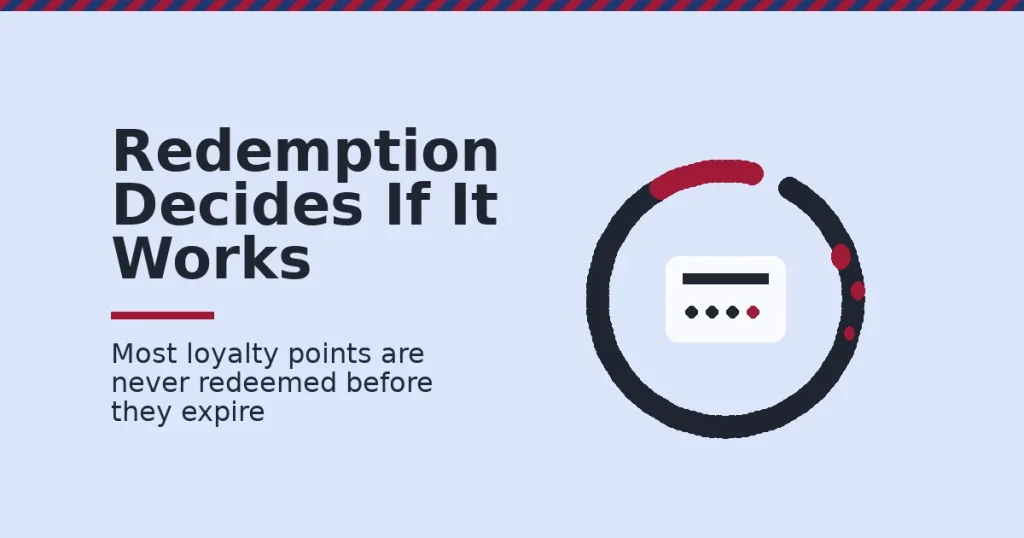
A customer loyalty program works by rewarding repeat purchases. Done well, it costs less than finding a new customer. The business keeps more profit from relationships it already has. The catch is simple. Most programs are built around earning points. Few close the gap between joining and actually coming back to redeem them.
Key Takeaways
- Retention is leverage, not loyalty for its own sake. Bain’s Fred Reichheld found that raising customer retention by just 5% can lift profits by 25% to 95%. Loyal customers cost less to serve, and they buy more over time.
- Most loyalty points go unused. Antavo’s Global Customer Loyalty Report found that 27% of points customers earned were left unspent. Among programs with expiration rules, 12% of total points earned expire before anyone redeems them.
- Members believe in the model; the design is what fails. The same Antavo survey found 82.6% of marketers believe their program makes customers feel valued. Only 56.2% of customers agree.
- A loyalty program changes behaviour when it is simple. Bond’s Loyalty Report surveyed over 20,000 US program members. It found 85% are more likely to keep doing business with a brand that has a program, and 73% say they spend more because of one.
- Scale proves the model, not the shortcuts. Starbucks reported a record 35.5 million 90-day active US Rewards members. Both Rewards and non-Rewards transactions grew together, a sign the program adds real demand rather than just reshuffling existing customers.
In this guide
- What Most Customer Loyalty Program Advice Misses
- Why a Customer Loyalty Program Changes the Economics of a Business
- Customer Loyalty Programs Differ by What They Ask the Member to Do
- How to Design Each Program Type So Members Actually Redeem
- Common Mistakes That Sink a New Loyalty Program
- How to Measure a Customer Loyalty Program Honestly
- The Most Useful Rule: Judge the Program on Redemption, Not Sign-Ups
- A Real Case: Why Starbucks Reports Active Members, Not Just Sign-Ups
- Frequently Asked Questions About Customer Loyalty Programs
- Start With the Metric That Tells You the Truth
What Most Customer Loyalty Program Advice Misses
Most guides on building a customer loyalty program focus on mechanics. Pick points or a tier system. Set a reward catalogue. Launch an app. That advice is not wrong, but it skips the part that decides whether the program pays for itself: whether members redeem what they earn.
This guide treats redemption, not sign-ups, as the real success metric. It covers why loyalty economics work, how the main program types differ, what to change in each one, and how to measure a live program honestly.
A few ground rules first. The retention-to-profit figures below come from Bain’s long-running research. People cite them often. The logic holds across industries: lower service cost, higher repeat spend. But the exact multiple varies by business. The Antavo and Bond figures are survey snapshots of specific member panels. They are not universal constants. Read them as a strong signal, not a guarantee for your own program.
Why a Customer Loyalty Program Changes the Economics of a Business
A customer loyalty program works because retained customers are cheaper to keep than new customers are to find, and the gap compounds. According to Harvard Business Review, acquiring a new customer costs five to twenty-five times more than retaining an existing one. Reichheld’s research found that lifting retention by 5% can increase profits by 25% to 95%.
That swing happens for three reasons. Repeat customers need less convincing, so marketing cost per order falls. They tend to spend more per visit once they trust a brand. And they generate word of mouth, which brings in new customers at close to zero marginal cost. A loyalty program is a structured way to earn that trust faster than it would happen on its own.
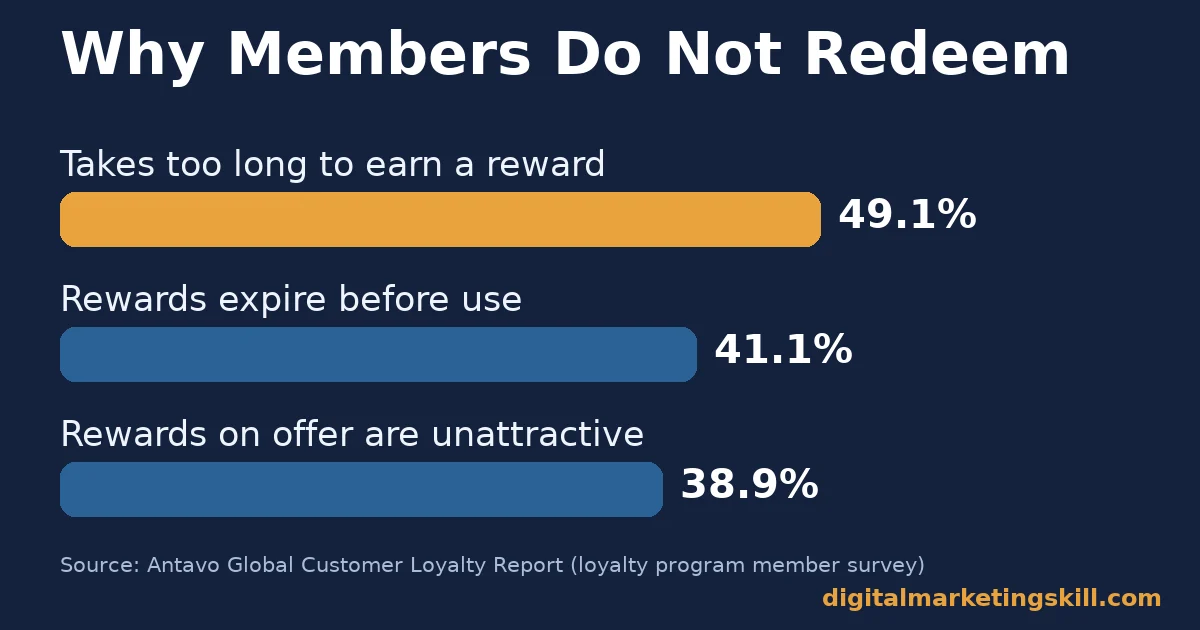
The mechanism breaks down when the reward feels too far away to matter. Antavo’s Global Customer Loyalty Report asked loyalty program members why they feel disappointed. 49.1% said it takes too long to earn a reward. 41.1% said rewards expired before they could use them. 38.9% said the rewards on offer were not attractive. Each of those is a design failure, not a loyalty failure. Members were willing to participate. The customer loyalty program simply made participation not worth the wait.
The Trust Gap Behind the Frustration
The same survey found a wider trust gap behind that frustration. Antavo’s own metrics guide notes that marketers consistently overestimate how valued their rewards make customers feel. That is exactly the 82.6%-versus-56.2% gap this guide opened with.
If your team believes the program is working, check the member-side numbers before you trust that instinct. Internal sentiment is not evidence. Only redemption data and member surveys tell you what is actually happening.
Customer Loyalty Programs Differ by What They Ask the Member to Do
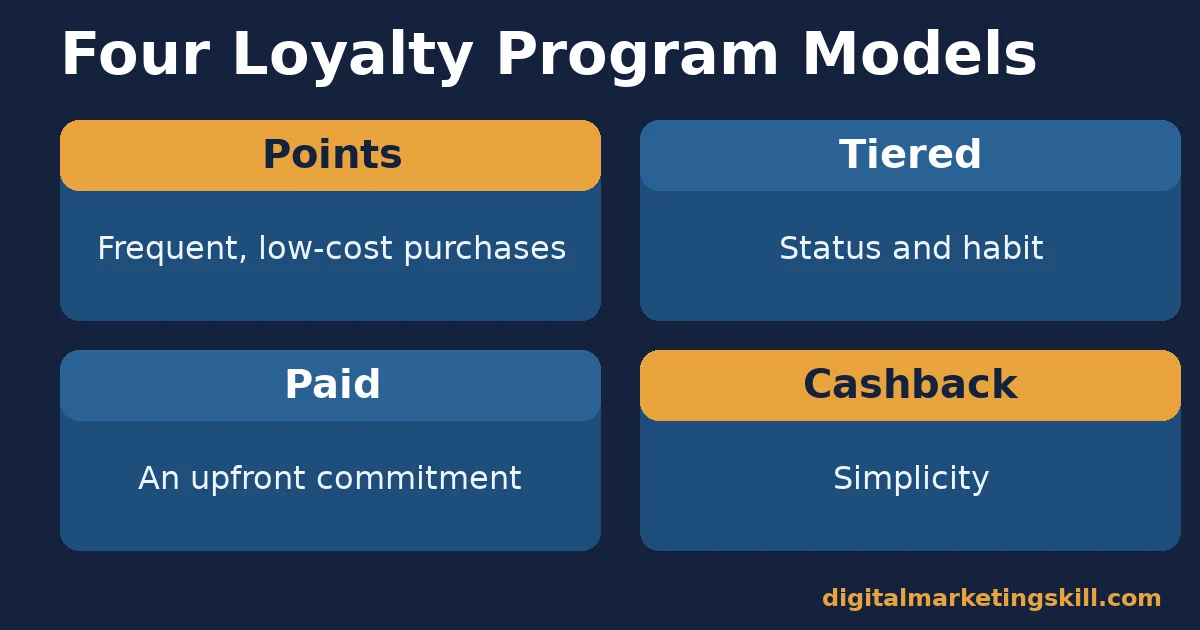
Most programs fall into four families. Each one asks something different of the member in exchange for a different kind of reward. Picking the wrong type for your margins and purchase frequency is the most common reason a new program underperforms.
Points Programs: Built for Frequent, Low-Cost Purchases
Points programs award a small unit of value per purchase, redeemable later for a discount or product. They suit businesses with frequent purchases and thin margins, like coffee shops or grocery retailers. The per-visit reward is tiny, but high visit volume makes the total cost predictable.
Tiered Programs: Built for Status and Habit
Tiered programs group members into levels, such as silver, gold and platinum, based on spend. Higher tiers unlock better perks. This works well where status matters to the customer, such as airlines and hotels, because climbing a tier is motivating even when the extra perks cost the business little.
Paid Programs: Built for an Upfront Commitment
Paid, or subscription, loyalty programs charge an annual or monthly fee for guaranteed perks such as free shipping or exclusive pricing. They work when the perk is something the member would otherwise pay for anyway. The fee buys convenience, not a discount.
Cashback Programs: Built for Simplicity
Cashback programs return a flat percentage of spend as store credit or cash. There are no tiers or point conversions to learn. They suit businesses whose customers want a simple, transparent deal rather than a game to play.
How to Design Each Program Type So Members Actually Redeem
The sections below mirror the four program types above. Start with the design fix that matches the model you already run. A mismatch between model and execution is usually the real problem, not the model itself.
Points Programs: Shorten the Distance to the First Reward
Set the first reward threshold low enough that an average customer reaches it within their first month. A small, fast first reward teaches the habit of returning to redeem, which later, bigger rewards depend on. Then publish the earn rate in plain language, not a confusing multi-tier table.
Set an expiry window long enough that casual customers do not lose points before they can use them. Early expiry is one of the three biggest sources of frustration in Antavo’s panel, so a generous window costs little and avoids a direct source of churn.
Tiered Programs: Make the Next Tier Visible and Reachable
Show members exactly how far they are from the next tier, in units they already track, such as dollars spent or nights stayed. Ambiguity about progress kills the motivation that makes tiers work.
Keep the top tier reachable by a meaningfully large, though not universal, share of your active customers. A tier almost nobody reaches reads as a marketing gimmick rather than a real goal. That undercuts the whole program’s credibility.
Paid Programs: Prove the Math in the First Sentence
State the annual value of the perks against the membership fee as a simple ratio, right where someone decides whether to join. If the perks are worth less than the fee for a typical customer, redesign the perks before launch. Paid members churn fast once the math stops working for them.
Track usage of the headline perk closely. If most paying members never use the flagship benefit, such as free next-day delivery, the fee is being paid for a promise rather than a service. Renewal will suffer as a result.
Cashback Programs: Pay Out Automatically, Not on Request
Credit cashback automatically at the point of sale or on a fixed schedule. Do not require the member to log in and claim it. Any extra step between earning and receiving a reward reduces how real it feels, even when the amount is identical.
Keep the percentage consistent across most products, rather than hidden behind fine-print exclusions. A cashback program’s whole appeal is simplicity. A long exclusions list quietly turns a simple program into a confusing one.
Common Mistakes That Sink a New Loyalty Program
Beyond picking the wrong model, most failed programs share a short list of avoidable mistakes. Check your plan against each one before launch, because fixing these later is harder once members have already formed an impression.
- Launching without a redemption target. If nobody on the team owns a redemption-rate goal, nobody will notice when it quietly drops. Assign it to a person, not just a dashboard.
- Copying a competitor’s structure wholesale. A tier system built for an airline rarely fits a local retailer’s purchase frequency. Match the structure to how often your own customers actually buy.
- Treating the launch as the finish line. Most teams put real effort into the launch campaign, then stop iterating. The program needs the same ongoing attention as any other revenue channel.
- Hiding the rules in long terms and conditions. If a member cannot explain the earn rate back to you in one sentence, the program is too complicated to build a habit around.
- Ignoring the members who never return. A churn-focused review of lapsed members usually reveals the same one or two frictions repeating across hundreds of accounts.
- Measuring the launch, not the habit. A spike in sign-ups during launch week proves the campaign worked. It does not prove the customer loyalty program itself will hold attention three months later, so keep watching after the buzz fades.
How to Measure a Customer Loyalty Program Honestly
Sign-up counts flatter every program, because joining is free and easy. The metrics below show whether the program is actually changing behaviour. Each is defined in one sentence, so you can track it without specialist loyalty software.
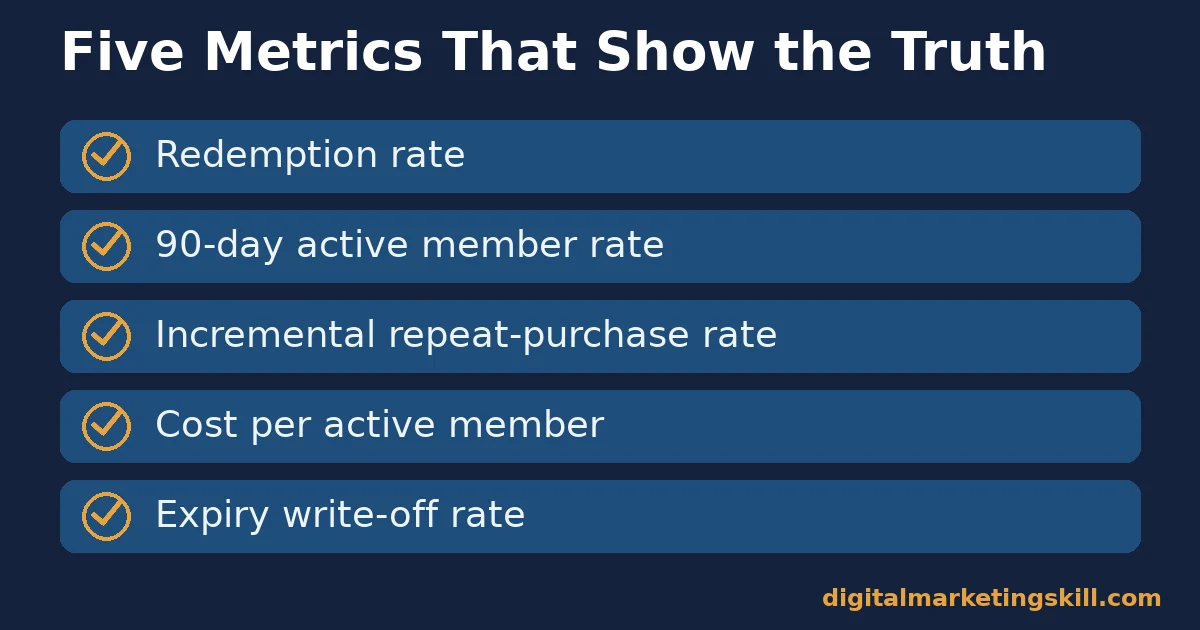
Five Metrics That Separate a Working Program From a Vanity One
- Redemption rate. The share of earned points or rewards members actually use. A healthy program keeps this well above the roughly 50% range reported across recent loyalty surveys. A rate far below that points to a design problem, not a marketing one.
- 90-day active member rate. The share of enrolled members who made a qualifying purchase in the last 90 days. This is the metric Starbucks reports publicly, because sign-ups without activity do not move revenue.
- Incremental repeat-purchase rate. The gap in repeat-purchase rate between members and a matched group of non-members. This isolates the program’s effect from the fact that your best customers would likely have returned anyway.
- Cost per active member. Total program cost, including rewards, platform and staff time, divided by active members, not total sign-ups. Compare it against the cost of acquiring a new customer to see whether retention is still the cheaper lever.
- Expiry write-off rate. The share of issued points or credit that expire unused. A rising write-off rate is an early warning that members are losing interest before they stop being customers entirely.
Pull these numbers from tools you likely already run. Google Analytics can segment repeat purchasers from first-time buyers, which gives you most of the data you need to calculate incremental repeat-purchase rate without a dedicated loyalty platform.
Reading the Metrics Together
Read redemption rate and active member rate side by side first. A low redemption rate with a healthy active member rate usually means the reward threshold is too high. A low active member rate with reasonable redemption means the sign-up incentive is not strong enough to build a habit.
Once both look healthy, move to incremental repeat-purchase rate and cost per active member together. That pair tells you whether the program pays for itself, which is the question that decides whether it survives a budget review.
The Most Useful Rule: Judge the Program on Redemption, Not Sign-Ups
If you take one decision rule from this guide, make it this. Never report sign-up numbers without the redemption rate next to them. A program with ten thousand members and an 18% redemption rate is weaker than one with two thousand members and a 60% redemption rate. The second program is actually changing how people buy.
Here is an illustrative example, with invented numbers. A mid-sized online retailer launches a points program and signs up 8,000 customers in its first quarter, which looks like a strong result in a launch report. But only 22% ever redeem a point, so the real base of engaged members is closer to 1,760 people. The team lowers the first-reward threshold and shortens the expiry window. Six months later, redemption rises to 46% on a larger base of 11,000 members, roughly 5,060 actively redeeming. Nothing about the marketing changed. Only the design of the reward path did.
A Real Case: Why Starbucks Reports Active Members, Not Just Sign-Ups
Starbucks is one of the few large retailers that discloses loyalty metrics every quarter, which makes its reporting a useful model even outside food service. According to its own investor relations release, the company’s 90-day active US Rewards member base reached a record 35.5 million, up 3% year over year.
What matters more than the headline number is what Starbucks chose to highlight alongside it. Both Rewards and non-Rewards transactions grew together for the first time in eight quarters. That detail matters, because it shows the program adding new demand. It is not simply converting existing regulars into point collectors, which is the real test any loyalty program eventually has to pass.
Treat this as a model for what to disclose and track, not a benchmark to copy directly. Starbucks operates at a scale and purchase frequency most businesses never will, so the absolute numbers do not transfer. The discipline of reporting active members instead of total sign-ups does transfer, at any size.
The same discipline shows up in Bond’s wider research. Its Loyalty Report surveyed over 20,000 US program members and found 85% are more likely to keep doing business with a brand that runs a loyalty program, with 73% saying they spend more because of one. Both figures describe member sentiment, not guaranteed revenue, and they come from self-reported US survey data, not transaction records.
Frequently Asked Questions About Customer Loyalty Programs
What is a customer loyalty program?
A customer loyalty program is a structured system that rewards customers for repeat purchases, usually through points, tiers, cashback or a paid membership. Its purpose is to make retention cheaper and more predictable than constantly acquiring new customers.
Which type of loyalty program is best for a small business?
A simple cashback or low-threshold points program usually works best for small businesses. It needs little software and no complex tier logic. Choose the model that matches how often your typical customer buys, not the model a large competitor uses.
How do I know if my loyalty program is actually working?
Check the redemption rate and the 90-day active member rate before anything else. High sign-ups with low redemption means members are not finding the reward worth coming back for.
Why do customers not redeem their loyalty points?
Survey data from Antavo’s loyalty report points to three recurring reasons. It takes too long to earn a reward. Rewards expire before members can use them. And the rewards on offer are not attractive enough to bother with.
Does a paid loyalty program work better than a free one?
A paid program can build stronger habits, because members have already committed money. But that only holds if the perks are clearly worth more than the fee. If a free program already drives strong repeat purchases, add a paid tier to extend it rather than replace it.
How much should a loyalty program reward be worth?
There is no fixed figure, because it depends on your margin and purchase frequency. The practical test is whether a typical customer can reach a first, meaningful reward within their first month. That is what builds the redemption habit the whole program depends on.
Can a small business afford a customer loyalty program?
Yes. Simple programs built on free or low-cost platforms can run on thin margins, because the reward cost scales with actual purchases, not sign-ups. The main cost is staff time spent tracking redemption and fixing a design that is not working.
How long does it take to see results from a customer loyalty program?
Give it at least one full purchase cycle before judging the results. For a coffee shop that might be a month; for a furniture retailer it could be closer to a year. Judge the program against redemption rate and active member rate at the end of that cycle, not against sign-ups in the first week.
Start With the Metric That Tells You the Truth
A customer loyalty program only earns its cost when members redeem what they earn. Audit your current redemption rate before you add a single new reward tier. If the number is weak, fix the distance to the first reward and the expiry window first. Measure again after one full purchase cycle.
If you want to build this skill properly, alongside the retention, CRM and lifecycle work it depends on, Digital Marketing Skill Institute teaches it hands-on. The Master Diploma in Digital & AI Marketing covers 10 courses across four AI-powered tracks, including AI-powered lead generation and email automation and AI-powered social media management and advertising. It comes with unlimited 1-on-1 coaching and mentoring and real project-based work experience with a US partner company from day one. The diploma is dual US and UK accredited and recognised in more than 100 countries.
The program is 100% online, so you can study and apply this anywhere in your country. Related guides, including our breakdowns of customer retention strategies, CRM in digital marketing and customer relations, are on the Digital Marketing Skill Institute blog. When you are ready, apply for the Master Diploma or start from the Digital Marketing Skill Institute homepage.
Every figure in this guide was checked against its original source before publication. Figures marked as illustrative are invented examples, not real results.
![9 Amazing Digital Marketing Skills to Make Money Online [With Proof]](https://digitalmarketingskill.com/wp-content/uploads/2019/07/9-Amazing-Digital-Marketing-Skills-to-Make-Money-Online-With-Proof-17.png)