
A Marketing Funnel is a model that maps how people move from first hearing about a brand to becoming customers, and often loyal fans. It gives your team a shared picture of the buyer’s path. As a result, you can plan the right content, channel and message for each step. It also shows you where people drop out, so you know what to fix first.
Key Takeaways
- A marketing funnel shows the path from awareness to purchase, and often on to loyalty.
- Most teams split it into top, middle and bottom stages.
- Each stage needs its own goals, content and metrics.
- Real buyers rarely move in a straight line, so treat the funnel as a guide.
- The marketing funnel sits alongside the sales funnel, which covers the later, sales-led steps.
What Is a Marketing Funnel?
A marketing funnel is a simple way to picture your buyers. Many people start at the wide top. Then fewer move into the middle. Finally, a smaller group buys at the narrow bottom.
HubSpot puts it plainly: “A marketing funnel represents the customer journey from initial brand awareness to final purchase decision.” So the funnel is less about tools and more about people. It asks one question at every stage: what does this person need right now?
Think of a new coffee shop in your street. First, you see its sign and notice it. Next, you read a few reviews and compare it with the café you already use. Then a free pastry offer tempts you in. Later, you return each week and tell your friends. In short, that is a marketing funnel in action.
The idea is old. In fact, it grew out of the AIDA model, which stands for Awareness, Interest, Desire and Action. Since then, marketers have added stages such as loyalty and advocacy. That way, the funnel no longer stops at the first sale.
Why It Matters
Without a funnel, teams often pour all their budget into one stage. For example, they buy lots of ads but have nothing to help people decide. On the other hand, a clear funnel shows the gaps. It helps you balance brand awareness work with work that drives sales. Also, it gives you a way to explain marketing results to managers and clients.
How a Marketing Funnel Works
A marketing funnel works by moving people from one stage to the next with the right message. Each stage has a job to do. When one stage is weak, fewer people reach the stages after it.
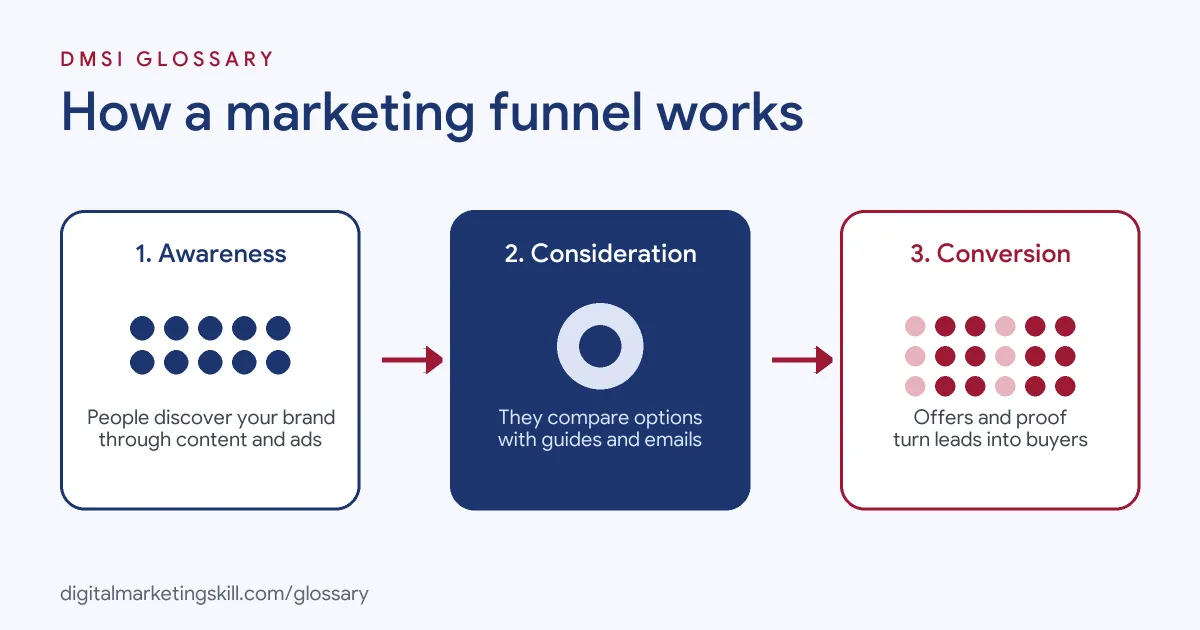
Top of the Funnel: Awareness
At the top of the funnel, people don’t know you yet. So your goal is to reach them and earn attention. Typical tools are social posts, short videos, blog articles and broad ads. Here you track reach, impressions and new visitors. However, don’t expect many sales at this point.
Middle of the Funnel: Consideration
In the middle of the funnel, people know their problem and compare options. Google describes this as the point when consumers are “exploring and evaluating their buying options.” It also calls it the “messy middle” of the purchase journey, “the space where customers are won and lost.” So this stage needs guides, comparisons, case studies, webinars and emails. In addition, you often capture an email address here.
Bottom of the Funnel: Conversion
At the bottom of the funnel, people are ready to act. Therefore, you remove doubts and make buying easy. Free trials, demos, reviews, clear pricing pages and offers all help. The key number here is the conversion rate.
After the Sale: Loyalty and Advocacy
Many modern funnels add a stage after the purchase. Here you welcome new customers, help them succeed and ask for reviews. As a result, happy customers buy again and refer others. That feeds new people back into the top.
Measuring Each Stage
A funnel is only useful if you measure it. So give every stage one main number. For example, track reach at the top, sign-ups in the middle and sales at the bottom. Then divide each number by the one before it. As a result, you get a stage-to-stage rate that shows where people leave.
Next, compare those rates over time. If the middle rate falls, look at your guides, emails and landing pages first. Similarly, if the bottom rate falls, check your offer, price and checkout. In addition, tag your links so you know which channel sent each visitor. That way, you can see which channels fill the funnel and which ones actually lead to sales. Finally, share one simple funnel report with your team, so everyone works on the same gap.
Examples of a Marketing Funnel
- A local gym. First, short videos on Instagram show real classes to people nearby. Next, a free seven-day pass collects names and emails. Then, a follow-up email series answers common worries. Finally, a members-only discount invites them to join.
- A software company selling to businesses. Blog posts and search ads bring in visitors at the top. After that, a free template and a webinar capture leads. Then, the team passes interested leads to sales for a demo.
- An online skincare shop. Creator videos build awareness. Also, retargeting ads remind visitors who looked at a product. Then, reviews and a first-order offer close the sale, and a loyalty email invites repeat buys.
Marketing Funnel vs Sales Funnel vs Customer Journey
These three terms overlap, so it helps to see them side by side. For a full guide to the sales side, see our sales funnel page.
| Point | Marketing Funnel | Sales Funnel | Customer Journey |
|---|---|---|---|
| Main focus | Attention, interest and leads | Qualified leads to closed deals | Every touchpoint a person has |
| Who owns it | Marketing team | Sales team | Shared across the business |
| Typical tools | Ads, content, social, email | Calls, demos, proposals, CRM | Journey maps, research, analytics |
| Shape | A simple, staged model | A staged model of deals | Often loops and branches |
| Key metrics | Reach, leads, cost per lead | Win rate, deal value | Satisfaction, effort, retention |
In short, the marketing funnel fills the sales funnel. Meanwhile, the customer journey is the wider, messier reality behind both.
How to Build a Marketing Funnel
- Know your buyer. Write down who you serve and what problem they want to solve.
- Name your stages. Start with top, middle and bottom. Then add loyalty if repeat buying matters.
- Set one goal per stage. For example, reach at the top, sign-ups in the middle and sales at the bottom.
- Match content to each stage. Use helpful posts at the top, deeper guides in the middle and offers at the bottom.
- Pick your channels. Choose where your buyers already spend time, such as search, social or email.
- Connect the stages. Add clear calls to action, so each piece points to the next step.
- Track the numbers. Measure how many people move from each stage to the next.
- Fix the weakest stage first. After that, test one change at a time and compare results.
Best Practices for a Marketing Funnel
- Start with the buyer. Build each stage around a real question your buyer asks.
- Keep it simple. Three or four stages are enough for most teams to manage well.
- Use one clear next step. Each piece of content should point to a single action.
- Agree on what a lead is. Marketing and sales should use the same definition before handing leads over.
- Nurture, don’t rush. Use lead nurturing emails to build trust before you ask for a sale.
- Review the funnel often. Buyer habits change, so check your stage numbers on a regular schedule.
Common Mistakes to Avoid
- Selling too early. Pushing a hard offer at the top can turn new people away.
- Ignoring the middle. Many teams fund awareness and sales but skip the stage where people decide.
- Treating it as a straight line. People jump between stages. So make it easy to re-enter at any point.
- Tracking only sales. If you only watch the bottom, you can’t see where the leak starts.
- Stopping at the first purchase. Repeat customers and referrals often cost less than new buyers.
- Copying another brand’s funnel. Your buyers, price and sales cycle are different, so test your own.
Where You’ll Use a Marketing Funnel at Work
Marketing funnels come up in growth, performance and brand roles. For example, real remote job listings ask for:
- “You’ll be expected to personally build, launch and improve complete marketing funnels, not simply plan them” (Funnel & Performance Marketing Specialist).
- “Proven, hands-on experience building and optimising complete marketing funnels.” (Funnel & Performance Marketing Specialist).
- “Help design and measure optimized brand marketing funnel touch-points-mapping key awareness and consideration moments” (Senior Growth Marketing Manager, Upper Funnel).
Learn It in the Full Stack Track
You can learn to plan and build funnels across search, social, email and websites in the Full Stack programme, which covers all four tracks. Every track includes a U.S. Project Internship from day one, with unlimited 1-on-1 mentoring.
Frequently Asked Questions
What are the main stages of a marketing funnel?
Most teams use three: top (awareness), middle (consideration) and bottom (conversion). Many also add loyalty and advocacy after the sale.
Is a marketing funnel the same as a sales funnel?
Not quite. The marketing funnel focuses on attention and leads. By contrast, the sales funnel focuses on turning qualified leads into deals.
Do small businesses need a marketing funnel?
Yes. Even a simple funnel helps a small team spend time and money on the right step. It also shows where people drop out.
How do I measure a marketing funnel?
Count how many people reach each stage. Then work out the share who move on to the next one, and focus on the biggest drop.
Is the funnel model still useful?
Yes, as a planning guide. However, real buyers loop back and skip steps, so pair the funnel with journey research and good data.
Sources: HubSpot: Marketing Funnel; Think with Google: The importance of mid-funnel marketing; Wikipedia: Purchase funnel; remote job listings on Himalayas and Himalayas.