
A Dofollow Link is a normal HTML link with no rel value that tells search engines not to follow it or pass ranking credit through it. In other words, it is simply a link with no limits added. These links matter because search engines use links to find pages and to judge which pages others trust. As a result, the mix of dofollow and qualified links on your site affects both your own SEO and the sites you link to.
Key Takeaways
- “Dofollow” is not a real HTML value. It just means a link without
nofollow,sponsoredorugc. - Every link is followed by default, so you never need to add anything to make it dofollow.
- Google uses normal links to discover pages and to understand how pages relate.
- Paid or swapped links must be marked with
sponsoredornofollowto stay within Google’s rules. - A healthy site uses dofollow links for trusted content and qualified links for ads, comments and paid placements.
What Is a Dofollow Link?
A link is the clickable text that takes you from one page to another. In HTML, it is an <a> tag with an href. For example, <a href="https://example.com/">Example</a> is a dofollow link. Nothing extra is needed.
So why does the word exist? People in SEO needed a name for the opposite of a nofollow link. As a result, “dofollow” became the everyday label for a plain link. However, you won’t find it in the HTML standard. MDN lists the real rel values, and “dofollow” is not one of them.
Think of a link as a personal recommendation. If a friend says “try this café”, you take it as a vote of trust. On the other hand, if the café paid your friend to say it, you would want to know. In the same way, a dofollow link says “I stand behind this page”. Meanwhile, a qualified link says “this one is an ad” or “a user posted this”.
Google explains when you need no label at all. In its own words, “For regular links that you expect Google to fetch and parse without any qualifications” you don’t need a rel attribute. So most editorial links on your site are dofollow by default.
Why It Matters
Links are a key part of off-page SEO. For instance, when a trusted site gives you a dofollow backlink, it can help search engines find and value your page. Likewise, the links you give out shape how Google sees your own site. If you sell links without marking them, you risk breaking Google’s spam rules. That is why you need to know which links should stay plain and which need a label.
How Dofollow Links Work
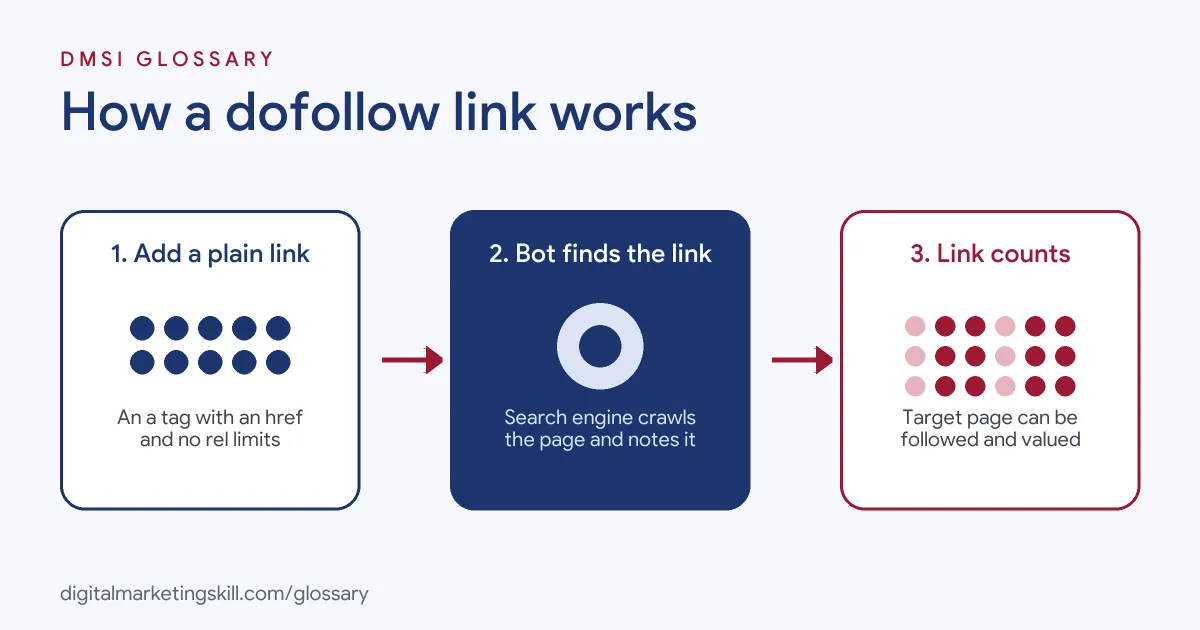
A dofollow link works in three simple steps. First, you add a plain link to a page. Then a search engine crawls the page and finds the link. Finally, it can follow that link and treat it as a normal signal between the two pages.
Step 1: You Add a Plain Link
You write an <a> tag with an href and no rel value. Most content tools, such as the WordPress editor, do this by default. Also, the words you choose to click on become the anchor text. That text gives search engines a clue about the linked page.
Step 2: The Bot Finds the Link
Next, a search bot reads your page during crawling. It notes each link and the page it points to. Because the link has no limits, the bot can add the target URL to its list of pages to visit.
Step 3: The Link Counts as a Signal
Then the search engine uses the link to understand how the pages connect. A link from a relevant, trusted page is a stronger signal than a link from a weak one. However, Google does not publish exactly how much each link is worth. So treat links as one signal among many, not a magic switch.
How Qualified Links Differ
By contrast, a link can carry one of three rel values. Google says to mark “advertisements or paid placements” with sponsored. Also, it recommends ugc for comments and forum posts. Finally, it says to use nofollow “when other values don’t apply”. Google adds that links with these values “will generally not be followed.”
Note the word “generally”. Google also says the linked pages “may be found through other means.” So a qualified link is a strong hint, not a hard wall. In the same way, a dofollow link is an open door, but Google still decides what to crawl and rank.
Inside Your Own Site
Dofollow links matter on your own pages too. For example, your menu, breadcrumbs and in-text links all help bots move from page to page. Good internal linking uses plain links, so every key page is easy to reach. On the other hand, adding nofollow to your own pages rarely helps. Instead, use noindex or robots rules when you want to keep a page out of search.
Examples of Dofollow Links
- A blog citing a study. A health blog links to a government research page as a source. The link is editorial and trusted, so it stays a plain dofollow link.
- A guest article. A marketer writes a useful article for an industry site through guest posting. The editor chooses to keep a plain link to the writer’s guide because it adds value for readers. However, if money changed hands, the link would need
sponsored. - A shop’s own menu. An online shop links from its home page to its category pages. These internal links are dofollow, so search engines can reach every category.
Dofollow Link vs Nofollow, Sponsored and UGC Links
| Link type | HTML | When to use it | How Google treats it |
|---|---|---|---|
| Dofollow | No rel value |
Editorial links you trust | Can be followed and used as a signal |
| Nofollow | rel="nofollow" |
Links you don’t want to vouch for | Generally not followed |
| Sponsored | rel="sponsored" |
Ads, paid and affiliate links | Generally not followed |
| UGC | rel="ugc" |
Comments and forum posts | Generally not followed |
How to Check and Use Dofollow Links
- Open the page. Go to the page that holds the link you want to check.
- Inspect the link. Right-click the link and choose “Inspect” in your browser. Then look at the
<a>tag. - Look for a rel value. If you see no
rel, or only values such asnoopener, the link is dofollow. If you seenofollow,sponsoredorugc, it is qualified. - Sort your outbound links. List the links you give out. Then mark ads and paid links as
sponsored, and user posts asugc. - Keep editorial links plain. Leave trusted, useful links as normal links. You don’t need to add anything.
- Check your backlinks. Use the Links report in Google Search Console or an SEO tool. As a result, you see which sites link to you.
- Review plugin settings. Some WordPress plugins add
nofollowto all external links. So check that your settings match your goals.
Best Practices for Dofollow Links
- Link to help readers. Give a plain link when the page truly adds value, not to trade favours.
- Label paid links. Use
sponsoredfor ads, paid posts and affiliate links. - Use clear anchor text. Describe the target page in a few natural words, not a list of keywords.
- Earn links, don’t buy them. Good link building uses useful content, digital PR and real partnerships.
- Keep internal links plain. Your own pages should link to each other with normal links, so bots can reach them.
- Audit links often. Check old posts for broken links and links that now need a label.
Common Mistakes to Avoid
- Adding rel=”dofollow”. It is not a valid value. It does nothing, and validators may warn about it.
- Selling plain links. Google lists “Buying or selling links for ranking purposes” as link spam.
- Chasing only dofollow backlinks. Qualified links can still send real visitors. Also, a natural profile has a mix of both.
- Nofollowing your own pages. This can make it harder for bots to reach your key content.
- Trusting every link offer. Cheap packages of dofollow links often come from spammy sites that can hurt you.
Where You’ll Use Dofollow Links at Work
We did not find current remote job listings on Himalayas that use the word “dofollow” itself. Instead, the idea sits inside wider link work. For example, SEO specialists, link building specialists, digital PR executives and content managers all check link types every week. They review backlink profiles, judge which outreach links will help, and make sure paid placements carry the right label. Also, WordPress managers set how plugins handle outbound links.
Learn It in the WordPress and SEO Track
You can learn link types, link building and wider SEO in the AI-Powered WordPress and SEO Specialist track. Every track includes a U.S. Project Internship from day one, with unlimited 1-on-1 mentoring.
Frequently Asked Questions
Is dofollow a real HTML attribute?
No. A dofollow link is just a normal link without a nofollow, sponsored or ugc value.
How do I make a link dofollow?
You don’t need to do anything. Links are followed by default, so simply leave out any limiting rel value.
Are dofollow links better than nofollow links?
For SEO signals, plain links can carry more weight. However, qualified links still bring visitors and look natural, so both have a place.
Can I sell dofollow links?
No, not within Google’s rules. Paid links must use sponsored or nofollow, or they count as link spam.
Does noopener stop a link being dofollow?
No. The noopener value is about browser security. So a link with only noopener is still a plain, followed link.
Sources: Google Search Central: Qualify your outbound links to Google; Google Search Central: Spam policies for Google web search; MDN Web Docs: HTML attribute rel.