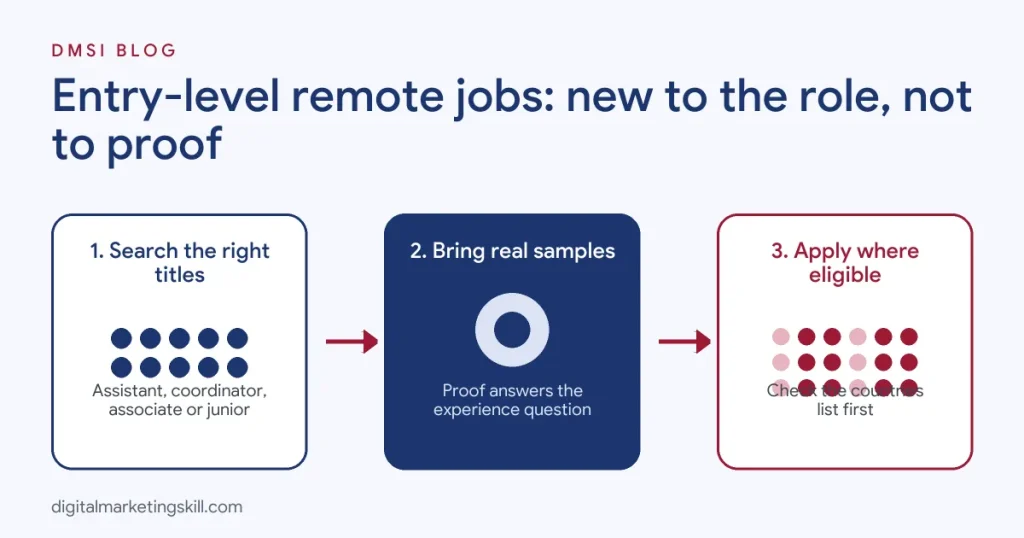
Entry-level remote jobs are first-step roles, such as assistant, coordinator, associate or junior positions, that you can do fully from home. In marketing, they include social media assistant, marketing coordinator and junior account roles. Many still ask for some proof of skill, even when they say “entry level”. So the fastest way in is to show real work samples, apply only where your country is accepted, and search the right job titles.
This guide explains how entry-level remote roles are set up, which titles to search for, what real listings ask for and how to get hired without years of experience. If you are changing careers, our digital marketing career change guide shows the wider path.
Key Takeaways
- A Kickresume study of 1,400 LinkedIn job ads found that 28% of entry-level roles asked for at least 1.5 years of experience. In marketing, the figure was 31%.
- In the same study, 44% of US entry-level marketing ads asked for at least 1.5 years, the highest of any US industry studied.
- The US Bureau of Labor Statistics lists no required work experience for market research analysts and marketing specialists, and projects 7% job growth from 2025 to 2035.
- Remote jobs were 9% of paid US LinkedIn postings but drew 37% of applications, so entry-level remote roles are crowded.
- On one remote job board, a search for entry-level marketing roles returned 208 listings, and junior marketing roles another 229.
In this guide
- What Most Advice on Entry-Level Remote Jobs Misses
- How Entry-Level Remote Jobs Actually Work
- Job Titles to Search For
- What Real Entry-Level Remote Listings Ask For
- How to Read the Requirements
- How to Get Hired: Six Steps
- Where to Find Entry-Level Remote Jobs
- Common Mistakes With Entry-Level Remote Applications
- What to Do in Your First 90 Days Once Hired
- How to Measure Your Progress
- The One Rule for Entry-Level Remote Jobs
- An Illustrative Case
- Frequently Asked Questions About Entry-Level Remote Jobs
- Your Next Step
What Most Advice on Entry-Level Remote Jobs Misses
Most advice treats “entry level” as “no experience needed”. The data says otherwise. A recent Kickresume analysis of 1,400 LinkedIn job ads in the US and UK found that 28% of entry-level roles asked for at least 1.5 years of prior experience. In marketing, it was 31%.
That doesn’t mean you can’t get in. It means “entry level” usually means “new to this role”, not “new to work”. Employers want to see that you can do the basic tasks already. So the gap you need to close is proof, not years.
This guide focuses on that gap. It also uses real listings we checked, so you can see exactly what employers ask for. Of course, no guide can promise a job. Listings change daily, and hiring depends on many things you can’t control.
How Entry-Level Remote Jobs Actually Work
An entry-level remote job is a first-step role in a field, done from home. The employer expects to train you on its own tools and processes. In return, it expects you to handle simple tasks reliably from week one.
In marketing, entry-level work usually supports a team. For example, you might schedule social posts, build email campaigns, update a website, prepare reports or take notes on client calls. Then, as you prove yourself, you take on more.
Why Remote Makes Entry Level Harder
In an office, a manager can see you learning and step in quickly. Remotely, they can’t. So remote employers look harder for signs that you can work on your own. These signs include clear writing, organised work and examples you made without being told how.
Competition is also higher. In LinkedIn’s February data, remote jobs were 9% of paid US LinkedIn postings but drew 37% of applications. In other words, each remote role gets far more applicants than an office role.
Why Marketing Is a Good Entry Point
Marketing has a lower formal barrier than many fields. The US Bureau of Labor Statistics lists no required work experience in a related occupation for market research analysts and marketing specialists. It also projects 7% job growth from 2025 to 2035, faster than average.
Better still, marketing work leaves visible proof. A content calendar, an email campaign or an ad report is something you can show. That makes it easier to prove skill without years on your CV.
Job Titles to Search For
Few employers use the words “entry level” in the job title. Instead, they use titles like these. Search for each one with the “Remote” filter turned on.
| Title | What the role usually does | Skill to show |
|---|---|---|
| Marketing assistant | Supports campaigns across email, social and the website | One finished campaign or email |
| Marketing coordinator | Keeps tasks, deadlines and content calendars on track | A sample content calendar |
| Social media assistant or coordinator | Schedules posts, replies to comments and reports results | A month of sample posts and a short report |
| Associate account manager | Supports client accounts at an agency | Clear writing and organisation |
| Junior performance or paid media marketer | Helps run and test paid ads | A small test campaign and its results |
| Marketing intern | Short-term learning role, often part time | Curiosity and one sample |
Our guide to digital marketing job titles explains what each title pays and needs in more detail.
What Real Entry-Level Remote Listings Ask For
We checked entry-level and junior marketing listings on Himalayas, a public remote job board. A search for entry-level marketing returned 208 listings, and junior marketing another 229. Here are five that show the range. Pay is shown only where the listing published it.
| Role and employer | Open to | Pay listed | What stands out |
|---|---|---|---|
| Associate Account Manager (Entry Level), elk Marketing | United States | $55,000 to $70,000 a year | Asks for 0 to 1 year of experience |
| Marketing Assistant, Remote Recruitment | South Africa | R23,000 to R25,000 a month | Remote role for a UK employer, on UK hours |
| Entry-level Communications Specialist, Canonical | Europe, Middle East and Africa | Not listed | Social media content, reporting and A/B tests |
| Junior Marketing Associate, CoverGo | Philippines | Not listed | Events, LinkedIn content and marketing support |
| Jr. Social Media & Marketing Assistant, Valatam | Latin America | Not listed | Asks for 1 to 2 years, Canva and CapCut |
The agency role stands out. It calls itself “a true entry-level role for someone just starting their career.” Even so, it lists clear tasks for the first 30, 60 and 90 days, such as building client decks and tracking deadlines. In short, the employer will train you, but it wants proof you can organise work.
The South African role shows another pattern. A UK business hires remotely for UK office hours. It asks for experience with an email platform such as Mailchimp or ActiveCampaign, plus basic Google Analytics. These are learnable skills, not years.
The Canonical role is worth noting for readers in Africa and the UK. It is open across the whole Europe, Middle East and Africa region, which includes Nigeria, Kenya and the UK.
How to Read the Requirements
Entry-level listings often look harder than they are. So split each listing into three parts before you decide whether to apply.
- Must-haves. These usually include language level, time zone, location and one or two tools. If you don’t meet the location rule, don’t apply.
- Experience asks. “1 to 2 years” in a junior listing often means “can you already do the basics?” Strong samples can answer that question.
- Nice-to-haves. Extra tools or industry knowledge. These are a bonus, not a filter.
If you meet the must-haves and can show the core tasks with real samples, apply. Then explain in one or two lines how your samples match their tasks.
How to Get Hired: Six Steps
Getting hired into an entry-level remote role is about removing doubt. Each step below answers one question a hiring manager has about you.
- Choose one role family. For example, social media, email marketing or paid ads. Applying to everything makes your profile look unfocused.
- List the tools that listings name. Read ten listings for your chosen role. Write down every tool, and learn the three that appear most.
- Build two or three work samples. Make them look like real tasks from the listings. Our marketing portfolio guide shows how to present them.
- Get real experience if you can. A short internship, volunteer project or small client gives you results and a reference. That turns “I learned” into “I did”.
- Tune your CV and LinkedIn. Lead with your samples and the tools you use. See our digital marketing resume guide for passing both the software and the human screen.
- Prepare for a test task. Many remote roles set one. Practise with our guide to digital marketing interview questions and the remote job interview glossary entry.
Where to Find Entry-Level Remote Jobs
Use two or three sources and check them on a routine, rather than scrolling every site every day.
- Remote job boards such as Himalayas and We Work Remotely, filtered by “Entry-level” and by the countries a role accepts.
- LinkedIn, using the “Entry level” and “Remote” filters. Our LinkedIn job search guide explains how recruiters decide who to contact.
- Agency careers pages. Marketing agencies hire juniors often and train them across many clients.
- Freelance marketplaces, where small paid projects can build your first results.
To save time, get one decoded remote marketing job in your inbox each day through our free Daily Decoded Remote Jobs email.
Common Mistakes With Entry-Level Remote Applications
Most rejected applications fail for a handful of fixable reasons. Check your own search against each one.
Applying to Roles You Can’t Accept
Many entry-level remote roles hire only in one country or region. If you apply anyway, the software usually filters you out before a person reads your CV. So read the location section first, every time.
Searching Only for “Entry Level”
Most first-step roles use titles like assistant, coordinator, associate or junior instead. As a result, a search for “entry level” alone misses most of them. Search each title separately, with the remote filter turned on.
Sending a CV Without Samples
For a junior role, your samples are your experience. A CV that only lists courses gives the hiring manager nothing to judge. Instead, link to two or three samples near the top of your CV and in your message.
Writing Long, General Messages
Remote hiring managers read a lot of text. Therefore, a short message that names their tool, their task and your matching sample stands out. Three or four sentences is often enough.
Giving Up Before the Numbers Tell You Anything
Ten applications is too few to judge your approach. Track at least 20 eligible applications before you change your plan, then change one thing at a time.
What to Do in Your First 90 Days Once Hired
Landing the role is the start, not the finish. Remote employers judge new starters quickly, because they can’t see you at a desk. So use your first three months to build trust.
- Days 1 to 30: learn the system. Learn the team’s tools, processes and how it likes updates. Ask questions in writing, and keep notes so you don’t ask twice.
- Days 31 to 60: own one task. Take full ownership of one recurring task, such as the weekly report or the content calendar. Deliver it on time, every time.
- Days 61 to 90: show results. Share a short summary of what you delivered and one improvement you suggest. This turns quiet work into visible value.
Interestingly, the agency listing we checked set out almost exactly this kind of 30, 60 and 90-day plan. In other words, employers already expect it, so you can plan for it before day one.
How to Measure Your Progress
Track a few numbers each week. They tell you which part of your search to fix.
- Eligible applications. Only count roles that accept your location.
- Reply rate. If you get no replies after 20 eligible applications, improve your samples or your opening lines.
- Interviews and test tasks. These show your application works. If they don’t turn into offers, practise your answers and your test-task speed.
- New proof added. One new sample or result each fortnight keeps your profile getting stronger.
The One Rule for Entry-Level Remote Jobs
Read “entry level” as “new to this role”, and bring proof that you can already do the basic tasks. That is the rule.
When you follow it, the experience line in a listing stops being a wall. Instead, it becomes a question you can answer with samples, a project or an internship. That is also why hands-on experience matters so much more than another certificate.
An Illustrative Case
This is an illustrative example, not a real person. Grace finished a business degree in Nairobi and wants a remote marketing job. At first, she applies to 30 roles titled “Marketing Manager” and hears nothing back. Then she notices that those roles ask for five years of experience.
So she changes her search to “marketing assistant”, “marketing coordinator” and “social media coordinator”, and she filters for roles open to Africa. Next, she builds a sample email campaign and a one-month content calendar. She also joins a short internship project and gets a reference from it.
Her reply rate rises, and she gets two test tasks. She doesn’t win the first role, but the feedback shows her what to improve. A few weeks later, she is offered a junior position. Results like this are not typical or guaranteed; they depend on the work you put in and the market at the time.
Frequently Asked Questions About Entry-Level Remote Jobs
Do entry-level remote jobs require experience?
Many do. A Kickresume study found that 28% of entry-level roles asked for at least 1.5 years of experience, and 31% in marketing. However, strong work samples, an internship or a small client project can often stand in for that experience.
What are good entry-level remote jobs in marketing?
Common first roles include marketing assistant, marketing coordinator, social media assistant, associate account manager and junior paid media marketer. Each one uses a small set of skills you can learn and show with samples.
How much do entry-level remote marketing jobs pay?
Pay depends heavily on the employer’s country and yours. In our check, one US agency listed $55,000 to $70,000 a year, and one UK-employer role for South Africa listed R23,000 to R25,000 a month. Always check the listed range and the currency.
Can I get an entry-level remote job from Nigeria or Kenya?
Yes, but filter for roles open to Africa or to your country. Some roles, such as one we found at Canonical, accept the whole Europe, Middle East and Africa region. Freelance marketplaces are another open route to first experience.
Do I need a degree for an entry-level remote marketing job?
Some employers prefer one, especially larger companies. However, many marketing roles care more about proof of skill. A portfolio of real work and a reference from a real project can carry a lot of weight.
Why do I get no replies to entry-level remote applications?
The most common reasons are applying where your country isn’t accepted, a CV without work samples, or applying to roles that are too senior. Fix those three first, then track your reply rate again.
Is an internship worth it for remote marketing jobs?
Yes, if it gives you real tasks and a reference. An internship turns learning into experience you can describe in an interview. Look for one with clear tasks, not just observation.
How long does it take to land an entry-level remote job?
There is no fixed timeline. It depends on your samples, the roles you target and the market. People who focus on one role family and track their numbers usually improve faster. For roles with no experience at all, see our guide to remote jobs with no experience.
Should I apply if I don’t meet every requirement?
If you meet the must-haves, such as location, language and the core tools, and you can show the main tasks with samples, it is usually worth applying. Nice-to-haves rarely decide the outcome on their own.
Are remote internships worth it for entry-level roles?
Yes, when they give you real tasks, feedback and a reference. Those three things are exactly what entry-level remote employers look for.
Your Next Step
Entry-level remote employers want proof that you can already do the basics. The Master Diploma in Digital & AI Marketing at Digital Marketing Skill Institute is built around that gap. You choose one of four AI-powered tracks: Social Media Management and Advertising, Lead Generation and Email Automation, Google Specialist, or WordPress and SEO Specialist, with a Full Stack option for all four.
Every track includes a U.S. Project Internship from day one, so you do real work on a real company’s project and finish with a verified U.S. work reference letter. You also get unlimited one-on-one coaching and career support with CV reviews and mock interviews. The program carries dual US and UK accreditation, is recognised in more than 100 countries, and runs 100% online over three months.
You can build that proof wherever you live, anywhere in your country. Read student reviews, then apply for the 65% partial scholarship to see if you qualify.
Every figure in this guide was checked against its original source before publication. Job listings were checked on Himalayas in November and may have closed since. The case above is an illustrative example, not a real result.