A digital marketing career change is more common, and more achievable, than it feels from the outside. Nearly half of people who switch careers move into an entirely different industry, not a related one. This guide covers what actually predicts a successful transition. It covers a practical step-by-step path, how to measure your progress, and the real mechanism behind why some changers succeed faster than others.
Key Takeaways
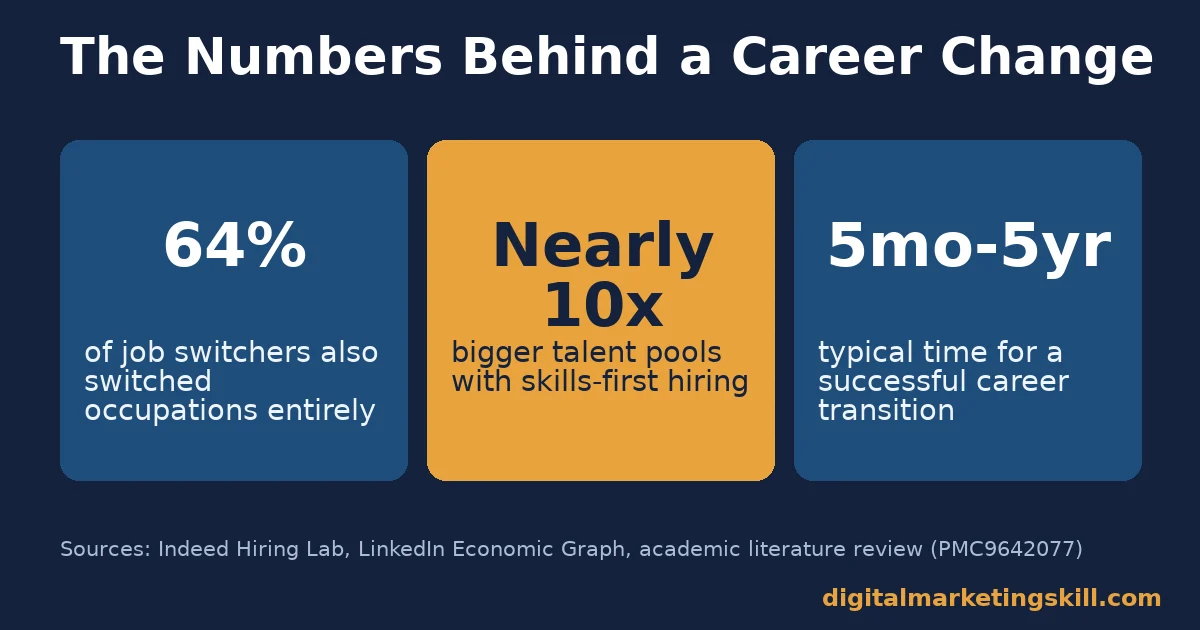
- Industry switches are the norm, not the exception. A literature review of career transition research found that 46% of career-transitioning workers moved into an entirely different industry.
- It takes longer than a weekend course. That same review found successful transitions typically take five months to five years. The range depends on the size of the jump.
- Skills-first hiring widens the door. LinkedIn’s Economic Graph research found something striking. A skills-first approach to hiring expands eligible talent pools by nearly 10 times, compared with hiring on job titles alone.
- Not having a marketing degree is not a disadvantage. The same research found skills-first hiring grows candidate pools for workers without a bachelor’s degree. That growth was 9% larger than for workers who have one.
- Changing careers is already normal. US Bureau of Labor Statistics data found that one cohort held an average of 12.7 jobs between ages 18 and 56. Change itself is the pattern, not the exception.
- Occupation changes outnumber job changes. An Indeed Hiring Lab analysis of over 35 million US resumes found that 64% of people who switched jobs also switched occupations entirely. A job switch and an occupation switch are usually the same event.
In this guide
- What Most Career Change Advice Gets Wrong
- What Actually Predicts a Successful Career Change
- What Differs by Where You Are Starting From
- Three Myths That Slow Down a Digital Marketing Career Change
- The Step-by-Step Path to a Digital Marketing Career Change
- A Four-Week Plan to Start a Digital Marketing Career Change
- Common Digital Marketing Career Change Mistakes
- How to Measure Progress on a Digital Marketing Career Change
- The Most Useful Rule: Build Proof Before You Build Confidence
- Frequently Asked Questions About a Digital Marketing Career Change
- Start With One Project, Not One More Course
What Most Career Change Advice Gets Wrong
Most advice treats a digital marketing career change as a simple checklist: take a course, update your resume, start applying. None of that is wrong, but it skips what the research says actually predicts success.
This guide names that gap first. Then it builds a practical path around it. That path covers the factors that predict a faster transition, the steps to get real experience without a job yet, and how to measure whether your approach is working.
A quick ground rule first. The 46% and five-month-to-five-year figures come from a literature review, which synthesises other research rather than running its own study. The BLS figure covers one specific US age cohort. Treat every number here as evidence from its stated scope, not a universal guarantee.
What Actually Predicts a Successful Career Change
A career change into digital marketing is not random. Research synthesising the field points to a specific set of factors that separate faster, smoother transitions from stalled ones.
The literature review found five recurring factors. These are a growth mindset, social support through mentoring, a clear personal brand, honest self-reflection, and resilience through the inevitable setbacks. Each one is learnable, not fixed. None of these require starting from zero.
Your Existing Experience Is Not Wasted
Nobody changing into digital marketing starts with literally nothing. Communication, analysis, project management and creative problem-solving transfer from almost any prior role. The work is translating them into marketing language, not acquiring them from scratch.
A former teacher already knows how to explain complex ideas simply, which is most of what content marketing requires. A former accountant already reads numbers for patterns, which is most of what analytics work requires. The skill rarely needs to be learned twice; it needs a new name and a new context.
Hiring Has Shifted Toward Skills, Not Just Degrees
This timing favours career changers. LinkedIn’s own research found that when employers search by skills instead of job titles, eligible talent pools expand by nearly 10 times. The growth is even larger for candidates without a bachelor’s degree in the field. A demonstrable skill now counts for more than it used to.
What Differs by Where You Are Starting From
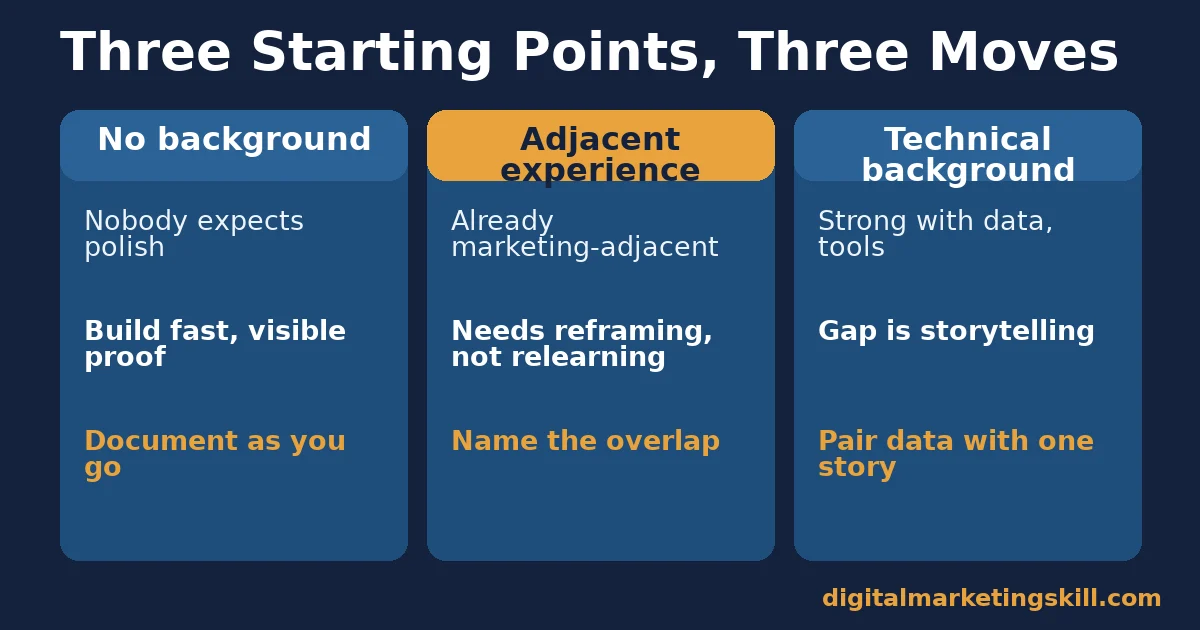
Not every digital marketing career change starts from the same place. Someone with zero marketing exposure needs a different first move than someone with adjacent experience. Someone switching from a technical field needs a third approach entirely.
No Marketing Background: Built on Fast, Visible Proof
Starting from zero means your first job is generating proof, fast. A personal project, a volunteer campaign, or a well-documented case study teaches you the basics. It also gives you something concrete to show, which matters more at this stage than another certificate.
The advantage of starting from zero is that nobody expects polish yet. A rough first project, honestly described with what worked and what did not, often reads as more credible to an experienced hiring manager than a flawless-looking campaign with no visible learning process behind it.
The trap here is over-preparing. Months of courses without a single real or simulated project leave you with knowledge but no portfolio. Portfolios, not course lists, are what get interviews.
Adjacent Experience: Built on Reframing, Not Relearning
If you come from sales, customer service, writing or events, you likely already do marketing-adjacent work without the title. The move here is reframing existing achievements in marketing terms. Then fill the specific technical gaps, such as analytics tools or ad platforms.
A sales background, for example, already includes persuasion, objection handling and audience understanding, all core to marketing copy and campaign strategy. Naming that overlap explicitly, with a specific result attached, does more for an application than a generic statement of interest in the field.
Technical Background: Built on Translating Rigor
Coming from a technical field, your advantage is comfort with data and tools. The gap is usually storytelling and audience empathy. Pairing your analytical strength with one creative or content-focused project rounds out the profile employers want.
This combination is rarer than it sounds, and it is valuable. Many marketing teams have plenty of creative instinct but too few people who can set up tracking correctly and read the resulting numbers honestly. Leading with that strength, rather than hiding it behind generic marketing language, often differentiates a technical career changer from the rest of the applicant pool.
Three Myths That Slow Down a Digital Marketing Career Change
Before the steps, a few myths cause people to delay or quit early. Clearing these up saves months.
The first myth is that you need a degree in marketing. You do not. Marketing has historically been one of the more accessible fields for career changers, because results are visible and measurable in a way that is hard to fake, and demonstrated results matter more than where you studied.
The second myth is that you must master every discipline before applying. You do not. Most entry-level and junior marketing roles focus on one or two disciplines. Broad awareness of the rest is enough to start, with depth coming on the job.
The third myth is that your previous career was wasted time. It was not. Every field teaches communication, problem-solving or organisation in its own way, and those skills transfer. The task is translation, not replacement.
The Step-by-Step Path to a Digital Marketing Career Change
The steps below apply the background differences above. Move through them in order, but spend more time on the step that matches your actual gap.
Five Steps to Build the Foundation
- Audit your transferable skills honestly. List what you already do that overlaps with marketing: writing, data analysis, project coordination, persuasion. This becomes your starting narrative, not a blank slate.
- Learn the core disciplines, not everything at once. SEO, content, paid ads, email and analytics are the core pillars. Get working knowledge of all five before specialising in one. Google’s own guidance on helpful content is a free, authoritative starting point for the SEO and content fundamentals.
- Build one real project before applying anywhere. A website, a small campaign, or a documented case study turns theory into something a hiring manager can actually look at.
- Offer your skills for free or cheap, briefly. A short volunteer engagement or heavily discounted freelance project gives you a real result. It often earns a reference too, faster than waiting for a paid role.
- Document everything as you go. Screenshots, before-and-after metrics and short write-ups of what you tried and learned become your portfolio without extra work later.
Five Steps to Build Momentum
- Build one piece of visible online presence. A profile and a small amount of original content signal that you are serious. They do this before anyone asks you to prove it in an interview.
- Find one or two mentors, not a crowd. The research above names social support as a recurring success factor. A single experienced mentor who reviews your work regularly outperforms a large, passive network. Free platforms like Adplist connect career changers with volunteer mentors already working in the field.
- Tailor every application specifically. A resume and cover letter rewritten for each role, using that job’s own language, consistently outperforms one generic version sent everywhere.
- Apply before you feel fully ready. Waiting for complete confidence costs more time than applying and learning from the interviews themselves.
- Keep learning after you land the first role. The discipline that got you in the door is the same one that moves you up. Honest skills audits and continued practice do not stop once you are hired.
A Four-Week Plan to Start a Digital Marketing Career Change
You do not need to quit your current job to start. This plan takes a few hours a week alongside whatever you are already doing.
- Week one: audit your transferable skills. Write down every skill from your current or past role that overlaps with marketing, and research the five core disciplines so you know the landscape.
- Week two: pick one project. Choose a website, a social campaign for a cause you care about, or a documented case study you can realistically finish in two to three weeks.
- Week three: build and document. Work on the project, taking screenshots and notes as you go, so the write-up is already half-written by the time the project is done.
- Week four: publish and reach out. Share the finished project publicly, ask one person in the field for feedback, and send your first few applications or outreach messages.
At the end of the month, you will have one real project, one piece of visible work, and your first real feedback from someone in the field. Repeat the cycle with a second, more ambitious project while you start applying from the first.
Common Digital Marketing Career Change Mistakes
Even motivated career changers slow themselves down with a few repeated mistakes. Check your own approach against this list.
- Collecting certificates instead of building proof. A stack of course completions with no real project attached rarely moves a hiring decision on its own.
- Trying to learn every specialism at once. Spreading effort across SEO, paid ads, email, content and analytics simultaneously, in depth, usually means none of them reach a job-ready level.
- Hiding the career change instead of explaining it. A clear, confident one-line explanation for the switch reads better than an application that avoids the topic.
- Applying only to senior-adjacent titles. Expecting your old seniority to transfer directly often means missing entry points where your transferable skills would actually be valued.
- Networking only when job-hunting. Relationships built only during an active search feel transactional. Building them earlier makes the eventual ask easier for everyone involved.
How to Measure Progress on a Digital Marketing Career Change
Course completions feel like progress, but they do not predict whether you will get hired. The signals below track what actually matters.
Five Signals That Show Real Progress
- Projects completed, not courses finished. A real or simulated project you can describe in an interview is worth more than another certificate.
- Interview requests per applications sent. A rising ratio shows your resume and portfolio are resonating, even before any offer arrives.
- Specific feedback received. Detailed feedback, rather than silence or generic rejection, shows you are getting close and tells you exactly what to fix.
- Mentor or network conversations per month. Consistent conversations with people in the field correlate with faster access to real opportunities.
- Confidence describing your own work. If you can explain what you built, why, and what it achieved in two sentences, you are closer than the application count alone suggests.
Reading These Signals Together
Review these monthly, not after every application. A single rejection or a single quiet week rarely tells you much, since hiring timelines vary widely and are often unrelated to the quality of your work.
If projects are stalling, the gap is usually time or focus, not ability. If interviews are not converting to a second round, the gap is usually how your project results are explained, not the projects themselves. And if you have real projects and are not even landing first interviews, the gap is often visibility: nobody active in the field knows you exist yet.
The Most Useful Rule: Build Proof Before You Build Confidence
Take one decision rule from this guide: do not wait to feel ready before creating something real. Confidence in a digital marketing career change comes from having built and shown something, not from finishing one more course first.
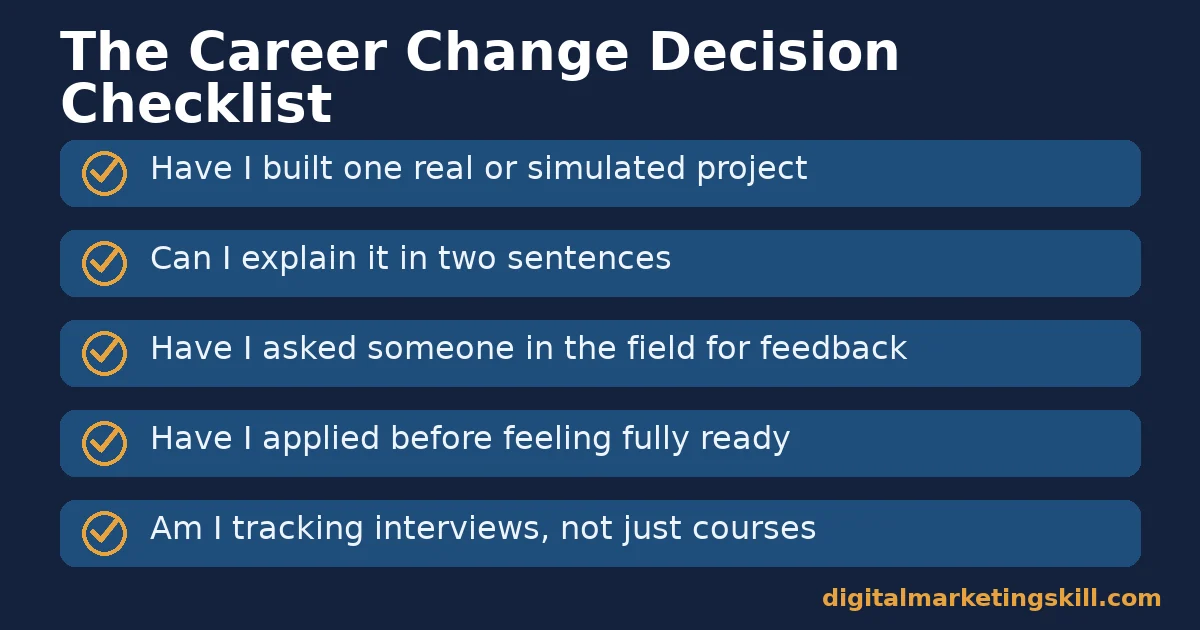
Here is an illustrative example, with invented numbers. Two people start learning digital marketing on the same day. One spends four months completing eight separate courses before applying anywhere.
The other spends four months completing two courses and building one real campaign for a local business, then starts applying in month two. She receives interview requests roughly twice as often, because reviewers can see demonstrated work rather than a list of completions.
This does not mean courses do not matter. It means a project built alongside learning converts into interviews faster than the same amount of time spent only consuming content.
Frequently Asked Questions About a Digital Marketing Career Change
Can I make a digital marketing career change with no prior experience?
Yes. Research on career transitions shows nearly half of people who change careers move into an entirely different industry, and digital marketing specifically rewards demonstrated skill over formal credentials more than many fields do.
How long does a digital marketing career change usually take?
Research synthesising career transitions found a typical range of five months to five years, depending on how large the jump is from your current field and how much time you can dedicate to it.
Do I need a certification to break into digital marketing?
Not on its own. A certification helps you learn the fundamentals, but a real project or documented result is what most hiring managers actually weigh when deciding between candidates.
Which digital marketing skill should I learn first?
Start with the discipline closest to your existing strengths. A strong writer often starts with content, an analytical person often starts with analytics or paid ads, because early wins build momentum fastest. Once that first discipline feels solid, the rest become easier to layer on, since the core marketing logic is shared across all of them.
Is digital marketing a good career change for someone over 40?
Yes. The skills-first hiring shift benefits experienced career changers specifically, since employers increasingly evaluate demonstrated ability over a traditional, linear resume. Decades of professional judgement, client management or leadership experience often become real advantages once reframed for a marketing context, rather than liabilities to downplay.
How do I explain a career change in an interview?
Briefly state the reason for the change, connect your prior experience directly to the role’s requirements, and pivot quickly to a specific project or result rather than dwelling on the gap itself. A confident, two-sentence version of this explanation, practised in advance, removes most of the awkwardness interviewers report feeling from candidates themselves.
What is the biggest mistake people make during a digital marketing career change?
Collecting course completions without building a real, demonstrable project. Hiring managers consistently respond more to shown work than to a list of certificates.
Can I change careers into digital marketing while working full time?
Yes, and most people do exactly this. A few hours a week dedicated to learning and one project at a time is enough to build a portfolio before you apply anywhere, without quitting your current income.
Do I need to start with an unpaid internship?
No. An internship can help, but volunteer work, freelance projects or a personal project you build and document yourself can create the same kind of visible proof, often faster and on your own schedule.
Start With One Project, Not One More Course
A digital marketing career change moves fastest when you build something real alongside learning the fundamentals, rather than waiting until you feel fully prepared. Pick one project you can complete in the next month, and let the learning follow the work.
The research in this guide points the same direction every time: demonstrated proof, not accumulated theory, moves a transition forward. For the online presence that supports it, see our guide to personal branding strategy, and for getting your work seen, our guide to social media content promotion.
If you want guided, hands-on practice making this exact transition, Digital Marketing Skill Institute teaches it inside the Master Diploma in Digital & AI Marketing. The programme runs four AI-powered tracks built from ten execution-first courses, with a Full Stack option to complete all four.
It also includes unlimited 1-on-1 coaching and mentoring, plus a U.S. Project Internship with a verified U.S. Work Reference Letter, so you graduate with the real project proof this guide recommends. It is dual US and UK accredited, recognised in more than 100 countries.
The programme is fully online, so you can make your digital marketing career change from anywhere in your country. Explore more guides on the Digital Marketing Skill Institute blog, and when you are ready, apply for the Master Diploma or start from the Digital Marketing Skill Institute homepage.
Every figure in this guide was checked against its original source before publication. Figures marked as illustrative are invented examples, not real results.