
A Remote Job Interview is a job interview that takes place online, usually by video call, phone or a pre-recorded video, instead of in the same room as the employer. Most remote and work-from-anywhere roles hire this way from start to finish. So the interview is often the first real proof of how you work online. If you handle the call, the tech and the follow-up well, you show the same skills the remote job needs.
Key Takeaways
- Remote job interviews can be live video calls, phone calls or pre-recorded video answers.
- Test your camera, microphone, internet and software well before the call starts.
- A quiet space, good light and a plain background help the interviewer focus on you.
- The STAR method helps you give clear, short answers with real examples.
- A short follow-up email and a strong portfolio can help you stand out after the call.
What Is a Remote Job Interview?
A remote job interview is any interview where you and the employer are in different places. Usually, it happens on a video tool such as Zoom, Google Meet or Microsoft Teams. However, some first rounds are phone calls. Others ask you to record answers to set questions.
The National Careers Service explains the two main video types. It says “A live video interview is like a face-to-face interview.” By contrast, “In a pre-recorded interview you will not be speaking to anyone.” Instead, you see a question on screen and record your answer within a time limit.
Think of it like a TV news link-up. The reporter is in one place and the studio is in another. Because they can’t share a room, the sound, picture and timing all need to work. In the same way, a remote interview depends on both your answers and your set-up.
Many remote hiring processes have several stages. For example, you might have a recruiter screen, a video interview with the hiring manager, a practical task and a final call. Some firms also add a short paid trial project. So it helps to ask early what each stage involves.
Why It Matters
For remote work, the interview is a preview of daily life. Employers watch how you speak on camera, how you manage time and how clearly you write. For instance, a late link or a noisy room can suggest you may struggle on team calls. On the other hand, a calm, prepared call shows you can work well with people you rarely meet. That is why preparation counts so much.
How a Remote Job Interview Works
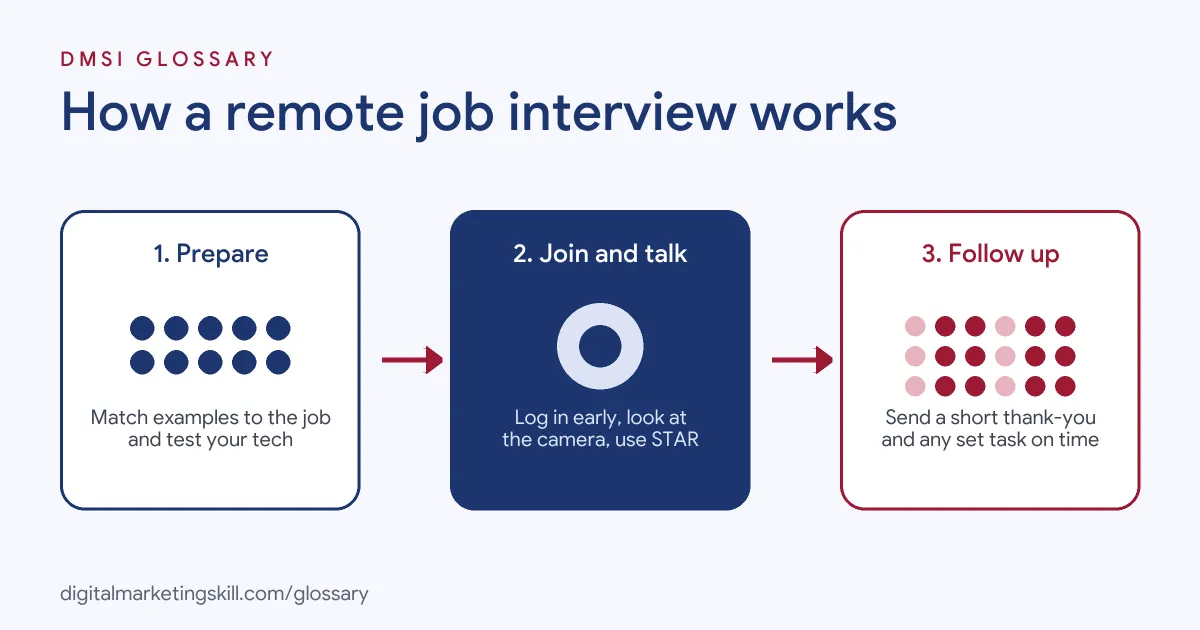
A remote job interview usually follows three stages. First, you prepare your answers and your tech. Then you join the call and talk with the interviewer. Finally, you follow up and wait for the next step.
Stage 1: Prepare
Start with the job description. Note the skills the employer asks for, and match each one to an example from your work. Also, research the company. The National Careers Service suggests you “do some research on the company’s website.” Then check your tools. It advises: “Before you start you should test your microphone and make sure you know how to use the software.”
Stage 2: Join and Talk
On the day, join early. The same guide says to “Log in with at least half an hour to spare so that you can check everything is working well.” Next, sit in a quiet place with good light in front of you. When you speak, look at the camera, not the screen. As a result, the interviewer feels you are making eye contact.
Answer with clear examples. For example, the STAR method helps you explain the Situation, Task, Action and Result. Keep each answer short and focused. Then, near the end, ask your own questions about the team, the tools and how success is measured.
Stage 3: Follow Up
Afterwards, send a short thank-you email the same day. Mention one thing you enjoyed discussing. If you were not told when you will hear back, the National Careers Service says “You might want to follow up after the interview with an email or phone call.” Also, if a task was set, send it on time and in the format they asked for.
Pre-Recorded Interviews
Pre-recorded interviews need extra care. Usually, you get a short time to think and a fixed time to answer. Sometimes you can’t record again. So practise with a timer first. Also, record yourself on your phone and watch it back, as the National Careers Service suggests.
Examples of Remote Job Interviews
- A social media role. A candidate has a 30-minute video call with an agency. Then they share their screen to walk through a content calendar they built. As a result, the interviewer sees their real work, not just their CV.
- An email marketing role. A software company sends a link to a pre-recorded interview with five questions. The candidate records short STAR answers about past campaigns. Later, the team invites them to a live call.
- A paid ads role. A shop asks the candidate to review a sample account before the final call. During the call, the candidate explains three changes they would make and why.
Remote Job Interview vs In-Person Interview
| Point | Remote job interview | In-person interview |
|---|---|---|
| Where it happens | Video call, phone or recorded video | At the employer’s office |
| Main risks | Poor connection, noise, tech problems | Travel delays, finding the venue |
| How you show skills | Screen sharing, links to a portfolio, tasks | Printed work, whiteboards, face-to-face chat |
| Body language | Mostly face, voice and eye contact with the camera | Handshake, posture and full presence |
| Who it suits | Remote, hybrid and international roles | Office-based and local roles |
How to Prepare for a Remote Job Interview
- Read the job ad closely. List the skills and tools it mentions. Then match each one to a real example.
- Research the company. Look at its website, social channels and recent work.
- Prepare STAR stories. Write four or five short stories that show results you helped achieve.
- Get your portfolio ready. Have links or files open, so you can share your screen quickly.
- Test your tech. Check the software, camera, microphone and internet the day before.
- Set up your space. Choose a quiet room, a plain background and light in front of you.
- Check the time zone. Confirm the call time in your own time zone, so you don’t miss it.
- Write your questions. Prepare two or three questions about the role and the team.
- Follow up. Send a short thank-you email after the call.
Best Practices for Remote Job Interviews
- Have a backup plan. Keep your phone charged and ask for a phone number in case the video fails.
- Dress for the role. Wear plain, smart clothes that don’t distract on camera.
- Close other apps. Turn off alerts so nothing pops up while you share your screen.
- Show your work. A short case study or portfolio piece is stronger than general claims.
- Talk about remote habits. Explain how you manage time, update a team and work across time zones.
- Keep your profile current. Make sure your LinkedIn and personal branding match what you say in the call.
Common Mistakes to Avoid
- Testing tech at the last minute. A software update or a broken link can make you late.
- Looking at yourself. Watching your own video instead of the camera breaks eye contact.
- Long, vague answers. Without a clear example, your answer is hard to remember.
- Getting the time zone wrong. Always confirm the time in writing.
- Trusting fake offers. Be wary of “interviews” held only by text chat or offers that ask you to pay a fee.
Where You’ll Use Remote Job Interviews at Work
You will meet remote interviews when you apply for remote marketing roles. Also, recruiters and hiring managers run them every week. For example, real remote job listings say:
- “Candidates who do not complete the video interview may not move forward in the hiring process.” (Recruiter).
- “Evaluating candidate qualifications and suitability through initial phone or video interviews, assessing their skills, experience, and cultural fit.” (Talent Sourcer).
- “If there appears to be a fit, we will schedule up to 3 interviews.” (Assistant Recruitment Manager).
Later, if you lead a team or work as a freelance digital marketer, you may run remote interviews yourself.
Learn It in the Full Stack Track
You can build the skills and portfolio that remote interviews test in the Full Stack programme, which covers all four tracks. Every track includes a U.S. Project Internship from day one, with unlimited 1-on-1 mentoring.
Frequently Asked Questions
How long is a remote job interview?
Many first calls are short, while later rounds can be longer. If you are not sure, ask the recruiter how long to plan for.
What should I wear to a video interview?
Wear smart, plain clothes that suit the role. Avoid busy patterns that can look distracting on camera.
What is a pre-recorded interview?
It is an interview where you record answers to set questions. You don’t speak to a person live.
Where should I look during a video interview?
Look at your camera when you speak. As a result, the interviewer feels you are making eye contact.
Should I follow up after a remote interview?
Yes. Send a short thank-you email the same day. If you don’t hear back by the date given, a polite check-in is fine.
Sources: National Careers Service: How to do well in video interviews; National Careers Service: Interview advice; National Careers Service: The STAR method; remote job listings on Himalayas, Himalayas and Himalayas.