

Digital marketing job titles sound similar but describe very different kinds of daily work. An SEO specialist waits weeks for a ranking to move. A paid media buyer checks spend every morning. US postings for these roles took a median of 42 days to fill in one hiring study. This guide maps each title to its real demand, pay and fastest route in.
Key Takeaways
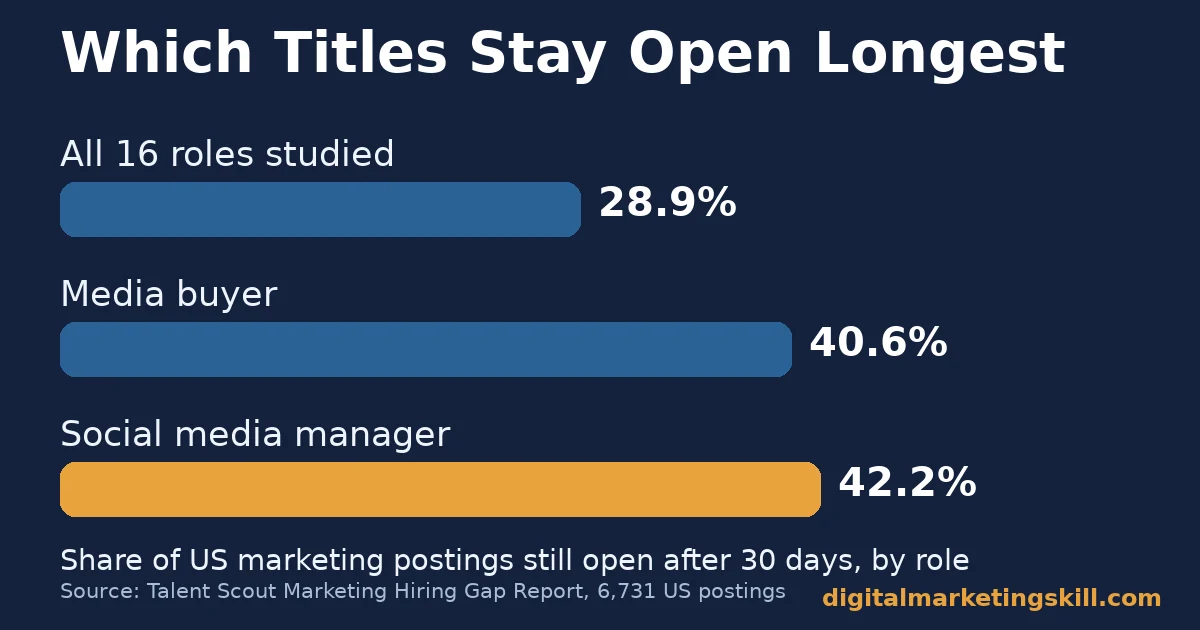
- Vacancy time varies sharply by title. Talent Scout studied 6,731 US marketing postings. It found 28.9% still open after 30 days. Social media manager postings stayed open 42.2% of the time. Media buyer postings stayed open 40.6% of the time.
- Pay climbs fastest in management titles. The US Bureau of Labor Statistics puts median pay for advertising, promotions and marketing managers at $165,780 a year. Market research analysts and marketing specialists, a role family that covers many hands-on digital marketing job titles, earn a median of $78,760.
- Demand keeps growing, but not evenly. BLS projections show 6% growth for marketing manager roles over the next decade, and 7% for marketing specialist roles. Both beat the all-occupation average, but neither guarantees any single title.
- Negotiating pays off. Link in Bio surveyed 2,500 social media professionals in more than 40 countries. Close to three in four who negotiated their pay received more than the first offer. Successful negotiators earned about 15% more on average.
- Freelance rates sit below employed median pay. Upwork’s own hiring page lists a median rate of $35 an hour for marketing consultants on its marketplace. That is a useful anchor for pricing early project work before you step into a full-time title.
In this guide
- What Most Digital Marketing Job Titles Lists Miss
- How Digital Marketing Job Titles Map to Real Work
- Five Digital Marketing Job Title Families, and What Each Is Built For
- Digital Marketing Job Titles Are Not Just a US Story
- How to Land Each Digital Marketing Job Title
- SEO and Content: Lead With a Ranking or Published Piece You Can Prove
- Paid Media: Lead With a Budget You Actually Managed
- Social Media: Lead With a Channel You Grew From Scratch
- Email and Lifecycle: Lead With a Sequence That Converted
- Management and Analytics: Lead With a Report That Changed a Decision
- How to Measure Whether a Title Is Working for You
- The One Rule: Match the Title to Your Tolerance for Delay
- A Real Case: Trading Employment for a Managed Campaign Portfolio
- Frequently Asked Questions About Digital Marketing Job Titles
- Build the Proof Each Title Actually Rewards
What Most Digital Marketing Job Titles Lists Miss
Most lists of digital marketing job titles describe duties and stop there. They say an SEO specialist “optimises websites for search engines.” They say a social media manager “manages social accounts.” Both statements are true and useless on their own.
A title actually determines something more useful. It decides how you get judged, how fast you get feedback, and how much budget you control. This guide treats each title as a different working rhythm, not just a task list. Match that rhythm to how you naturally work, and the right title becomes an easier, more obvious choice.
The figures below come from government labour data, one dedicated hiring study and two independent salary surveys, each named with its scope. Pay and vacancy figures are US-only unless stated otherwise, so treat them as current benchmarks, not a fixed ranking, because hiring markets move.
How Digital Marketing Job Titles Map to Real Work
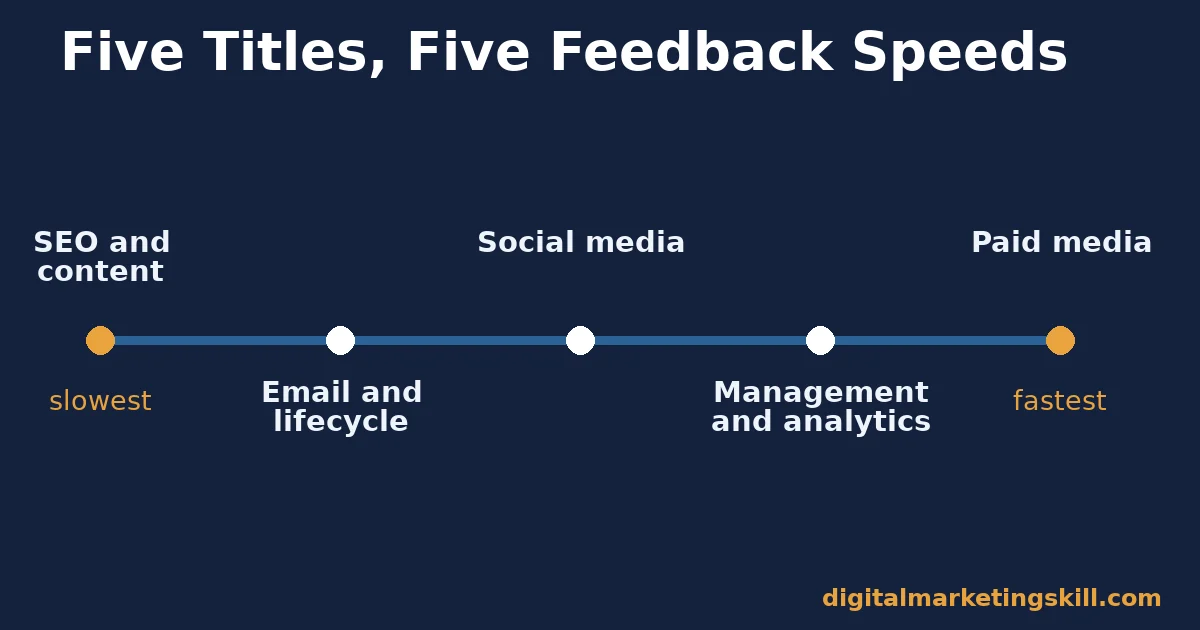
Every digital marketing job title sits on two axes. The first is how long it takes to see whether an action worked. The second is how much budget or audience the role controls directly. An SEO specialist’s feedback loop runs weeks to months, because search rankings move slowly. A paid media buyer’s feedback loop runs hours, because ad platforms report spend and clicks the same day.
That gap explains why people often struggle moving between titles without retraining. A content writer used to judging success by reader time on page can find a paid media role stressful. The metrics change daily there, and a wrong call costs money right away, not just attention.
Employers hire for this working rhythm as much as for the skill list. That is why postings increasingly separate two kinds of title. A “specialist” title covers one channel with fast feedback. A “manager” title covers several channels, with slower feedback and real budget ownership.
The US Bureau of Labor Statistics groups most hands-on digital marketing job titles under one broad category: market research analysts and marketing specialists. That covers SEO specialists, content specialists, social media specialists and email marketing specialists.
Median pay for the category is $78,760 a year, with growth projected at 7% over the next decade, faster than the average for all occupations. Management titles that oversee several specialists sit in a separate, higher-paid category.
Five Digital Marketing Job Title Families, and What Each Is Built For
Group digital marketing job titles by working rhythm and the differences become practical, not just descriptive. Here are the five families that cover most open roles today.
SEO and Content: Built for Compounding Results
SEO specialists, content strategists and copywriters work on a delay. A page published today might not rank for months, so a content calendar is really a bet on what will matter later.
The Bureau of Labor Statistics reports median pay of $76,910 a year for writers and authors, a role family close to many content-marketing titles. In that occupation, 65% are self-employed, which shows how much of this work happens on a freelance basis.
Paid Media: Built for Daily Decisions
Paid media buyers manage live budgets against a daily reporting cycle. In Talent Scout’s hiring-gap analysis of 6,731 postings, media buyer roles stayed open 40.6% of the time past 30 days, among the hardest digital marketing job titles to fill. Its chief executive linked this less to a shortage of applicants. He pointed instead to employers wanting proven, lower-risk hires for roles that touch spend directly.
Social Media: Built for Constant Output
Social media management is the single hardest digital marketing job title to fill, according to the same Talent Scout dataset, with postings open 42.2% of the time past 30 days.
Link in Bio’s salary and career survey of 2,500 respondents in more than 40 countries found 77% reported active or recent burnout. Another 67.2% felt they were doing more than one job. That pattern helps explain why employers struggle to keep these seats filled, even when candidates exist.
Email and Lifecycle Marketing: Built for Retention
Email and lifecycle marketers work on audiences a business already has, not new discovery. That makes their results easier to attribute directly to revenue. This title rewards people who are comfortable with segmentation, automation logic and long testing cycles. It often sits inside the same “marketing specialist” pay band the BLS tracks, since few employers list it as a separate occupational category.
Marketing Management and Analytics: Built to Connect Them All
Marketing managers and analysts do not run one channel. They decide where budget moves between channels, and they defend that decision with data. The BLS puts median pay for advertising, promotions and marketing managers at $165,780 a year, more than double the specialist median. That gap reflects both the budget responsibility and the years of specialist experience most employers expect first.
Digital Marketing Job Titles Are Not Just a US Story
Every figure above about pay and vacancy rates comes from US data, because that is where the hiring studies are published. The underlying demand is not US-only.
DataReportal’s Global Digital Overview counts more than 6 billion internet users worldwide. Almost every one of those markets now has local businesses competing for attention online. That is why the same five title families show up in job postings far beyond the US, even where pay bands and hiring speed differ.
MBO Partners’ State of Independence research counts 11.5 million independent professional service providers in the US alone. That figure has climbed sharply as more marketing work moves to contract and project arrangements rather than fixed employment.
If you live outside the US, use the US figures in this guide as a structure for comparing titles, not as a literal price list. Search for your own country’s marketing salary surveys or job boards instead. Then apply the same logic: match the title to your tolerance for delay, not to the title with the most impressive name.
How to Land Each Digital Marketing Job Title
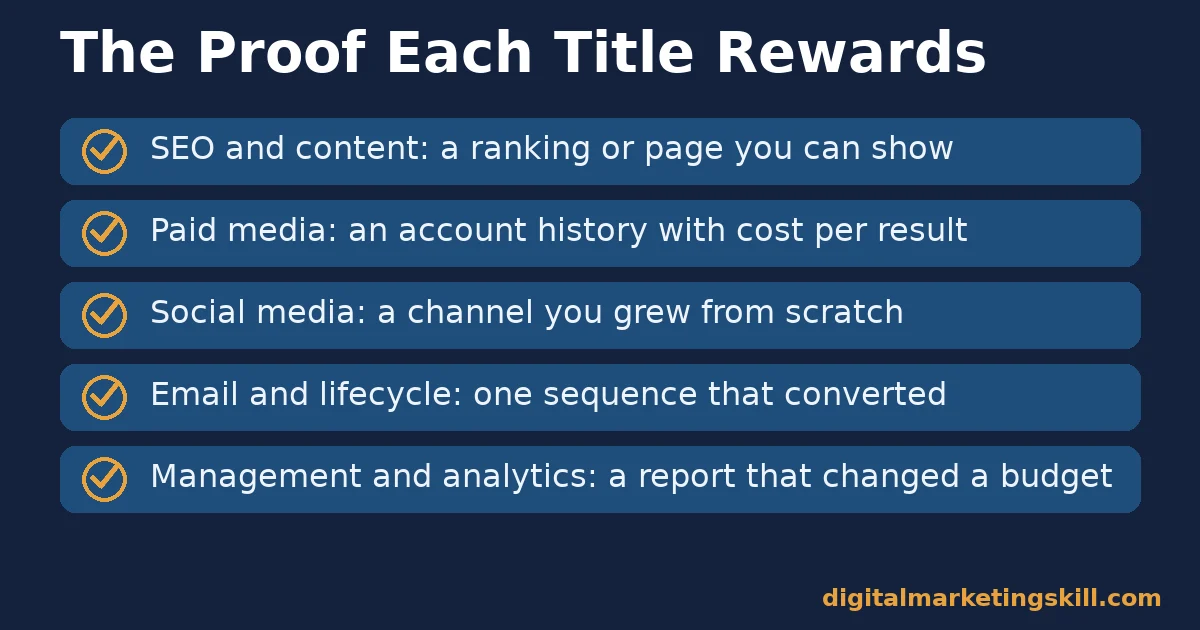
Knowing the difference between digital marketing job titles only helps if it changes what you show an employer. Each family below rewards a different kind of proof.
SEO and Content: Lead With a Ranking or Published Piece You Can Prove
Bring a page or article you wrote or optimised, with before-and-after ranking or traffic numbers if you have them. Results take months, so a hiring manager cannot watch you work in real time. Your portfolio has to carry that proof instead. One practical first project: rewrite one page on a real or practice site, then track its ranking for eight weeks before you apply.
Paid Media: Lead With a Budget You Actually Managed
Bring a screenshot-backed account history, even from a small self-funded test budget. Show cost per result, and what you changed when a campaign underperformed. Employers hiring for these digital marketing job titles are checking for judgment under live spend. A documented mistake you caught and fixed is often more convincing than a campaign that simply worked.
Social Media: Lead With a Channel You Grew From Scratch
Bring one account, even a personal or practice account, where you can show a growth curve. Explain which specific posts or formats moved it. This is the hardest title to fill, according to the Talent Scout data, so candidates who show sustained weekly output, not just one viral post, stand out fast.
Email and Lifecycle: Lead With a Sequence That Converted
Bring one automated sequence you built, with open, click and conversion numbers. Explain one segment you treated differently from the rest. This title is judged on retention math. Showing you understand which subscribers you kept matters more than showing how many emails you sent.
Management and Analytics: Lead With a Report That Changed a Decision
Bring one case where a report you built changed where a budget went, instead of just a dashboard you maintained. These digital marketing job titles require defending trade-offs between channels. Employers want evidence you can argue for a decision, not only measure one after the fact.
How to Measure Whether a Title Is Working for You
Each digital marketing job title has a different signal that shows whether the work is landing, separate from whether you personally enjoy it.
- Time to first result. For SEO and content titles, track weeks from publishing to a measurable ranking or traffic change. A lengthening gap signals a content or technical problem, not just normal delay.
- Cost per result trend. For paid media titles, track whether cost per lead or sale is falling, flat or rising over a rolling four-week window. This separates a genuinely improving account from one hiding problems behind total spend.
- Output-to-engagement ratio. For social titles, track engagement per post against posting frequency, not just total followers. Raw follower counts can rise while real engagement falls.
- Segment-level conversion. For email titles, track conversion rate by segment, not just the blended average. The average can hide whether automation works for the audience that actually buys.
- Budget-shift accuracy. For management and analytics titles, track how often a recommended budget move produced the predicted result within one reporting period. This is a direct measure of judgment, not just activity.
Reading the Numbers Together
Read these metrics alongside whatever your employer already tracks, not instead of it. A metric that looks fine alone but contradicts the business result, such as rising engagement with falling sales, usually means the wrong thing is being measured.
These same measures work as a self-check before you even apply for a title. If you cannot picture tracking cost per result every week without dread, a paid media title will wear on you faster than the pay band suggests. If a months-long wait for a ranking change sounds unbearable, the SEO and content family is probably the wrong starting point, no matter how much you enjoy writing.
The One Rule: Match the Title to Your Tolerance for Delay
The single most useful filter across all digital marketing job titles is this: pick the title whose feedback cycle matches how you actually work, not the title with the best-sounding name. Someone who needs daily proof will burn out in an SEO role waiting months for results.
Someone who finds daily live-spend decisions stressful will make worse calls in paid media than in content or lifecycle work, because that cycle runs slower and forgives more.
Illustrative, invented example: a career changer enjoys writing but checks analytics anxiously every hour. That person is likely a poor fit for a pure SEO or content title, even though the skills overlap. A hybrid content-and-email role, with weekly rather than monthly feedback, is often a better match. This is a reasoning example, not a documented case.
Use the same test before picking a title to train for. List the last three times you checked a number out of habit, not because a report was due.
If that number was a bank balance or an ad dashboard, you likely tolerate fast, visible feedback well. If it was a long-term goal, like a savings target or a reading list, a slower-feedback title such as SEO or content strategy probably fits you better than a trading-floor style paid media seat.
A Real Case: Trading Employment for a Managed Campaign Portfolio
Digital Marketing Skill Institute graduate Damola Akanbi left a fixed job to manage paid campaigns directly for clients. He now averages $1,500 per client running digital marketing campaigns, so the move paid off, according to the story published on the Institute’s own reviews page.
The shift mirrors the paid-media pattern above: once a specialist can show a documented account history, the title stops being “employee” or “freelancer.” It becomes whichever arrangement pays better for the same proven skill. Results like this depend on one person’s effort, client base and market, so they are not typical, as the Institute’s own earnings disclaimer explains.
Frequently Asked Questions About Digital Marketing Job Titles
Which digital marketing job titles are hardest to fill right now?
Social media manager and media buyer postings stayed open the longest in Talent Scout’s analysis of 6,731 US postings, at 42.2% and 40.6% past 30 days. Both sit well above the 28.9% average across all 16 roles studied.
Do digital marketing job titles require a degree?
Most do not require a specific degree. The US Bureau of Labor Statistics lists a bachelor’s degree as “typical” entry-level education for marketing manager and specialist roles. That describes common practice, not a legal requirement, and portfolios increasingly substitute for formal credentials in hiring decisions.
What is the pay difference between a specialist and a manager title?
US median pay sits at $78,760 a year for the market research analyst and marketing specialist category, against $165,780 for advertising, promotions and marketing managers. The gap reflects added budget responsibility and usually several years of specialist experience first.
Can I move between digital marketing job titles later?
Yes. The underlying skills, such as writing, data reading and platform mechanics, transfer across titles.
The working rhythm does not transfer automatically, so expect an adjustment period when you move from a slow-feedback title like SEO into a fast-feedback title like paid media, or the reverse. Many people who move titles later in their career do so because a first role revealed which feedback speed actually suits them, not because the original choice was wrong.
Is freelancing a realistic way to start in these roles?
It can be. Upwork’s own hiring page lists a median marketplace rate of $35 an hour for marketing consultants, a starting benchmark for pricing early project work before you pursue a full-time title. Marketplace rates still vary widely by specialism and experience.
Which digital marketing job titles are growing fastest?
US Bureau of Labor Statistics projections to the mid-2030s show marketing specialist roles growing 7% and marketing manager roles growing 6% over the decade, both faster than the average for all occupations. Neither figure guarantees demand for one specific title or location.
How much does negotiating pay actually change for these titles?
In Link in Bio’s survey of 2,500 social media professionals across more than 40 countries, close to three in four who negotiated received more than the initial offer. Successful negotiators earned about 15% more on average than those who did not negotiate.
Do employers value AI skills across these titles now?
LinkedIn’s analysis of its own hiring data lists AI literacy among the fastest-rising skills employers hire for across marketing roles. The ranking is based on outcomes of people actually hired, not self-reported skill claims.
That suggests AI literacy is becoming a baseline expectation rather than a specialist add-on. It holds across every title family in this guide, from SEO and content through paid media and management, because each one now touches at least one AI-assisted tool somewhere in its daily workflow.
Build the Proof Each Title Actually Rewards
Pick one digital marketing job title family from this guide. Build the one piece of proof its hiring managers look for, then measure it for a few weeks before you apply or pitch.
Digital Marketing Skill Institute’s Master Diploma in Digital & AI Marketing follows that same logic. It covers ten practical, AI-powered courses across SEO, content, paid advertising, email automation, analytics and social media.
Students get unlimited one-on-one mentoring, plus real project work inside a US partner company from day one, so you build portfolio proof, not just certificates. The diploma is dual accredited in the US and UK and recognised in more than 100 countries, delivered 100% online, so you can build these skills anywhere in your country.
Where to Go Next
See the full curriculum on the Master Diploma program page, read outcomes on the reviews page, or browse more guides on the blog. Go straight to the application page to start, or learn more at digitalmarketingskill.com.
For related reading: see how pay and requirements compare across digital marketing job roles, what the data says about website SEO optimisation, how segmentation changes email marketing ROI, the steps to become a social media manager, and a broader guide to freelancing for beginners. Whatever path you choose, start at digitalmarketingskill.com.
Every figure in this guide was checked against its original source before publication. Figures marked as illustrative are invented examples, not real results.
![9 Amazing Digital Marketing Skills to Make Money Online [With Proof]](https://digitalmarketingskill.com/wp-content/uploads/2019/07/9-Amazing-Digital-Marketing-Skills-to-Make-Money-Online-With-Proof-17.png)






