CCPA compliance means meeting the requirements of the California Consumer Privacy Act, as amended by the California Privacy Rights Act (CPRA): telling California residents what personal information you collect and why, honouring their rights to know, delete, correct and opt out of the sale or sharing of their data, and protecting that data with reasonable security. For marketers, the CCPA affects everyday tools such as tracking pixels, cookies, ad targeting, email lists, lead forms and customer data platforms. This guide explains who the CCPA applies to, the rights it gives consumers, what it means for digital marketing, a step-by-step compliance checklist, how it compares with GDPR and the mistakes that have led to enforcement. It is general information, not legal advice.
Key Takeaways
- The CCPA applies to for-profit businesses that do business in California and meet at least one threshold: annual gross revenue above an inflation-adjusted amount (set at $26,625,000 from January 2025), buying, selling or sharing the personal information of 100,000 or more California consumers or households, or earning half or more of revenue from selling or sharing personal information.
- Consumers have rights to know, delete, correct, opt out of the sale or sharing of personal information, limit the use of sensitive personal information and not be discriminated against for using these rights.
- “Sharing” includes disclosing personal information for cross-context behavioural advertising, which is why many ad pixels and retargeting tools fall within the law.
- Businesses must honour opt-out preference signals such as Global Privacy Control.
- The California Privacy Protection Agency and the Attorney General enforce the law, with administrative fines of up to $2,500 per violation or $7,500 per intentional violation or violation involving minors, amounts that are adjusted for inflation.
- What Is the CCPA?
- Who Must Comply?
- Consumer Rights
- What the CCPA Means for Marketers
- CCPA Compliance Checklist
- CCPA vs GDPR
- Enforcement and Penalties
- FAQ
What Is the CCPA?
The California Consumer Privacy Act is a state law that gives California residents control over the personal information businesses collect about them. It took effect at the start of 2020 and was significantly expanded by the California Privacy Rights Act, which voters approved later that year and which created a dedicated regulator, the California Privacy Protection Agency (CPPA). Today, when people say “CCPA”, they usually mean the law as amended by the CPRA, together with its regulations.
Personal information is defined broadly. It includes obvious identifiers such as names, email addresses and phone numbers, but also IP addresses, device IDs, cookie identifiers, browsing and search history, purchase history, geolocation, inferences drawn to build a profile and more. Some categories, such as precise geolocation, account log-ins, racial or ethnic origin, health information and certain financial data, are treated as sensitive personal information with extra protections.
The law also covers employees, job applicants and business contacts, not just consumers in the everyday sense. That matters for business-to-business marketers, whose lead lists and contact data are personal information under the law.
What Most CCPA Guides Miss for Marketers
Many CCPA guides are written for lawyers or security teams. Three points matter most for marketing teams:
- Your ad tech may count as “sharing”. Pixels and tags that send website visitors’ data to advertising platforms for targeting across other sites are a common area of risk.
- Opt-out signals are not optional. If a visitor’s browser sends a Global Privacy Control signal, covered businesses must treat it as a request to opt out of sale and sharing.
- Marketing owns many of the data flows. Forms, email platforms, CRMs, analytics, chat tools and agencies all touch personal information. Compliance needs marketing involvement, not just a privacy policy written by legal.
Who Must Comply With the CCPA?
The CCPA applies to for-profit businesses that collect California residents’ personal information, do business in California and meet at least one of these thresholds:
- Annual gross revenue above the threshold set by the law, adjusted for inflation every two years; from January 2025 the figure is $26,625,000.
- Buying, selling or sharing the personal information of 100,000 or more California consumers or households each year.
- Deriving 50 per cent or more of annual revenue from selling or sharing California residents’ personal information.
A business does not need to be based in California. An online shop or software company elsewhere that meets a threshold and has California customers can be covered. Service providers and contractors that process data on behalf of covered businesses have their own obligations, mainly through contracts. Most nonprofits and government agencies are not covered, and some data covered by other laws, such as certain health and financial information, has specific exemptions.
Even businesses below the thresholds often follow CCPA-style practices, because clients, partners and platforms expect them and because other US states have passed similar privacy laws.
Consumer Rights Under the CCPA
Right to know
Consumers can ask what personal information a business has collected about them, where it came from, why it is used and who it is disclosed to, and can request a copy of the specific information.
Right to delete
Consumers can ask a business to delete personal information it collected from them, subject to exceptions, for example where the data is needed to complete a transaction or meet legal obligations. Businesses must also tell their service providers to delete it.
Right to correct
Consumers can ask a business to correct inaccurate personal information.
Right to opt out of sale or sharing
Consumers can tell a business not to sell their personal information or share it for cross-context behavioural advertising. Businesses that sell or share personal information must offer a clear way to opt out, often a link titled “Do Not Sell or Share My Personal Information”, and must honour browser opt-out preference signals.
Right to limit use of sensitive personal information
Where a business uses sensitive personal information beyond what is necessary to provide the service, consumers can ask it to limit that use, often through a “Limit the Use of My Sensitive Personal Information” link.
Right to non-discrimination
Businesses cannot deny goods or services, charge different prices or provide lower quality because a consumer exercised their rights. Financial incentives, such as loyalty programmes that offer discounts in exchange for data, are allowed only with a clear notice and if the value offered is reasonably related to the value of the data.
Businesses must provide at least two ways to submit requests in most cases, verify requests where appropriate and generally respond within 45 calendar days, with a possible extension.
What the CCPA Means for Marketers
Website tracking and ad pixels
Many marketing websites use pixels and tags from advertising and social platforms to track visitors, build audiences and measure conversions. Where these tools let third parties use data for advertising across other websites and apps, they may count as sharing for cross-context behavioural advertising. Covered businesses need to disclose this, offer an opt-out and make sure opt-outs actually stop the relevant tags from firing.
Cookies and consent tools
Unlike the EU, California does not require opt-in consent for most cookies, but businesses must give notice and honour opt-outs. Many teams use a consent management platform that can respond to Global Privacy Control and regional rules. Our glossary entries on cookie consent and consent mode explain related concepts.
Email marketing and lead forms
Forms must include or link to a notice at collection explaining what is collected and why. Email lists, CRM records and lead databases are personal information, so access, deletion and correction requests apply to them. Keep a clear record of where each contact came from.
Customer data platforms and data sharing
Uploading customer lists to ad platforms for targeting, sharing data with partners or buying data from brokers can involve sale or sharing. Review each data flow, update contracts and check whether consumers have opted out before data is shared.
Agencies and vendors
Agencies, freelancers and software providers that handle personal information on your behalf should have contracts that limit how they use it, as the CCPA requires for service providers and contractors.
Children and teenagers
Selling or sharing the personal information of consumers under 16 requires opt-in consent, from a parent or guardian for under-13s. Penalties for violations involving minors are higher.
Loyalty programmes and incentives
Discounts or rewards in exchange for personal information count as financial incentives. They need a clear notice explaining the terms and how the value was calculated, and people must be able to withdraw.
CCPA Compliance Checklist for Marketing Teams
1. Check whether the CCPA applies
Work with finance and legal to confirm whether your business meets any threshold, and whether you act as a business, service provider or contractor for particular data. If you are an agency, your clients’ status matters too.
2. Map your marketing data
List every place marketing collects or uses personal information: website forms, analytics, pixels and tags, chat tools, email platforms, CRM, events, webinars, social media lead forms, surveys, loyalty programmes and data purchased or shared with partners. For each, note what data is collected, why, where it is stored, how long it is kept and who receives it.
3. Identify sale, sharing and sensitive data
Flag any flows where personal information is sold, shared for cross-context behavioural advertising or used for profiling, and any sensitive personal information you collect. These need the clearest notices and opt-outs.
4. Update your privacy policy and notices
Your privacy policy should explain categories of personal information collected, sources, purposes, retention periods, who it is disclosed to, whether it is sold or shared, and how consumers can exercise their rights. Provide a short notice at collection on forms and other collection points.
5. Add opt-out links and honour signals
If you sell or share personal information, add a clear “Do Not Sell or Share My Personal Information” link, or an alternative such as a “Your Privacy Choices” link with the official icon, and a “Limit the Use of My Sensitive Personal Information” link if relevant. Configure your consent tool and tags so that opt-outs and Global Privacy Control signals actually stop sale and sharing.
6. Set up request handling
Create simple ways for people to submit requests, such as a web form and email address, and an internal process to verify, track and respond within the required time. Make sure deletion requests reach every system, including email platforms and ad audiences.
7. Review contracts with vendors and agencies
Ensure agreements with service providers, contractors and third parties include the terms the law requires, such as limits on use of data.
8. Minimise and secure data
Collect only what you need, keep it only as long as necessary and protect it with reasonable security. Data breaches caused by poor security can lead to consumer lawsuits.
9. Train your team
Make sure marketers understand what counts as personal information, sale and sharing, and how to handle requests and new tools.
10. Review regularly
Laws and regulations change, and marketing teams add new tools often. Review your data map, tags and notices at least once a year and whenever you launch new tracking or data sharing.
CCPA vs GDPR
| CCPA (with CPRA) | GDPR | |
|---|---|---|
| Where it applies | California residents’ data, for businesses meeting thresholds | People in the EU and EEA, for most organisations processing their data |
| Main approach | Notice and opt-out for most uses, opt-in for some (such as minors) | Lawful basis needed, often consent for marketing cookies |
| Who is covered | For-profit businesses above thresholds | Almost all organisations, including small ones and nonprofits |
| Key rights | Know, delete, correct, opt out, limit sensitive data, non-discrimination | Access, rectification, erasure, restriction, portability, objection |
| Regulator | California Privacy Protection Agency and Attorney General | National data protection authorities |
A business that complies with GDPR is often well prepared for the CCPA, but the two are not identical. CCPA-specific requirements, such as opt-out links, Global Privacy Control and financial incentive notices, still need attention. Our glossary entry on GDPR covers the European rules.
CCPA Enforcement and Penalties
The California Privacy Protection Agency and the California Attorney General enforce the law. Administrative fines can reach $2,500 per violation, or $7,500 for intentional violations or those involving minors, with amounts adjusted for inflation over time. Because each affected consumer or instance can count as a separate violation, totals can add up quickly. Consumers also have a limited right to sue when their non-encrypted or non-redacted personal information is exposed in a data breach caused by a business’s failure to maintain reasonable security.
Enforcement actions have focused on issues highly relevant to marketing, including failing to honour Global Privacy Control signals, not disclosing the sale or sharing of data through advertising technology, confusing or manipulative opt-out designs and failing to process requests properly. The Attorney General’s settlement with retailer Sephora, which concerned the sale of personal information through tracking technology and failure to honour opt-out signals, is often cited as an early example. Official enforcement updates on the Attorney General and CPPA websites are the best source for current cases.
Dark Patterns and Opt-Out Design
CCPA regulations require that privacy choices are easy to understand and use, and they prohibit so-called dark patterns, designs that steer people into choices they did not intend. For marketers, this matters in cookie banners, opt-out pages and sign-up forms. Examples to avoid include making the “accept” option bright and obvious while hiding the opt-out, requiring more steps to opt out than to opt in, using confusing double negatives, pre-ticked boxes for data sharing and guilt-laden wording that pressures people to stay opted in. A simple test is symmetry: opting out should be as easy as opting in. Clear, honest design is not only a legal requirement but also builds trust with visitors.
Other US State Privacy Laws
California is no longer alone. A growing number of US states have passed comprehensive consumer privacy laws with similar rights to access, delete and opt out of targeted advertising, sale of data and profiling. The details differ, including thresholds, definitions and whether opt-out signals must be honoured. Marketing teams working across the United States often adopt one consistent set of practices that meets the strictest common requirements, such as clear notices, universal opt-out support and careful handling of sensitive data, rather than managing each state separately. Check with legal advisers on which laws apply to your business.
Common Mistakes
- Assuming the law only applies to California companies. It applies to qualifying businesses anywhere that handle Californians’ data.
- Ignoring ad pixels. Advertising tags can count as sharing personal information.
- Opt-out links that do not work. The link must actually stop sale and sharing.
- Not honouring Global Privacy Control. Covered businesses must treat it as an opt-out request.
- Outdated privacy policies. Policies must reflect current tools and data uses.
- Forgetting B2B and employee data. These are covered too.
- No process for deletion across tools. Requests must reach every system holding the data.
- Manipulative cookie banners. Dark patterns can invalidate choices and attract enforcement.
One Rule to Remember
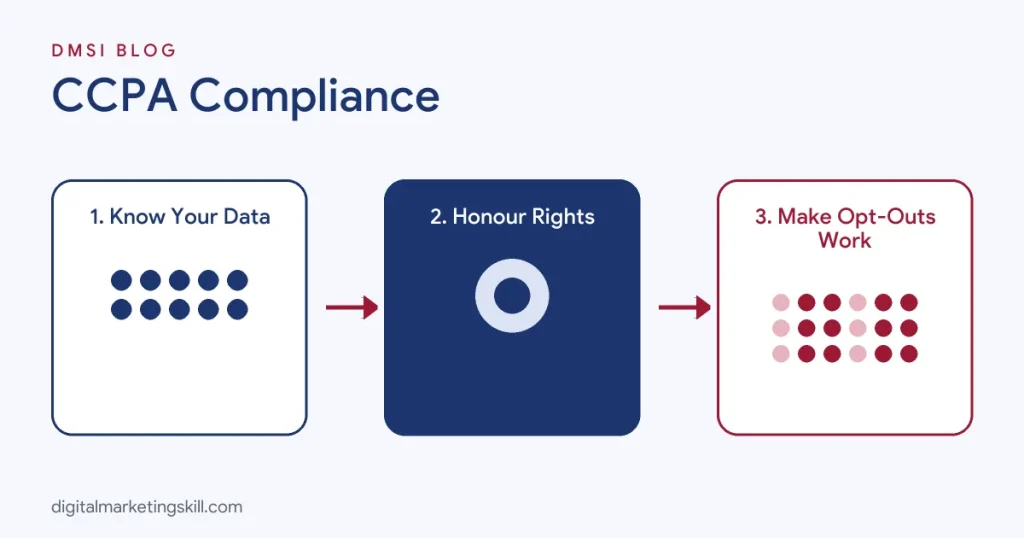
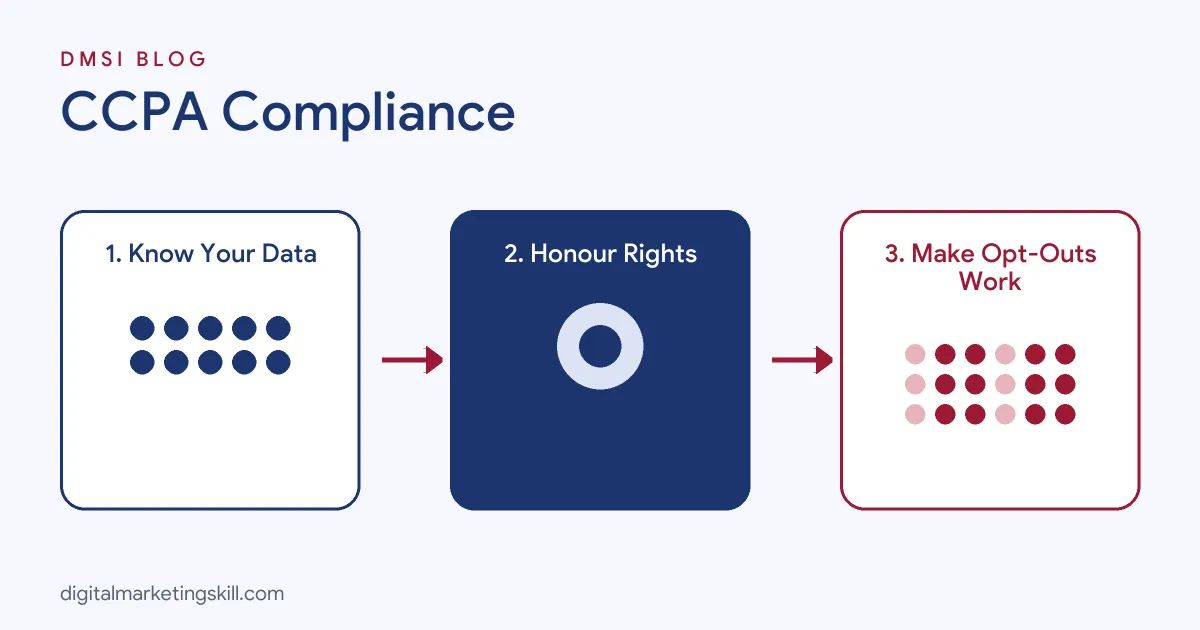
Know your data, tell people the truth and make their choices work. Most CCPA problems in marketing come from tools collecting or sharing data nobody mapped, or opt-outs that do not actually stop the tracking.
An Illustrative Example
This example is illustrative and not a real business. An online homeware retailer with customers across the United States discovered during a website audit that more than a dozen marketing tags were sending visitor data to advertising and analytics platforms. Its privacy policy mentioned only two. The marketing manager worked with legal and the web developer to map every tag, remove the ones no longer used, update the privacy policy, add a “Your Privacy Choices” link and configure the consent platform so that opt-outs and Global Privacy Control signals stopped advertising tags from firing. They also connected the request form to the email platform and CRM so deletion requests were processed everywhere. Retargeting audiences shrank slightly, but the retailer reduced its legal risk and found that cleaner data improved the accuracy of its analytics.
The lesson: a tag audit is often the most valuable first step for CCPA compliance in marketing.
Privacy Compliance as a Career Skill
Marketers who understand privacy laws, consent tools and tag management are increasingly valuable, because so much marketing depends on data. If you are building marketing skills in your country or anywhere else, practise by auditing the tags on a website you manage using your browser’s developer tools or a tag inspection extension, comparing them with the privacy policy and writing a short list of fixes. Knowing how to balance effective marketing with privacy rules is a strong selling point in interviews.
Frequently Asked Questions
What does CCPA compliance mean?
Meeting the California Consumer Privacy Act’s requirements on notices, consumer rights, opt-outs, contracts and security for California residents’ personal information.
Who needs to comply with the CCPA?
For-profit businesses doing business in California that meet a revenue threshold, handle the data of 100,000 or more California consumers or households, or earn half or more of revenue from selling or sharing personal information.
Is the CCPA only for California companies?
No. It applies to qualifying businesses anywhere that collect California residents’ personal information.
What is the difference between the CCPA and the CPRA?
The CPRA amended and expanded the CCPA, adding rights such as correction and limiting sensitive data use, and created the California Privacy Protection Agency.
What is the difference between GDPR and CCPA?
GDPR requires a lawful basis, often consent, for processing and covers almost all organisations. The CCPA mainly uses notice and opt-out and applies to businesses above thresholds.
Do I need a cookie banner for the CCPA?
The CCPA does not require opt-in cookie consent for most uses, but you must give notice and honour opt-outs, which many businesses manage through a consent tool.
What is Global Privacy Control?
A browser setting that sends a signal asking websites not to sell or share the user’s personal information. Covered businesses must honour it.
What are the penalties for violating the CCPA?
Administrative fines of up to $2,500 per violation or $7,500 for intentional violations or those involving minors, adjusted for inflation, plus consumer lawsuits for certain data breaches.
Does the CCPA apply to B2B data?
Yes. Business contact and employee data are covered.
How long do businesses have to respond to requests?
Generally 45 calendar days, with a possible extension.
Your Next Step
Want to learn how to run data-driven marketing that respects privacy rules? The Master Diploma in Digital & AI Marketing at Digital Marketing Skill Institute covers AI-powered Social Media Management and Advertising, Lead Generation and Email Automation, Google, and a WordPress and SEO track where you build and rank a real website.
From day one, you work on a real U.S. company’s project through the U.S. Project Internship, so you finish with real results and a verified U.S. work reference letter. You also get unlimited one-on-one coaching. The program carries dual US and UK accreditation, is recognised in more than 100 countries, and runs 100% online over three months.
You can build those skills wherever you live, anywhere in your country. Read student reviews, then apply for the 65% partial scholarship to see if you qualify.
Sources checked November 2026: California Attorney General, “California Consumer Privacy Act (CCPA)”; California Privacy Protection Agency FAQs; Wikipedia, “California Consumer Privacy Act”; Osano, “Guide to CCPA”; Thomson Reuters, “The California Consumer Privacy Act”; Proofpoint, “What Is CCPA Compliance?”. This article is general information, not legal advice. Check official sources and a qualified adviser for your situation.