
An opt-in is a clear, active choice a person makes to receive marketing from you, such as ticking an unticked box or submitting a sign-up form. It is their way of saying “yes, you may contact me” by email, text or another channel. It matters because, in the UK and many other places, you usually need that choice before you send marketing messages, and lists built on real consent tend to engage far better.
Key Takeaways
- An opt-in is an active “yes”. Silence, inactivity and pre-ticked boxes do not count.
- The UK regulator, the ICO, says you must not send marketing emails or texts to individuals without specific consent, unless the soft opt-in applies.
- The soft opt-in only covers existing customers who bought something similar and had a simple way to opt out.
- US law works differently. CAN-SPAM focuses on giving people an easy way to opt out.
- You must keep records that show who opted in, when and how.
What Is an Opt-In?
Think of an opt-in as permission you can prove. A visitor reads your offer, decides they want it, and takes a step to join your list. That step is the moment of consent.
For example, a bakery adds a form to its website that says “Get our weekly recipe email.” A visitor types their email address and presses Subscribe. That person has opted in to the recipe email. However, they have not agreed to texts or to have their details shared with other firms.
So consent is always tied to something specific. In other words, people agree to a clear purpose, not to “any marketing, forever”. The ICO puts it simply: consent means “giving people genuine choice and control over how you use their data.”
The same idea applies across channels. For instance, a person may happily accept emails but not texts or phone calls. Each channel needs its own clear choice, so your forms should let people pick. Meanwhile, the rules for businesses differ. The ICO notes that you may email or text corporate bodies, such as limited companies, but sole traders count as individuals. Even so, it is good practice to keep a “do not email” list for any business that asks you to stop.
How an Opt-In Works
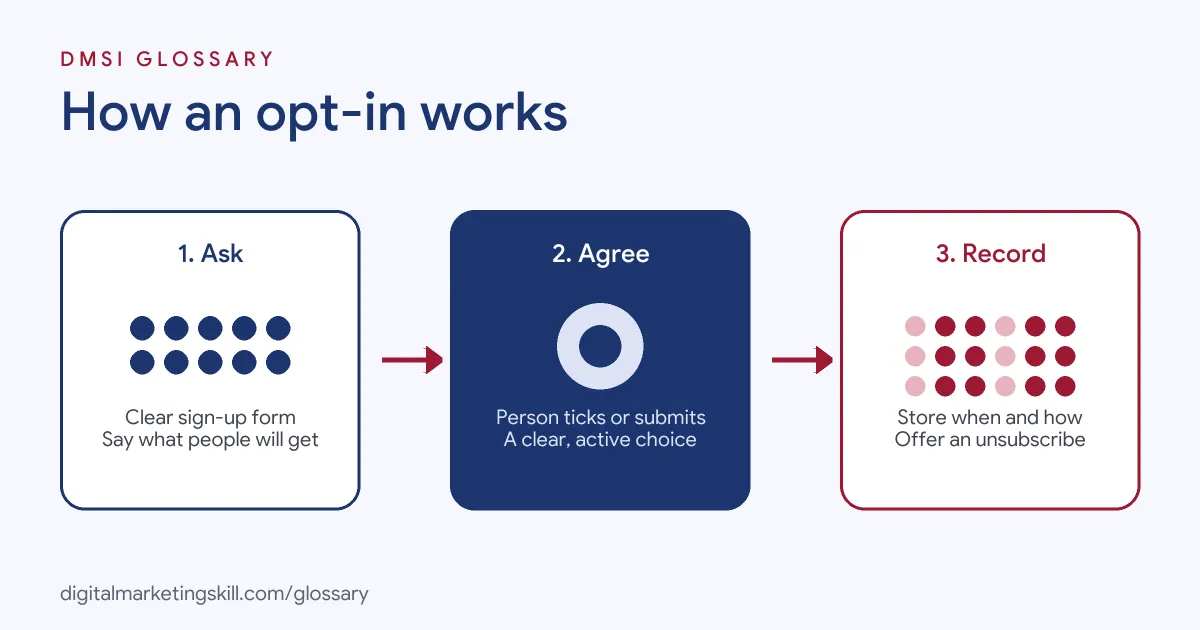
Every opt-in follows the same three steps. First, you ask clearly. Next, the person makes an active choice. Finally, you record that choice and respect it from then on.
What Makes Consent Valid
Under UK GDPR, valid consent must be “freely given, specific, informed and unambiguous”. The ICO adds that “someone must take deliberate and specific action to opt in”. That’s why a box someone ticks themselves works, while a box you tick for them does not.
The request should also stand out. According to the ICO, it needs to be “prominent, concise, separate from other terms and conditions”. So don’t hide your opt-in inside a long privacy notice.
The Soft Opt-In
The UK rules for email and text marketing (called PECR) include one exception, known as the soft opt-in. It lets you email existing customers without fresh consent, but only if three things are true. They bought, or talked about buying, a similar product from you. You gave them a simple way to opt out when you collected their details. Then you give that same chance in every message.
However, the soft opt-in does not cover new prospects or bought-in lists. It also does not cover charity fundraising or political campaigns.
Keeping a Record
Finally, you need proof. The ICO says “you must be able to demonstrate that someone has consented.” In practice, your email platform stores the date, the form and the wording each person saw. As a result, you can answer a complaint quickly.
Opt-In Examples
Here are three everyday opt-in examples:
- Newsletter form: A travel blog asks for an email address in return for a weekly deals email. The visitor submits the form, so they have opted in to that email.
- Checkout tick box: An online shop adds an unticked box at checkout that says “Email me offers and new products.” Only buyers who tick it join the marketing list.
- Lead magnet: A training firm offers a free checklist. The form says people will also receive tips by email. As a result, the opt-in is clear before anyone signs up. Our glossary entry on the lead magnet covers this swap in more detail.
Opt-In vs Opt-Out vs Soft Opt-In
These three ideas often get mixed up, so here is a simple comparison:
| Approach | How it works | Where it fits |
|---|---|---|
| Opt-in | The person takes an active step to agree | The safe default for marketing to individuals in the UK |
| Soft opt-in | Existing customers get similar offers, with an opt-out each time | UK email and text marketing to past buyers only |
| Opt-out | You send until the person asks you to stop | The US model under CAN-SPAM, where you must honour opt-outs within 10 business days |
In short, an opt-in asks first, while an opt-out model asks people to say no later. The ICO is clear that “there is no such thing as ‘opt-out consent’.”
How to Set Up an Opt-In Form
You can build an opt-in in almost any email tool. The steps below work for most of them:
- Decide what people will receive and how often. For example, “one email a week with new recipes.”
- Write a short, plain request near the form. Name your business and say what you will send.
- Use an empty email field and, where you need one, an unticked box.
- Add separate boxes for separate channels, such as email and text, so each choice stays specific.
- Link to your privacy notice, so people can read how you use their data.
- Turn on consent records in your email platform. Then check that each new contact shows the source and date.
- Add an unsubscribe link to every marketing message, and test that it works.
After that, send a welcome email straight away. It confirms the sign-up and reminds people what they agreed to.
Best Practices for Sign-Up Forms
- Say what happens next. People opt in more readily when they know exactly what they will get.
- Keep the form short. Ask only for what you need, which is often just an email address.
- Split your choices. Consent should be “unbundled from other terms and conditions”, so never tie marketing consent to buying.
- Make leaving easy. Under the ICO guidance, people must be able to withdraw consent at any time.
- Consider a confirmation step. A double opt-in, where people click a link in an email, also proves the address is real.
For more ideas on placing forms, see our guide to email list building with popups, landing pages and inline forms.
Common Mistakes to Avoid
Beginners often make the same few errors. First, they pre-tick the box, which the ICO says does not count as consent. Second, they bury the request in the terms and conditions. Third, they buy a list and assume the soft opt-in covers it, even though it doesn’t. Fourth, they collect email consent and then send texts as well. Finally, they forget to keep records, so they can’t prove anything later. Each mistake is easy to avoid once you know the rules.
Where You’ll Use Opt-In Skills at Work
Consent is part of daily work in email and marketing automation roles. For example, recent remote job listings ask candidates to:
- “Own the marketing email preference center and related workflows, including subscriptions, language preferences, opt-ins, unsubscribes, and consent history” (Marketing Automation and Campaign Operations Manager).
- “Monitor deliverability, list hygiene, consent states, and WhatsApp/SMS opt-in quality” (CRM Marketing Specialist).
- “Implement approved consent policies with Privacy and Legal, aligned with GDPR, CASL, and CAN-SPAM” (Marketing Automation and Campaign Operations Manager).
So if you want to work as an Email Marketing Specialist or Marketing Automation Specialist, employers will expect you to set up opt-in forms, manage consent and keep lists clean.
Learn It in the Lead Generation Track
You can learn to build compliant opt-in forms in the AI-Powered Lead Generation and Email Automation track. There, you build a lead magnet and an automated email sequence that converts, so you finish with work you can show an employer. You also join a U.S. Project Internship from day one, with unlimited 1-on-1 mentoring.
Want to grow the list once your forms are ready? Read our guide to growing your email list.
Frequently Asked Questions
What does opt-in mean in marketing?
It means a person has actively agreed to receive marketing from you, for example by submitting a sign-up form or ticking an empty box.
Is a pre-ticked box a valid opt-in?
No. The ICO says silence, pre-ticked boxes or inactivity should not count as consent. The person must tick the box themselves.
What is the soft opt-in?
It is a UK exception for existing customers. You can email them about similar products if you gave them a simple way to opt out at the start and in every message.
Do I need an opt-in to email people in the US?
CAN-SPAM mainly requires an easy opt-out, a valid postal address and honest messages. Even so, many businesses use opt-ins everywhere, because consented lists are easier to manage.
What is the difference between opt-in and double opt-in?
A single opt-in adds people as soon as they sign up. A double opt-in sends a confirmation email first, and only adds people who click the link.
Sources: ICO: What is valid consent?; ICO: Electronic mail marketing; FTC: CAN-SPAM Act compliance guide for business; remote job listings on Himalayas.