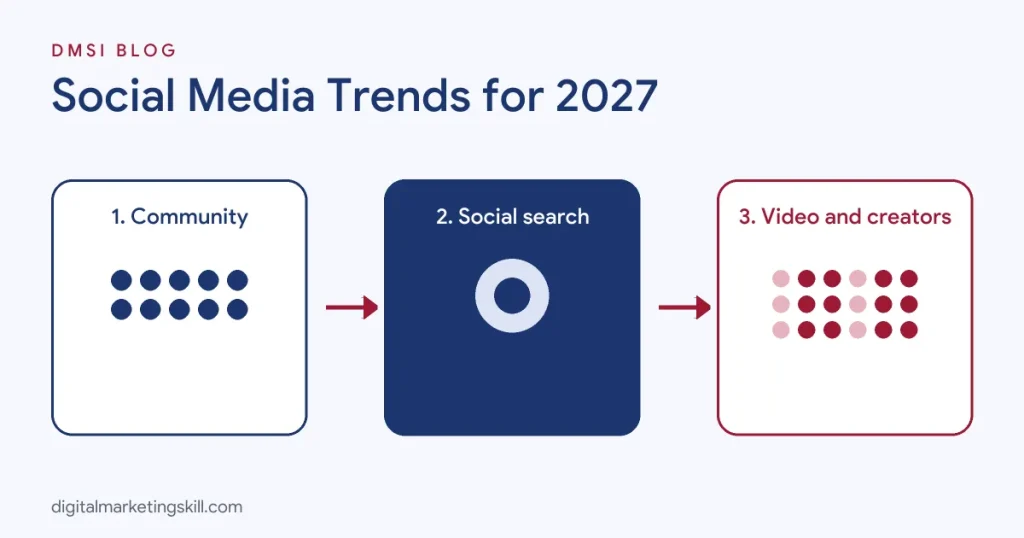
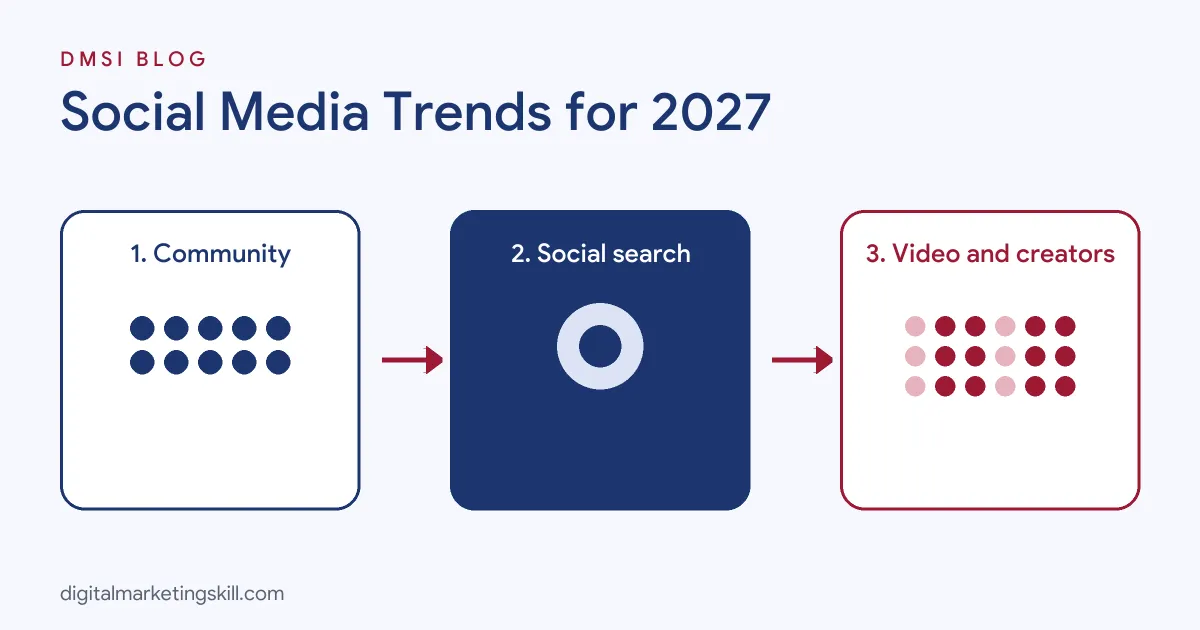
The biggest social media trends going into 2027 are a shift from chasing virality to building community, social platforms working as search engines, video in both short and serialised long forms, AI becoming a normal part of content creation alongside a premium on authentic human storytelling, creators and employees as trusted voices, social commerce becoming routine, and measurement moving from vanity metrics to business outcomes. This guide explains each trend in plain language, what it means for brands and marketers, and exactly what to do about it, plus a framework for deciding which trends deserve your time and which you can safely ignore.
Key Takeaways
- Sprout Social’s trend list includes video remaining dominant, AI-generated content becoming mainstream, serialised content, resonance and community over virality, authenticity and human-led storytelling, and social search.
- Hootsuite says ROI will be the defining factor of creator partnerships and employee ambassador programmes.
- National University’s analysis highlights social platforms turning into search engines, social commerce becoming normal and measurement moving from vanity metrics to business outcomes.
- National University also flags team sustainability and burnout as a strategic risk for social media teams.
- Not every trend suits every brand: test the ones that match your audience, goals and capacity.
- 1. Community and Resonance Over Virality
- 2. Social Platforms as Search Engines
- 3. Video: Short, Long and Serialised
- 4. AI Everywhere, Humans in Demand
- 5. Creators and Employees as Trusted Voices
- 6. Social Commerce Becomes Normal
- 7. Measurement Grows Up
- 8. Private and Niche Spaces
- 9. Engagement Signals Over Follower Counts
- 10. Sustainable Social Teams
- How to Evaluate a Trend
- A 90-Day Action Plan
- FAQ
What Most Social Media Trends Lists Miss
Trend reports are useful, but they tend to share two weaknesses. First, they list trends without telling you which ones fit your situation, so small teams end up chasing everything. Second, they describe what is happening without explaining what to do on Monday morning. A trend only matters if it changes a decision you make.
This guide takes a different approach. For each trend, you will find what is happening, why it matters and a concrete action. Then you will find a simple scoring method to decide which trends to act on now, which to test and which to ignore. Social media trends are different from viral trends, such as a popular sound or meme format, which come and go in days. Here we focus on the structural shifts that should shape your strategy for the year ahead. For wider marketing changes, see our guide to digital marketing trends.
1. Community and Resonance Over Virality
Sprout Social lists brands prioritising resonance and community over virality as one of its key trends. Viral reach is unpredictable and often brings people who will never buy. A smaller audience that recognises, trusts and returns to your brand is usually worth more.
This shows up in how brands spend their time: replying to comments, building groups and community spaces, featuring customers, hosting live sessions and creating recurring formats that loyal followers look forward to. It also connects with the growth of niche and community platforms, covered in our guide to alternative social media platforms.
What to do: set aside time every week for community management, not just publishing. Track replies, conversations and returning engagers, not only reach. Create at least one recurring format your audience can rely on, such as a weekly tip, Q&A or customer spotlight.
2. Social Platforms as Search Engines
Social search is a trend highlighted by Sprout Social, and National University describes social platforms continuing to turn into search engines. Many people, especially younger audiences, search TikTok, Instagram, YouTube and Pinterest for product recommendations, how-to advice, reviews and local places before or instead of using a traditional search engine.
That changes how content should be created. Posts need to answer specific questions, use the words people actually search, include clear spoken and on-screen keywords, captions and descriptions, and be useful long after the day they are posted. It also links social media more closely with SEO and answer engines that draw on social content.
What to do: research the questions your audience asks, using platform search suggestions and comments. Create content that answers them directly, with keywords in captions, on-screen text and spoken audio. For TikTok specifically, see our guide to TikTok SEO.
3. Video: Short, Long and Serialised
Sprout Social’s first trend is that video is still king, and its list also includes serialised content earning audiences’ attention. National University describes short-form video maturing while long-form returns with a purpose. In other words, video is not one format but a range.
- Short-form video remains the main way to reach new people on most platforms.
- Long-form video, such as YouTube videos, podcasts and live streams, builds depth, trust and search visibility.
- Serialised content, recurring series with a familiar format, characters or storyline, gives people a reason to follow and come back.
What to do: plan one recurring video series rather than random one-off videos. Use short clips to introduce people to your brand and longer content to build trust. Repurpose long videos into several short clips, adapted for each platform.
4. AI Everywhere, Humans in Demand
Sprout Social expects AI-generated content to become mainstream, and National University describes AI becoming a default part of social marketing. AI now helps with ideas, captions, editing, translation, scheduling, reporting, social listening and customer replies. For many teams, the question is no longer whether to use AI but how to use it well.
At the same time, Sprout Social lists authenticity and human-led storytelling as a trend that wins hearts and minds. As feeds fill with generic AI output, often called AI slop, real faces, real opinions, genuine behind-the-scenes moments and original expertise stand out more. The two trends work together: AI handles the repetitive work so people can spend more time on the human parts.
What to do: use AI for research, first drafts, repurposing and analysis, but keep humans responsible for ideas, voice, fact-checking and final approval. Put real people in your content: founders, staff, customers and experts. Be transparent where AI is used in ways that could mislead, and follow each platform’s labelling rules for AI-generated media.
5. Creators and Employees as Trusted Voices
National University describes credibility shifting towards creators, user-generated content and communities. People often trust individuals more than brand accounts. Hootsuite says ROI will be the defining factor of creator partnerships and employee ambassador programmes, meaning brands expect these programmes to prove their value rather than simply produce content.
This covers several approaches:
- Creator partnerships, from large creators to small, niche creators with highly engaged audiences.
- Employee advocacy, where staff share their expertise and the company’s work on their own profiles.
- User-generated content, where customers share their experiences, which brands can feature with permission.
What to do: choose creators for audience fit and trust, not follower counts. Agree clear goals, tracking links or codes and disclosure in every partnership. Make it easy for employees to share by offering guidance, ideas and recognition, without forcing scripted posts. Ask customers for content and permission to reuse it. The wider shift is covered in our guide to the creator economy.
6. Social Commerce Becomes Normal
National University describes social commerce becoming more normal than novel. Shopping features inside social apps, such as product tags, in-app shops, live shopping and checkout links, are now standard tools for many retailers rather than experiments. Social commerce shortens the path from discovering a product to buying it.
What to do: if you sell physical products, set up shopping features on the platforms where your customers browse. Tag products in posts and videos, test live shopping or creator-led product demos and track sales from each platform. Keep product information, pricing and stock consistent with your website, and make returns and customer service easy to find.
7. Measurement Grows Up
National University describes measurement evolving from vanity metrics to business outcomes. Leaders increasingly want to know what social media contributes to leads, sales, retention and brand reputation, not just how many likes a post received.
This does not mean engagement metrics are useless. They are leading indicators: signs that content resonates. But they should connect to business results. Useful measures include website traffic and conversions from social, leads and sales attributed to social, customer service response times and satisfaction, share of voice and sentiment, and creator or employee programme results.
What to do: agree two or three business goals for social media with leadership. Use UTM parameters on all links, connect social data with your analytics and CRM and report on outcomes monthly. Review which content types and platforms contribute most and shift effort accordingly.
8. Private and Niche Spaces Keep Growing
A lot of sharing now happens in group chats, private communities, newsletters and smaller platforms rather than public feeds. People share recommendations privately, ask questions in groups and follow trusted creators through newsletters. This makes some influence harder to measure, but it is very real.
What to do: make content easy to share privately, such as useful guides, checklists and clear product explanations. Consider owned communities, such as a Discord server, WhatsApp channel or email newsletter, if your audience values them. Ask new customers how they heard about you, because many will mention conversations you cannot see in analytics.
9. Engagement Signals Over Follower Counts
Platforms increasingly show content to people based on what they are likely to enjoy, not just who they follow. Signals such as watch time, completion, shares, saves, comments and meaningful conversations shape distribution more than follower counts. That means a smaller account can reach many people with the right content, and a large account can see falling reach if its content does not hold attention. Our guide to the X algorithm explains how one platform weighs these signals.
What to do: focus on hooks in the first seconds of videos, content worth saving and sharing, and posts that invite genuine replies. Track shares, saves and engagement rate alongside reach. Do not judge success on follower growth alone.
10. Sustainable Social Teams
National University lists team sustainability and burnout as a strategic risk. Social media managers often handle content, community, customer service, reporting and crisis response, sometimes across many platforms and outside normal hours. Burned-out teams make more mistakes and produce weaker work.
What to do: limit the number of platforms to those that matter, batch content creation, use scheduling and AI tools for repetitive work, set clear response-time expectations and plan cover for evenings and weekends. Treat social media as a strategic function with proper resources, not an afterthought.
Social Media Trends at a Glance
| Trend | Who it matters most to | First action |
|---|---|---|
| Community over virality | Almost every brand | Weekly community time and a recurring format |
| Social search | Consumer brands, local businesses, educators | Answer real questions with keyword-rich content |
| Short, long and serialised video | Brands with capacity for video | Launch one recurring series |
| AI plus human storytelling | All teams | AI for drafts and analysis, humans for voice and approval |
| Creators and employees | B2C and B2B brands with credible people | Pilot one creator partnership or employee programme with tracking |
| Social commerce | Retail and e-commerce | Set up product tagging and track sales |
| Outcome-based measurement | Teams reporting to leadership | Agree business goals and add UTM tracking |
| Private and niche spaces | Brands with loyal or specialist audiences | Make shareable resources; consider an owned community |
| Engagement signals | All brands | Improve hooks; track shares and saves |
| Sustainable teams | All teams | Cut low-value platforms; batch and schedule |
How to Evaluate a Social Media Trend
Not every trend deserves your time. Score each one from 1 to 5 on four questions and act on the trends with the highest totals.
- Audience fit: do your customers actually behave this way on the platforms you use?
- Goal fit: would acting on this trend help a business goal, such as leads, sales, retention or reputation?
- Capacity: do you have the skills, time and budget to do it well?
- Durability: is this a lasting shift or a short-lived fad?
A trend that scores high on audience and goal fit but low on capacity may be worth a small test, or a reason to build skills. A trend that scores low on audience fit can be ignored, however popular it looks in trend reports. Check your own data and talk to customers before following the crowd.
How to Spot Social Media Trends Yourself
Trend reports arrive once a year, but audiences change constantly. Build a simple habit of spotting trends early:
- Watch your own analytics: look for content types, topics and formats that perform unusually well or badly.
- Use social listening: track conversations about your brand, competitors and industry.
- Follow platform announcements: new features often signal where a platform wants to grow.
- Study creators in your niche: creators often adopt new formats before brands.
- Talk to customers: ask where they discover products, what they search and whom they trust.
- Read a few trusted reports: compare several sources rather than relying on one.
A 90-Day Action Plan
Days 1 to 30: audit and focus
Review your platforms, content and results. Score the trends above for your brand. Choose two or three to act on, agree business goals with leadership and set up tracking with UTM parameters and analytics.
Days 31 to 60: test
Launch a recurring content series, publish search-focused content answering real customer questions and pilot one creator, employee or community initiative. Keep tests small and clearly defined so you can learn quickly.
Days 61 to 90: measure and decide
Compare results with your baseline and goals. Keep and expand what works, adjust what shows promise and stop what does not. Document what you learned so the team can build on it next quarter.
What These Trends Mean on Each Major Platform
The same trends play out differently on each platform. Here is a practical summary of where to focus.
Short video, carousels and Stories remain central. Saves and shares are strong signals that content is valuable, so educational carousels, tips and useful guides perform well. Shopping features matter for retailers, and direct messages are a growing channel for customer conversations.
TikTok
TikTok is both an entertainment platform and a search engine for many users. Content that answers questions, uses clear keywords and hooks people in the first seconds tends to travel. Creator partnerships and social commerce features are particularly important for consumer brands.
YouTube
YouTube combines long-form search-driven video with Shorts. Long videos build depth and trust and keep appearing in search results for years, while Shorts help new viewers discover a channel. Serialised content suits YouTube well.
On LinkedIn, individuals often outperform company pages. Employee advocacy, founder-led content, expert opinions and useful industry insight work best. Video and document posts can also perform well for B2B audiences.
Facebook remains strong for groups, local communities, events and advertising. Community-focused brands and local businesses can still build engaged audiences through groups and helpful local content.
X, Threads and Bluesky
Text-based platforms reward timely, conversational content and real participation in discussions. Personal voices tend to do better than corporate accounts, and replies often matter as much as original posts.
Pinterest works as a visual search engine for planning and inspiration. Keyword-rich pins that link to useful pages can drive traffic for long periods, making it a strong fit for social search.
Common Mistakes
- Chasing every trend. Spreading effort across too many trends and platforms leads to weak results everywhere.
- Copying formats without adapting them. A trend only works if it fits your brand, audience and message.
- Using AI without human review. Generic or inaccurate content damages trust.
- Choosing creators by follower count. Audience fit and trust matter more than size.
- Reporting only vanity metrics. Leaders need to see business impact.
- Ignoring community. Publishing without replying makes social media a one-way broadcast.
- Burning out the team. Unsustainable workloads lead to mistakes and turnover.
One Rule to Remember
Follow your audience, not the trend report: act on the few trends that fit your customers, your goals and your capacity, and measure whether they move a business result.
Example: a small skincare brand reviews the year’s social media trends. It scores social search, recurring video and creator partnerships highest for its audience. Over 90 days it publishes weekly short videos answering common skin questions with clear keywords, launches a monthly live Q&A with its founder, and works with three small skincare creators using tracked discount codes. It drops a platform where its audience is inactive. By the end of the quarter, it can see which videos drive website visits and which creator codes produce sales, and it plans the next quarter around those results. This example is illustrative and not a real business.
Why These Trends Matter for Your Career
Employers look for social media marketers who can do more than post content: they want people who understand social search, video, community management, creator partnerships, AI tools and measurement linked to business results. Keeping up with trends, and knowing which ones to act on, shows strategic thinking. If you are in your country, building a portfolio that shows tested ideas and measured results across these areas can help you stand out for social media roles with employers and clients around the world.
Frequently Asked Questions
What are the biggest social media trends right now?
Key trends include community over virality, social search, short and serialised video, AI-assisted content alongside human storytelling, creator and employee advocacy, social commerce and measurement focused on business outcomes.
How do I find social media trends?
Watch your own analytics, use social listening, follow platform announcements, study creators in your niche, ask customers and compare several trusted trend reports.
Is short-form video still important?
Yes. Short-form video remains one of the main ways to reach new audiences, but long-form and serialised video are increasingly valuable for building trust and loyalty.
What is social search?
Social search is when people use social platforms such as TikTok, Instagram, YouTube or Pinterest to search for information, products and recommendations instead of, or as well as, traditional search engines.
Should brands use AI-generated content on social media?
AI can help with ideas, drafts, editing and analysis, but content should be reviewed by people, reflect a genuine brand voice and follow platform rules on labelling AI-generated media.
Are influencers still worth it?
Creator partnerships can be effective when creators genuinely fit your audience and partnerships are tracked against clear goals. Hootsuite expects ROI to be the defining factor in these programmes.
What is employee advocacy?
Employee advocacy is when staff share their expertise and company news on their own social profiles, often reaching audiences who trust individuals more than brand accounts.
How should small businesses keep up with trends?
Focus on one or two platforms, pick the few trends that fit your audience and capacity, test them for a set period and measure results before adding more.
What social media metrics matter most?
Engagement metrics such as shares, saves and comments show whether content resonates, while traffic, leads, sales and customer retention show business impact. Track both.
What is the difference between a social media trend and a viral trend?
A viral trend is a short-lived format, sound or meme. A social media trend, in the strategic sense, is a lasting change in how people use platforms or how marketing works.
How often should I review my social media strategy?
Review performance monthly and your overall strategy at least every quarter, adjusting as platforms, audiences and results change.
Your Next Step
Learn practical social media marketing, from content and community to measurement. The Master Diploma in Digital & AI Marketing at Digital Marketing Skill Institute covers AI-powered Social Media Management and Advertising, Lead Generation and Email Automation, Google, and a WordPress and SEO track where you build and rank a real website.
From day one, you work on a real U.S. company’s project through the U.S. Project Internship, so you finish with real results and a verified U.S. work reference letter. You also get unlimited one-on-one coaching. The program carries dual US and UK accreditation, is recognised in more than 100 countries, and runs 100% online over three months.
You can build those skills wherever you live, anywhere in your country. Read student reviews, then apply for the 65% partial scholarship to see if you qualify.
Sources checked November 2026: Sprout Social: Social media trends, Hootsuite: Social media trends, National University: Social media trends. We have no connection with these organisations.