To choose a digital marketing agency, start with your own goals and budget, decide whether you need a specialist or a full-service agency, shortlist three to five agencies, and compare them on relevant results, the people who will actually do the work, transparent pricing, reporting and, crucially, whether you keep ownership of your ad accounts, analytics and data. The wrong agency can waste months of budget; the right one becomes an extension of your team. This guide gives you a step-by-step process, a scoring sheet, the questions to ask on sales calls, what a fair contract should include, the red flags to walk away from and how to judge results in the first 90 days.
Key Takeaways
- Define goals, budget and the channels you need before contacting agencies; it makes proposals comparable.
- DigiSphere Marketing advises understanding the difference between full-service and specialist agencies before evaluating specific firms.
- Hustle Marketers recommends using a scorecard and making sure your business owns accounts such as Google Ads, GA4, Search Console and your Business Profile.
- Guaranteed rankings, no transparency, very low pricing and long contracts without accountability are red flags highlighted by DigiSphere Marketing.
- AdRoll suggests outlining company goals and desired outcomes first, and expecting a proposed strategy to cover research, strategy, execution and analytics.
- What to Decide Before You Contact Agencies
- Full-Service vs Specialist Agencies
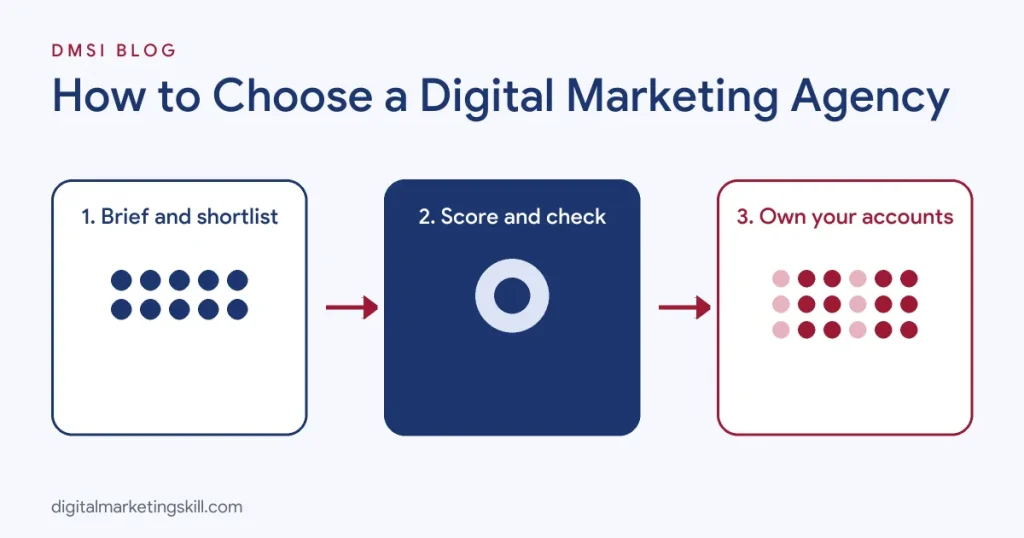
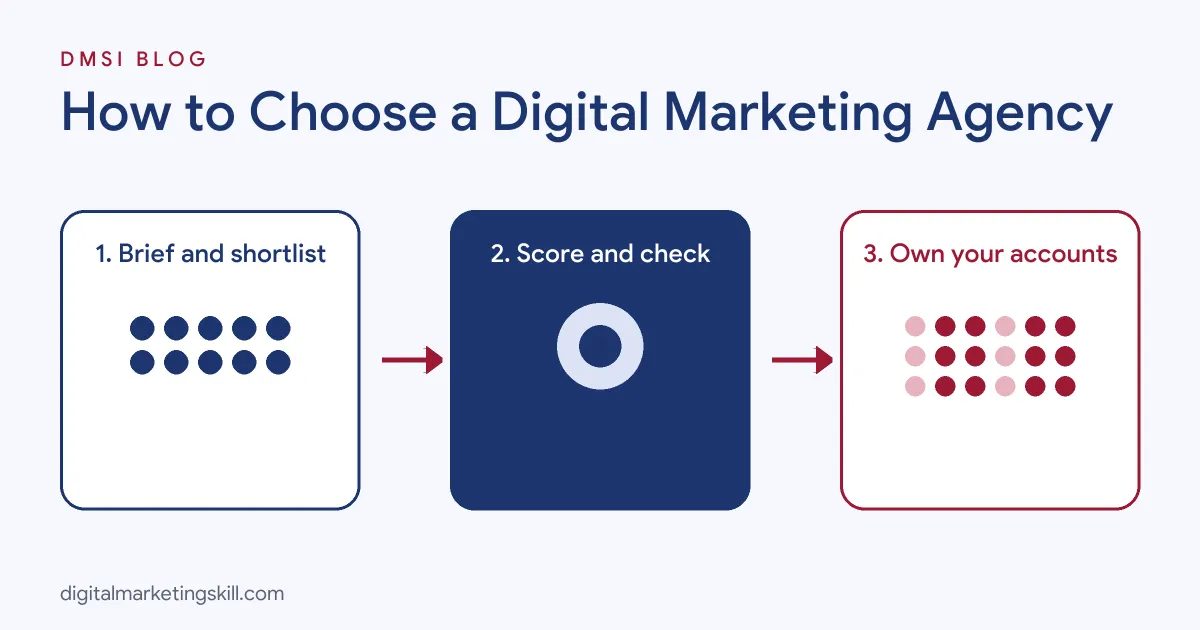
- How to Choose: Step by Step
- Agency Scorecard
- Questions to Ask
- Account Ownership
- What the Contract Should Include
- Red Flags
- How Agencies Charge
- The First 90 Days
- FAQ
What Most Agency Selection Guides Miss
Most advice focuses on how impressive an agency looks: awards, client logos, a polished pitch. Those signals matter less than three practical questions that many businesses only ask after something goes wrong.
- Who owns your accounts and data? If the agency creates your ad accounts, analytics or tracking under its own login, leaving can mean losing years of history.
- Who actually does the work? The senior people in the pitch are often not the people managing your account day to day, and some work may be outsourced.
- How will you know whether it is working? Without agreed business metrics and a baseline, reports can look positive while revenue stays flat.
If you get these three right, most other decisions become easier.
What to Decide Before You Contact Any Agency
Agencies will happily tell you what you need. You will get better proposals, and be able to compare them fairly, if you decide a few things first.
Your business goal
Be specific: more qualified leads, more online sales, lower cost per sale, more local enquiries, launching in a new market or rebuilding a weak brand. A goal such as “grow our online presence” invites vague proposals. A goal such as “increase qualified demo requests from mid-sized companies by a meaningful amount over six months, at a cost per lead we can afford” gives agencies something to plan around.
Your current baseline
Gather what you know: website traffic, conversion rate, leads or sales by channel, current ad spend, cost per lead or sale and customer lifetime value if you have it. If you do not have reliable data, that is useful to know too; fixing tracking may be the first job for any agency.
Your budget
Separate two figures: agency fees and media spend, which is the money paid to platforms such as Google or Meta for advertising. A marketing budget that only covers the agency fee leaves nothing for ads, and an ad budget that is too small for the fee makes the agency’s cost disproportionate. Be honest with agencies about both figures; a good agency will tell you if your budget does not fit the goal.
What you will keep in-house
Decide which tasks your team will handle, such as social media posting, content approvals, sales follow-up or product information, and which you want the agency to own. This prevents overlap and gaps.
Your decision process
Agree who will choose the agency, who will be the day-to-day contact and how quickly you can give feedback and approvals. Slow approvals are one of the most common reasons agency work stalls.
Full-Service vs Specialist Agencies
A digital marketing agency can cover many channels or focus deeply on one. Neither is better in general; the right choice depends on your needs and the strength of your own team.
| Type | Best for | Strengths | Watch out for |
|---|---|---|---|
| Full-service agency | Businesses with little in-house marketing that need a joined-up strategy across channels | One partner, coordinated campaigns, one set of reporting | Uneven quality across services; some services may be outsourced |
| Specialist agency | Businesses with an in-house team or a clear need in one channel, such as SEO or paid social | Deep expertise, often faster improvement in that channel | You coordinate between several partners; risk of channels working in silos |
| Industry-specialist agency | Regulated or complex sectors, such as finance, health or B2B software | Understands your customers, regulations and buying cycle | May work with competitors; ask how they handle conflicts |
| Freelancer or small team | Small budgets or well-defined tasks | Lower cost, direct access to the person doing the work | Limited capacity and cover for holidays or illness |
A common approach is to start with a specialist for the channel that matters most and expand only once results are proven. Businesses with large budgets sometimes use several specialists and keep strategy in-house.
How to Choose a Digital Marketing Agency: Step by Step
Step 1: Write a short brief
One or two pages is enough: who you are, what you sell, who your customers are, your goal, your baseline numbers, your budget for fees and media, the channels you think matter, what you will handle in-house, your timeline and how you will decide. Send the same brief to every agency so their answers are comparable.
Step 2: Build a longlist
Ask for recommendations from businesses similar to yours, look at who runs campaigns you admire, check agency directories and platform partner directories, and search for agencies that publish useful content in your industry. Note whether each agency has worked with businesses of your size and type.
Step 3: Shortlist three to five agencies
Screen the longlist quickly: relevant experience, services that match your needs, a size that suits your budget and a website and content that show real expertise. An agency whose own marketing is weak is unlikely to transform yours. Three to five agencies is usually enough to compare options without spending weeks on calls.
Step 4: Hold discovery calls
A good agency spends the first call asking about your business rather than talking about itself. DigiSphere Marketing lists an agency doing all the talking on the sales call as a red flag. Pay attention to whether they ask about your margins, customers, sales process and past results, and whether they challenge assumptions sensibly.
Step 5: Ask for proposals
Ask each shortlisted agency for a proposal that covers their understanding of your goal, the strategy and channels they recommend and why, what they will deliver each month, who will work on the account, how they will measure success, their fees and the contract terms. AdRoll notes that a proposed strategy should cover several aspects of marketing, including research, strategy, execution and analytics.
Step 6: Check evidence and references
Ask for case studies that show business outcomes, such as leads, sales or cost per acquisition, not just clicks and impressions. Then speak to at least two current or recent clients, ideally similar to you. Ask what went well, what went wrong and how the agency handled problems.
Step 7: Score and compare
Use the scorecard below to compare agencies on the same criteria. Scoring reduces the influence of the most charismatic pitch and makes it easier to explain your choice to colleagues.
Step 8: Negotiate terms and start with a defined period
Before signing, agree scope, deliverables, reporting, ownership of accounts and assets, notice period and what happens when the relationship ends. Where possible, start with an initial period or a defined project before committing to a long contract.
A Simple Agency Scorecard
Hustle Marketers recommends scoring agencies to compare them fairly. Here is a simple version you can adapt. Score each criterion from 1 to 5 and multiply by the weight.
| Criterion | What good looks like | Weight |
|---|---|---|
| Relevant results | Case studies with business outcomes for similar businesses | 5 |
| Strategic thinking | Asked good questions; proposal is specific to your business | 5 |
| Team | You have met the people who will do the work; clear roles | 4 |
| Account and data ownership | Your business owns all accounts and assets, in writing | 5 |
| Measurement and reporting | Agreed KPIs linked to business goals; clear reporting rhythm | 4 |
| Transparency of pricing | Fees, media spend and any extra costs clearly separated | 4 |
| Contract terms | Reasonable notice period, clear scope, fair exit | 3 |
| Communication and fit | Responsive, honest, works at your pace | 3 |
| References | Clients speak positively and specifically | 3 |
Use the total as a guide, not a final answer. If an agency scores poorly on account ownership or transparency, treat that as a reason to stop regardless of the total.
Questions to Ask a Digital Marketing Agency
These questions reveal how an agency thinks and works. Listen for specific, honest answers rather than polished promises.
About results and approach
- What results have you achieved for businesses like ours, and what were the starting points?
- What would you do in the first 30, 60 and 90 days?
- What do you think we should not do, and why?
- What would make you say our goal is unrealistic for this budget?
- Tell us about a campaign that did not work. What did you learn and change?
About the team
- Who exactly will work on our account, and how much of their time will we get?
- Is any of the work outsourced or white-labelled to other providers?
- How do you handle staff changes on an account?
About measurement
- Which metrics will you report, and how do they connect to revenue or leads?
- How do you set up and check conversion tracking?
- How often will we meet, and what will each report include?
About money and terms
- How are your fees structured, and what is not included?
- Will media spend be paid directly by us to the platforms, or through you? If through you, is there a markup?
- What is the notice period, and what happens to our accounts, data and creative if we leave?
- Do you work with any of our direct competitors?
Account Ownership: The Question That Protects You Most
Hustle Marketers gives a full section to who should own your Google Ads, GA4, Search Console and Business Profile, and for good reason. When a relationship ends badly, account ownership decides whether you keep your history, audiences, tracking and creative or start again from nothing.
The principle is simple: your business should own every account and asset, and the agency should be given access to them. In practice:
- Google Ads: the account should be created under your business, with your billing details. Agencies normally link it to their manager account to work on it. If you leave, the link can be removed and the account, with its history, stays with you.
- Google Analytics and Search Console: your business should hold the top-level administrator role. Give the agency the access level it needs, and remove it when the work ends.
- Google Tag Manager: keep the container in your account and give the agency publishing access only if it needs it; review changes regularly.
- Meta and other social ad platforms: keep your business portfolio, pages, ad accounts and pixels under your own business, and give the agency partner access rather than letting it own the assets.
- Google Business Profile: your business should be the primary owner; agencies can be added as managers.
- Website, domain and hosting: register the domain and hosting in your business name with your own logins.
- Creative and content: the contract should state that you own the ads, images, copy and content you have paid for, including source files, unless agreed otherwise.
If an agency resists this arrangement, ask why. There are occasional technical reasons for agency-owned setups, but they should be explained and documented, with a clear handover plan.
What a Digital Marketing Agency Contract Should Include
A contract protects both sides. Read it carefully, and take legal advice for larger commitments. A fair contract usually covers:
- Scope of work: the channels, deliverables and activity levels included each month, and how changes are agreed and priced.
- Fees and payment terms: how fees are calculated, when they are paid and what counts as an extra cost.
- Media spend: who pays the platforms, and any management fees or markups.
- KPIs and reporting: the agreed metrics, reporting frequency and meeting schedule.
- Ownership: who owns accounts, data, creative and intellectual property.
- Access and confidentiality: how the agency will handle your data, including personal data, and keep information confidential.
- Term and notice: the length of the agreement, notice period and any minimum term.
- Exit and handover: what the agency will hand back and how quickly when the relationship ends.
- Responsibilities: what you must provide, such as approvals, product information and access, and by when.
If the agency will process personal data for you, such as email lists or customer data for advertising audiences, data protection laws in many countries require a written agreement covering how that data is handled.
Red Flags When Hiring a Digital Marketing Agency
DigiSphere Marketing highlights guaranteed rankings, no transparency, extremely low pricing, long-term contracts with no performance accountability and agencies that do all the talking. Here is a fuller list of warning signs:
- Guarantees of rankings, traffic or revenue. Nobody controls search engine algorithms or ad auctions. Google’s own guidance on hiring an SEO warns against anyone who guarantees a ranking.
- Vague answers about what they will actually do. You should know what work happens each month.
- Refusal to give you ownership of accounts. This makes leaving difficult and is a strong warning sign.
- Prices far below the market. Very cheap services often mean automated, low-quality or risky tactics.
- Long lock-in contracts with no performance review. A confident agency can accept a reasonable notice period.
- Reports full of vanity metrics. Impressions and followers alone do not show whether your business is growing.
- No references or only anonymous case studies. Some confidentiality is normal, but there should be some evidence you can verify.
- The same proposal for everyone. If a proposal could apply to any business, the agency has not thought about yours.
- Pressure to sign quickly. Discounts that expire tomorrow are a sales tactic, not a partnership.
How Digital Marketing Agencies Charge
Prices vary widely by country, agency size, channel and scope, so compare structures as well as totals. The common models are:
| Pricing model | How it works | Best for | Watch out for |
|---|---|---|---|
| Monthly retainer | A fixed monthly fee for an agreed scope | Ongoing work such as SEO, paid media management or social media | Unclear scope; check exactly what is included each month |
| Project fee | A fixed price for a defined project | Website builds, audits, campaign launches | Extra charges for changes outside the original brief |
| Percentage of ad spend | A fee based on a percentage of media spend | Paid advertising management at scale | Can reward spending more rather than spending well; often combined with a minimum fee |
| Hourly or day rate | Pay for time used | Consulting, training or small tasks | Costs can be hard to predict |
| Performance-based | Fees partly tied to agreed results, such as leads or sales | Businesses with reliable tracking and clear targets | Disputes over attribution and lead quality; define terms carefully |
When comparing proposals, work out the total cost for a year, including fees, media spend, tools and set-up costs. Then compare that with what the expected results would be worth, using your own figures for customer acquisition cost and customer lifetime value.
What the First 90 Days With a New Agency Should Look Like
The first three months set the tone for the relationship. A typical, healthy start looks like this:
Days 1 to 30: onboarding and audit
The agency gets access to your accounts, reviews past performance, checks tracking, learns your products, customers and sales process and agrees KPIs and reporting with you. Expect questions and requests for information. Fixing broken tracking is often the most valuable early task, because every later decision depends on accurate data.
Days 31 to 60: first changes and tests
The agency implements quick wins, such as fixing wasted ad spend or technical website problems, and starts structured tests. You should see a clear plan of what is being tested and why.
Days 61 to 90: review and adjust
Review results against the baseline and the agreed KPIs. Discuss what is working, what is not and what will change. By now you should understand how the agency thinks, how quickly it responds and whether reports are honest about problems.
How Long Should You Give an Agency Before Judging Results?
It depends on the channel. Paid advertising can show early signals within weeks, though campaigns usually need time to learn and be optimised. SEO and content usually take several months to show meaningful results because search engines need time to crawl, index and rank new or improved content. Email and conversion rate improvements can show results quickly if you have enough traffic and an existing list.
Instead of waiting for a fixed date, agree leading indicators for each stage. For SEO, that might be technical fixes completed, content published and rankings improving for target topics before leads increase. For paid ads, it might be cost per lead trending towards target. If leading indicators are not moving after a reasonable period, and the agency cannot explain why, it is time for a frank conversation.
Agency, In-House Team or Freelancer?
An agency is not always the right answer. AdRoll compares agencies with in-house teams, and the trade-offs are worth understanding before you sign.
- Choose an agency when you need a range of skills quickly, want access to experience across many clients and tools, or cannot justify several full-time hires.
- Build in-house when marketing is central to your business, you need deep product knowledge and fast daily decisions and you can afford to hire and train people.
- Use freelancers for specific tasks, smaller budgets or to fill gaps in an in-house team.
Many businesses combine them: an in-house marketing lead who owns strategy and works with an agency or freelancers for specialist execution. Even if you outsource most of the work, someone inside the business should understand marketing well enough to brief, challenge and evaluate the agency.
Common Mistakes
- Choosing on price alone. The cheapest option often costs more in wasted media spend and lost time.
- Choosing on the pitch alone. A great presentation does not guarantee great execution; check the team and references.
- Not sharing real numbers. Agencies cannot plan well without your margins, conversion rates and sales data.
- Letting the agency own your accounts. This creates dependence and risk if the relationship ends.
- Changing direction every month. Constant changes in priorities make it impossible to learn what works.
- Slow approvals and feedback. Delays on your side reduce the value of what you are paying for.
- Measuring the wrong things. Agree business metrics, not just activity or vanity metrics.
One Rule to Remember
Choose the agency that asks the best questions about your business, shows relevant evidence and lets you own every account and asset: impressive pitches fade, but ownership and honest measurement protect you for the whole relationship.
Example: a small accounting software company wants more demo requests. It writes a two-page brief with its current cost per demo and a monthly budget, and sends it to four agencies. One agency promises to triple demos in a month; another asks detailed questions about sales cycle length, lead quality and existing tracking, and proposes fixing conversion tracking before increasing spend. Scoring both on the same criteria, the company chooses the second agency, keeps its Google Ads and analytics accounts in its own name and agrees a three-month initial period with monthly reviews. This example is illustrative and not a real business.
Why This Matters for Your Career
Knowing how to brief, choose and manage agencies is a valuable marketing skill in its own right. Marketing managers and in-house specialists are often responsible for agency relationships, and freelancers and agency staff who understand what clients look for can win and keep more work. If you are in your country, building practical skills in strategy, paid media, SEO and analytics helps you both evaluate agencies and work for them, whether you join an in-house team, an agency or work remotely with clients abroad. If you are thinking of starting your own agency, our guide to building a digital marketing agency covers the other side of the table.
Frequently Asked Questions
How many agencies should I talk to before choosing one?
Three to five shortlisted agencies is usually enough to compare approaches, prices and teams without the process taking months.
How do I know if a digital marketing agency is legitimate?
Check for verifiable case studies, client references you can speak to, a clear business address and company details, reviews on independent platforms and an honest, specific proposal. Be wary of guarantees and pressure to sign quickly.
How much does a digital marketing agency cost?
Costs vary widely by country, agency size, channels and scope. Agencies typically charge monthly retainers, project fees, a percentage of ad spend, hourly rates or performance-based fees. Compare the total yearly cost, including media spend, against the value of expected results.
Can a digital marketing agency guarantee results?
No agency can guarantee rankings or revenue, because they do not control search algorithms, ad auctions or your market. They can commit to work, processes, transparency and agreed targets.
Should I choose a local or remote agency?
Local agencies can help if local knowledge or in-person meetings matter to you. Many businesses work successfully with remote agencies. Focus on relevant experience, communication and fit rather than location alone.
What contract length is normal for a marketing agency?
Terms vary. Many agencies offer monthly rolling contracts with a notice period, while others ask for minimum terms, especially for SEO. Avoid long lock-ins without review points and clear exit terms.
Should I pay ad spend through the agency?
Paying platforms directly from your own accounts is usually simpler and more transparent. If ad spend goes through the agency, ask whether there is a markup and get itemised invoices.
Do I lose my Google Ads history if I change agencies?
Not if the account belongs to your business. If the agency created the account under its own ownership, you may lose access to the account and its history, so settle ownership before you start.
How do I know if my current agency is underperforming?
Compare results with the agreed KPIs and your baseline, check whether the agency explains changes clearly and proactively, and look at whether leading indicators are improving. Ask for a frank review before deciding to switch.
Is a full-service agency better than a specialist?
Neither is better in general. Full-service agencies suit businesses that need coordinated strategy across channels; specialists suit businesses with in-house teams or a clear need in one channel.
What should I include in an agency brief?
Include your business overview, customers, goal, current performance data, budget for fees and media, channels of interest, what you will handle in-house, timeline and how you will decide.
Your Next Step
Build the skills to brief, choose and manage marketing agencies, or to work for one. The Master Diploma in Digital & AI Marketing at Digital Marketing Skill Institute covers AI-powered Social Media Management and Advertising, Lead Generation and Email Automation, Google, and a WordPress and SEO track where you build and rank a real website.
From day one, you work on a real U.S. company’s project through the U.S. Project Internship, so you finish with real results and a verified U.S. work reference letter. You also get unlimited one-on-one coaching. The program carries dual US and UK accreditation, is recognised in more than 100 countries, and runs 100% online over three months.
You can build those skills wherever you live, anywhere in your country. Read student reviews, then apply for the 65% partial scholarship to see if you qualify.
Sources checked November 2026: DigiSphere Marketing: How to choose a digital marketing agency, Hustle Marketers: Agency scorecard, questions and red flags, AdRoll: How to choose a digital marketing agency, Google Search Central: Do you need an SEO?. We have no connection with these companies.