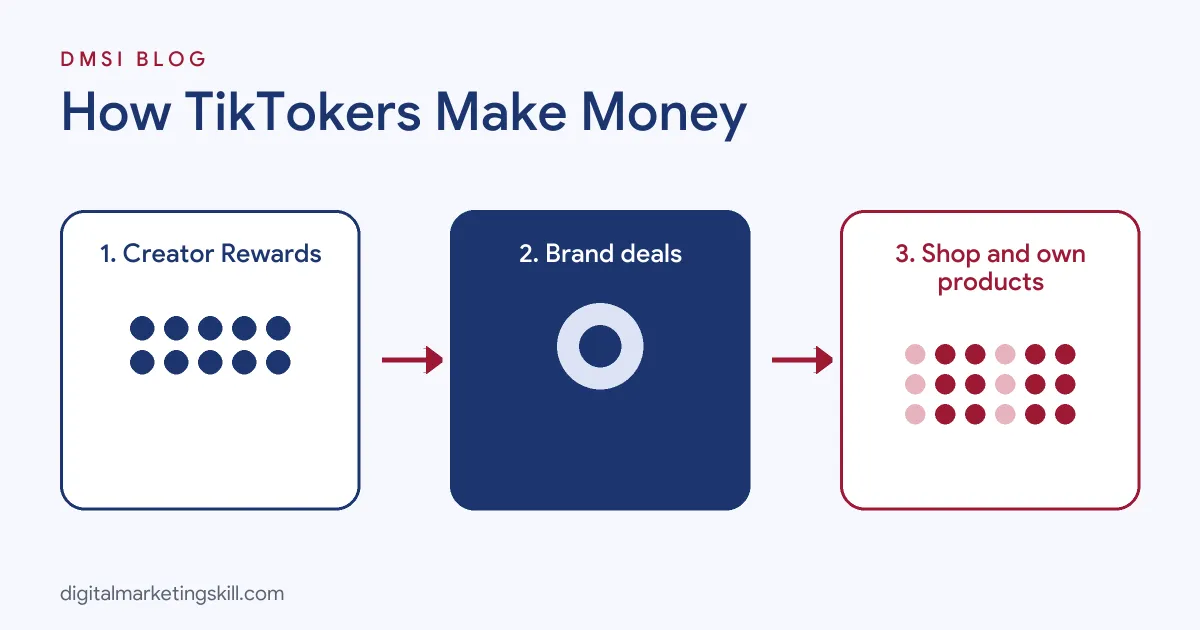
How much TikTokers make varies enormously: most creators earn little or nothing directly from TikTok, while a small number earn substantial incomes, mostly from brand partnerships, TikTok Shop commissions, LIVE gifts and their own products rather than from views alone. TikTok’s own Creator Rewards Program pays eligible creators for qualified views on original videos of at least one minute, but rates are not fixed and depend on factors such as audience location, engagement and content. This guide explains every way TikTokers earn money, what TikTok officially requires to join its programmes, what affects earnings, realistic expectations for different account sizes and how marketers and businesses can use the same skills, without hype or promises.
Key Takeaways
- TikTok’s Creator Rewards Program requires creators to be at least 18, have at least 10,000 authentic followers and at least 100,000 authentic video views in the last 30 days, according to TikTok’s programme terms.
- TikTok says videos must be high-quality, original and at least one minute long to earn through the Creator Rewards Program, which replaced the earlier Creator Fund.
- Creator Rewards is available only in selected countries; TikTok’s Creator Academy lists markets including the US, UK, Germany, Japan, South Korea, France, Mexico and Brazil.
- Third-party estimates of Creator Rewards pay per 1,000 qualified views vary widely, and TikTok does not publish a fixed rate.
- For many successful creators, brand deals, TikTok Shop affiliate commissions, LIVE gifts and their own products matter more than view-based payouts.
- The Short Answer
- Creator Rewards Program
- All the Ways TikTokers Earn
- What Affects Earnings
- Expectations by Account Size
- TikTok vs YouTube and Instagram
- Lessons for Marketers
- FAQ
What Most “How Much Do TikTokers Make” Articles Miss
Many articles lead with eye-catching figures for the biggest stars. Those numbers describe a tiny fraction of creators and say little about what a typical account earns. They also mix up different income sources, such as views, sponsorships and merchandise, which behave very differently.
- Views alone rarely pay the bills. View-based payouts are only one income stream, and they require meeting strict eligibility rules in specific countries.
- Audience matters more than size. A smaller account with a clear niche and engaged, buying audience can earn more from brand deals than a larger general entertainment account.
- Income is unpredictable. Algorithm changes, policy updates and trends can change earnings quickly, so most creators treat TikTok as one part of a wider business.
If you want to build a TikTok presence, see our guides to becoming a TikTok content creator and building a TikTok marketing strategy.
The Short Answer: How Much Do TikTokers Make?
There is no single answer, because TikTokers earn in several ways and results vary dramatically. A useful way to think about it:
- Most accounts earn nothing directly from TikTok, either because they do not meet eligibility requirements, are not in an eligible country or post for fun.
- Eligible creators in the Creator Rewards Program earn based on qualified views of their longer videos, with amounts that vary by audience, engagement and content.
- Creators with an engaged niche audience often earn more from brand partnerships, affiliate commissions and selling their own products or services.
- A very small number of top creators build substantial businesses across TikTok and other platforms.
Anyone promising guaranteed TikTok income should be treated with caution.
The TikTok Creator Rewards Program
What it is
The Creator Rewards Program is TikTok’s main way of paying creators for their content. TikTok’s support pages explain that the earlier Creator Fund is no longer available and has been replaced by the Creator Rewards Program, which pays for high-quality, original videos that are at least one minute long.
Eligibility requirements
According to TikTok’s programme terms and Creator Academy, creators must:
- be at least 18 years old, or the age of majority where they live;
- live in a country where the programme is available;
- have at least 10,000 authentic followers;
- have at least 100,000 authentic video views in the last 30 days;
- have a personal account in good standing, not a business account or a political or government account;
- follow TikTok’s Community Guidelines and Terms of Service.
Some markets have different thresholds. For example, TikTok’s terms for Japan and South Korea list a higher follower requirement. Requirements can change, so always check TikTok’s current terms for your country.
Which countries are eligible
TikTok’s Creator Academy lists the United States, United Kingdom, Germany, Japan, South Korea, France, Mexico and Brazil among the countries where the programme is available. Creators outside eligible countries cannot join, and TikTok’s terms specifically prohibit using a VPN to appear to be in an eligible market.
How much it pays
TikTok does not publish a fixed rate. Payments are based on qualified views, which exclude certain views such as those from videos under one minute, and are influenced by factors such as engagement, search value and audience location. Third-party estimates vary widely: for example, ThePower Education estimates roughly $0.40 to over $1.00 per 1,000 qualified views for Creator Rewards, while older estimates for the former Creator Fund, such as those cited by HighSocial, were far lower at a few cents per 1,000 views. Treat all such figures as rough estimates rather than promises.
All the Ways TikTokers Make Money
ThePower Education describes several revenue streams beyond view payouts, and HighSocial lists LIVE gifts, sponsored content, affiliate marketing and selling your own products alongside TikTok’s own programmes. Here is how each works.
1. Brand partnerships and sponsored content
For many creators, sponsored content is the largest income source. Brands pay creators to feature products or services in videos, usually with clear disclosure. Rates are negotiated and vary with audience size, engagement, niche, content format, usage rights and exclusivity. Creators in niches with high-value audiences, such as finance, technology, B2B software or beauty, can often command higher fees than general entertainment accounts of the same size. TikTok’s creator marketplace tools help brands and creators find each other, and many creators also work with agencies or approach brands directly.
2. TikTok Shop and affiliate commissions
TikTok Shop lets creators earn commission by promoting products in videos and LIVE streams, where viewers can buy without leaving the app. Commission rates are set by sellers and vary by product. Shop is available in selected markets. For creators whose audiences like product recommendations, affiliate income can be significant, but it depends on trust: audiences quickly lose interest in accounts that promote everything. Read more about TikTok Shop and social commerce.
3. LIVE gifts
During LIVE streams, viewers can send virtual gifts bought with TikTok Coins. Creators receive Diamonds, which can be converted into money after TikTok’s share and any fees. LIVE income depends on having an engaged community that enjoys watching and interacting in real time. TikTok has age and follower requirements for going LIVE and receiving gifts.
4. Subscriptions
Eligible creators can offer monthly subscriptions that give fans perks such as badges, subscriber-only content or chats. This provides more predictable income from a loyal community.
5. Selling your own products or services
Many creators use TikTok to grow a business: physical products, digital products such as courses, templates or e-books, coaching, consulting or freelance services. TikTok drives awareness and traffic, while the creator keeps more of the revenue. For marketers and freelancers, this is often the most valuable use of TikTok: as a marketing channel for their own services.
6. Off-platform income
Successful TikTokers often expand to YouTube, Instagram, newsletters, podcasts, speaking and licensing their content. Diversifying protects income if TikTok’s algorithm, policies or availability change.
| Income stream | Who it suits | Requirements | Predictability |
|---|---|---|---|
| Creator Rewards Program | Creators making longer original videos | Eligibility thresholds, eligible country, 1-minute+ videos | Variable |
| Brand partnerships | Creators with a clear niche and engaged audience | Professional approach, disclosure | Varies by deal |
| TikTok Shop affiliate | Product-focused creators | Shop availability and eligibility | Variable |
| LIVE gifts | Creators who enjoy live interaction | LIVE eligibility | Variable |
| Subscriptions | Creators with loyal fans | Eligibility requirements | More predictable |
| Own products or services | Experts, freelancers, businesses | A product or service to sell | Depends on the business |
What Affects How Much TikTokers Make
Audience location
ThePower Education highlights that the same video can earn different amounts depending on where viewers are. Advertisers pay more to reach audiences in some countries, which affects both view-based payouts and brand deal rates.
Niche and audience value
Brands pay more to reach audiences that are likely to buy their products. A niche such as personal finance, software or business can be more valuable to advertisers than broad entertainment, even with fewer followers.
Engagement and watch time
Views that come with long watch time, comments, shares and saves signal genuine interest. Engagement influences how widely TikTok distributes videos and how attractive a creator is to brands.
Content format and length
Creator Rewards pays only for eligible videos of one minute or longer, so creators who mainly post very short clips may earn little from the programme even with many views.
Consistency and professionalism
Brands prefer creators who post reliably, communicate well, meet deadlines, disclose partnerships properly and provide performance data. Treating the account like a business, a point ThePower Education makes when it suggests managing your account like a profit and loss statement, improves earnings over time.
Diversification
Creators who combine several income streams are less exposed to changes in any one programme or platform.
Realistic Expectations by Account Size
These stages describe typical opportunities rather than income figures, because earnings vary too much to predict reliably.
Starting out: under 10,000 followers
Creators at this stage are not usually eligible for Creator Rewards. Income, if any, tends to come from small brand collaborations, affiliate links where available or using TikTok to promote their own products or services. The focus should be on finding a niche, improving content and building an engaged audience.
Growing: 10,000 to 100,000 followers
Creators who meet the view requirement in an eligible country can join Creator Rewards. Brands increasingly approach niche creators at this stage, and some creators begin earning steady side income from partnerships and affiliate commissions. Many small brands actively prefer working with smaller creators because their audiences are often highly engaged.
Established: 100,000 followers and above
Larger creators often have several income streams and may work with managers or agencies. Brand partnerships, longer-term ambassador deals, product launches and off-platform businesses become more common. Even at this level, income can fluctuate significantly from month to month.
Follower count alone does not determine income. Engagement, niche, audience location and business skills often matter more.
TikTok vs YouTube and Instagram for Creator Income
ThePower Education compares TikTok with YouTube Shorts and Instagram Reels. In general terms:
- YouTube has long offered revenue sharing on long-form videos through its Partner Programme, and long videos can keep earning views for years. Many creators see YouTube as more reliable for ad-based income.
- Instagram offers various creator monetisation features that change over time, with brand partnerships the most common income source.
- TikTok is strong for discovery and fast audience growth, with income opportunities through Creator Rewards, TikTok Shop, LIVE and partnerships.
Many creators use TikTok to grow an audience quickly, then build income across several platforms and owned channels such as email lists.
How to Increase Your Earning Potential on TikTok
- Pick a clear niche that you can create content about consistently and that brands want to reach.
- Make longer, valuable videos where it suits your content, since Creator Rewards pays for videos of one minute or more.
- Focus on watch time and engagement, with strong hooks, clear structure and content worth saving and sharing.
- Use TikTok search, by answering questions your audience searches for. Our guide to TikTok SEO explains how.
- Build a media kit with your audience demographics, engagement and examples of past work for brand outreach.
- Diversify income across partnerships, affiliate commissions, your own products and other platforms.
- Capture your audience on owned channels, such as an email list, so you are not dependent on one app.
- Follow the rules: disclose paid partnerships, follow TikTok’s Community Guidelines and keep records for tax.
What This Means for Marketers and Businesses
For marketers, understanding creator economics matters in two ways. First, if you work with TikTok creators on behalf of a brand, knowing how creators earn helps you design fair partnerships, set realistic budgets and choose creators based on audience fit and engagement rather than follower numbers alone. Second, the same skills that help creators earn, such as short-form video, storytelling, community building, analytics and social commerce, are valuable marketing skills in their own right. Many marketers and freelancers use TikTok not to earn from views but to attract clients, customers and job opportunities. See our guide to the creator economy for the wider picture.
How Brand Deal Pricing Usually Works
Because brand partnerships are often the biggest income source, it helps to understand how they are priced. There is no official rate card, but creators and brands usually consider the same factors. Audience size and engagement matter, but so do audience demographics and location, the niche, how much work the content involves, whether the brand wants to reuse the video in its own ads, how long it can use it, whether the creator must avoid working with competitors and whether the deal includes several videos, LIVE sessions or other platforms. Many creators also offer packages, such as a video plus Stories on another platform plus a link in bio for a set period.
Some partnerships are paid as a flat fee, others combine a smaller fee with affiliate commission on sales, and some smaller creators begin with product-only collaborations. Whatever the structure, agree deliverables, deadlines, approval rights, usage rights, payment terms and disclosure requirements in writing before starting. Brands increasingly ask for performance data, so tracking views, watch time, engagement and clicks for past sponsored posts makes negotiations easier.
Taxes, Payments and Paperwork
Creator income is usually treated as self-employment or business income, and the rules depend on where you live. Keep records of all payments from TikTok, brands and affiliate programmes, along with business expenses such as equipment and software. Some countries require registration for income tax or sales taxes once income passes certain thresholds. TikTok and brand payments may arrive through different payment providers and currencies, so track exchange rates and fees. Speak to a qualified accountant in your country if you start earning regularly, because getting this right early saves problems later.
Common Mistakes
- Expecting views alone to pay. View-based payouts are only one, often small, part of creator income.
- Buying followers or views. TikTok’s programmes require authentic followers and views, and fake engagement can get accounts penalised.
- Using a VPN to access programmes. TikTok’s terms prohibit this.
- Chasing every brand deal. Promoting irrelevant products erodes audience trust.
- Not disclosing partnerships. Advertising rules in many countries require clear disclosure.
- Relying on one platform. Policy or algorithm changes can affect income suddenly.
- Ignoring taxes. Creator income is usually taxable and needs good record-keeping.
One Rule to Remember
Treat TikTok as a channel for building an engaged audience and a business, not a pay-per-view job: diversify income, follow the rules and never rely on views alone.
Example: a personal finance creator with a modest following in an eligible country focuses on longer explainer videos that answer common money questions. She qualifies for Creator Rewards, but most of her income comes from a few carefully chosen brand partnerships with budgeting apps, affiliate links and a paid spreadsheet template she sells through her website. She builds an email list from her TikTok audience so she can reach followers directly if her reach on the app changes. This example is illustrative and not a real person.
Why Creator Skills Matter for Your Career
Short-form video, content strategy, community management, analytics and social commerce skills are in demand from brands, agencies and creators themselves. Whether you want to grow your own audience, manage creators for a brand or run TikTok campaigns for clients, understanding how TikTok creators earn helps you work more effectively. If you are in your country, where creator programmes may not yet be available, these skills can still help you win brand work, freelance clients and marketing roles. Our guide on how to go viral on TikTok covers content techniques in more depth.
Frequently Asked Questions
How much does TikTok pay per 1,000 views?
TikTok does not publish a fixed rate. Payments through the Creator Rewards Program depend on qualified views, engagement, audience location and other factors, and third-party estimates vary widely.
How many followers do you need to get paid on TikTok?
For the Creator Rewards Program, TikTok generally requires at least 10,000 authentic followers and 100,000 authentic views in the last 30 days, plus other conditions. Some markets have higher thresholds.
Does TikTok pay creators in every country?
No. Creator Rewards is available only in selected countries, such as the US, UK, Germany, Japan, South Korea, France, Mexico and Brazil, according to TikTok’s Creator Academy. Check TikTok’s current list.
How much can I earn if my video gets 1 million views?
It depends on whether you are in Creator Rewards, whether the views are qualified, your audience location and engagement. Many creators earn more from brand deals linked to viral content than from the views themselves.
Do videos need to be a certain length to earn?
Yes. TikTok says Creator Rewards pays for original videos that are at least one minute long.
What is the best way to make money on TikTok?
For many creators, brand partnerships and selling their own products or services earn more than view payouts. TikTok Shop affiliate commissions and LIVE gifts can also contribute.
Is TikTok or YouTube better for earning money?
Each has strengths. YouTube is often seen as more reliable for ad revenue on long videos, while TikTok is strong for discovery and fast growth. Many creators use both.
Can small creators make money on TikTok?
Yes, often through small brand collaborations, affiliate links and promoting their own services, even before meeting Creator Rewards thresholds.
What happened to the TikTok Creator Fund?
TikTok replaced the Creator Fund with the Creator Rewards Program, which focuses on original videos of at least one minute.
Do TikTok creators pay tax?
Creator income is generally taxable. Rules vary by country, so keep records and speak to a qualified accountant.
Your Next Step
Learn short-form video, social media and content skills employers and brands value. The Master Diploma in Digital & AI Marketing at Digital Marketing Skill Institute covers AI-powered Social Media Management and Advertising, Lead Generation and Email Automation, Google, and a WordPress and SEO track where you build and rank a real website.
From day one, you work on a real U.S. company’s project through the U.S. Project Internship, so you finish with real results and a verified U.S. work reference letter. You also get unlimited one-on-one coaching. The program carries dual US and UK accreditation, is recognised in more than 100 countries, and runs 100% online over three months.
You can build those skills wherever you live, anywhere in your country. Read student reviews, then apply for the 65% partial scholarship to see if you qualify.
Sources checked November 2026: TikTok Creator Academy: Creator Rewards Program, TikTok: Creator Rewards Program terms, TikTok Support: Creator Fund update, ThePower Education: How much does TikTok pay, HighSocial: How much does TikTok pay per view. We have no connection with TikTok or these companies.