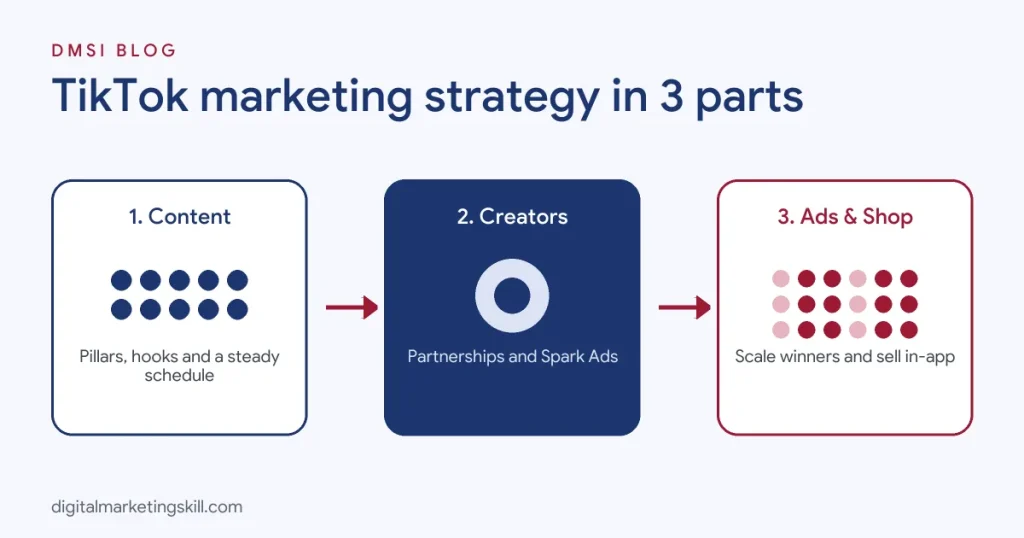
A TikTok marketing strategy is a plan for using TikTok to reach a defined audience and move them towards a business goal, such as awareness, leads or sales. It combines four things: short, native videos posted consistently, a clear content focus that TikTok’s algorithm can match to the right viewers, partnerships with creators, and paid ads that amplify what already works. TikTok shows each video to people based on how earlier viewers react, not on follower count, so a brand with zero followers can reach thousands of people with one strong post. The brands that win treat TikTok as an entertainment and search platform first and an advertising channel second.
This guide walks you through building a TikTok marketing strategy step by step: setting goals, finding your content pillars, writing hooks, working with creators, running ads, using TikTok Shop and measuring results. If you are new to creating on the platform, our guide on becoming a content creator on TikTok covers the creator side.
Key Takeaways
- Pew Research Center found that 37% of U.S. adults use TikTok, up from 21% in 2021.
- Pew also reports that about one in five U.S. adults now regularly get news on TikTok, up from 3% in 2020.
- TikTok says the platform reaches more than one billion people every month worldwide.
- TikTok Ads Manager requires a minimum budget of $50 a day per campaign and $20 a day per ad group.
- Industry benchmark studies put typical TikTok ad CPMs at roughly $4 to $12 per thousand impressions, depending on format and audience.
In this guide
- What Most TikTok Strategy Guides Miss
- What Is TikTok Marketing?
- Why TikTok Marketing Matters
- How the TikTok Algorithm Decides Who Sees Your Videos
- How to Set Up TikTok for Business
- How to Build a TikTok Marketing Strategy in 9 Steps
- TikTok Content Ideas That Work for Brands
- Working With TikTok Creators
- TikTok Ads: Formats, Costs and When to Use Them
- TikTok Shop and Social Commerce
- TikTok Marketing Tools
- Common TikTok Marketing Mistakes
- How to Measure Your TikTok Strategy
- The One Rule for TikTok Marketing
- An Illustrative Case
- Frequently Asked Questions About TikTok Marketing Strategy
- Your Next Step
What Most TikTok Strategy Guides Miss
Most TikTok guides give you a list of tactics: use trends, post often, add hashtags, work with influencers. Those tactics are not wrong, but they skip the reason most brand accounts stall after a few weeks. Three things matter far more than any single tactic.
- A narrow, repeatable topic. TikTok learns what your account is about from the videos you post and the people who watch them. If you post a dance trend on Monday, a product shot on Tuesday and an office tour on Wednesday, the algorithm cannot work out who to show you to. Accounts that grow fast usually own one clear topic.
- The first three seconds. On TikTok, people decide almost instantly whether to keep watching. A video with a weak opening loses viewers before your message even starts, and low watch time tells TikTok not to show it to more people.
- A path from views to business results. Views feel good but pay nothing. A real strategy connects content to a next step: a profile link, a lead form, a TikTok Shop product or a retargeting audience for ads.
The rest of this guide is built around those three ideas. Get them right, and the tactics start to work. Get them wrong, and no amount of trending audio will help.
What Is TikTok Marketing?
TikTok marketing is the use of TikTok to promote a brand, product or service. It covers organic content posted from a business account, paid advertising through TikTok Ads Manager, partnerships with creators and, in supported countries, selling directly through TikTok Shop.
What makes TikTok different from older social networks is the For You feed. Instead of mainly showing posts from accounts you follow, TikTok fills the feed with videos it predicts you will enjoy. That means distribution is earned video by video. A new account can reach a large audience, and a large account can still post a video that flops.
For marketers, this changes the job. You are not just building a follower count. You are producing a steady stream of short-form videos that each have a fair chance of reaching new people, and then turning that attention into results.
Organic vs Paid TikTok Marketing
Organic TikTok marketing means posting your own videos, replying to comments and joining conversations without paying for reach. It costs time rather than money and builds trust over months. Paid TikTok marketing means running TikTok ads to reach a chosen audience straight away. Most strong strategies use both: organic content to learn what people respond to, and ads to put the winners in front of more of the right people.
Why TikTok Marketing Matters
TikTok has grown from a lip-sync app into one of the main places people spend time online, discover products and even look for information.
- Reach. TikTok says more than one billion people use it each month. In the U.S., Pew Research Center found that 37% of adults use TikTok, up from 21% in 2021, making it one of the few major platforms with sustained growth.
- Attention. The For You feed keeps people watching video after video. That gives brands repeated chances to be seen in a relaxed, entertainment mindset.
- Search and discovery. Many people now type questions into TikTok’s search bar, from recipes to product reviews. Pew reports that about one in five U.S. adults regularly get news on TikTok, up sharply from 2020, which shows how far its role has widened beyond entertainment.
- Product discovery. “TikTok made me buy it” became a common phrase because products shown in genuine, everyday videos often sell out. TikTok Shop now lets people buy without leaving the app in markets where it operates.
- Fair competition. Because distribution depends on each video’s performance, a small business with good ideas can compete with big brands on the same feed.
TikTok is not right for every business. If your buyers are senior procurement teams who never use the app, other channels may serve you better. But for consumer brands, creators, coaches, local businesses, ecommerce stores and anyone selling to people under 45, it is hard to ignore.
How the TikTok Algorithm Decides Who Sees Your Videos
TikTok explains that its recommendation system ranks videos based on a mix of signals. These include how users interact with content (likes, shares, comments, watch time and whether they finish a video), information about the video itself (captions, sounds and hashtags) and device and account settings such as language and country.
In practice, every new video is shown to a small group of viewers first. If they watch it through, rewatch it, share it or comment, TikTok shows it to a larger group. If people swipe away quickly, distribution slows. This is why one video can get 300 views and the next 300,000 from the same account.
Three practical lessons follow:
- Watch time is king. A video people watch to the end, or watch twice, beats one with more likes but low completion. Keep videos as short as the idea allows.
- Clarity helps matching. Captions, on-screen text, spoken words and a few relevant hashtags help TikTok understand your topic and serve it to interested viewers.
- Consistency trains the system. When you post regularly about the same subject, TikTok learns which audience responds and finds more people like them.
For more on how platforms rank content, see our glossary entry on the social media algorithm.
How to Set Up TikTok for Business
Before you post, set up the right account and tools. It takes about 20 minutes.
- Create or switch to a Business Account. In the TikTok app, go to Settings and privacy, then Account, and switch to a Business Account. This unlocks analytics, a commercial music library and the option to add a website link.
- Choose a clear username and profile photo. Use your brand name and logo so people recognise you instantly.
- Write a short bio. Say who you help and what you offer in one line, then add your link. A simple link page that points to your best offer works well.
- Set up TikTok Ads Manager. Even if you are not running ads yet, create an account at TikTok for Business so you are ready to boost winning videos.
- Install the TikTok Pixel or Events API. These track what people do on your website after seeing your content or ads, such as sign-ups and purchases. They also let you build retargeting audiences.
- Explore TikTok Shop if you sell products. Where it is available, you can apply for a seller account and link your product catalogue.
How to Build a TikTok Marketing Strategy in 9 Steps
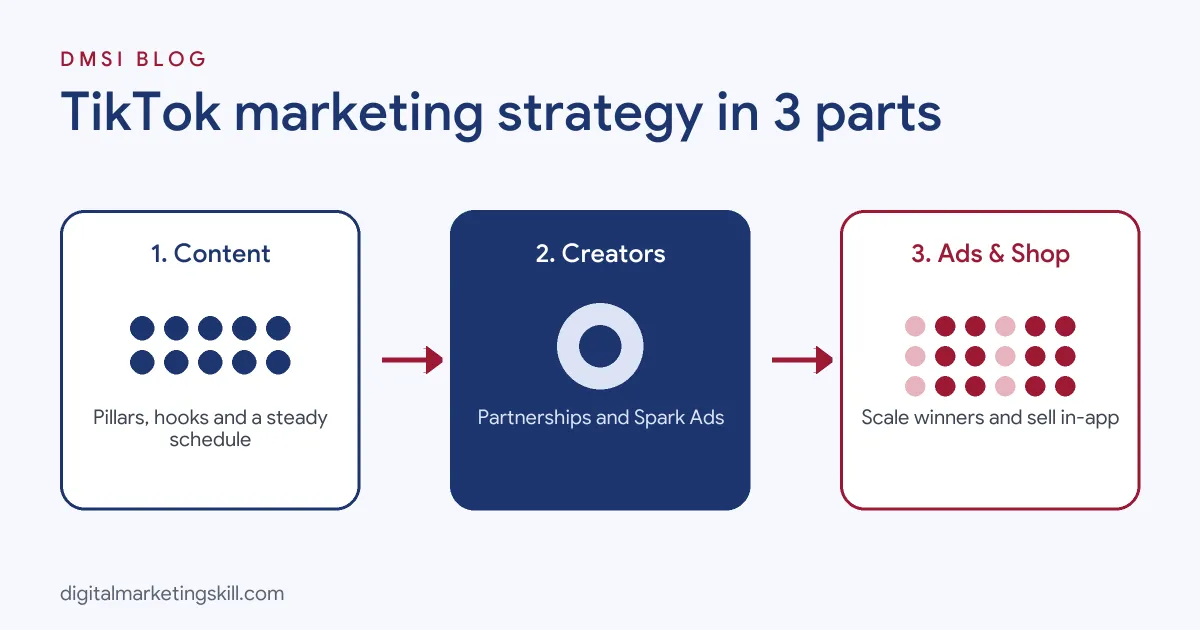
Here is a practical process you can follow whether you manage your own brand or a client’s account.
1. Set One Main Goal
Decide what TikTok should do for the business in the next 90 days. Typical goals are brand awareness, followers in a target niche, website traffic, leads or sales. Pick one main goal and write it as a SMART objective, for example: “Get 200 email sign-ups from TikTok by 31 March through three videos a week.” One clear goal decides what you post and how you measure success.
2. Define Your Audience
Describe the person you want to reach in detail: age range, location, interests, problems and the questions they would type into TikTok search. A simple buyer persona helps. Then spend 30 minutes scrolling TikTok as that person. Search their questions, follow the creators they would follow and note which videos get the most comments. This is the fastest audience research you will ever do.
3. Study Competitors and Creators
Find five brands or creators already reaching your audience. For each, note their best-performing videos, their hooks, video length, posting frequency and how they talk. Look for gaps: questions nobody answers well, formats nobody in your niche uses, or a tone that feels missing. A short competitor analysis saves weeks of guessing.
4. Choose Three to Five Content Pillars
Content pillars are the recurring themes your account covers. They keep you consistent and help TikTok understand your niche. A skincare brand might choose: routines for specific skin types, ingredient myths, behind the scenes of product making and customer before-and-afters. A digital marketing freelancer might choose: quick tool tutorials, client results, career advice and common mistakes.
5. Master the Hook
The first one to three seconds decide whether people stay. Strong hooks often do one of these:
- Name the viewer: “If you run a small bakery, watch this.”
- Promise a result: “How I got my first 100 customers without ads.”
- Start mid-action or show the end result first.
- Challenge a common belief: “Posting every day is killing your reach.”
- Ask a sharp question the viewer wants answered.
Add the hook as on-screen text too, because many people watch with the sound off. Our glossary entry on hook content has more examples.
6. Plan a Realistic Posting Schedule
Consistency beats volume. Start with three to five videos a week that you can keep up for three months, rather than two a day for two weeks. Batch film several videos in one session and schedule them with a content calendar. Check your TikTok analytics to see when your own followers are most active, and test posting times rather than copying generic advice.
7. Use Trends Selectively
Trends, sounds and formats can boost reach, but only when they fit your brand and pillars. Use the Creative Center in TikTok for Business to see trending hashtags, songs and creators by country. Join trends early, add your own angle and skip anything that feels forced. A trend that brings in the wrong audience can hurt your account’s focus.
8. Engage Like a Person, Not a Brand
Reply to comments quickly, especially in the first hour after posting. Use the reply-with-video feature to turn good questions into new content. Duet and stitch videos from creators in your niche. Go live once you have a small audience. This kind of community management builds loyalty and signals to TikTok that people care about your content.
9. Review, Learn and Double Down
Every two weeks, look at your analytics. Which videos had the highest average watch time and completion rate? Which brought profile visits, link clicks or sales? Make more of what works, retire what does not and turn your best organic videos into ads.
TikTok Content Ideas That Work for Brands
You do not need a film crew. Most successful brand content on TikTok looks like it was shot on a phone, because it was. Here are formats that work across many niches.
| Format | What it looks like | Best for |
|---|---|---|
| Tutorials and how-tos | Show how to do one specific thing in under 60 seconds | Software, beauty, cooking, services |
| Behind the scenes | Packing orders, making products, a day in the office | Small businesses, ecommerce |
| Myth-busting | “Three things people get wrong about…” | Experts, coaches, B2B |
| Before and after | Show a transformation, then how it happened | Home, fitness, design, marketing results |
| Customer stories | A real customer explains their result in their own words | Any brand with happy customers |
| Answering comments | Reply to a viewer question with a new video | Building community and trust |
| Product in use | Show the product solving a real problem, not a polished ad | Ecommerce and TikTok Shop |
Encourage customers to post their own videos too. User-generated content feels authentic and often outperforms brand-made videos. For more inspiration, browse our guide to social media content.
How to Use Hashtags on TikTok
Hashtags help TikTok categorise your video but will not make a weak video go viral. Use three to five relevant hashtags: one or two broad ones for your niche and a few specific ones that describe the video. Skip generic tags that say nothing about your content. Clear captions and spoken keywords matter just as much, because TikTok also reads them for search.
Working With TikTok Creators
Creators already have the trust and style your audience responds to. Partnering with them is often the fastest way to reach new people with credibility.
- Find the right fit. Look for creators whose audience matches yours, not just those with the most followers. Micro-influencers with 10,000 to 100,000 engaged followers often deliver better results per pound or dollar spent.
- Use TikTok’s tools. TikTok One, which brought together the former Creator Marketplace and other creative tools, lets brands search for creators, view audience data and manage campaigns.
- Give a brief, not a script. Share your goal, key message and any must-say points, then let the creator make it in their own voice. Over-scripted creator videos look like ads and perform like them.
- Disclose properly. Paid partnerships must be labelled using TikTok’s branded content toggle and the advertising rules in your country.
- Amplify with Spark Ads. With the creator’s permission, you can turn their post into a Spark Ad that keeps their likes and comments while you pay for extra reach.
Our guide to influencer marketing for small businesses explains how to find, brief and pay creators on a budget.
TikTok Ads: Formats, Costs and When to Use Them
Organic content tells you what works. Ads let you scale it. TikTok Ads Manager uses the same structure as most ad platforms: campaign (objective and budget), ad group (audience, placement and bidding) and ad (the video).
| Ad format | What it is | When to use it |
|---|---|---|
| In-Feed Ads | Video ads that appear in the For You feed between organic videos | Most campaigns, from traffic to sales |
| Spark Ads | Boosted organic posts from your account or a creator’s, keeping engagement | Scaling proven organic videos and creator content |
| TopView | A full-screen ad shown when users first open the app | Big launches with large budgets |
| Branded effects | Custom filters and effects people can use in their own videos | Awareness and participation campaigns |
| Shopping ads | Ads linked to products in a catalogue or TikTok Shop | Ecommerce sales |
How Much TikTok Ads Cost
TikTok Ads Manager sets a minimum daily budget of $50 at campaign level and $20 at ad group level. Lifetime budgets follow the same logic, so a 10-day ad group needs at least $200. Above that, you pay through an auction, so costs depend on your audience, objective, creative quality and season.
Benchmark studies from ad agencies and software companies put typical CPMs, the cost per thousand impressions, somewhere around $4 to $12, with premium formats like TopView costing much more. Treat these as rough guides. What matters is your cost per lead or cost per sale compared with what a customer is worth to you. A cheap CPM that brings no buyers is expensive; a higher CPM that brings profitable customers is a bargain.
Tips for TikTok Ads That Perform
- Make ads look like TikToks: vertical, fast, human and sound-on friendly.
- Start with your best organic videos as Spark Ads before making new ads from scratch.
- Test several hooks for the same video. The opening line often changes results more than anything else.
- Use the TikTok Pixel and choose a conversion objective once you have enough data.
- Refresh creative every few weeks. Ad fatigue sets in quickly on a fast-moving feed.
- Retarget people who watched most of your videos or visited your site with a clear offer.
TikTok Shop and Social Commerce
TikTok Shop lets people buy products inside the TikTok app, from shoppable videos, live streams and a shop tab on your profile. It is available in a growing list of markets, including the U.S. and the UK, so check TikTok’s seller pages to see whether your country is supported.
For ecommerce brands, TikTok Shop changes the strategy in three ways. First, every product video can become a direct sales opportunity. Second, the affiliate programme lets creators earn commission by promoting your products, which scales word-of-mouth. Third, live shopping sessions turn product demos into events. If you sell physical products, TikTok Shop is worth testing alongside your website. Our glossary entry on social commerce explains the wider trend.
TikTok Marketing Tools
You can run a strong TikTok strategy with a phone and the free tools inside the app. As you grow, these help:
- TikTok Studio and in-app analytics for views, watch time, traffic sources and follower activity.
- TikTok Creative Center for trending sounds, hashtags, top ads and creative inspiration.
- CapCut for editing, captions and templates designed for TikTok.
- Canva for thumbnails, text overlays and quick graphics.
- A scheduling tool such as Hootsuite, Later or Sprout Social to plan posts alongside other channels.
- TikTok Ads Manager for paid campaigns, audiences and conversion tracking.
For a wider list, see our roundup of social media marketing tools.
Common TikTok Marketing Mistakes
- Reposting TV ads or polished brand videos. They look out of place and people swipe past. Make content for TikTok, not for a boardroom.
- No clear niche. Random topics confuse both viewers and the algorithm.
- Slow openings. Logos, long introductions and “Hi everyone, welcome back” waste the seconds that matter most.
- Chasing every trend. Trends bring views, but not always the right viewers.
- Ignoring comments. Unanswered questions are missed content ideas and missed customers.
- Judging by follower count. On TikTok, reach depends on each video. Track watch time, profile visits and conversions instead.
- Giving up too early. Most accounts need dozens of videos before they find a format that clicks.
- No next step. If viewers cannot easily find your link, offer or shop, attention never turns into business.
How to Measure Your TikTok Strategy
Track a small set of key performance indicators tied to your goal. Check them every two weeks and compare trends, not single videos.
| Goal | Metrics to track |
|---|---|
| Awareness | Video views, reach, average watch time, completion rate |
| Community | Follower growth, comments, shares, engagement rate |
| Traffic | Profile views, link clicks, website sessions from TikTok |
| Leads and sales | Sign-ups, purchases, cost per lead, cost per acquisition, return on ad spend |
Use UTM parameters on your bio link so website analytics can show which sales came from TikTok. Pair in-app numbers with your website data for the full picture. Our glossary entry on social media analytics explains the core measures.
The One Rule for TikTok Marketing
Make videos people would choose to watch even if your brand name were removed. If a video is genuinely useful, funny or interesting, TikTok will find an audience for it. If it only works as an advert, people will treat it like one and swipe away. Earn attention first, then ask for the click.
An Illustrative Case
Consider a small online skincare brand selling to women aged 20 to 35. For months, it posted polished product photos turned into slideshows. Views hovered around 200 per video, and sales from TikTok were close to zero.
The owner rebuilt the strategy around three pillars: routines for specific skin concerns, ingredient myths and packing orders. Every video opened with a direct hook, such as “If your skin gets oily by lunchtime, try this.” She posted four times a week, replied to every comment for the first hour and turned common questions into new videos.
After six weeks, two routine videos passed 50,000 views. She turned them into Spark Ads with a $50 daily budget aimed at women in her shipping countries, linked to a starter bundle. Within the month, TikTok became her second-biggest source of sales after Instagram, at a cost per sale she could afford. Nothing about the product changed. The strategy did.
This example is illustrative, not a real company, but it reflects a pattern many small brands follow when they switch from posting ads to posting TikToks.
Frequently Asked Questions About TikTok Marketing Strategy
What is a TikTok marketing strategy?
It is a plan for using TikTok content, creators and ads to reach a defined audience and achieve a business goal, such as awareness, leads or sales.
How do I start marketing on TikTok?
Switch to a Business Account, define one goal and audience, choose three to five content pillars, then post consistently and review your analytics every two weeks.
What is the TikTok three-second rule?
It is the idea that you have about three seconds to hook a viewer before they swipe. Open with a clear promise, question or striking visual, and add the hook as on-screen text.
How often should a business post on TikTok?
Three to five times a week is a sustainable start for most businesses. Consistency over months matters more than posting several times a day for a short burst.
How much do TikTok ads cost per 1,000 views?
Benchmark studies suggest typical CPMs of roughly $4 to $12, but costs vary by audience, objective and season. TikTok requires at least $50 a day per campaign and $20 a day per ad group.
Do I need a lot of followers to succeed on TikTok?
No. TikTok shows videos based on how viewers react, so a new account with strong content can reach thousands of people. Followers help, but each video earns its own reach.
Is TikTok good for B2B marketing?
It can be. Many professionals use TikTok, and educational, behind-the-scenes and expert content can build awareness and trust. It works best alongside channels like LinkedIn and email.
What type of content performs best on TikTok?
Short, authentic videos with a strong hook usually win: tutorials, behind-the-scenes clips, myth-busting, before-and-afters and customer stories. Content that feels native beats polished ads.
How many hashtags should I use on TikTok?
Three to five relevant hashtags is a good rule. Mix one or two niche tags with specific ones that describe the video, and rely on clear captions and spoken keywords for search too.
Can I market on TikTok from Nigeria or the UK to reach other countries?
Yes. Organic videos can reach viewers in many countries, and TikTok Ads Manager lets you target supported markets. Ad costs depend on the audience’s location, and TikTok Shop is only available in some countries.
Your Next Step
Running TikTok for a brand means combining content planning, video creation, community management, ads and analytics. The Master Diploma in Digital & AI Marketing at Digital Marketing Skill Institute includes an AI-powered Social Media Management and Advertising track where you plan, create and run real social campaigns, alongside tracks in Lead Generation and Email Automation, Google, and WordPress and SEO.
From day one, you work on a real U.S. company’s project through the U.S. Project Internship, so you finish with real results and a verified U.S. work reference letter. You also get unlimited one-on-one coaching. The program carries dual US and UK accreditation, is recognised in more than 100 countries, and runs 100% online over three months.
You can build those skills wherever you live, anywhere in your country. Read student reviews, then apply for the 65% partial scholarship to see if you qualify.
Every figure in this guide was checked against its source before publication: Pew Research Center, TikTok for Business and published TikTok advertising benchmark studies. Ad costs change with country, season and competition, so treat benchmarks as a starting point. The case above is an illustrative example, not a real result.