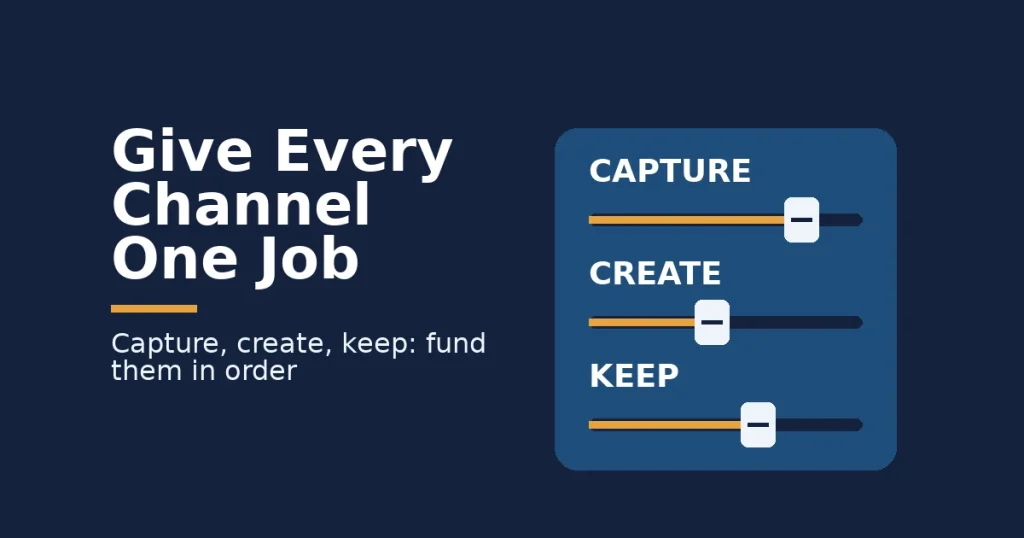
A good marketing channel mix gives each channel one job and funds them in order. Search and paid ads capture buyers who are already looking. Social media and digital PR create future buyers. Email keeps the customers you have. So start with capture, add creation once capture stops getting cheaper, and never starve retention.
Key Takeaways
- Most buyers are not shopping today. Research by LinkedIn’s B2B Institute and the Ehrenberg-Bass Institute estimates that 95% of potential business buyers are out of the market at any given time.
- Capture channels can take credit they did not earn. When eBay stopped brand search ads on two search engines, 99.5% of the lost click traffic still reached eBay through free results.
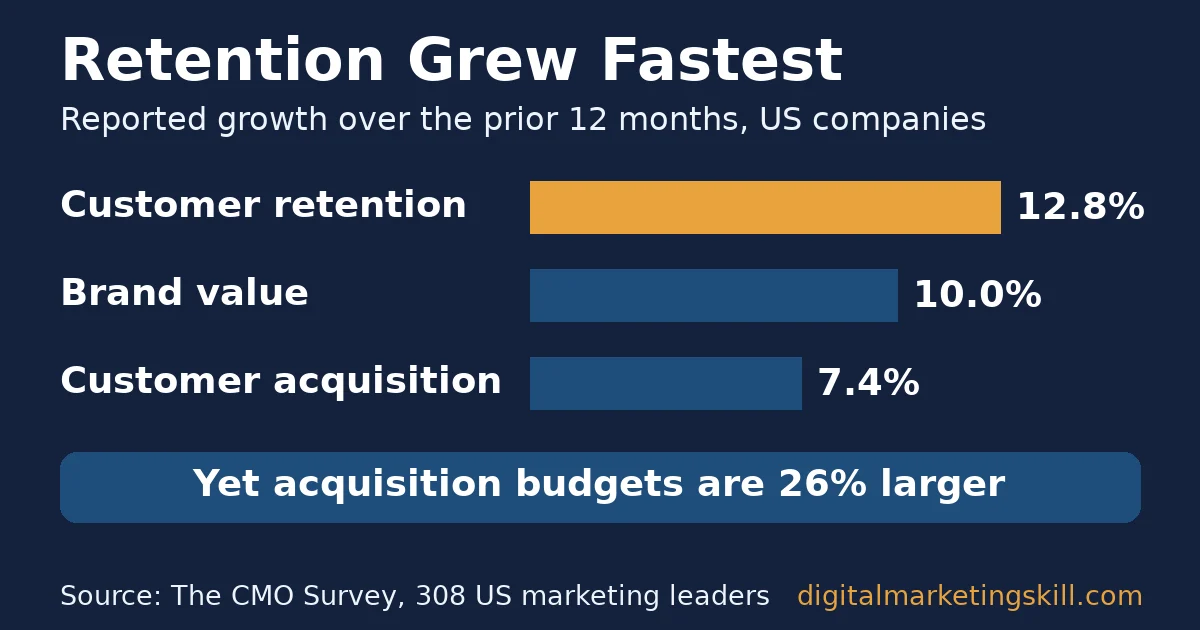
- Retention is underfunded. The CMO Survey of 308 senior US marketers found acquisition budgets are 26% larger than retention budgets, while retention grew faster (12.8% against 7.4%).
- Digital keeps taking share. The same survey found digital marketing spend grew 8.2% in a year, while total marketing spend grew only 1.7%.
- Digital PR works only when it fits. In a Muck Rack survey of 897 journalists, 86% said some stories start from PR pitches, but 88% ignore pitches outside their beat.
In this guide
- What Most Channel Mix Advice Leaves Out
- How a Marketing Channel Mix Works: Capture, Create, Keep
- What Each Channel Does in a Marketing Channel Mix
- How to Build Your Marketing Channel Mix, Channel by Channel
- How to Measure a Marketing Channel Mix
- The One Rule: Add a Channel When the Last One Stops Getting Cheaper
- A Real Case: What eBay Learned When It Switched Off Search Ads
- Frequently Asked Questions About the Marketing Channel Mix
- Start With One Capture Channel, Then Add the Next
What Most Channel Mix Advice Leaves Out
Most guides to the marketing channel mix start with a budget split, such as 70% for proven channels, 20% for growth bets and 10% for experiments. That rule of thumb is easy to copy. However, it skips the question that decides whether the money works: what job is each channel supposed to do for you?
The gap matters because budgets are tight. The CMO Survey from Duke University’s Fuqua School of Business found that marketing budgets have fallen to 9.0% of company revenue. It surveyed 308 senior marketers at US companies, so treat it as a US picture. Still, the lesson travels, because a smaller budget leaves less room for channels that do the wrong job.
This guide fills that gap by treating the marketing channel mix as a set of jobs, not a pie chart. First, it explains how channels split into three jobs. Then it shows what each channel is built for, how to weight it, how to measure it, and one rule for when to add the next channel.
Ground Rules for Reading This Guide
The capture, create and keep model below is a working model, not a law of marketing. It is an informed inference from the research cited here, so test it against your own numbers. The survey figures are a snapshot, not a permanent ranking, and most of them come from US or English-speaking samples.
Channel prices also change from one market to another. For that reason, check your own costs for buyers wherever you live, including anywhere in your country, before you copy anyone’s split.
How a Marketing Channel Mix Works: Capture, Create, Keep
Every channel in a marketing channel mix does one of three jobs. Capture channels meet people who are already searching for what you sell. Create channels reach people who are not shopping yet, so they will think of you later. Keep channels bring existing customers back to buy again.
The split matters because most people are not ready to buy on any given day. The LinkedIn B2B Institute’s 95-5 rule, based on work with the Ehrenberg-Bass Institute, estimates that 95% of potential business buyers are out of the market. For example, it notes that 75% of companies buy computers only once every four years.
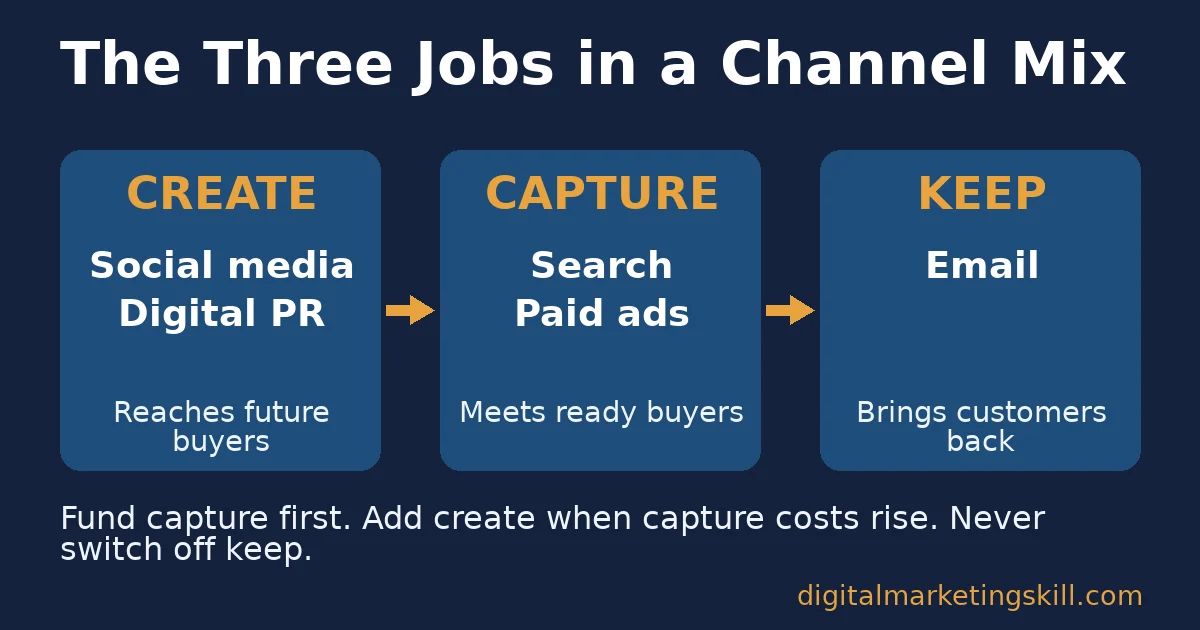
So capture channels fight over a small pool of ready buyers, while create channels fill the pool for later. Keep channels, in turn, protect the buyers you already paid to win. A healthy marketing channel mix needs all three, but not all at once and not in equal amounts.
Why Last-Click Reports Favour Capture Channels
Google Analytics defines attribution as assigning credit for important actions to the ads, clicks and other factors along a buyer’s path. Its last-click model gives 100% of the credit to the final channel someone clicked before converting.
That model rewards capture channels, because they sit at the end of the path. In contrast, a social post that introduced your brand weeks earlier often gets no credit at all. As a result, a report can tell you to cut the very channel that filled your pipeline.
What Each Channel Does in a Marketing Channel Mix
Each channel below has a main job, a typical speed and a common trap. Most businesses need only three or four of them in their marketing channel mix. The headings state the job, so you can see at a glance where each one fits in your mix.
Search: Built to Capture Demand That Already Exists
Search captures demand, which means it only works when people already type your topic into a search box. An Ahrefs study of about 14 billion pages found that 96.55% get no traffic from Google at all. Its main reasons were no search demand, no backlinks and a mismatch with what searchers wanted.
Search is also slow. Google’s own SEO Starter Guide says some changes take effect in a few hours, while others can take several months. So search suits patient businesses whose buyers already know what to look for.
Paid Ads: Built to Buy Speed and Test Data
Paid ads buy speed, because you can reach buyers the same day you launch. They also buy information, since a small test tells you which message and offer get a response. However, the platforms need data before they settle. Google Ads says a bid strategy can need up to about 50 conversions, or three conversion cycles, to calibrate.
The trap is paying for buyers who would have come anyway. Brand-name search ads are the classic example, as the eBay case later in this guide shows.
Social Media: Built to Create Demand
Social media creates demand, because it reaches people before they search. The reach is huge. DataReportal’s Global Digital Overview counts 5.79 billion social media user identities, although one person can hold more than one identity.
Budgets are moving this way too. The CMO Survey found that social media takes 14.3% of US marketing budgets. Yet it also warns that marketers’ 12-month forecasts for social spend have beaten actual spend by 2.1 points on average. In other words, plans for social often run ahead of what teams actually deliver.
Email: Built to Keep the Customers You Already Paid For
Email keeps customers, because it reaches people who have already given you permission. Litmus, an email software vendor, states that email drives an average return of $36 for every dollar spent. It does not publish its method on that page, so treat the figure as a vendor claim.
The wider case for keeping customers is stronger. Harvard Business Review reports that winning a new customer costs 5 to 25 times more than keeping one. Even so, the CMO Survey found that 82% of US companies spend more on acquisition than on retention.
Digital PR and Guest Content: Built to Borrow Trust
Digital PR means earning mentions in articles, podcasts and newsletters that your buyers already trust. Guest content means writing for another site’s audience. Both create demand by borrowing someone else’s credibility.
Journalists do use pitches. In Muck Rack’s State of Journalism survey, 86% of 897 journalists said at least some stories start from PR pitches. But 88% ignore pitches that miss their beat, and the sample is mostly US-based. Muck Rack also sells PR software, so it has an interest in the topic.
How to Build Your Marketing Channel Mix, Channel by Channel
Knowing the job of each channel is half the work of building a marketing channel mix. The other half is knowing when to give a channel more weight, and what to do first when you do. Each heading below mirrors the one above, so you can move straight from diagnosis to action.
Search: Lead With Pages People Already Search For
Give search more weight when people already search for your product, service or problem. Start with the five questions your customers ask most, then write one useful page for each. Next, check in Google Search Console whether those pages earn impressions, which are the times your page appeared in results.
If a page earns no impressions after a few months, the demand may not exist. In that case, shift effort to a create channel instead of writing more pages on the same topic.
Paid Ads: Lead With One Campaign and a Holdout
Give paid ads more weight when you need answers fast, such as testing a new offer. Run one campaign with one clear goal, then leave the settings alone while the system learns. Meanwhile, avoid bidding on your own brand name unless competitors bid on it too.
Where possible, measure lift rather than clicks. Google’s Conversion Lift compares people who saw your ads with a control group that did not. The difference is the lift, meaning the conversions your ads actually caused. The tool is not open to every account, so smaller advertisers can pause ads in one region as a rough test.
Social Media: Lead With One Platform Your Buyers Use
Give social more weight when buyers do not yet know your category or your brand. Pick the one platform where your buyers already spend time, then post there on a schedule you can keep. Consistency on one platform usually beats a thin presence on five.
Judge social on reach, saves, replies and branded searches, not only on last-click sales. After all, its job is to fill the pool that search and ads will later capture.
Email: Lead With a Welcome and a Win-Back Message
Give email more weight when customers buy from you more than once. Start with two automated messages. First, send a welcome email that sets expectations and points to your best offer. Second, send a win-back email to customers who have not bought for a while.
Those two messages protect the money you spent on acquisition. They also give you a steady baseline, so you can see whether new channels add customers or just move them around.
Digital PR and Guest Content: Lead With Data a Journalist Can Use
Give digital PR more weight when trust is what holds buyers back. Lead with something a writer cannot get elsewhere, such as your own customer data, a clear expert view or a useful local angle. Then pitch only writers who cover that exact topic.
Keep guest posts honest. Google’s spam policies list links with optimised anchor text in guest posts as link spam. Such links are fine when they carry a nofollow or sponsored tag, so write guest content for readers, not for rankings. Our guide to earning links the right way covers the safer routes.
How to Measure a Marketing Channel Mix
A marketing channel mix needs a few numbers that compare channels fairly. Track these five every month, next to the sales and traffic figures you already watch.
- Cost per new customer: a channel’s spend divided by the new customers it brought in. Read it as a trend, because a rising cost is the first sign that a channel is running out of easy buyers.
- Blended cost per new customer: total marketing spend divided by all new customers. If channel costs look good but the blended cost rises, channels are claiming the same buyers.
- Incremental lift: the extra sales a channel causes compared with a group that did not see it. This is the truest test, although it needs a holdout group or a paused region.
- New-customer share: the percentage of sales from first-time buyers. If it falls while spend rises, your capture channels are mostly reaching people who already know you.
- Repeat purchase rate: the percentage of customers who buy again within a set period. This is the scorecard for your keep channels, so review it each quarter.
A Four-Step Monthly Review of Your Marketing Channel Mix
Numbers only help if you look at them on a fixed routine. So block one hour at the same point each month and work through these four steps in order.
- Update the five numbers. Pull spend, new customers and repeat buyers for each channel into one sheet, so every channel is judged on the same page.
- Flag the trends. Mark any channel whose cost per new customer rose for a second month in a row, because that is the signal the decision rule below uses.
- Check for overlap. Add up the new customers each channel claims. If the total is higher than your real number of new customers, two channels are counting the same buyers.
- Make one change. Move one slice of budget, or start one test, and write down what you expect to happen. Next month, compare the result with your note.
One change at a time keeps the marketing channel mix readable. If you move three budgets at once, you cannot tell which move worked.
Read the five numbers together rather than alone. For example, a cheap cost per customer means little if lift is near zero. Likewise, strong repeat purchases can justify a higher acquisition cost. For more on where visits come from, see our guide to growing each source of website traffic.
The One Rule: Add a Channel When the Last One Stops Getting Cheaper
If you remember one thing from this guide, make it this rule.
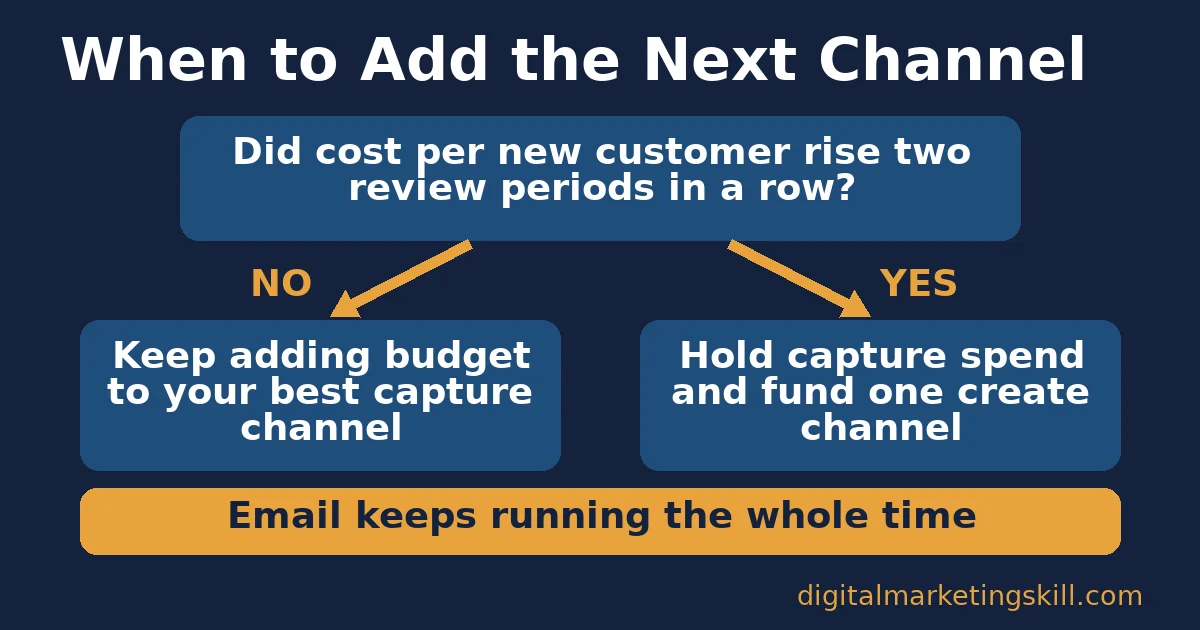
Decision rule: keep adding budget to your best capture channel until its cost per new customer rises two review periods in a row. Then move the next slice of budget to a create channel, and keep email running the whole time.
The rule works because capture channels have a ceiling. Once you have reached most of the ready buyers, each extra customer costs more. At that point, the cheapest growth usually comes from creating new demand, not from squeezing the same small pool harder.
A Worked Example (Illustrative, Invented Numbers)
Imagine a small online shop that spends $1,000 a month on search ads and wins 50 new customers. That is $20 per customer. In month two, it raises spend to $1,500 and wins 60 customers, so each one costs $25. In month three, it spends $2,000 and wins 64, which is about $31 each.
Cost per customer has now risen twice in a row, so the rule says stop raising search spend. Instead, the shop holds search at $1,500 and moves $500 to one social platform. Meanwhile, its welcome and win-back emails keep running, so the customers it already won keep buying.
A Real Case: What eBay Learned When It Switched Off Search Ads
eBay ran one of the best-known tests of a capture channel. Economists Tom Blake, Chris Nosko and Steven Tadelis published the results in a National Bureau of Economic Research working paper. First, eBay stopped brand-keyword ads on Yahoo and MSN. About 99.5% of the lost click traffic still reached eBay, because shoppers simply clicked the free listing below.
Next, eBay stopped non-brand search ads in a random 30% of US regions for 60 days. The paper estimates that paid search added only 0.66% to sales, a result it could not separate from zero. Its best estimate of the return was minus 63%. By contrast, a simple correlation of spend and sales suggested a return of over 4,100%.
The ads did work for one group. They helped most with new and infrequent shoppers, while frequent buyers barely responded. So the lesson is not that search ads fail. Instead, it is that ads aimed at people who already know you mostly buy sales you would have made anyway.
The limits matter. eBay is a famous brand with strong free listings, and the test ran on US traffic only. A small or unknown business may see much bigger gains, because fewer people find it without ads.
Still, the method travels to any business: pause a channel somewhere, then measure what you really lose. Our guide to why each channel fails differently covers the traps that make these tests go wrong.
Frequently Asked Questions About the Marketing Channel Mix
What is a marketing channel mix?
A marketing channel mix is the set of channels a business uses to reach buyers, together with how much time and money each one gets. A useful mix gives every channel a clear job: capturing ready buyers, creating future ones, or keeping current customers.
How many channels should a small business use?
Most small businesses do best with two or three channels run well, rather than six run poorly. A common start is one capture channel, one create channel and email for existing customers.
Should I split my budget 70-20-10?
A 70-20-10 split is a rule of thumb, not a finding from research. It can help you protect a test budget, but the channel jobs and your own cost per customer should decide the final split.
Which channel should I start with?
Start with the channel closest to the buyers who are already looking for you. For most businesses, that means search or search ads, plus email for anyone who has already bought.
How do I know if a channel is really working?
Compare results with and without the channel. You can pause it in one region, or use a lift test where available, then check whether sales actually fall. Channel reports alone often overstate their own impact.
How often should I change my channel mix?
Review the numbers monthly, but change the mix only when a trend holds for two review periods. Moving money every week resets learning on ad platforms and hides the real results.
Start With One Capture Channel, Then Add the Next
A strong marketing channel mix is built in order, not all at once. Pick your best capture channel, set up welcome and win-back emails, and track cost per new customer from the first month. When that cost rises twice in a row, add one create channel and measure it the same way.
For ideas on holding on to the buyers you win, read our guide to keeping customers coming back, and our overview of how paid media channels differ.
If you want guided practice, Digital Marketing Skill Institute teaches these skills hands-on. The Master Diploma in Digital & AI Marketing includes nine practical courses. They include strategy and planning, search engine optimisation, Google advertising, email marketing and automation, social media advertising and Google Analytics. Each student gets unlimited 1-on-1 coaching and mentoring, plus real project work inside a U.S. company.
The diploma is dual US and UK accredited and recognised in more than 100 countries.
The programme is 100% online, so you can study from anywhere in your country. You can find more guides on the Digital Marketing Skill Institute blog. When you are ready, apply for the Master Diploma, or start from the Digital Marketing Skill Institute homepage.
Every figure in this guide was checked against its original source before publication. Figures marked as illustrative are invented examples, not real results.
![9 Amazing Digital Marketing Skills to Make Money Online [With Proof]](https://digitalmarketingskill.com/wp-content/uploads/2019/07/9-Amazing-Digital-Marketing-Skills-to-Make-Money-Online-With-Proof-17.png)