
Good affiliate marketing content does three things well. It answers one buying question clearly. It backs the pick with real proof. And it states the commission in plain view. Most affiliate posts skip at least one of these. That gap is why so many posts earn almost nothing, even with real traffic.
Key Takeaways
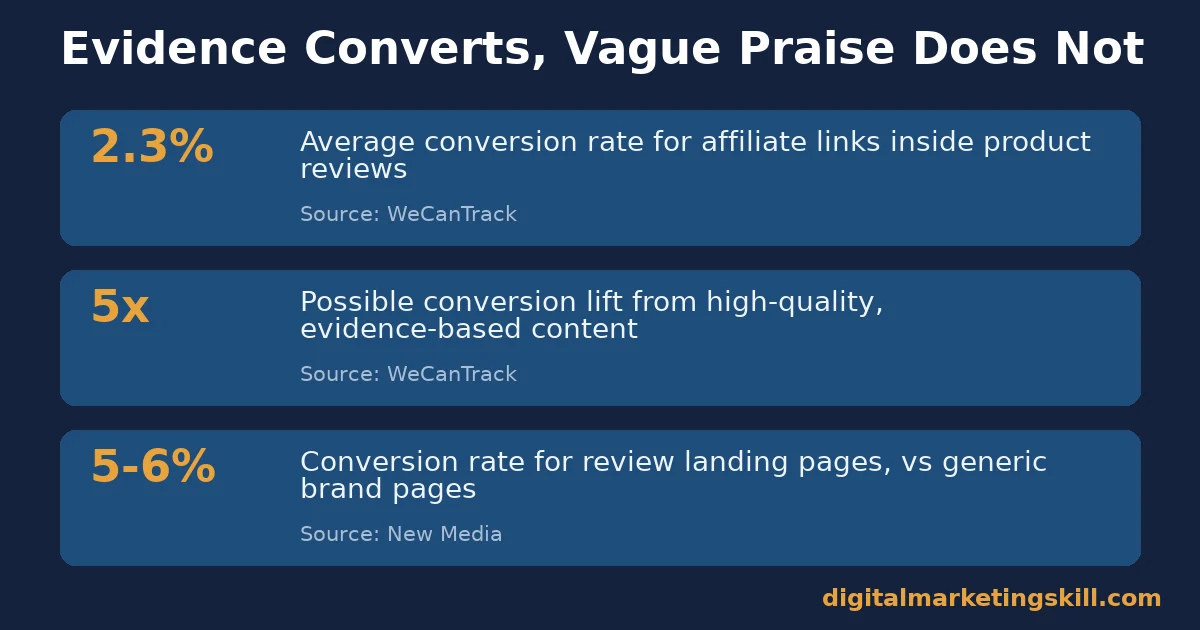
- Affiliate links placed inside product review content convert at roughly 2.3%. That beats generic promotional content, according to WeCanTrack’s own affiliate data. High-quality, evidence-based content can lift conversions up to five times over generic content, per the same tracking.
- Google’s own helpful content documentation names effort, originality, expertise, and trust. Those are the four attributes it checks in ranked content, affiliate content included.
- Wirecutter, now owned by The New York Times, drove $150 million in e-commerce transactions in a single year before its acquisition, according to Forbes’ reporting of the deal. The whole business was built on affiliate marketing content.
- The US Federal Trade Commission requires a clear disclosure on every affiliate link and sponsored recommendation. That rule applies in any country, any time a commission or free product is involved.
- Affiliate landing pages built around product reviews reach 5% to 6% conversion rates, nearly double generic brand pages, according to New Media’s own affiliate data roundup, because they answer a specific buying decision instead of a general topic.
In this guide
- The Gap Most Affiliate Marketing Content Guides Miss
- How Affiliate Marketing Content Actually Converts
- Three Content Formats, Three Different Jobs
- Writing Each Format Without The Common Losses
- Measure The Numbers That Actually Predict Revenue
- The One Decision Rule That Matters Most
- What A Documented Affiliate Content Business Looks Like
- Frequently Asked Questions About Affiliate Marketing Content
- Where To Start, Wherever You Live
The Gap Most Affiliate Marketing Content Guides Miss
Most guides to affiliate marketing content focus on keywords and link placement. They rarely explain why one review converts at 5% and another, on the same product, converts at under 1%. The difference is almost always evidence, not keywords.
A few ground rules first. Rates shift by niche, traffic source, and device. So treat the numbers here as a general range, not a promise for any one post. Every figure in this guide comes from the group that first shared it. What it does and does not prove is stated plainly.
How Affiliate Marketing Content Actually Converts
A reader clicks an affiliate link for one of two reasons. Either the content answered their exact buying question, or it built enough trust that they will act on the recommendation anyway. Weak affiliate content tries to skip straight to the link, without doing either.
Google’s own helpful content guidance checks for the same thing a buyer checks. Does this content show real effort, real expertise, and real evidence? Or does it read like every other page targeting the same keyword? Content that only exists to insert a link usually fails both the reader’s test and Google’s.
Evidence Comes Before The Link, Not After
Readers decide whether to trust a recommendation before they reach the link itself. So the evidence, a real test, a specific comparison, a clear limitation, has to appear earlier in the content. A link dropped into generic praise converts far worse than the same link placed after a specific, checkable claim.
Three Content Formats, Three Different Jobs
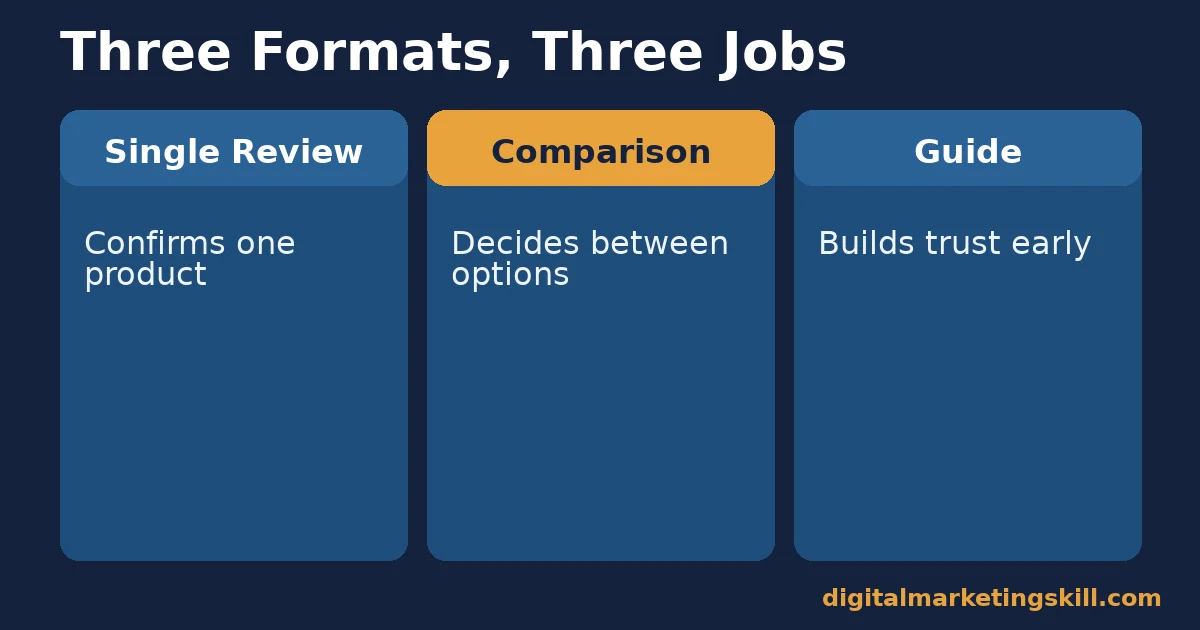
Each format below answers a different stage of a buyer’s decision. Picking the wrong format for where your reader actually is costs more conversions than any weak sentence ever will.
Single Product Reviews: Built For Depth
A single product review works when a reader has already picked a type of product and just needs to check one option. It needs real proof: how it was tested, where it fell short, and who it does not suit. Vague praise with no flaw named reads as an ad, not a review, and readers can tell the difference fast.
Comparison Posts: Built For A Direct Decision
A comparison post works when a reader is still choosing between two or three options. It answers the decision directly: which option for which situation. That direct match between content and decision is also why comparison content tends to out-convert a single review covering only one product.
Educational Guides: Built For Early-Stage Readers
A guide works when a reader does not yet know enough to compare products at all. It earns trust first, through real explanation, then recommends a product once the reader understands why it matters. This format converts slower, but it builds the audience that the other two formats later sell to.
Writing Each Format Without The Common Losses
Single Reviews: Lead With What Was Actually Tested
State exactly what was tested, for how long, and under what conditions. Readers and Google’s own product review guidance both reward visible evidence over claimed expertise. A photo, a specific result, or a named limitation does more for conversion than another adjective.
Comparisons: Lead With The Criteria, Not The Products
State what actually separates the options, before you list the options themselves. Name the factors up front, such as price, how long it lasts, and how easy it is to use. That lets a reader find their own row fast, instead of reading every section first.
Guides: Lead With One Clear Next Step, Not Five
A guide that recommends five different products at the end usually converts on none of them. Pick the single best next step for the reader who just finished the guide, and place that recommendation once, clearly, instead of scattering links throughout.
Disclosure Is Not Optional, In Any Format
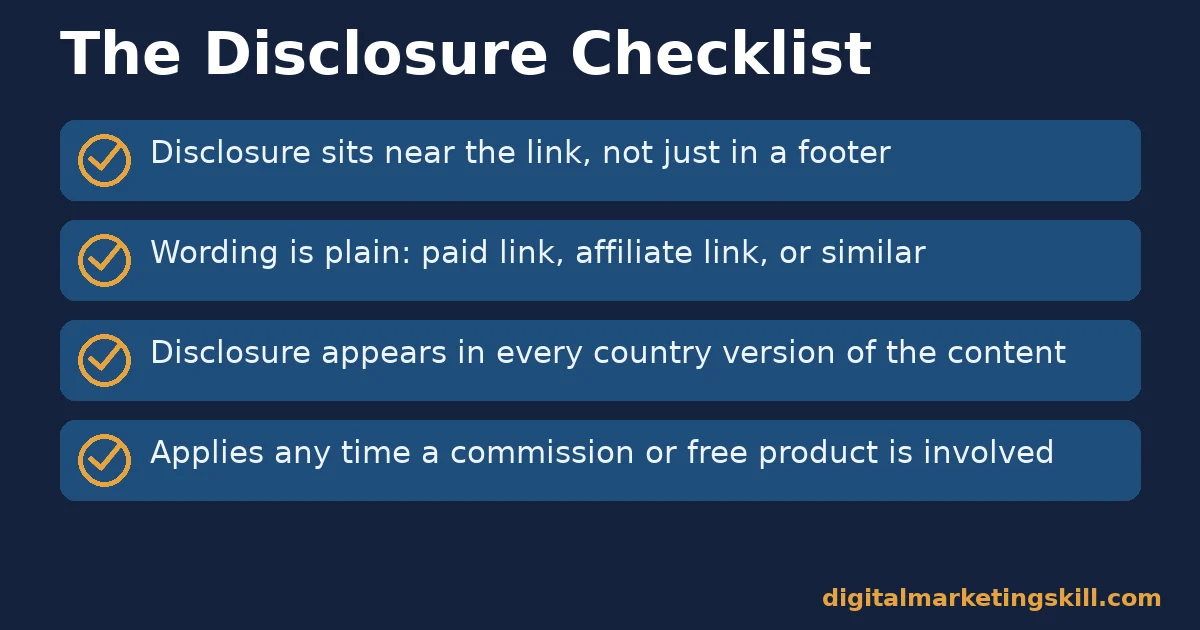
Every piece of affiliate marketing content needs a clear, visible disclosure. That rule applies in every country, any time a commission or free product is involved. The FTC’s own endorsement guidance says a disclosure must be clear and conspicuous, not buried in a footer or a long paragraph. Skipping it risks more than a penalty. It also costs the trust that made the content convert in the first place.
Avoid The Mistakes That Quietly Cap Revenue
A few mistakes repeat across almost every affiliate page that stalls. Writing about a product never actually used is the most common one. Readers can usually tell, and once they spot one vague or copied claim, they stop trusting every claim that follows, including the one near the link.
Linking to too many products in one piece is another common mistake. A page with twenty affiliate links rarely converts better than one with three strong, well-argued picks, because the reader has to do the comparison work the content should have done for them. Fewer, stronger recommendations consistently outperform a long list of weak ones.
A third mistake is letting content go stale. A product that once was the best option can later be discontinued, repriced, or outclassed by something newer. Outdated affiliate marketing content does not just convert worse. It actively damages reader trust, since a dead link or a wrong price is the clearest possible sign that nobody checked the page recently.
Measure The Numbers That Actually Predict Revenue
Track these four numbers together. Traffic alone says nothing about whether affiliate marketing content is actually working.
- Click-through rate on the affiliate link: the share of readers who click, out of total page visitors. This number reflects how clearly the content answered the buying question.
- Conversion rate on the click: the share of clicks that become an actual sale. The merchant sets this, not the publisher, so a low number here usually points to a mismatch between the content’s promise and the product itself.
- Earnings per click: total commission divided by total clicks. This lets you compare two very different products or programs on equal footing.
- Content half-life: how long a piece keeps earning before it needs an update. Evergreen comparison and review content usually earns far longer than a trend-driven post.
Our guide to content marketing for startups covers how to pick one content channel and measure it properly. That same habit applies directly to tracking affiliate content performance.
The One Decision Rule That Matters Most
Never publish an affiliate recommendation without one piece of specific, checkable evidence behind it. A specific test result, a named limitation, or a direct comparison beats generic praise every time, on every format.
Illustrative, invented numbers: a review page gets 1,000 visitors a month. A generic version, with no specific evidence, converts 0.8% of clicks. A version with one added testing detail and one named limitation converts 2.3%, nearly three times as many sales, from the identical traffic.
That single addition, specific evidence instead of generic praise, usually costs less time than writing an entirely new post, yet moves the number that actually predicts affiliate marketing content revenue.
What A Documented Affiliate Content Business Looks Like
Wirecutter started as a small product review site built entirely on affiliate marketing content. Before its acquisition, it drove $150 million in e-commerce transactions in a single year, according to reporting on the deal by Forbes. The New York Times then acquired it for roughly $30 million.
The limit on this case: Wirecutter ran a large staff of testers and writers, and years of accumulated trust, neither of which a new site starts with. Its relevance here is not the scale. It is the mechanism: specific, tested evidence, published consistently, is what the acquisition price actually paid for.
What transfers from the case is narrower. Treat every review as a real test, state limitations honestly, and let the evidence, not the adjectives, do the convincing. That discipline compounds the same way at any scale.
Frequently Asked Questions About Affiliate Marketing Content
How long should affiliate marketing content be?
Length should match the decision, not a word count target. A single, well-tested product review can convert well at under 1,000 words. A comparison covering five options naturally needs more space to state criteria and evidence for each.
Do I need to buy every product I review?
Not always, but the content must say clearly whether a product was personally tested, used briefly, or researched from other sources. Misrepresenting the level of testing breaks both reader trust and Google’s own product review guidance.
What is the best affiliate content format for a brand-new site?
Educational guides usually work best first, since they build trust and traffic before a site has enough authority for competitive comparison or review keywords to rank.
How often should affiliate marketing content be updated?
Update whenever the product, price, or availability changes, and review evergreen comparison content at least twice a year, since outdated specifics are one of the fastest ways to lose reader trust and conversions.
Does affiliate disclosure actually hurt conversion rates?
No reliable evidence shows a clear, honest disclosure reduces conversions. Readers who notice an undisclosed link losing trust in the content costs far more than a visible disclosure label ever does.
Should affiliate links open in a new tab?
This is a minor usability choice, not a conversion driver. What matters far more is that the link sits right after the specific evidence that earned the click, in any tab behaviour.
Can short-form video replace written affiliate marketing content?
It can complement it, but the same rule applies: evidence beats generic praise, in video or in writing. Many of the highest-converting affiliate pages still pair a short video with a detailed written review for readers who want the specifics.
How many affiliate links should one piece of content include?
Fewer than most writers assume. A handful of strong, well-argued links usually outperforms a dozen scattered ones, since each extra link dilutes the attention and trust built by the content around it.
What is the biggest difference between affiliate marketing content and a paid ad?
An ad is bought placement. Affiliate marketing content earns its placement by being genuinely useful first, with the commission as a side effect of that usefulness, not the main pitch. Readers trust the two very differently, even when the end goal is the same.
Where To Start, Wherever You Live
Every format in this guide, single reviews, comparisons, and educational guides, depends on the same underlying skill: building content that proves its claims instead of asserting them, then disclosing honestly so readers keep trusting the next recommendation too.
Where Digital Marketing Skill Institute Fits
That is exactly what Digital Marketing Skill Institute’s Master Diploma in Digital & AI Marketing teaches. Its AI-Powered Google Specialist track covers writing content that meets Google’s own helpful content standards, and its AI-Powered Lead Generation and Email Automation track covers turning that content into a list you can market to directly, anywhere in your country.
It also includes unlimited 1-on-1 coaching and mentoring, a U.S. Project Internship with a verified U.S. Work Reference Letter, and dual US and UK accreditation recognised in more than 100 countries, delivered 100% online. See the full track breakdown on the Master Diploma program page, read outcomes on the reviews page, and browse more guides on the digital marketing blog.
When you are ready, apply here. Learn more at digitalmarketingskill.com, and start building the content skills that make any affiliate marketing content worth publishing, from digitalmarketingskill.com.
Every figure in this guide was checked against its original source before publication. Figures marked as illustrative are invented examples, not real results.
![9 Amazing Digital Marketing Skills to Make Money Online [With Proof]](https://digitalmarketingskill.com/wp-content/uploads/2019/07/9-Amazing-Digital-Marketing-Skills-to-Make-Money-Online-With-Proof-17.png)






