
The fastest way to promote affiliate products is to match the product to an audience that already trusts you. Then prove the recommendation with a real use case. Picking the right channel and disclosing the link honestly matters more than how many platforms you post on.
Key Takeaways
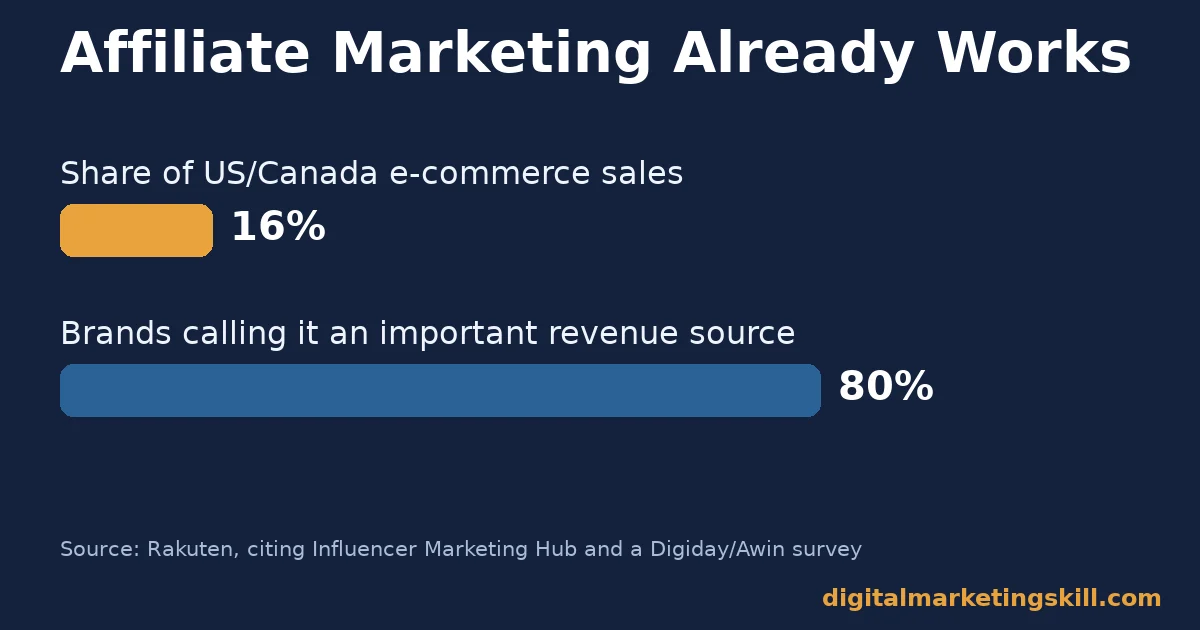
- Affiliate marketing already drives real sales. It accounts for about 16% of e-commerce sales in the US and Canada, according to Influencer Marketing Hub data cited by Rakuten.
- Brands rely on it. 80% of brands call affiliate marketing an important source of revenue, per a Digiday and Awin survey cited by Rakuten.
- Commission rates vary by category, not by effort. Amazon Associates pays 1% to 10% depending on category, with most categories sitting around 4%.
- Disclosure is not optional. US regulator the FTC requires a clear, close-to-the-link disclosure of any affiliate connection; vague wording like “affiliate link” alone is not enough.
- The clock on a click is short. Amazon’s cookie window is about 24 hours, while many other programs credit purchases for 30 days or longer, per Shopify’s guide to affiliate marketing.
In this guide
- What Most Lists of Ways to Promote Affiliate Products Miss
- How People Decide to Click an Affiliate Link
- Four Channels to Promote Affiliate Products
- How to Promote Affiliate Products on Each Channel
- How to Measure Whether a Promotion Is Working
- The One Decision Rule: Promote Where Trust Already Exists
- A Real Case: Turning a Small Ad Budget Into Paid Clicks
- Frequently Asked Questions About How to Promote Affiliate Products
- Start With One Channel, One Product
What Most Lists of Ways to Promote Affiliate Products Miss
Most lists of ways to promote affiliate products are really a list of platforms. Post here. Post there. Add a link everywhere. Platforms are not the hard part.
The hard part is matching a product to people who already trust the source recommending it. That match has to happen on the channel where the trust already exists, not wherever is easiest to post.
This guide covers four channels. It explains what each one is actually built for, and one way to run each well. It also covers disclosure, because a promotion that breaks a platform’s or regulator’s trust rules can undo months of audience-building in a single post.
How This Guide Is Organised
Each section follows the same shape, so you can skim to the channel that matters most to you right now. First comes what the channel is built for. Then comes the one fix that makes it work. Finally, the measurement section shows the single number that tells you whether a promotion is actually earning its place.
A quick ground rule first. The Rakuten figures and the FTC guidance below describe US and Canada conditions specifically. Affiliate programs and disclosure laws vary by country, so check your own regulator’s rules before publishing. Treat every commission rate as a snapshot that a program can change at any time.
None of the fixes in this guide depend on a specific platform staying the same forever. They are built around how people decide to trust a recommendation, which changes far more slowly than any single app or algorithm.
How People Decide to Click an Affiliate Link
A reader clicks an affiliate link for one of two reasons. Either they already trust the person recommending it, or the recommendation answers a question they were about to search for anyway. Promotions that rely on neither usually get ignored, no matter how many times they are repeated.
Trust Comes Before the Click
Google’s guidance on helpful, people-first content asks whether a page demonstrates first-hand experience with a product. That same test applies off search engines too.
A short, specific detail earns more trust than a long feature list. Mention how long you used a product, or what it replaced. That single detail does more to earn a click than specifications copied from the product page.
Rakuten reports that affiliate marketing already accounts for about 16% of e-commerce sales across the US and Canada. It also cites a Digiday and Awin survey in which 80% of brands call affiliate marketing an important revenue source. Readers are used to seeing affiliate recommendations. What they are not used to trusting is a vague or pushy one.
Why Disclosure Protects the Promotion
The FTC’s endorsement guidance requires a clear, conspicuous disclosure of any affiliate connection. That disclosure must sit close to the recommendation itself, not buried on a separate page. The guidance is explicit: a vague phrase like “affiliate link” on its own is not enough context for a reader.
Clear disclosure is not just a compliance step to promote affiliate products responsibly. Readers who later realise a recommendation was undisclosed tend to distrust every future recommendation from that source. That cost is bigger than any click you might have gained by hiding it.
Think of disclosure as part of the pitch, not a disclaimer tacked on afterward. A short, plain sentence such as “I earn a commission if you buy through this link, at no extra cost to you” reads as honest rather than as a legal formality.
Four Channels to Promote Affiliate Products
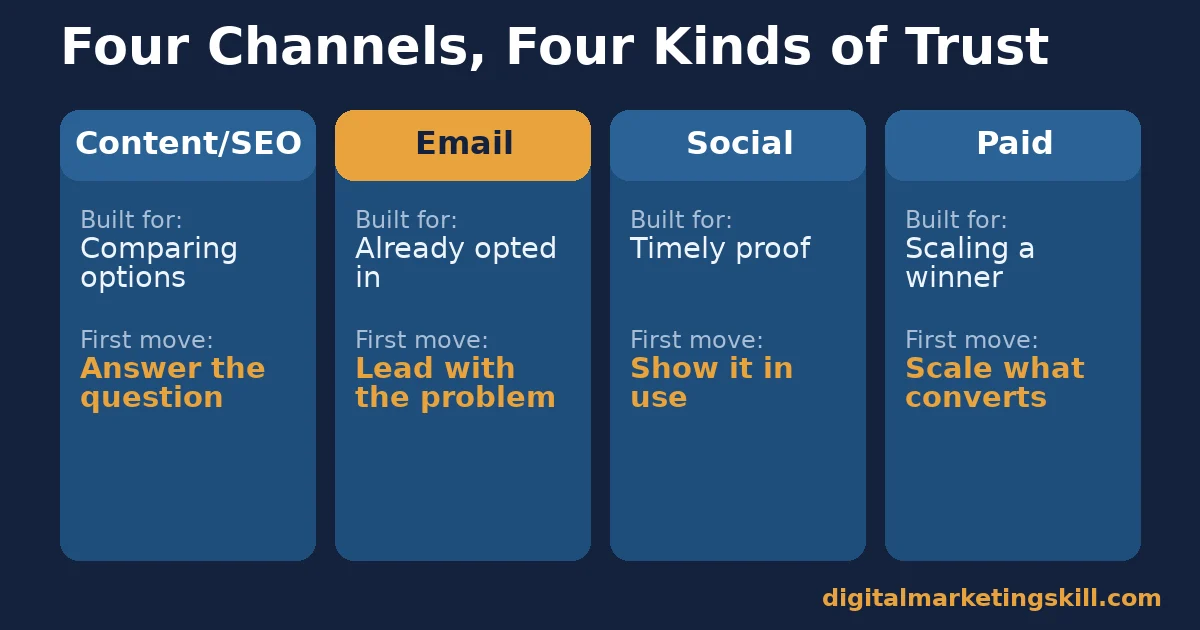
Each channel below suits a different stage of buying intent. Match the channel to where your audience already is. Do not try to run all four at once from day one.
None of these four channels needs a large budget to start. Each one is a different kind of trust, not a different size of investment, which is why a small creator can promote affiliate products just as effectively as a larger one once the channel fits the audience.
Content and SEO: Built for Buying Questions
Search content works because readers arrive already comparing options. Ahrefs studied roughly 14 billion pages and found that 96.55% get no traffic from Google at all. So the topic you choose matters as much as the writing itself.
A comparison or “best for” article aimed at a real search question converts far better than a generic product roundup. The reader is already deciding; your job is to answer the exact comparison they are making.
This is usually the slowest channel to build, because search traffic takes time to arrive. However, it also tends to keep paying off for the longest, since one well-ranked comparison page can promote affiliate products to new readers for months without any extra work.
Email: Built on a List That Opted In
Subscribers already chose to hear from you. They tend to be more forgiving of a recommendation than a cold visitor would be. The cost is list size: email only promotes a product to people already on the list, so it works best alongside a channel that keeps growing that list. Even so, a small list that opens and clicks consistently often outperforms a much larger one that rarely engages.
Social Media: Built on Timely Proof
Social posts work through timing and proof, not search intent. A demonstration, an unboxing moment or a before-and-after result performs better than a static product photo. It shows the product doing the thing the viewer actually wants. So the goal is not more posts; it is one honest demonstration that answers the question a viewer would otherwise have to guess at.
Paid Promotion: Built to Scale a Proven Link
Paid promotion is not a discovery channel. It is a scaling channel. It works best once organic content or email has already shown that a specific link converts.
Paid spend then amplifies a proven result instead of testing a guess at scale. Skipping straight to paid spend to promote affiliate products, before anything has proven itself organically, is one of the most common and most expensive mistakes in this list.
How to Promote Affiliate Products on Each Channel
Each fix below mirrors the channel above, in the same order. Pick the channel where your audience already spends time. Apply its fix before adding a second channel. None of these fixes requires new software, only a different weekly habit around the content you already make.
Content and SEO: Answer the Comparison Question First
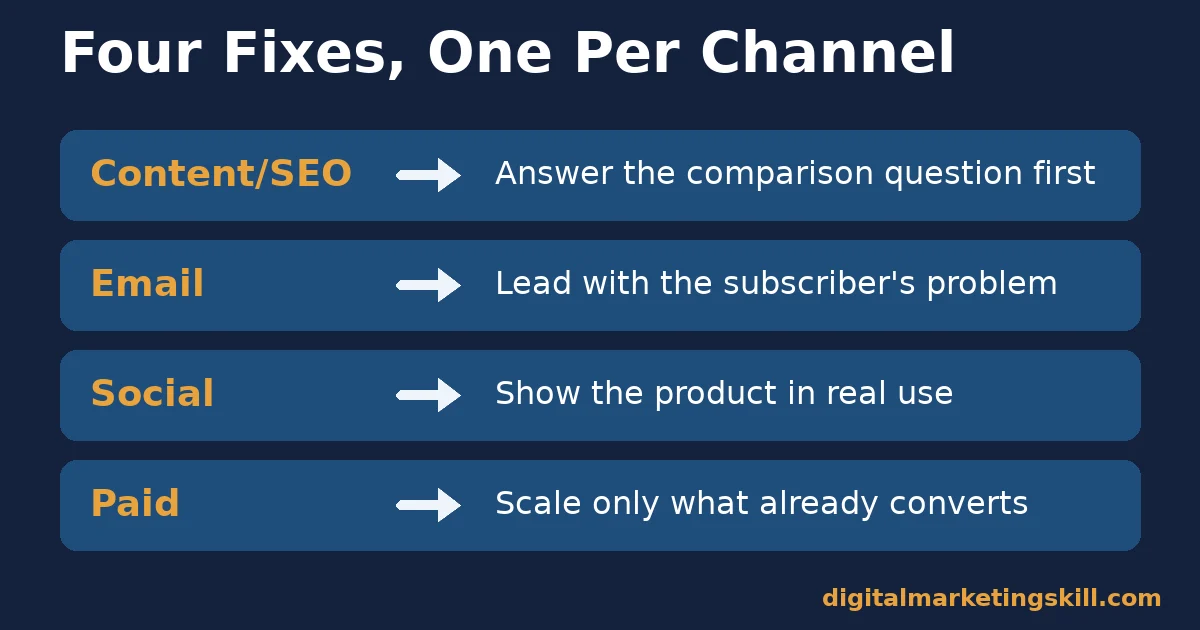
Write the piece around the exact comparison a buyer is making, such as “X versus Y” or “best X for a specific use case.” Put your own first-hand detail near the top, not buried under generic specifications.
Disclose the affiliate relationship in the first few sentences, not only in a footer. A reader who sees the disclosure early trusts the recommendation that follows more, not less. This single habit is one of the simplest ways to promote affiliate products without ever risking the trust the rest of the piece is built on.
Email: Lead With the Problem, Not the Product
Open with the problem the product solves, described in the subscriber’s own words. Name the product only after the problem is clear. Send the recommendation only to the segment of your list it actually fits, rather than to everyone on it. One well-targeted email usually beats three generic ones. Segmenting by past clicks or purchase history, rather than guessing, keeps each send relevant to the people reading it.
Social Media: Show the Product in Use
Film or photograph the product doing the specific thing your audience cares about. Avoid a flat product shot with no context. Put the disclosure directly in the caption or on-screen text, not only in a bio link.
A short, honest limitation mentioned alongside the praise usually increases trust rather than reducing clicks. Viewers notice when a recommendation sounds too perfect to be real.
Paid Promotion: Scale Only What Already Converts
Before spending on ads, confirm the organic version of the same link already converts at a reasonable rate. Start with a small daily budget on the single best-performing piece of content or post. Scale the spend only after a few days of stable results. Watch earnings per click, not just clicks, while you scale, because a cheaper click that converts poorly is not actually a win.
How to Measure Whether a Promotion Is Working
Each channel above needs its own number, or you cannot tell a real result from a lucky week. The five metrics below are defined in one sentence each, with a note on how to read them. They work alongside whatever reporting your affiliate network already provides, so none of this requires a new dashboard.
Five Numbers Worth Tracking
Pick a fixed day each week to check these five numbers, the same way you would check any other business report. A short, repeatable habit catches a falling number while there is still time to act on it.
- Click-through rate. This is the share of people who see the link and click it. A falling click-through rate usually means the surrounding content stopped matching what the audience expected.
- Earnings per click (EPC). This is total commission divided by total clicks on a link. EPC lets you compare two different products fairly, even when their commission rates differ.
- Cookie-window conversions. This is the share of clicks that convert within the program’s own tracking window. Shopify notes that window can run from about 24 hours on some programs to 30 days or more on others. A short window rewards urgency; a long one rewards patience.
- Disclosure compliance. This is a simple yes or no per post: is the affiliate relationship disclosed clearly and close to the link? Track it the same way you track any other publishing checklist item.
- Revenue per channel. This is total affiliate revenue split by the channel that sent the click. It shows which one channel deserves more of your time next month, rather than guessing from memory.
The One Decision Rule: Promote Where Trust Already Exists
If you take only one decision rule from this guide, make it this one. Promote a product on the one channel where your audience already trusts you most. Add a second channel only after the first one is working. A single well-matched channel usually earns more clicks than four half-run ones.
This rule matters most for anyone with limited time. Running four channels badly costs more hours than running one channel well, and it rarely produces more revenue. Depth beats spread when you are trying to promote affiliate products on a tight schedule, especially in the first few months of a new project.
Here is an illustrative example, with invented numbers. A small hobby blog has a modest but engaged email list and a quiet social account. Instead of spreading one new product link across five platforms, the writer sends one honest, specific email.
That email goes only to the list segment that already asked about this exact type of product. It converts at a far higher rate than the writer’s usual social posts. The audience and the product were already matched before the first message went out, so the email did not need to work hard to earn attention it already had.
The lesson is about fit, not volume. One well-matched channel outperformed five scattered attempts, because the promotion met an audience that was already looking for it.
A Real Case: Turning a Small Ad Budget Into Paid Clicks
A real student case from Digital Marketing Skill Institute’s published reviews shows how a small, proven channel can scale. Ayooluwa Osemi described spending $14 on Facebook and Instagram ads and making $878 from that spend. The published figures are in US dollars. See the Institute’s earnings disclaimer for the limits on income claims like this one.
The pattern matches the paid-promotion fix above. It was a small test budget on a channel the student already understood, scaled only after it showed a result worth scaling. As with any individual case, treat it as one documented result, not a guaranteed outcome.
The case is useful here for one reason: it shows that a small, careful test can reveal whether a channel is worth scaling, before any serious money is committed to promote affiliate products or paid offers more broadly.
Frequently Asked Questions About How to Promote Affiliate Products
What is the best way to promote affiliate products as a beginner?
Start with the one channel where you already have an audience, even a small one. Do not try to build four channels at once. A well-matched email or piece of content to an existing, trusting audience usually outperforms a wider, colder push.
Do I have to disclose affiliate links?
In the US, the FTC requires a clear disclosure placed close to the link itself, not buried on a separate page. Most other countries have similar consumer-protection rules, so check your own regulator. Vague wording alone, such as the phrase “affiliate link” with no context, is not considered sufficient disclosure.
Which channel converts best to promote affiliate products?
There is no single best channel. It depends on where your specific audience already trusts you. Content and SEO suit people actively comparing options. Email suits an audience that already opted in, and social suits timely, visual proof. Test one channel for a month before assuming another would have done better.
How long do affiliate cookies last?
It varies by program. Amazon’s window is about 24 hours, while many other programs credit a purchase for 30 days or longer, according to Shopify’s affiliate marketing guide. Always check the specific program’s own terms before relying on a longer window.
Should I use paid ads to promote affiliate products?
Only once an organic version of the same link already converts. Paid promotion scales a proven result. It rarely finds a working product and audience match on its own, so testing with a small budget first keeps early losses low.
How do I know if a promotion is actually working?
Track earnings per click and revenue by channel, not just total clicks. A channel with fewer clicks but a higher earnings-per-click figure can be worth more of your time than a louder channel with weaker conversions. Review these numbers monthly, not daily, so normal week-to-week noise does not drive decisions that should wait for a clearer trend.
How many affiliate products should I promote at once?
Fewer than you think. One or two products that genuinely fit your audience, promoted well on one channel, usually earn more trust and more clicks than a long list of unrelated products spread thin.
Can I promote affiliate products without a website?
Yes. Email and social media both work without a website, as long as the platform’s own affiliate-link rules allow it. A website helps most with search content, since that channel depends on a page Google can index and rank. Many link-in-bio tools also let you disclose and track clicks without a full site.
Start With One Channel, One Product
You do not need four channels running at once to promote affiliate products well. Pick the one channel where your audience already trusts you. Choose one product that genuinely fits that audience.
Measure earnings per click for a month before adding a second channel.
If you want structured practice choosing channels, writing honest promotions and reading the numbers behind them, Digital Marketing Skill Institute teaches these skills hands-on inside the Master Diploma in Digital & AI Marketing.
The AI-Powered Social Media Management and Advertising track covers the social and paid-promotion fixes above. The AI-Powered Lead Generation and Email Automation track covers the email and measurement side.
You can combine all four tracks through the Full Stack option, and both include unlimited 1-on-1 coaching and mentoring plus a U.S. Project Internship with a verified U.S. Work Reference Letter. The diploma is dual US and UK accredited and recognised in more than 100 countries.
The programme is fully online, so you can study and apply these fixes from anywhere in your country. Browse more guides on the Digital Marketing Skill Institute blog, including our guide to becoming an affiliate marketer, read more real results on the reviews page, and when you are ready, apply for the Master Diploma or start from the Digital Marketing Skill Institute homepage.
Every figure in this guide was checked against its original source before publication. Figures marked as illustrative are invented examples, not real results.
![9 Amazing Digital Marketing Skills to Make Money Online [With Proof]](https://digitalmarketingskill.com/wp-content/uploads/2019/07/9-Amazing-Digital-Marketing-Skills-to-Make-Money-Online-With-Proof-17.png)






