
The importance of lead generation comes down to one fact: almost no one buys the first time they see your business. Lead generation finds people who show real interest in what you sell. It also collects a way to reach them again. Done well, it turns strangers into a pipeline you can forecast and improve.
Key Takeaways
- Lead generation is still the top sticking point. HubSpot’s State of Marketing survey asked 3,400 marketers worldwide. 30% named generating leads as a top challenge.
- Quality beats volume in how teams judge success. The same survey found 40% of marketers rate lead quality as their top metric. That beats traffic or raw lead count.
- Cost per lead varies enormously by channel and industry. WordStream and LocaliQ’s benchmark report studied US search ad campaigns. Median cost per lead was $66.69, ranging from $26.84 in Arts and Entertainment to $131.63 for Attorneys and Legal Services.
- Not every channel earns leads the same way. HubSpot’s analysis of traffic from over 5,000 businesses found LinkedIn converted visitors to leads at 2.74%. Facebook managed 0.77% and X/Twitter managed 0.69%.
- Content still does real pipeline work. The Content Marketing Institute’s B2B research surveyed 980 respondents. 74% said content marketing helped them generate demand or leads.
In this guide
- What Most Advice on Lead Generation Gets Wrong
- How Lead Generation Actually Works
- Why the Importance of Lead Generation Differs by Channel
- How to Capture Each Kind of Lead
- How to Measure Whether Lead Generation Is Working
- The One Decision Rule: Fund the Best Lead-to-Customer Rate, Not the Lowest Cost per Lead
- A Real Case: Turning Lead Generation Into a Service Business
- Frequently Asked Questions About the Importance of Lead Generation
- Put the Importance of Lead Generation to Work, Anywhere in the World
What Most Advice on Lead Generation Gets Wrong
Most articles repeat the same line about the importance of lead generation: more leads equal more sales. That is not false. But it skips the part that actually decides whether a lead generation effort pays for itself. That part is whether the right leads arrive, at the right moment, through a channel that fits how that buyer shops.
This guide treats lead generation as a system, not a single tactic. It has inputs, a capture point and a measurement loop. Below, you will find how the mechanism works, where channels genuinely differ, how to fix each one, how to measure results honestly, and one simple rule for deciding where to spend next.
A few ground rules first. Each figure below names the report that published it. None of these numbers are fixed forever, so read each as a snapshot, not a permanent ranking. For instance, some sections describe a framework rather than a cited figure. Treat those as an informed inference built from the research, a starting point to adapt, not a settled fact. Overall, the importance of lead generation shows up more clearly once the mechanism, the channel differences and the measurement loop sit side by side.
How Lead Generation Actually Works
Lead generation has three moving parts. First, a reason for a stranger to raise their hand. Second, a way to capture that interest. Third, a process that moves the resulting contact toward a sale. Skip any one part and the importance of lead generation collapses into noise. You either attract nobody, capture nothing, or capture contacts nobody follows up with.
The “reason to raise a hand” is usually content, an offer, an ad or a conversation. It matches something the person already wants: an answer, a tool, a discount or a comparison. The “way to capture it” is a form, a chat message, a call or a sign-up. This turns an anonymous visitor into a named contact. A business can then follow up on its own schedule, instead of hoping the visitor returns.
The “process that moves it forward” is lead qualification and nurturing. Most teams sort new contacts into stages. A Marketing Qualified Lead (MQL) fits the target profile and shows enough interest to deserve marketing’s continued attention. A Sales Qualified Lead (SQL) has been vetted further and is ready for a direct sales conversation. HubSpot’s survey found 40% of marketers already treat lead quality and MQL volume as their top success metric. That only works when teams agree on those stage definitions and track them consistently.
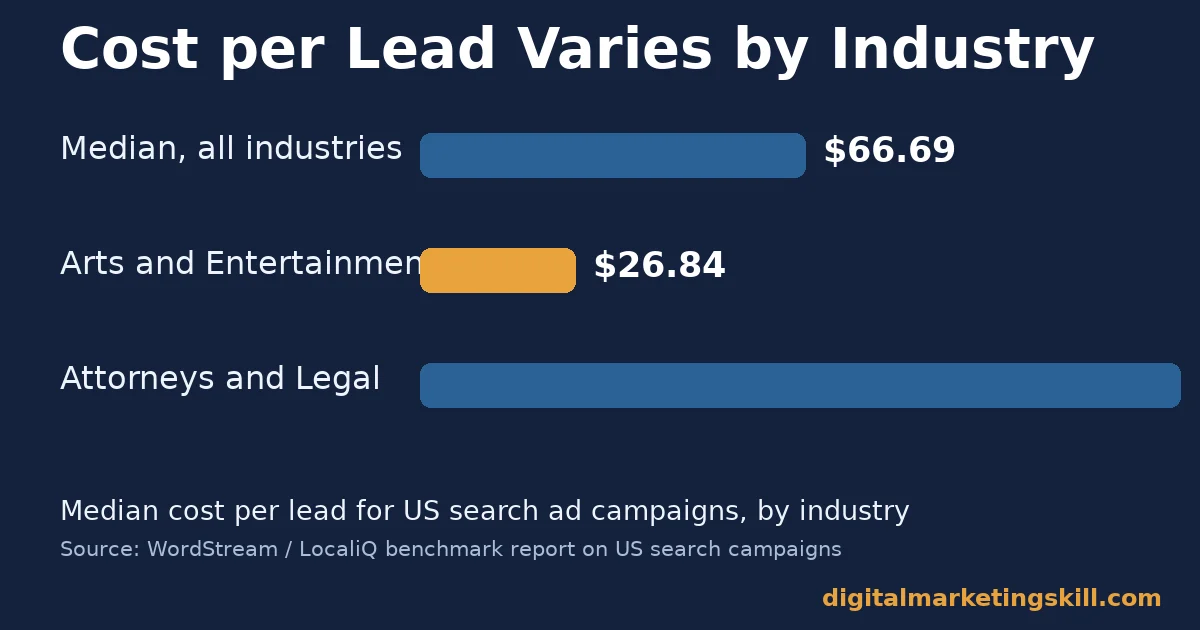
Cost is the part most businesses underestimate. WordStream and LocaliQ’s benchmark report, built on US search ad campaigns, found a median cost per lead of $66.69. The spread between industries was wide: $26.84 in Arts and Entertainment against $131.63 for Attorneys and Legal Services. A lead generation plan that ignores its own industry benchmark will either celebrate a bad result or panic over a normal one. Our guide to lead conversion strategies covers what happens after you capture a lead.
Why the Importance of Lead Generation Differs by Channel
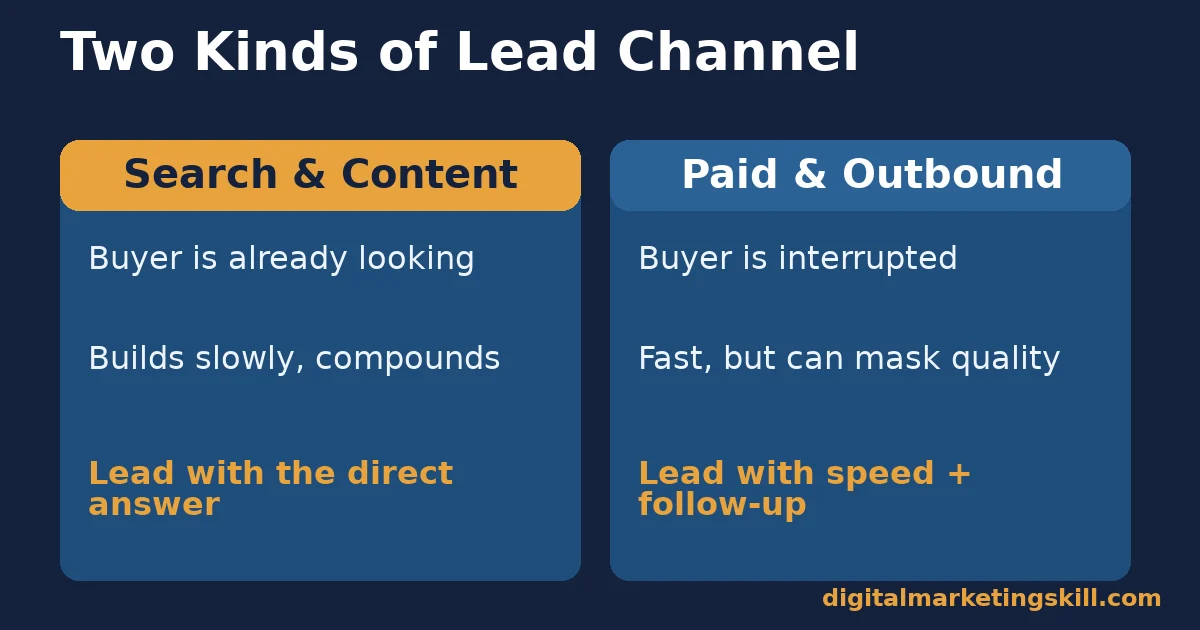
Not every channel earns a lead the same way. Treating them identically is where most lead generation budgets go to waste. In practice, the clearest split sits between channels built for patient, already-searching buyers, and channels built for speed and volume. This is where the importance of lead generation strategy, not just lead generation effort, starts to matter.
Search and Organic Content: Built for Patient, Already-Searching Buyers
Someone who searches a question has already decided they have a problem. They are comparing how to solve it. The Content Marketing Institute’s B2B research surveyed 980 respondents and found 74% of B2B marketers said content marketing helped generate demand or leads. That number holds up because the content meets a buyer who is already looking. See our guide to content marketing strategy for how to plan that content.
The trade-off is speed. Organic content and search rankings take time to build. A single article rarely produces a flood of leads right away. The importance of lead generation through this channel shows up as a compounding asset instead: each useful page keeps earning qualified visits long after you publish it. That suits businesses that can stay patient for the first few months.
Paid Social and Outbound: Built for Speed and Volume
Paid ads, outbound email and cold outreach work on the opposite logic. You interrupt someone who was not actively looking, so the message has to convince faster. HubSpot’s analysis of over 5,000 businesses found that, among social channels, LinkedIn converted visitors into leads at 2.74%. Facebook reached 0.77% and X/Twitter reached 0.69%. HubSpot credits the gap to LinkedIn’s professional, buyer-ready audience for business offers.
These channels can produce leads immediately. That makes them useful for testing a new offer or filling a short-term gap. But volume can mask quality. A channel that is cheap per click can still be expensive per qualified lead if the audience is only loosely interested. That is exactly why cost per lead needs measuring per channel, never blended across all of them.
How to Capture Each Kind of Lead
The fix for each channel mirrors why it works the way it does. Start with whichever channel already brings you the most visits. As a result, an improvement there compounds fastest, which is often the quickest way to raise the importance of lead generation inside a small marketing budget.
Search and Organic Content: Lead With the Direct Answer
Give the searcher the answer to their actual question in the first few sentences. Skip the scene-setting. A visitor who gets the answer quickly trusts the rest of the page enough to look at your offer. One who has to scroll and guess leaves for a competitor’s result instead.
Keep the lead-capture step light for this audience. A visitor who is still researching will not fill in a ten-field form. A short newsletter sign-up, a free checklist or a simple contact form converts better, because it asks for commitment that matches how far along the visitor actually is. HubSpot’s own analysis of over 40,000 customer landing pages found that extra fields, such as age, phone number or street address, tend to lower conversion. Use that as a check on any form built for a searching visitor. Google’s own guidance on helpful, people-first content asks whether a reader will leave feeling they learned enough. That is a fair test for whether your page earned the lead before it asked for one.
Paid Social and Outbound: Lead With Speed and Honest Follow-Up
Because these channels interrupt rather than answer a search, the message needs one clear promise and one clear next step. Aim it at a specific audience, not everyone. A vague ad to a broad audience produces clicks that rarely turn into real conversations.
The follow-up matters as much as the ad. A lead from paid or outbound channels is often less certain about what they want than a searcher. A human reply that answers their specific question usually moves them toward a sale faster than an automated sequence alone. If a form or chat captured the lead, reply while the interest is still warm. Keep that buyer engaged afterward the way our guide to customer relationship management describes.
How to Measure Whether Lead Generation Is Working
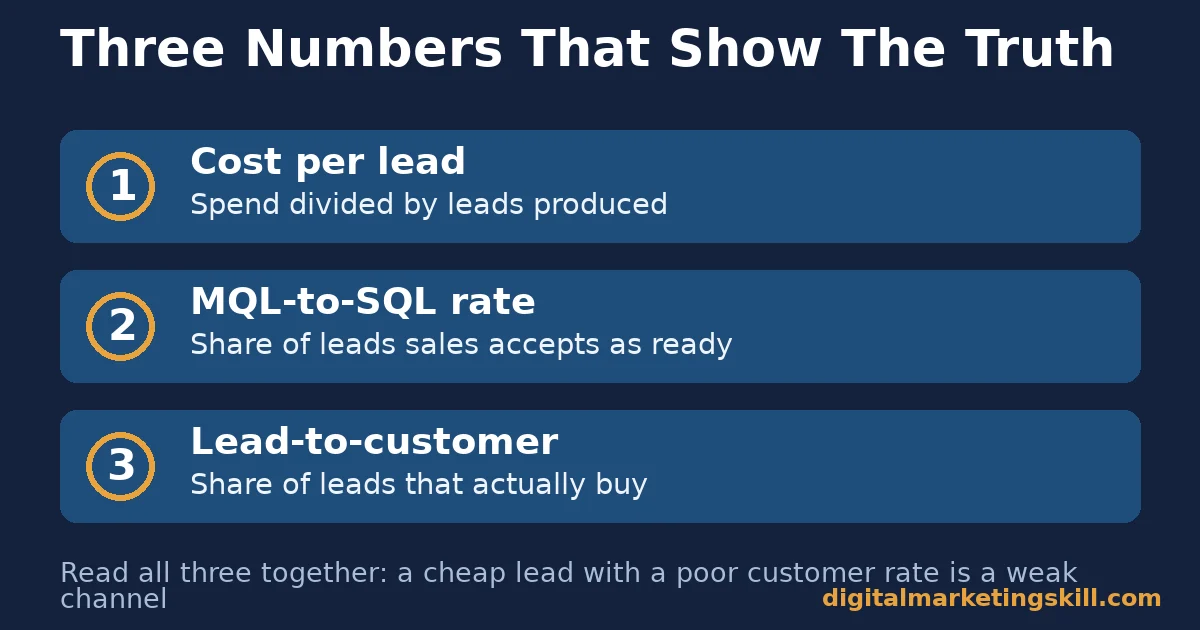
Three numbers tell you most of what you need to know. Each one means something different on its own.
Cost per lead (CPL) divides total channel spend by the number of leads it produced. It shows how expensive raising a hand is. It says nothing about whether that hand belongs to a real buyer.
MQL-to-SQL rate shows the share of marketing-qualified leads your sales process accepts as genuinely sales-ready. It shows whether marketing and sales agree on what a good lead looks like. A low rate often means the definitions, not the leads, cause the problem.
Lead-to-customer rate shows the share of leads, across the whole funnel, who eventually buy. This number finally connects lead generation spending to revenue. Compare it across channels; the other two numbers work best within a single channel.
Read these three numbers together, not one at a time. For example, a cheap cost per lead paired with a poor lead-to-customer rate usually means the channel attracts the wrong audience. On the other hand, a high cost per lead paired with a strong lead-to-customer rate can still be the better channel to keep funding. If email is one of your lead-nurturing channels, our introduction to email marketing covers the sequences that move a lead from first contact to customer.
The One Decision Rule: Fund the Best Lead-to-Customer Rate, Not the Lowest Cost per Lead
When budgets are limited, resist the instinct to fund whichever channel shows the cheapest cost per lead on a dashboard. Fund the channel with the strongest lead-to-customer rate instead. That number reflects how many of those leads actually become paying customers. The gap is real: Salesforce’s State of Marketing report, based on nearly 4,500 marketers worldwide, found 83% recognise the shift toward personalised engagement, yet only one in four feel satisfied with how they use data to power it, which is exactly the gap a clear decision rule closes.
Here is an illustrative example with invented numbers to show the logic. Channel A costs $40 per lead and converts 2% of leads to customers. Channel B costs $90 per lead and converts 8% of leads to customers. Channel A needs 50 leads, or $2,000, to win one customer. Channel B needs about 12.5 leads, or roughly $1,125, to win one customer. In this illustrative case, the channel with the higher cost per lead is actually the cheaper way to win a customer.
A Real Case: Turning Lead Generation Into a Service Business
Lead generation skills can become a service, not only an internal marketing function. On Digital Marketing Skill Institute’s reviews page, student Oluwatosin Jegede describes the outcome in their own words: “Now I have skills to monetize, sell any product, drive traffic, generate converting leads that have a positive ROI on any business.” This specific result is one student’s account, not a guaranteed outcome for every learner. It stays consistent with the Institute’s earnings disclaimer.
Here is the limit worth naming: this is a single published testimonial, not a controlled study. Results will vary by market, effort and starting point. Treat it as a real example of lead generation skills in use, not as a promise of what any one learner will earn.
Frequently Asked Questions About the Importance of Lead Generation
What is the real importance of lead generation for a small business?
For a small business, lead generation replaces guesswork with a repeatable way to find buyers. Growth no longer depends on referrals or luck alone. It also builds a list of contacts you can follow up with over time, instead of a one-time visit you cannot reach again.
Is lead generation still worth the cost?
It is worth the cost when the lead-to-customer rate justifies the spend. In other words, that number matters more than cost per lead alone, which is the whole case for the importance of lead generation measurement over gut feel. A channel can look expensive per lead and still be the cheapest way to win a customer, as the decision-rule example above shows.
How many leads does a business need before it sees results?
There is no universal number. It depends on your close rate and average deal value. A business that closes one in five leads needs far fewer leads than one that closes one in fifty. Track your own lead-to-customer rate for a few months before you judge whether volume is the real problem.
What is the difference between a lead and an MQL?
A lead is any contact who shows some interest and gives you a way to reach them. An MQL, or marketing-qualified lead, has been checked against your target profile and shows enough engagement that marketing considers them worth sales’ attention. Not every lead reaches that bar.
Can content marketing alone generate enough leads?
It can be a major source. But the Content Marketing Institute’s research found 74% of B2B marketers who used it said it helped generate demand or leads, not that it was their only source. Most businesses combine organic content with at least one faster channel, such as paid social or outbound.
Should a business chase more leads or better leads?
Chase better leads first. For the most part, a smaller number of well-qualified leads with a strong lead-to-customer rate is usually more valuable. It is also cheaper per customer won than a large number of poorly matched contacts that rarely close.
Put the Importance of Lead Generation to Work, Anywhere in the World
The importance of lead generation is not the number of contacts you collect. It is whether those contacts turn into customers you can measure and repeat. Pick the channel that already brings you the most visits. Fix its first move using the section above. Then track lead-to-customer rate before you spend more on volume.
If you want to build this as a skill rather than a one-off project, Digital Marketing Skill Institute’s Master Diploma in Digital & AI Marketing includes an AI-Powered Lead Generation and Email Automation track. It sits among four AI-powered tracks totalling ten courses, with a Full Stack option for completing all four. It comes with unlimited 1-on-1 coaching and mentoring, a U.S. Project Internship with a verified U.S. Work Reference Letter, and dual US and UK accreditation recognised in more than 100 countries. The whole program runs 100% online, so you can study from anywhere in your country.
Wherever you live, the fundamentals of lead generation in this guide apply the same way: define your stages, measure lead-to-customer rate, and fund what actually converts. Explore the training at Digital Marketing Skill Institute, read more on the blog, or apply to get started with Digital Marketing Skill Institute today.
Before you generate more leads, make sure you are chasing the right ones. Our guide to target market segmentation covers how to group buyers by real behavior instead of surface traits.
Every figure in this guide was checked against its original source before publication. Figures marked as illustrative are invented examples, not real results.
