
Target market segmentation means splitting your total market into groups that actually buy differently. Then you match your message and spend to each group. Mass-market messaging wastes budget on people who will never buy. Bain & Company research links strong segmentation to a real profit gap over time. This guide shows which variables matter, how to pick a segment worth serving, and how to measure the result.
Key Takeaways
- Segmentation has a measurable payoff. A Bain & Company survey found organizations with strong customer segmentation had 10% higher profit than peers with weak segmentation, over a five-year period.
- Most executives know this, few act on it. The same Bain research found 81% of executives call segmentation critical to profit growth. Yet fewer than 25% believe their own company does it well.
- Segmentation works at scale, not just in theory. Bain’s own case work with a telecom client used tiered customer segmentation. It drove 15% growth in one business line and a 20% boost in enterprise sales.
- Not every market needs deep segments. If every buyer purchases for the same reason, finer segmentation adds cost without adding insight. Segment where buying behavior genuinely differs.
- The variables differ for consumer and business markets. Consumer markets split well by demographics, psychographics and behavior. Business markets split better by firm size, industry and buying role.
In this guide
- What Most Target Market Advice Misses
- Why Target Market Segmentation Pays Off
- What Differs Between Consumer and Business Markets
- How to Segment for Each Market Type
- How to Measure a Segmentation Strategy
- The One Decision Rule: Segment Only Where Behavior Actually Differs
- A Real Case: Segmentation at a Telecom Business
- Frequently Asked Questions About Target Market Segmentation
- Put Target Market Segmentation to Work
What Most Target Market Advice Misses
Most advice on finding a target market says the same thing. List some demographics. Write a buyer persona. Then move on. That step alone rarely changes results.
This guide fills the gap. It explains why target market segmentation pays off, and it covers the variables that matter for different business types in target market segmentation. It also gives one rule for deciding how finely to segment. Treat the research here as named evidence, not a guarantee. Your own result depends on how different your buyers actually are.
Why Target Market Segmentation Pays Off
A single message aimed at everyone persuades almost no one fully. Different buyers care about different things. A message built for one group feels generic to everyone else.
Segmentation fixes this by trading reach for relevance. You speak to fewer people at once. But each message lands harder, because it answers a specific buyer’s specific reason to care. A Bain & Company survey, cited widely in segmentation research, found organizations with strong segmentation held a real profit edge over five years.
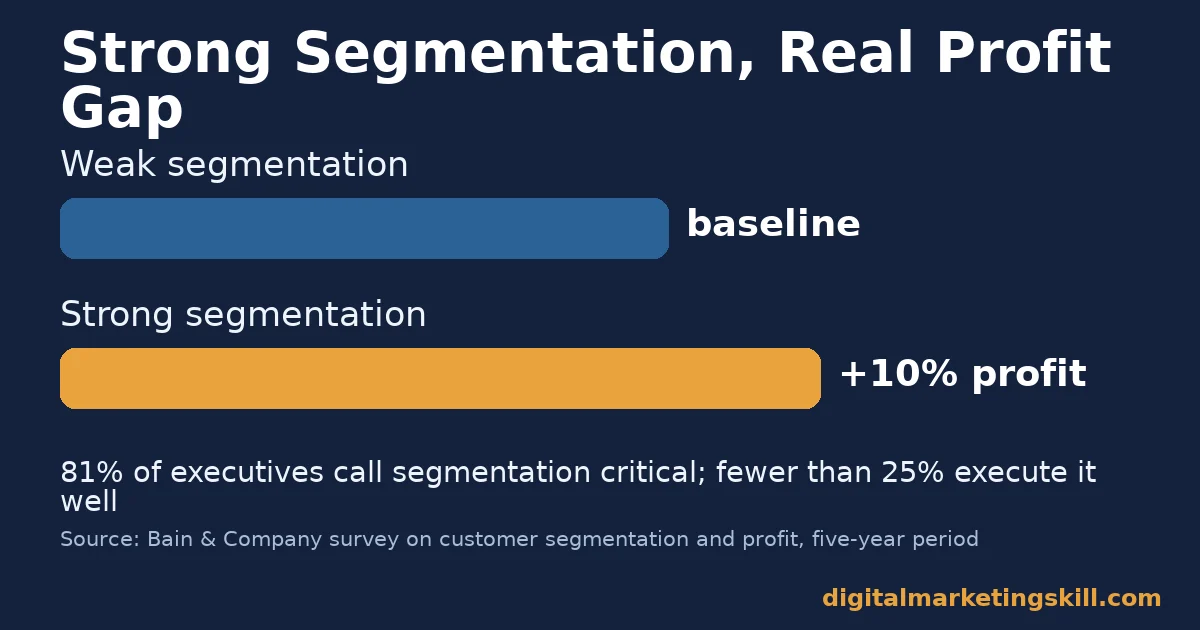
The same research found a gap between belief and action. Most executives agree segmentation matters. Few trust their own company’s execution. That gap is often the opportunity. A competitor who segments properly can out-convert you on the same ad budget, simply by saying something more relevant to a smaller, better-chosen group.
What Differs Between Consumer and Business Markets
Segmentation variables are not one-size-fits-all. A consumer business and a business-to-business company split their markets differently. The thing that predicts a purchase is different for each.
Consumer Markets: Built on Demographics, Psychographics and Behavior
In consumer markets, purchase decisions track who someone is and how they behave. For example, demographics cover age, income, location and life stage. Psychographics cover values, interests and attitudes. Behavioral data covers what someone has actually bought, browsed or clicked.
Behavioral data usually predicts the next purchase better than demographics alone. Two 35-year-olds in the same city can have nothing in common as buyers. What they clicked last week says more than their age ever will.
Business Markets: Built on Firmographics and Buying Role
In business markets, the buyer is rarely one person. Firmographic data, such as company size, industry and revenue, narrows the field first. Buying role narrows it again. The person who feels the problem is often not the person who signs off on the budget.
A message aimed at a junior user will not move a budget-holder, and the reverse is just as true. According to Gartner’s research on the B2B buying journey, a typical buying group involves six to ten stakeholders. So effective business segmentation usually means preparing more than one message for the same deal, not just one pitch repeated to everyone in the room.
How to Segment for Each Market Type
These two sections mirror the groups above. Use the one that matches your business. Treat the other as background if you sell to both.
Consumer Markets: Lead With Behavior, Confirm With Demographics
Start with what people actually do. Group buyers by purchase frequency, basket size, or the specific product they came for. Demographics work best as a second filter. Use them to sanity-check a behavioral group and help you choose where to advertise.
Keep each segment large enough to target efficiently. So a segment of a few hundred people rarely justifies a separate campaign. A segment of tens of thousands, with a genuinely different reason to buy, usually does.
Build each segment from a clear trigger, not a vague interest. For example, “bought a starter kit in the last 60 days” is a usable segment. “Interested in fitness” is not, because almost any consumer claims that interest when asked. The first trigger predicts behavior. The second only predicts a survey answer.
Review each segment every quarter, not once a year. Buying behavior shifts as products, prices and competitors change. So a segment that was sharp six months ago can quietly become generic again, and nobody notices until the campaign built on it starts underperforming.
Business Markets: Lead With the Account, Then the Role
Build your segments around the account first. Group target companies by industry and size, since that shapes both budget and need. Then build separate messaging for each buying role within the account. The end user, the technical evaluator and the budget-holder each need a different argument.
Do not assume one champion inside the account can sell for you. So give every role in the buying group a reason, in their own language, to say yes. Qualtrics’s overview of segmentation methods is a useful reference for a fuller list of consumer and business variables.
How to Measure a Segmentation Strategy
Segmentation should show up in your numbers within a few campaigns. The four measures below are each defined in one sentence.
- Cost per acquisition by segment. Your ad or outreach spend, divided by new customers, calculated separately for each segment. A falling cost in one segment shows the message there is landing.
- Conversion rate by segment. The share of contacted or reached people in a segment who become customers. Compare it against your blended, unsegmented rate to see the real lift.
- Customer lifetime value by segment. The average revenue a customer in that segment generates over their relationship with you. However, some segments convert easily but are worth far less long-term.
- Segment size versus campaign cost. This checks whether a segment is large enough to justify a dedicated campaign. A perfectly targeted message to a tiny group rarely pays for itself.
Read these four together. A segment with a strong conversion rate but a weak lifetime value may not be worth a dedicated budget. A segment with a high lifetime value but a tiny size may be worth a manual, non-scaled approach instead of paid media.
The One Decision Rule: Segment Only Where Behavior Actually Differs
If you take one rule from this guide, make it this one. For instance, before you build a new segment, confirm that the group actually buys differently, not just looks different on paper. Two groups with different ages but the same reason to buy do not need separate campaigns.
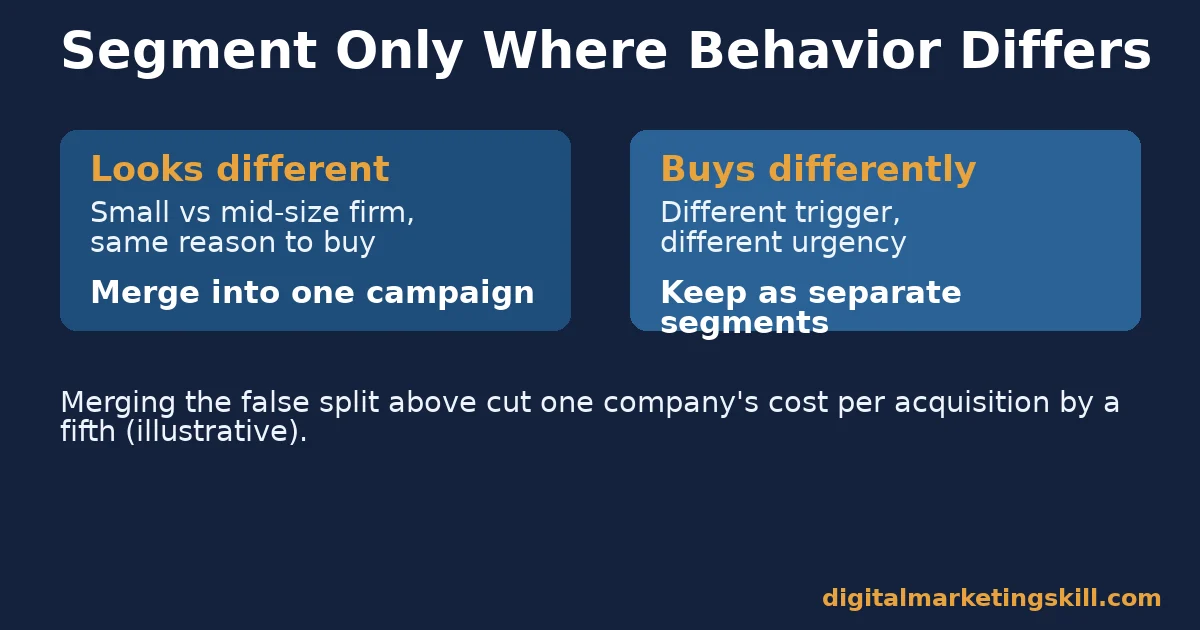
Here is an illustrative example, with invented numbers. A software company assumes small businesses and mid-size businesses need different messaging, based on size alone. After reviewing actual deal data, it finds both groups buy for the identical reason: saving time on the same task. It merges the two campaigns into one message. Cost per acquisition then drops by a fifth, because the team stops splitting its budget across a distinction that buyers never actually felt.
The lesson is about restraint. More segments is not automatically better. Still, each new segment adds cost and complexity. So each one needs to earn its place with a real behavioral difference.
A Real Case: Segmentation at a Telecom Business
Bain & Company’s own published case work describes a telecommunications client facing declining enterprise revenue despite ambitious growth plans. The firm segmented large business and government customers into tiers. It also built a dedicated organization for its networked services business, and set up formal account planning for its largest accounts.
The results were specific. The networked services business grew 15%. Enterprise sales rose 20% through better account planning. In its first year under the new approach, the company exceeded its own growth target by one percentage point.
The limit is worth stating. This is one company’s published case, in one industry, over one period. Of course, the specific percentages will not transfer directly to a different market. But the method, tiering accounts and tailoring the approach to each tier, generalizes well.
Treat segmentation case studies the same way you would treat any single data point. Useful for direction, not for predicting your own exact percentage. The variables that drove this telecom result, account size and public versus private buyers, may not even exist in your market.
Notice what the case does not claim. It does not say segmentation alone caused the result. The company also built a new organization and formal account planning around its segments. So segmentation set the direction, but execution, following through with process and people, delivered the number. That pairing matters more than the target market segmentation framework by itself.
Frequently Asked Questions About Target Market Segmentation
What is target market segmentation?
It is the practice of splitting a broad market into smaller groups that buy for genuinely different reasons. You then tailor message, product or price to each group, instead of using one approach for everyone.
Why does target market segmentation improve results?
Because a message built for a specific group’s actual reason to buy outperforms a generic message aimed at everyone. Bain & Company research links strong segmentation to a measurable long-term profit advantage over weaker segmentation.
What variables should I segment by?
For consumer markets, start with behavior, such as what someone has actually bought or browsed, then confirm with demographics. For business markets, start with firm size and industry, then layer in the buying role of each contact.
How many segments should a small business create?
As few as the real differences in buying behavior justify. Otherwise, it adds cost without adding results.
Can segmentation hurt a business?
Yes, if segments are built on surface traits rather than real behavior. Splitting a market that actually behaves as one group only fragments your budget and message, without any matching gain.
How is B2B segmentation different from B2C segmentation?
B2B segmentation usually starts with the account, such as company size and industry, then layers in the buying role of each person involved. B2C segmentation usually starts with individual behavior and demographics instead.
How do I know if my target market segmentation is working?
Track cost per acquisition, conversion rate and lifetime value separately for each segment, and compare them to your blended average. A segment that beats the average on all three is worth a dedicated budget.
Do I need special software to segment my target market?
No. A spreadsheet of past purchases, grouped by frequency, product or company size, is enough to start. Dedicated segmentation or CRM tools help once you have enough data to automate the grouping, but the thinking comes first.
Put Target Market Segmentation to Work
Target market segmentation pays off when it is built on real behavioral differences, not surface traits. Pick the variables that fit your market type. Confirm each segment actually buys differently, then measure cost per acquisition, conversion rate and lifetime value before you scale any one message further.
If you want to build these skills with guided practice, Digital Marketing Skill Institute teaches them hands-on inside the Master Diploma in Digital & AI Marketing. The programme runs four AI-powered tracks, including AI-Powered Lead Generation and Email Automation and AI-Powered Google Specialist. All four total ten courses, with a Full Stack option for completing them together. It includes unlimited 1-on-1 coaching and mentoring, plus a U.S. Project Internship with a verified U.S. Work Reference Letter. It is dual US and UK accredited, and recognised in more than 100 countries.
See our related guides to the importance of lead generation for turning a defined segment into pipeline, and marketing return on investment for measuring what a segmented campaign actually earns back. The programme is fully online, so you can study from anywhere in your country. Browse more guides on the Digital Marketing Skill Institute blog, and when you are ready, apply for the Master Diploma or start from the Digital Marketing Skill Institute homepage.
Every figure in this guide was checked against its original source before publication. Figures marked as illustrative are invented examples, not real results.
![9 Amazing Digital Marketing Skills to Make Money Online [With Proof]](https://digitalmarketingskill.com/wp-content/uploads/2019/07/9-Amazing-Digital-Marketing-Skills-to-Make-Money-Online-With-Proof-17.png)






