
Benefits of digital marketing include a lower cost per lead than most traditional channels, precise audience targeting, and results you can measure in real time instead of guessing. Businesses of every size can reach the 6.12 billion people now online. But the size of the benefit still depends on the stage of the business and how well it is executed.
Key Takeaways
- The audience is nearly the whole world. DataReportal’s global digital report found 6.12 billion people, 73.8% of the world’s population, now use the internet.
- Reach is mostly on phones. Statcounter’s global traffic data shows mobile devices generate 58.99% of web page views worldwide, against 39.26% from desktop.
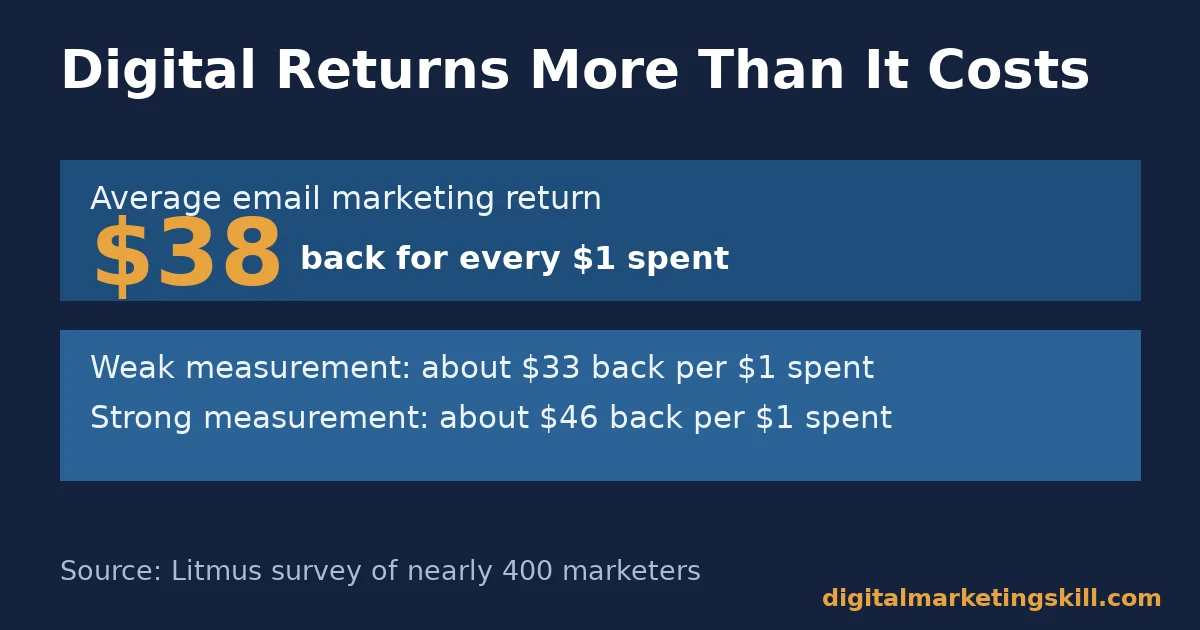
- Measurable return is real, but channel-specific. Litmus’s survey of nearly 400 marketers found that email marketing alone returned about $38 for every $1 spent.
- “Free” reach is not automatic. Ahrefs’ analysis of roughly 14 billion pages found that 96.55% get zero traffic from Google. So organic reach still has to be earned.
- The career side keeps growing. In the United States, the U.S. Bureau of Labor Statistics projects market research analyst and marketing specialist roles to grow 7% over the decade, adding about 66,300 positions.
In this guide
- What Most “Benefits of Digital Marketing” Lists Miss
- How Digital Marketing Actually Produces These Benefits
- Where the Benefits of Digital Marketing Differ by Business Stage
- How to Capture the Benefit at Your Stage
- How to Measure Whether You Are Getting the Benefits
- The One Rule: Measure Before You Multiply Channels
- A Real Case: A Fast, Self-Reported Return
- Frequently Asked Questions About the Benefits of Digital Marketing
- Put the Benefit That Matches Your Stage to Work
What Most “Benefits of Digital Marketing” Lists Miss
Most lists of digital marketing benefits read the same way. Digital marketing is cheap, it is measurable, and it reaches more people than old media. None of that is wrong. But it treats every business as if it were in the same position.
A solo freelancer, a growing local business and an established brand do not get the same benefit from the same channel. A small business mostly needs cheap reach, while a big brand mostly needs to defend the customers it already has. So the benefits of digital marketing are real for both, but they show up in different places.
Here are the ground rules. The traffic figures below come from named research you can check yourself, so treat them as a snapshot of a fast-moving market, not a permanent ranking. The business-stage framework is one useful way to read that evidence, not a settled fact. Gartner’s budget figures describe large enterprises above $1 billion in revenue, so they will not match a small business weighing its first ad spend.
It also helps to separate a benefit from a tactic. “Run more social ads” is a tactic; “reach a defined audience for less than traditional media charges” is the benefit it should deliver.
Older lists name thirteen or more perks: cheaper reach, mobile access, better targeting, faster feedback. Most roll up into the two or three mechanisms this guide covers. Naming the mechanism lets you check whether it is actually working for your business.
How Digital Marketing Actually Produces These Benefits
Digital marketing creates its benefits through two things traditional advertising never had: targeting and feedback. A billboard reaches whoever happens to look up. A digital campaign reaches only the audience you choose, and it records the result the moment someone sees or clicks it.
That feedback loop is what makes digital marketing measurable. Google Analytics counts a session as “engaged” when it lasts 10 seconds or more, includes a key event, or includes two or more page views. It also logs a scroll event the first time a visitor reaches 90% of a page. Print and TV ads never gave marketers signals like these.
Because of that feedback, a business running a digital campaign can see within hours whether people are responding, then change course before the budget runs out. That speed is one of the benefits of digital marketing traditional formats simply cannot offer.
The Cost Side of the Mechanism
Cost is the other half of the mechanism. Gartner’s CMO Spend Survey polled 401 senior marketing leaders at large enterprises. It found marketing budgets average 7.8% of revenue, down sharply from four years earlier. Even so, 56% of those leaders said their budget still was not enough.
That pressure is exactly the condition digital channels are built to fit. You set a daily spending cap, then measure the return each week. Because you see the number early, you can adjust it before ever committing to a quarter of print space in advance. That flexibility is one of the clearest benefits of digital marketing over older formats.
Where the Benefits of Digital Marketing Differ by Business Stage
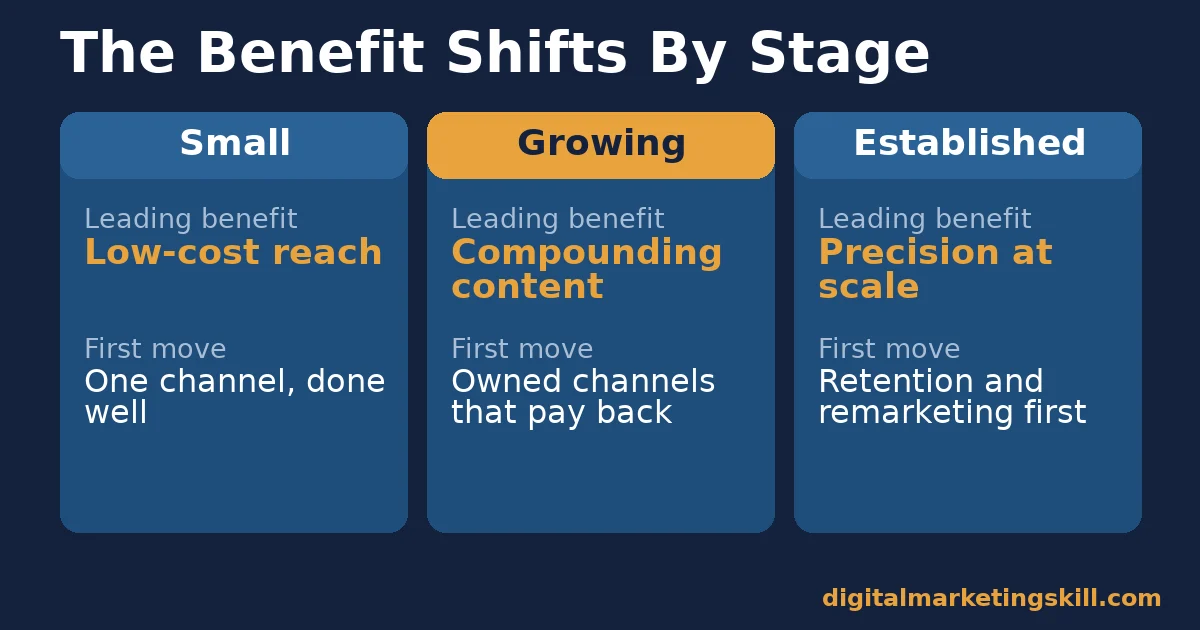
The same list of 13 benefits means something different depending on where a business starts. Three stages cover most real cases: a small business with little budget, a growing business with some traction, and an established brand defending its position.
Solo and Small Businesses: Built for Low-Cost Reach
For a solo or small-team business, the main benefit of digital marketing is that it removes the old capital requirement. A local service business can run a geotargeted ad for a few dollars a day. No newspaper or radio slot ever allowed that.
The trade-off is time, not money. Small businesses usually run their own marketing. So this benefit only shows up if the owner can work one or two channels consistently, rather than spreading effort across five at once.
Customer service is the other benefit small businesses tend to underrate. A direct message or comment reply costs nothing but a few minutes, yet it does the same trust-building work a toll-free phone line used to need a call center to deliver. One owner who replies quickly and personally can out-perform a larger competitor’s slower, scripted support, and that responsiveness becomes a visible, shareable advantage rather than a hidden cost.
Growing Businesses: Built for Compounding Channels
A business with some traction gets a different benefit: compounding. Content, an email list and search visibility keep producing value long after the initial work is done. A paid ad stops the moment spend stops; owned content does not.
This is also where the “free traffic” benefit becomes real, but only for content that actually earns it. Ahrefs’ study found that 96.55% of the pages it analysed get no Google traffic at all. A growing business has to be selective about what it publishes. Publishing in volume is not the same as earning the benefit.
Established Brands: Built for Defending Market Share
For an established brand, the benefit shifts again. Digital marketing becomes less about discovery and more about keeping the customers who already know the brand. It also limits how much of that relationship a cheaper competitor can intercept.
At this stage, the budget pressure Gartner documented starts to bite. A flat or shrinking budget means every channel must justify its share. That is why larger brands lean so heavily on first-party data and retention, rather than broad awareness campaigns.
Personalization is the clearest version of this benefit at scale. An established brand holding years of purchase history can send one customer a different offer than another, automatically, at a volume no human team could manage by hand. However, that precision is only a benefit if the underlying data is accurate and current; a personalization engine built on stale segments wastes the advantage it is supposed to create.
How to Capture the Benefit at Your Stage
Knowing which benefit applies to your stage only helps if you act on it. The sections below mirror the three stages above, with one practical move for each.
Solo and Small Businesses: Lead With One Channel, Measured Weekly
Pick one channel that matches where your customers already look for you. That is usually search or a single social platform. Run it for a full month before you judge it. Track cost per lead every week, not just at the end, so one bad week does not get mistaken for a bad channel.
Resist the urge to be everywhere at once. A small business that does one channel well captures more of the low-cost-reach benefit than one spread thin across five. Our guide on how to increase website traffic breaks down which channels are worth that early focus.
Growing Businesses: Lead With Owned Channels That Compound
Shift part of the budget from pure paid reach into an email list and a small set of evergreen content pieces. These are the assets that keep paying back months after the work is finished. That payback is the real benefit a growing business should chase.
Pair that content with the basics in our guide to search engine optimization. That gives your pages a real chance of joining the small share that earns Google traffic, rather than adding to the 96.55% that do not. Building these content and email skills also overlaps with the core digital marketing skills most employers screen for.
Established Brands: Lead With Retention and Remarketing
Put the next budget increase into retention first: email, loyalty and remarketing to people who already engaged. Add new top-of-funnel spend only after that. Remarketing lets a brand keep showing up to a warm audience at a lower cost than reaching a cold one. It is one of the oldest, and still one of the most reliable, benefits on this list.
Review your budget-to-revenue ratio quarterly against your own past spend, not against one industry average. Gartner’s enterprise figure will not match a mid-size brand’s reality. Our guide to customer retention strategies covers the loyalty side of this in more depth.
How to Measure Whether You Are Getting the Benefits
“Cost-effective” and “measurable” are only real benefits if you track the right numbers. Each metric below is defined in one sentence, with a note on how to read it.
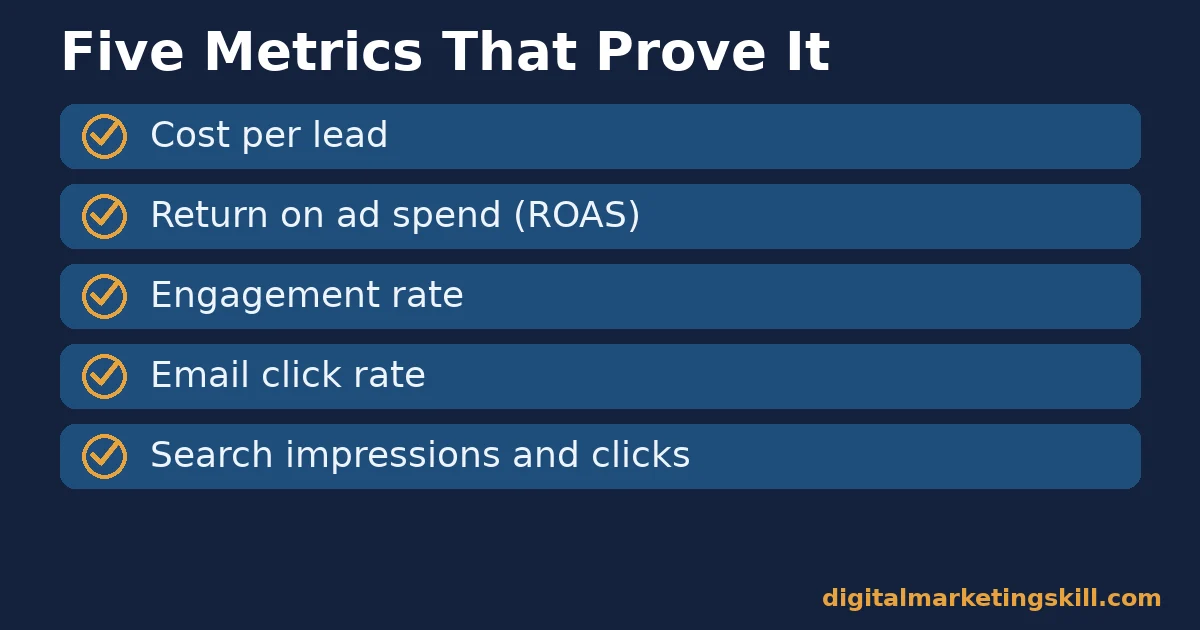
Five Metrics That Show the Benefit Is Real
- Cost per lead. Total spend on a channel, divided by the leads it produced. Compare it against your own past campaigns, not a generic benchmark, because cost per lead varies hugely by industry.
- Engagement rate. The share of sessions Google Analytics counts as “engaged” (10+ seconds, a key event, or 2+ page views). A low rate on a page that is getting traffic usually points to a mismatch between the ad and the content.
- Return on ad spend (ROAS). Revenue generated, divided by ad spend. A ROAS below 1 means the campaign lost money before overhead, so check it first before you scale a channel.
- Email click rate. The share of recipients who click through to your site. This is a more honest read of email performance than open rate, since Apple’s privacy features distort how opens are counted.
- Search impressions and clicks. From Search Console, these show whether a page is starting to earn the organic-reach benefit, as distinct from traffic you pay for.
Reading the Numbers Together
Start with cost per lead and ROAS. Together they answer the core question: is the spend working at all? When those two numbers are healthy but engagement is weak, the problem is usually the page, not the channel.
A different pattern points elsewhere. Rising search impressions with flat clicks usually means a weak title or meta description, not weak content underneath it. Reading the metrics in this order saves time, because it tells you which part of the funnel to fix first.
Review these five metrics on a fixed schedule, weekly for paid channels and monthly for organic ones. Paid spend reacts in days, while search and content benefits build over months.
Write the numbers down every time, even when nothing changed. A flat line across several weeks is itself useful information. It means the channel has plateaued, so the benefit you are chasing now has to come from a change you make, not from waiting.
The One Rule: Measure Before You Multiply Channels
Take one decision rule from this whole benefits of digital marketing guide and make it this one. Do not add a new digital channel until an existing channel is proven profitable on its own numbers. Adding channels without a baseline is the most common way businesses lose the cost-effectiveness benefit they started out chasing.
Here is an illustrative example, with invented numbers. A small business spends $400 a month on one search ad campaign. It tracks 20 leads a month, a cost per lead of $20, converting one in five leads to a $300 sale. That is a healthy return.
So before adding a second channel, the owner doubles the budget on the same campaign and confirms the cost per lead holds steady. That beats splitting the same $400 across three new, unproven channels at once.
A Real Case: A Fast, Self-Reported Return
Joy Akosa, a graduate of the Digital Marketing Skill Institute, is quoted on the Institute’s reviews page as having “achieved over 300% return within 2 weeks of starting, just by implementing what she learnt.”
Read this benefits of digital marketing case with its limits in view. It is one self-reported testimonial, published by the school whose course she took. It was not independently audited, and no dollar figure or channel detail is given alongside the percentage. Two weeks is also too short a window to show whether the return held up over a full quarter.
Treat this case as a sign that fast, measurable results are possible, not as a typical outcome. See the Institute’s earnings disclaimer for the full context on any income or return figures it publishes.
A single testimonial also cannot tell you which of the benefits in this guide produced the result. Was it lower cost, sharper targeting, faster feedback, or some mix of the three? Without that detail, the right way to use this case is as evidence that the benefits are achievable, then go measure your own numbers rather than expecting the same outcome on the same timeline.
Frequently Asked Questions About the Benefits of Digital Marketing
What are the main benefits of digital marketing?
The main benefits of digital marketing are a lower cost of entry than traditional advertising, precise audience targeting, real-time measurement, and reach into a global online population of 6.12 billion people. How much of each benefit a business captures depends on its stage and how consistently it executes.
Is digital marketing really cheaper than traditional marketing?
Often, yes. You can start with a few dollars a day and adjust spend immediately based on results, which print and broadcast advertising never allowed. It is not automatically cheaper if a small budget gets spread across too many channels to judge any one of them properly.
How fast can a business see the benefits of digital marketing?
Paid channels can show cost-per-lead data within days. Organic benefits, like search traffic, usually take months. Ahrefs’ research found most published pages never earn meaningful search traffic at all, so speed depends heavily on which benefit you are chasing.
Do small businesses get the same benefits of digital marketing as large brands?
Not in the same way. Small businesses mostly benefit from low-cost reach and fast feedback. Established brands get more value from retention and remarketing to an audience that already knows them. Gartner’s enterprise budget data will not reflect a small business’s reality.
What is the biggest career-related benefit of digital marketing?
Steady demand for people who can run and measure campaigns. The U.S. Bureau of Labor Statistics projects market research analyst and marketing specialist roles to grow 7% over the decade, adding about 66,300 positions, faster than average for all occupations.
How do you measure the benefits of digital marketing?
Track cost per lead, return on ad spend, engagement rate, email click rate, and search impressions, in that order. Compare each one against your own past performance, not a generic industry number.
Can digital marketing work with almost no budget?
It can produce some benefit, mainly through organic content and search. But Ahrefs’ data shows that 96.55% of pages get no Google traffic. So a near-zero budget strategy needs real selectivity about what gets published, not just volume.
What tools do I need to see these benefits for myself?
None of them are expensive to start. A free Google Analytics and Search Console account covers engagement and search benefits. Your ad platform’s own dashboard covers cost per lead and ROAS. An email platform’s built-in reporting covers click rate. You do not need a paid analytics suite to track the five metrics in this guide.
Put the Benefit That Matches Your Stage to Work
The benefits of digital marketing are real, but they are not generic. Identify which stage your business is in. Pick the one metric from this guide that matters most at that stage. Commit a full month to it before you judge the channel.
If you want structured, hands-on practice with these skills, Digital Marketing Skill Institute teaches them through the Master Diploma in Digital & AI Marketing. The program runs on four AI-powered tracks, including AI-Powered Google Specialist and AI-Powered Social Media Management and Advertising, totalling ten courses, with a Full Stack option covering all four.
It includes unlimited 1-on-1 coaching and mentoring, plus a U.S. Project Internship that comes with a verified U.S. Work Reference Letter. The diploma is dual US and UK accredited and recognised in more than 100 countries.
It is fully online, so you can study from anywhere in your country. Browse more guides on the Digital Marketing Skill Institute blog. When you are ready, apply for the Master Diploma or start from the Digital Marketing Skill Institute homepage.
Every figure in this guide was checked against its original source before publication. Figures marked as illustrative are invented examples, not real results.
