
You can make extra money online through freelancing, gig-platform tasks, affiliate and content income, or teaching what you know. Real survey data shows which path actually pays. In one national survey, 27% of adults had a side hustle. The median was $200 a month, and one in four earned over $500. This guide compares the four real paths and the warning signs of a scam.
Key Takeaways
- Side income is common but modest for most people. A Bankrate survey found 27% of adults have a side hustle. The median income was $200 a month, and only 14% cleared $1,000 a month.
- Skill-based work and spare-time tasks are different markets. Pew Research Center found 16% of adults have ever earned money on an online gig platform. Task and delivery work dominate that category, not skilled freelancing.
- Scams dressed as “jobs” are growing fast. The Federal Trade Commission says task-scam reports have grown roughly fourfold in a single year. They now make up close to 40% of job-scam complaints.
- Skilled freelance work pays closer to a real wage. The Bureau of Labor Statistics puts the median pay for writers and authors at $76,910 a year. That is a useful ceiling for a developed freelance skill.
- The method matters less than the match. Each path below rewards a different resource: skill, spare time, audience trust, or packaged knowledge. The right choice depends on which of those you already have.
In this guide
- What Most “Make Extra Money Online” Guides Skip
- How People Actually Make Extra Money Online
- Four Ways to Make Extra Money Online, Compared
- How to Make Progress on Each Path
- Five Signs a “Make Extra Money Online” Offer Is a Task Scam
- How to Measure Whether It Is Actually Working
- The One Rule: Match the Method to Your Spare Hours
- A Real Case: Turning a Side Skill Into Monthly Income
- Frequently Asked Questions About How to Make Extra Money Online
- Build Extra Income Into a Career, Wherever You Live
What Most “Make Extra Money Online” Guides Skip
Most lists of ways to make extra money online read the same way. Try freelancing. Start a blog. Do surveys. Sell on Fiverr. Repeat. None of that is wrong. But most guides treat every option as equally available to everyone. They rarely say which ones actually produce real income for most people who try them.
This guide groups the realistic options into four paths. It compares what each path needs and pays. It also shows the metrics that tell you honestly whether a path is working, plus the fastest-growing risk in this space: fake “task” job offers that imitate real gig work.
A few ground rules before the data. The Bankrate figures come from one survey of a few thousand adults. Treat them as a snapshot of typical outcomes, not a ceiling on what is possible. The Pew figures describe gig-platform work specifically, not freelancing or content income. Every other number below is attributed to the group that published it, with what it does and does not show.
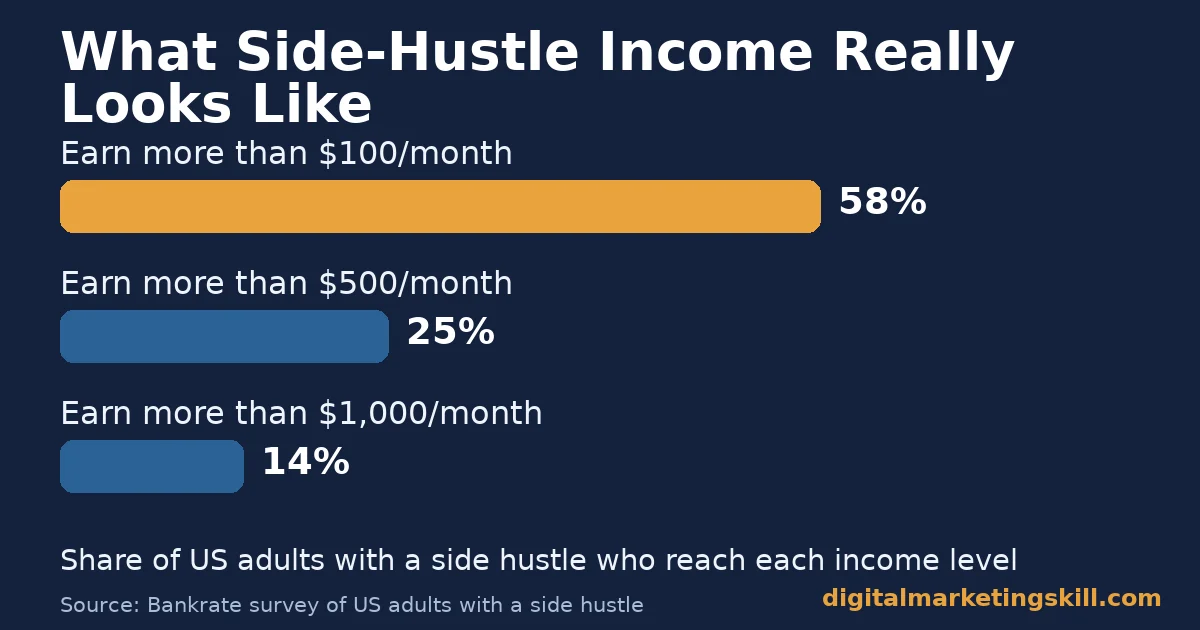
The same survey gives a fuller income picture worth holding onto as you read the rest of this guide. Among people who already have a side hustle, 58% earn more than $100 a month, a quarter earn more than $500, and only 14% clear $1,000. Most people who make extra money online are closer to the first number than the last, at least at first, which is exactly why the method you pick matters.
How People Actually Make Extra Money Online
Nearly every way to make extra money online converts one of four things into cash. It is a skill someone else will pay for, spare time sold by the task, an audience that trusts your recommendations, or knowledge packaged once and sold many times. Confusing these four is why so many people pick the wrong starting point.
Skill-based work pays the most per hour. It also takes the longest to set up, because clients want proof before they pay. Spare-time task work pays the least per hour, but it needs almost no setup. That is why it shows up first in most searches. Audience-based income scales well, but it needs traffic or followers before it earns anything. Packaged-knowledge income needs a real, demonstrable skill, plus the work of building something once.
Once you know which resource you actually have right now, the rest of this guide tells you which path to try first. It also shows what “working” looks like within the first few weeks. People who make extra money online successfully tend to pick one path, measure it honestly, and only then add a second.
Four Ways to Make Extra Money Online, Compared
These four paths cover almost every legitimate way to make extra money online. None of them is passive. All of them take longer to earn well than most ads promise.
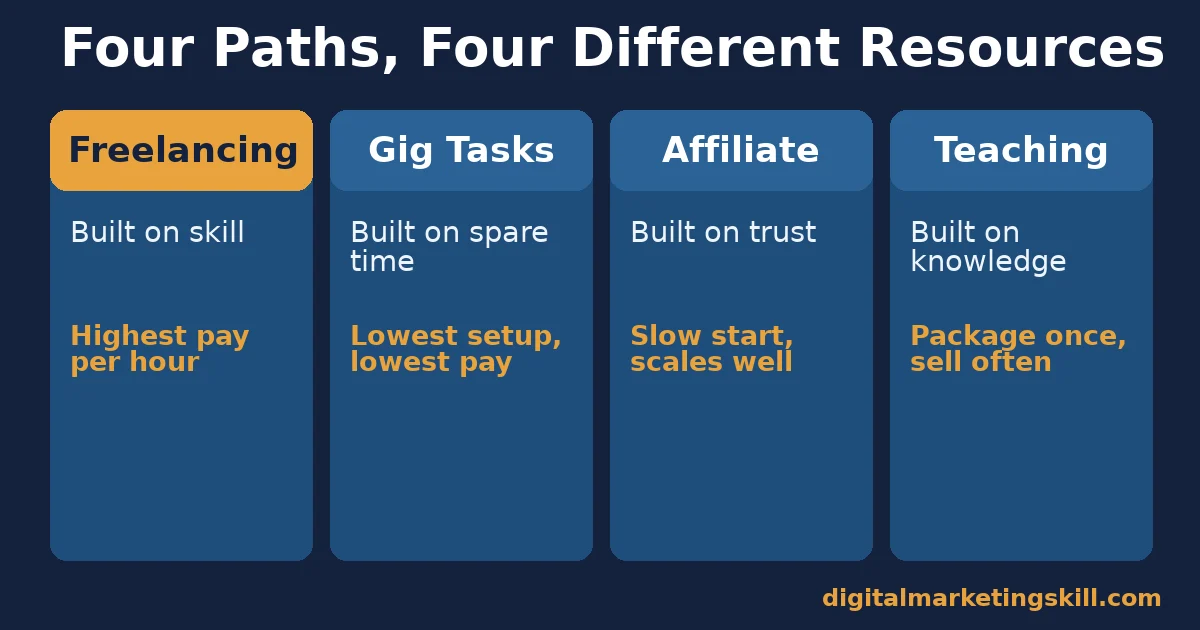
Before picking one, be honest about which resource you actually have spare right now: a provable skill, free hours, an existing audience, or knowledge worth packaging. People usually fail at a path not because the path is bad, but because they started with the wrong resource for their situation. Someone with no audience who jumps straight to affiliate content, for example, is choosing the slowest path first.
Freelancing: Built on a Skill You Already Have
Freelancing means selling a specific, deliverable skill directly to clients. Writing, design, social media management, bookkeeping, virtual assistant support, and website building all count. It pays the closest to a real market wage, because the client is buying expertise, not just time.
The ceiling is genuinely high. The Bureau of Labor Statistics reports a median annual wage of $76,910 for writers and authors, a group that includes many self-employed freelancers. That figure describes a developed, in-demand skill, not a first week of freelancing. The floor is real too: new freelancers with no portfolio often earn far less until they prove their work.
Gig-Platform Tasks: Built on Spare Time, Not Skill
Gig-platform tasks include delivery, rideshare driving, running errands, and similar work booked through an app. Little or no specialised skill is required. Pew Research Center found that 16% of adults have ever earned money this way, and 9% had done so in the past year. Participation is highest among younger adults and those with lower incomes.
This is the easiest path to start, and it pays the least per hour. The barrier to entry is low for everyone else too, which keeps pay down. It suits people with unpredictable free hours who want cash quickly, more than people trying to replace a skilled income.
Affiliate and Content Income: Built on Audience Trust
This path earns commissions or ad revenue by recommending products, running a blog, or posting content an audience follows, in the way our step-by-step guide to starting affiliate marketing describes. It is the slowest path to any income at all, because it needs real traffic or followers before a single sale happens. It is also the fastest path to scale once that audience exists.
Trust is the actual product being sold here. An audience that stops trusting your recommendations stops clicking them. So this path rewards patience and consistency over any single clever post.
Teaching and Digital Products: Built on What You Know
Online tutoring, coaching, and digital products such as templates, guides, or short courses turn a skill you already have into something sold once and delivered many times. This path needs real, demonstrable expertise. Buyers are paying for an outcome, not your time.
It has the best long-term economics of the four. The work of creating the product happens once. But it also has the longest lead time before the first sale, because the product and the proof that it works both need to exist first.
How to Make Progress on Each Path
Each path above rewards a different first move. Pick the path that matches the resource you have right now, not the one that looks most exciting. Then start with the move below.
Freelancing: Lead With a Narrow Portfolio
Build three to five real samples in one specific skill, such as product descriptions or Instagram captions. Skip the broad “I can do anything” profile. Our guide to becoming a freelance writer shows what that looks like for writing specifically. Clients hire specialists faster than generalists, because a narrow sample proves you can do their exact job. Our guide to getting clients as a freelancer covers where to find that first paying client once the samples exist.
Gig Platforms: Lead With Your Real Hourly Rate
Track your actual earnings against every hour spent. Count the time waiting between tasks, plus any cost of fuel, data, or a vehicle. Gig-platform pay looks higher per task than it is per hour once those costs are counted. Do this calculation after your first week, not before you start.
Affiliate and Content: Lead With One Trusted Topic
Choose one specific topic you can speak about honestly and repeatedly. Do not chase whatever trend is popular this week. Google’s own guidance on helpful, people-first content asks whether a reader will leave your page feeling they learned enough to reach their goal. Content that fails that test rarely earns repeat visits or repeat commissions.
Teaching and Digital Products: Lead With a Single Offer
Package one outcome, such as “learn to set up your first online store.” Skip the vague bundle of everything you know. A single, specific offer is easier to describe, price, and say yes to than a broad one. Our guide to becoming a virtual assistant shows a similar approach: start with one or two clear services before expanding.
Five Signs a “Make Extra Money Online” Offer Is a Task Scam
Fake job offers now imitate real gig and task work closely. The Federal Trade Commission has issued repeated warnings about them. Reports of these “task scams” have grown roughly fourfold in a single year. They made up close to 40% of all job-scam reports the agency received in that period. Crypto-related losses alone reached tens of millions of dollars.
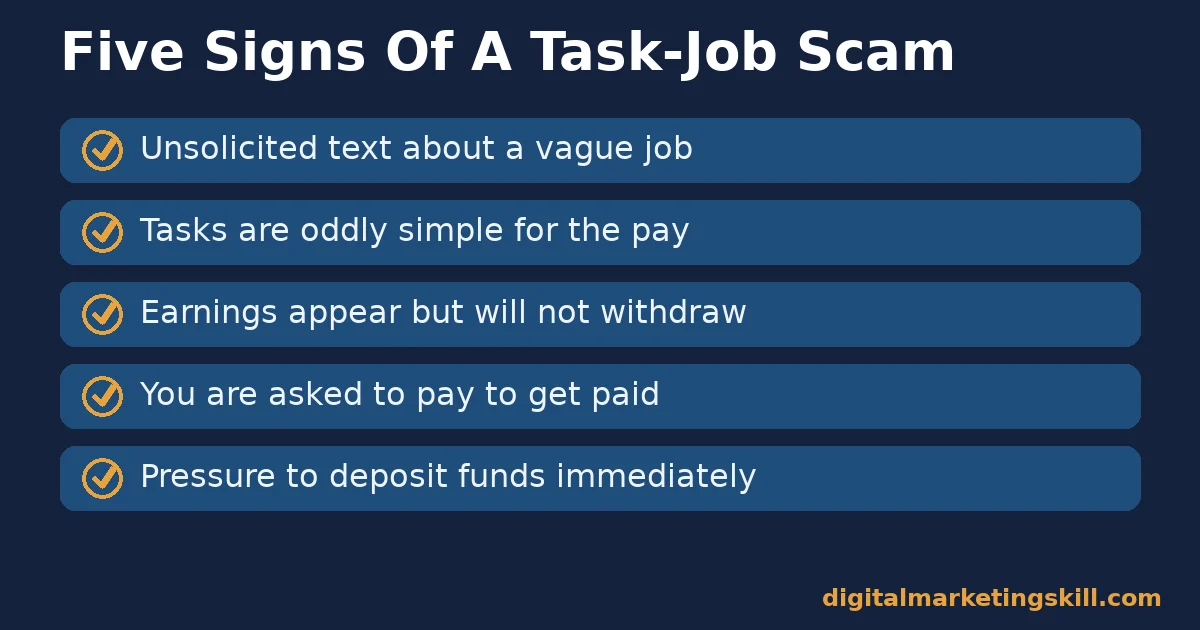
- You are contacted out of the blue by text or messaging app about a vague “job opportunity” you never applied for.
- The tasks are oddly simple, such as liking videos, rating products, or “testing” an app, for a supposed per-click commission.
- Your dashboard shows earnings you cannot withdraw until you unlock them somehow.
- You are asked to pay to get paid. The FTC is direct about this one. Being told to send money, usually in cryptocurrency, to release money you have “earned” is a sure sign of a scam.
- There is pressure to act fast, with claims that the opportunity, bonus, or slot will disappear if you do not deposit funds immediately.
If you spot any of these signs, stop, and do not send money. You can report a suspected scam at ReportFraud.ftc.gov, as the FTC’s own consumer alert on task scams explains. Any legitimate way to make extra money online pays you for finished work; it never asks you to pay first.
How to Measure Whether It Is Actually Working
Side income is easy to overestimate. It is tempting to count gross payouts and ignore the hours and costs behind them. These four numbers tell you the truth after the first few weeks.
Four Numbers That Tell You the Truth
- Effective hourly rate. Total payout for a period, divided by every hour spent. Count unpaid searching, waiting, and admin time too. This is the single most honest number on this list.
- Break-even time. How many paid hours or sales it takes to cover any upfront cost, such as software, a course, or driving expenses, before the work turns a real profit.
- Repeat-client or repeat-buyer rate. The share of clients or buyers who come back without you finding them again. A rising repeat rate means the work is becoming a real business, not a one-off task each time.
- Conversion rate. For affiliate or content income, the share of visitors or followers who click a link or make a purchase. This shows whether an audience trusts your recommendations, separate from how large it is.
Reading the Numbers Together
Read these four together, not alone. A high effective hourly rate with a falling repeat rate often means the work will not last. A long break-even time paired with a strong, rising repeat rate can still be worth finishing. The cost is then a one-time hurdle, not an ongoing drag.
Here is a worked, illustrative example of why the first number matters most. Someone earns $150 from a gig-platform task in a week that also cost them four hours of unpaid waiting between jobs, on top of six paid hours. Their effective hourly rate is $15, not the $25 their paid hours alone would suggest. Running that same math on a freelance client, where the quoted price already reflects the full job, usually shows a smaller gap between the headline number and the real one.
By the end of a few weeks of honest tracking, most people can say with real confidence whether their chosen path to make extra money online is worth the hours it takes, rather than guessing from gross payouts alone.
The One Rule: Match the Method to Your Spare Hours
Here is the single most useful rule in this guide. If your spare time comes in short, unpredictable blocks, choose gig-platform tasks or a narrow freelance service you can deliver quickly. If your spare time comes in longer, consistent blocks, choose content, affiliate, or teaching work instead, since those paths need sustained effort before they pay anything at all.
Here is an illustrative, invented example. Someone with four unpredictable hours a week, spread across odd evenings, will likely earn more, sooner, driving deliveries or taking short freelance gigs. Starting a blog needs months of consistent posting before its first commission, which does not fit that schedule. Someone with the same four hours in one fixed weekly block is better placed to build that blog instead. Consistency matters more than the total time.
A Real Case: Turning a Side Skill Into Monthly Income
Olajire Jacob, a graduate of the Institute’s Master Diploma programme, built freelance email marketing services into a reported $5,000 a month. This is described on the Institute’s own student reviews page. The path matches the freelancing model above. One specific, in-demand skill, delivered to paying clients, scaled over time rather than overnight.
Results like this are not typical. The Institute’s earnings disclaimer is clear that outcomes depend on the person, the market, and the work put in. Treat this case as evidence that the freelancing path can scale, not as a guarantee of what any specific effort will produce.
Frequently Asked Questions About How to Make Extra Money Online
How much can I realistically make extra money online in my first month?
Expect modest income at first. Bankrate’s survey found a median of $200 a month across all side hustlers, including people who have done this for years. A first month is often lower than that. Income tends to rise as a portfolio, audience, or client list builds.
Which way to make extra money online pays the most per hour?
Skilled freelance work generally pays the most per hour, once a portfolio and client base exist. The Bureau of Labor Statistics median for writers and authors sits well above typical gig-platform pay. Gig-platform tasks pay the least per hour, but they need no skill or setup time.
Earnings from selling digital products can vary widely. A template or short guide might sell for a few dollars or a few hundred. Once it is built, it can be sold repeatedly with little extra effort.
Do I need money to get started?
Most of the four paths need little or no upfront money, only time. A free portfolio page, a free gig-platform sign-up, or a free blog all work as a start. Weigh any paid tool, course, or vehicle expense against your break-even time before you commit to it. Once the income is real, check the IRS guidance on self-employment tax or your own country’s equivalent. Side income is usually taxable, even when it is paid informally.
Is it true that I have to pay a fee to receive my earnings?
No. The FTC is explicit on this point. Being asked to pay money, especially in cryptocurrency, to “unlock” earnings you have supposedly already made is a scam. It is never a normal part of a legitimate platform.
How do I know if an online job offer is legitimate?
Be cautious of unsolicited messages about vague jobs. Watch for tasks that are suspiciously simple for the pay offered, and any request to pay before you can withdraw money. Legitimate freelance and gig platforms never ask you to pay to release your own earnings.
Can I do more than one of these paths at the same time?
Yes, and many people do. The one rule above still applies to each path separately though. A content or teaching path running alongside a freelancing or gig-platform path is common. The first needs long, consistent effort, while the second can fill shorter, unpredictable gaps.
What is the single biggest mistake people make trying to make extra money online?
The most common mistake is picking a path that does not match the free time or resource they actually have, then giving up when it does not pay quickly. Someone with scattered, unpredictable hours who starts a blog expecting fast income is set up to quit before the audience-building work pays off. Match the method to your situation first, using the one rule above, and most of the frustration disappears.
Build Extra Income Into a Career, Wherever You Live
The freelancing path above has the clearest route from side income to a full career. The same skills that earn a first client can carry a lifetime of paid work, anywhere in your country or beyond.
The Digital Marketing Skill Institute’s Master Diploma in Digital & AI Marketing builds exactly those in-demand skills. It covers AI-powered lead generation, content creation, and social media marketing, with unlimited one-on-one mentoring and real project work inside a U.S. partner company from day one. The programme is dual US and UK accredited, recognised in more than 100 countries, and entirely online, so it works wherever you live.
See real outcomes on the student reviews page. Explore the Master Diploma programme in full, or browse more guides on the digital marketing blog. Visit digitalmarketingskill.com to see the full range of courses. When you are ready, apply here to get started from digitalmarketingskill.com.
Every figure in this guide was checked against its original source before publication. Figures marked as illustrative are invented examples, not real results.
