You become a virtual assistant by pairing one in-demand skill with a narrow client niche, then pricing by outcome instead of hours. Most guides list generic tasks and stop there. They never explain which tasks actually pay well.
This guide shows how demand and pay differ once you become a virtual assistant in a general role versus a specialized one. It also gives one pricing rule to use from your first client, and a five-step path to your first paying contract.
Key Takeaways
- Freelancing is now mainstream work, not a side hustle. Upwork’s Freelance Forward report found 38% of the US workforce, about 64 million people, freelanced in the past year. This is US data only.
- Skilled services dominate freelance income. The same Upwork report found 47% of freelancers, roughly 30 million people, provided knowledge-based services such as marketing, IT and business consulting rather than manual or administrative work alone.
- Specialized skills change your ceiling once you become a virtual assistant. Payoneer’s global freelancer survey of 7,000+ freelancers across 150+ countries found a worldwide average hourly rate of $21. It noted that the most popular fields do not pay the most once supply is high.
- Traditional admin roles are shrinking while outsourced skilled work grows. The US Bureau of Labor Statistics projects in-office secretary and administrative assistant roles to fall 2% over the coming decade. Meanwhile, Deloitte’s Global Outsourcing Survey of 500+ executives found 50% now outsource front-office work like sales, marketing and research.
- Remote flexibility is the top job factor for workers. FlexJobs’ State of the Workforce report found 81% of respondents rank remote work as their most important job factor, ahead of salary.
In this guide
- What Most Advice on How to Become a Virtual Assistant Gets Wrong
- How Virtual Assistant Work Actually Functions
- Pay and Demand Differ by Skill Tier
- How to Become a Virtual Assistant in Each Tier
- Five Steps to Becoming a Virtual Assistant
- The Tools You Need to Become a Virtual Assistant
- The Most Useful Rule: Price the Outcome, Not the Hour
- How to Measure Progress as a Virtual Assistant
- An Illustrative Case: Moving From Admin to Specialized Work
- Frequently Asked Questions About How to Become a Virtual Assistant
- Start With One Skill, Not a Long Service List
What Most Advice on How to Become a Virtual Assistant Gets Wrong
Most guides on how to become a virtual assistant list dozens of possible tasks. Inbox management, calendar scheduling, social media posting. Then they tell you to “pick what you enjoy.” That advice skips the part that actually determines your income. It never explains which tasks clients pay a premium for, and which ones are commoditized because thousands of other virtual assistants offer the same service.
This guide fills that gap. It explains how VA work is structured, why pay differs sharply between general admin tasks and specialized skills, and what to do differently depending on which tier you start in. The figures below come from named surveys. Read US figures as US-only and worldwide figures as broad averages, not a guarantee of your own rate.
How Virtual Assistant Work Actually Functions
A virtual assistant is a self-employed contractor who delivers defined tasks for a client remotely. Pay usually comes hourly, by retainer or by project. Unlike an employee, a VA sets their own hours, works with multiple clients, and carries their own tools and taxes. The client relationship runs on scope: a clear list of what you deliver, by when, and how success is judged.
Demand comes from two directions. Businesses outsource tasks they need done but do not want to hire full-time staff for. They also outsource skills they do not have in-house at all. The first type of task competes on price and reliability. The second competes on expertise, which is why the two tiers below pay so differently once you become a virtual assistant inside either one.
Understanding which direction a client’s demand comes from, before you pitch, tells you how much room there is to negotiate rate.
Virtual Assistant vs. Employee: Why the Difference Matters
An employee is paid for time inside a fixed role. The employer sets the schedule and provides the tools. A virtual assistant is paid for a defined deliverable instead. They set their own schedule and often serve several clients at once. This difference matters for pricing: a VA who still thinks like an hourly employee under-prices work that could be billed by outcome.
It also matters for growth. An employee’s income is capped by one employer’s budget. A VA’s income is capped only by how many clients they can serve and how much each client will pay. This is why specialization raises the ceiling faster than adding more hours. If you are weighing the two paths directly, our guide to remote versus in-office work compares them for digital marketers specifically.
Pay and Demand Differ by Skill Tier
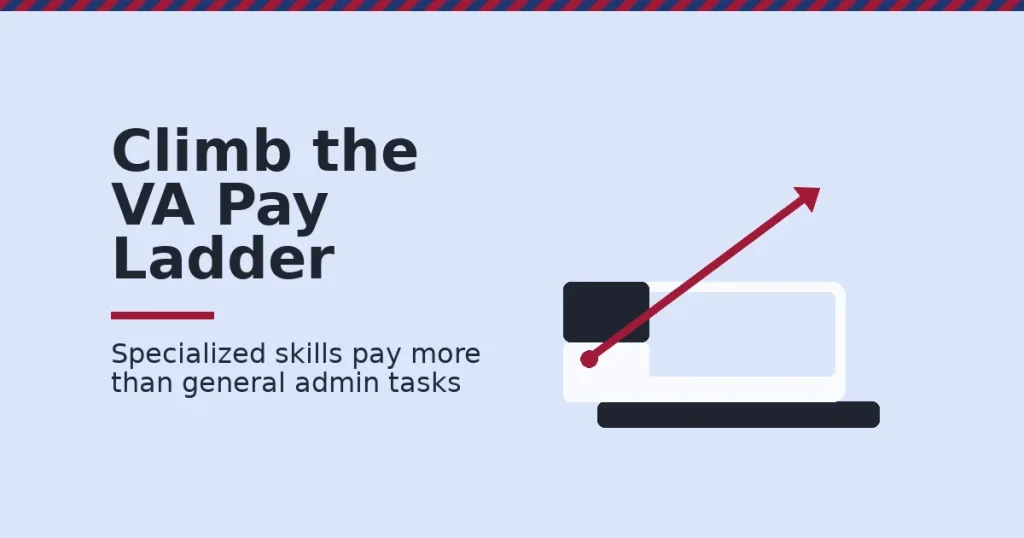
Not all virtual assistant work pays the same, and the reason is supply, not effort. General admin tasks have a huge pool of capable people who can do them, so clients can shop on price. Specialized skills have a smaller pool, so clients pay more to secure them. Knowing which pool you are competing in changes how you should price and pitch your services.
General Admin VAs: Built for Volume, Not Premium Pay
General admin work includes inbox management, calendar scheduling, data entry and basic customer support. It is the easiest tier to enter because it needs little specialized training. That ease is also why it is the most price-competitive. The US Bureau of Labor Statistics found the median pay for in-office secretaries and administrative assistants was $48,310 a year, or $23.23 an hour, slightly below the US median for all occupations.
The same data shows why this tier is shrinking inside traditional offices. In-office roles are projected to fall 2% over the coming decade as software lets staff handle their own documents. The work has not disappeared, though. It has moved to remote, flexible delivery, which is exactly where someone who chooses to become a virtual assistant can step in.
Specialized VAs: Built for Fewer Clients, Higher Rates
Specialized work includes social media management, email marketing, bookkeeping, e-commerce operations and basic SEO or paid ad support. These skills take longer to learn, but they face far less price competition because fewer VAs can do them well. Deloitte’s Global Outsourcing Survey found that half of surveyed executives now outsource front-office work like sales, marketing and research, not just back-office admin.
Specialized VAs also benefit from the mainstreaming of freelance work overall. Upwork’s research found 47% of US freelancers, around 30 million people, deliver knowledge-based services rather than manual tasks. That is a sign that clients increasingly expect to buy skilled remote help instead of hiring locally. If you are weighing the independence of this path against staying employed, our guide on how to transition to freelancing covers the practical steps.
How to Become a Virtual Assistant in Each Tier
Each tier needs a different first move when you are starting out. Match your approach to the tier you are actually entering, not the one you hope to reach eventually.
General Admin: Lead With Reliability and Range
If you are starting in general admin, compete on dependability and breadth rather than price alone. Offer a tight bundle of related tasks, such as inbox triage plus calendar management plus basic bookkeeping. One client can then replace several part-time helpers with you alone.
Treat this tier as a launchpad, not a destination. Use the client relationships and income here to fund training in one specialized skill. Then shift your marketing toward that skill once you can show real client results.
Specialized: Lead With One Proven Skill
If you already have a marketable skill, such as social media management or email marketing, lead with that single skill in your pitch instead of a long list of services. Clients hiring for expertise want a specialist, not a generalist who also does that task on the side.
Build one small portfolio piece before you pitch. Even an unpaid result for a friend’s business or your own practice account counts. A specific, demonstrated result beats a long list of claimed skills every time. Practicing real social media content promotion on a sample account is a fast way to build that first proof point.
Five Steps to Becoming a Virtual Assistant
Once you know your tier, this sequence turns interest into paying clients.
- Audit your current skills against real demand. List what you already do well. Then check which of those skills appear repeatedly in VA job posts and freelance platform listings. If you are not sure where your gaps are, our guide to how to upskill in digital marketing covers how to assess and close them. Overlap between what you know and what clients want is your starting point.
- Pick one narrow niche, not a broad service menu. “Virtual assistant for online course creators” attracts better clients than “general virtual assistant.” A narrow niche signals you understand their specific problems.
- Set up the minimum viable business. A simple contract template, an invoicing method and a dedicated email address are enough to start. You can add formal business structure once income is steady.
- Land your first client through your existing network. Former colleagues, past employers and personal contacts convert faster than cold platform applications, because trust is already established.
- Turn the first result into proof. Ask for a short testimonial or a specific number, such as hours saved or messages answered. Use it in every future pitch once you officially become a virtual assistant for paying clients.
The Tools You Need to Become a Virtual Assistant
You do not need an expensive software stack on day one. A handful of free or low-cost tools cover almost every task a new VA takes on, and you can add specialized tools as your niche becomes clearer. Most clients care more about how reliably you use a tool than which specific brand it is, so pick one option per category and learn it well rather than collecting subscriptions you rarely open.
- A shared calendar and scheduling tool. This lets clients book time with you and lets you manage their calendars without constant back-and-forth emails.
- A project or task tracker. A simple board with columns for to-do, in progress and done keeps you and the client aligned on what is happening and when.
- Shared access through a password manager. Clients need to hand over logins safely, and a password manager avoids sending credentials over email or chat.
- A time-tracking tool, even if you bill flat fees. Tracking your actual hours tells you whether a flat-rate retainer is still profitable as your efficiency improves.
- A simple invoicing and contract tool. This formalizes the relationship from the first project, which protects both you and the client if expectations drift.
Add tools specific to your specialized tier only once you have a client who needs them. Buying a full suite of marketing software before you have a marketing client wastes money you could spend on training instead.
The Most Useful Rule: Price the Outcome, Not the Hour
If you remember one decision rule from this guide, make it this one. New virtual assistants almost always price by the hour because it feels safe. Hourly pricing punishes you for getting faster, though, and caps your income at the number of hours in a week.
Instead, price by the outcome the client actually values: a managed inbox, a published content calendar, a set number of social posts scheduled. Outcome pricing lets you raise rates as you get more efficient, without having to justify every hour to the client.
Here is an illustrative example, with invented numbers. A VA charging $20 an hour spends six hours a week managing a client’s inbox and calendar, earning $120 a week. After three months she streamlines the process to three hours using templates and filters.
Hourly pricing would cut her pay to $60 unless she raises her rate. Switching to a $150 flat weekly retainer for the same outcome protects her income instead, and it keeps rewarding her as she gets faster at the work.
How to Measure Progress as a Virtual Assistant
Track your business with the same discipline you would want from a client. Each metric below is defined in one sentence, with a note on how to read it.
Five Numbers That Show Your VA Business Is Working
- Effective hourly rate. Total pay from a retainer or project divided by the hours it actually took. Rising effective rate over time shows your pricing is catching up with your skill.
- Client retention. The share of clients still with you after three months. Low retention usually means a scope or communication problem, not a pricing one.
- Pipeline coverage. How many months of income are booked versus how many months you are actively pitching for. Thin coverage means it is time to prospect, not relax.
- Niche concentration. The share of your clients in your chosen niche. Rising concentration shows your positioning is working and referrals are compounding.
- Rate growth per client cycle. How much your rate increases each time you replace a client or renew a contract. Flat rate growth signals it is time to raise prices or change your niche.
Review these monthly when you are under five clients, since early-stage swings are large. Move to quarterly review once your client base is stable.
An Illustrative Case: Moving From Admin to Specialized Work
Here is an illustrative case, with invented numbers, showing the tier shift in practice. A new VA starts with three general admin clients paying $18 an hour each. That totals about $1,500 a month for inconsistent hours.
Over four months, she uses two of those clients as case studies to learn and document basic social media management. She then pitches a fourth client specifically on that skill at a $600 monthly retainer. She keeps one admin client for stability and drops the other two. Within six months, she replaces them with two more social media retainer clients, roughly doubling her income on fewer total hours.
The lesson is not that admin work is worthless. Admin clients funded the transition into specialized work that pays more per hour. That is the path the two-tier model above predicts for anyone who decides to become a virtual assistant and then move up tiers deliberately.
Frequently Asked Questions About How to Become a Virtual Assistant
Do I need a certification to become a virtual assistant?
No certification is required to start, since clients care about results, not credentials. That said, structured training in a specialized skill, such as social media management or bookkeeping, shortens the time it takes to reach specialized-tier pay and gives you a portfolio piece to show.
How much can a virtual assistant earn?
It depends heavily on tier and location. Payoneer’s global freelancer survey found a worldwide average hourly rate of $21 across all freelance fields. US-specific administrative pay sits near $23 an hour per Bureau of Labor Statistics data. Specialized skills typically earn more than general admin work.
What is the fastest way to find my first virtual assistant client?
Your existing network. Former colleagues and past employers already trust your work, so they convert into paying clients faster than cold applications on freelance platforms.
Should I specialize or stay general when I become a virtual assistant?
Start general if you need income quickly, but plan to specialize. General admin work faces more price competition. Specialized skills like marketing or bookkeeping face less, which raises your ceiling.
Is virtual assistant work disappearing because of AI tools?
Traditional in-office administrative roles are projected to shrink, per Bureau of Labor Statistics data. Demand for outsourced, skilled remote support is rising instead, per Deloitte’s outsourcing research. The work is shifting tier and location, not vanishing.
How many clients should a virtual assistant have?
There is no fixed number, since it depends on scope per client. Track pipeline coverage and retention instead of a target client count. Add clients only when you can serve them without missing deadlines.
Can I become a virtual assistant with no prior digital marketing experience?
Yes. Start in general admin to build client-handling experience and income. Then use that base to fund training in a specialized skill like social media management or email marketing.
How long does it take to become a virtual assistant and land a first client?
Most people who build a simple contract, pitch their existing network and stay in a narrow niche land a first client within four to eight weeks. The timeline stretches when the niche is too broad or the first pitches go to strangers instead of warm contacts.
What is the biggest mistake new virtual assistants make?
Listing too many services at once. A long menu signals you are a generalist competing on price, which pushes you toward the general admin tier even if you have specialized skills. Naming one clear service attracts better clients and higher rates.
Start With One Skill, Not a Long Service List
You become a virtual assistant successfully by narrowing before you widen. Pick one skill that already overlaps with real demand. Pitch it to your existing network first, and turn your first result into proof before you add a second service.
If you want structured training in the specialized skills that pay more, Digital Marketing Skill Institute teaches them hands-on inside the Master Diploma in Digital & AI Marketing. The program is built from four AI-powered tracks totalling ten execution-first courses: AI-powered social media management and advertising, AI-powered lead generation and email automation, AI-powered Google specialist work, and AI-powered WordPress and SEO, with a Full Stack option for completing all four.
It includes unlimited 1-on-1 coaching and mentoring and a U.S. project internship with a verified U.S. work reference letter, useful proof when you pitch your first specialized clients. The diploma is dual US and UK accredited and recognized in more than 100 countries, fully online, so you can train from anywhere in your country on your way to becoming a virtual assistant with real, marketable skills.
Explore more guides on the Digital Marketing Skill Institute blog, read real outcomes on reviews, and when you are ready, apply for the Master Diploma or start from the Digital Marketing Skill Institute homepage.
Every figure in this guide was checked against its original source before publication. Figures marked as illustrative are invented examples, not real results.