
To become a digital marketer, you need three things: one real skill you can prove, one piece of work you can show, and a clear read on what employers actually pay for right now. This guide names all three, with the evidence behind them, instead of another generic step list.
Key Takeaways
- Marketing specialist roles are projected to grow 7% through the next decade in the US, per the Bureau of Labor Statistics, with about 82,000 openings a year.
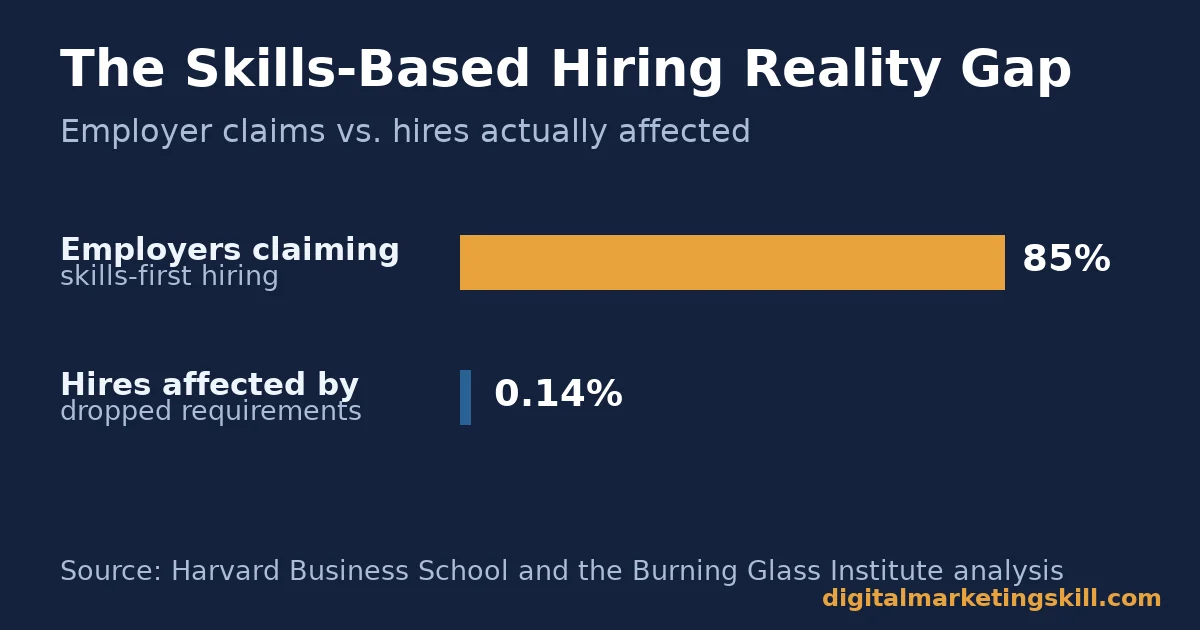
- 85% of employers say they prioritize skills over degrees. Harvard Business School and the Burning Glass Institute found only 3.6% of roles actually dropped degree requirements. Fewer than 1 in 700 hires were affected.
- Performance analysis and AI literacy are the two fastest-growing marketing skills, per LinkedIn’s Skills on the Rise data. Both now belong on a beginner’s first skill list, not a “someday” list.
- More than 6 billion people now use the internet worldwide, per DataReportal’s analysis. That is the scale of audience a new digital marketer learns to reach.
- Which path you take in, a course, self-study or a related job, matters less than finishing one real project before you apply anywhere.
In this guide
- Most “How To Become A Digital Marketer” Guides Skip The Evidence
- How Digital Marketing Hiring Actually Works Right Now
- Three Paths To Become A Digital Marketer
- What To Lead With On Each Path
- Common Mistakes People Make Trying To Become A Digital Marketer
- How To Know If You’re Actually Job-Ready
- The One Rule: Ship Before You Apply
- What Doing This Right Looks Like
- Frequently Asked Questions About How To Become A Digital Marketer
- Start With One Project, Not One More Course
Most “How To Become A Digital Marketer” Guides Skip The Evidence
Search how to become a digital marketer and you get the same five steps everywhere: learn the basics, pick a specialty, build a portfolio, network, apply. None of that advice is wrong. None of it tells you which step actually gets you hired.
What “experience” means for a role you’ve never held usually goes unexplained too. That gap is where most beginners get stuck. They repeat the same advice without a way to tell if they are making real progress toward a first job.
The missing piece is evidence: what is actually growing, what skills employers reward right now, and what a real first project looks like. This guide fills that gap. Treat it as a snapshot, not a permanent ranking, because what is true about entry-level hiring shifts as fast as the tools themselves.
How Digital Marketing Hiring Actually Works Right Now
Two things are true at once, and most guides only tell you one of them. First, demand is real. Marketing specialist and research roles are projected to grow 7% over the next decade in the US, well above the average occupation. That is per the Bureau of Labor Statistics, which also counts roughly 82,000 openings a year in the field.
Second, the “skills over degrees” story is overstated. Harvard Business School and the Burning Glass Institute’s analysis found that only 3.6% of roles actually removed degree requirements over a recent nine-year stretch.
Even where they did, fewer than 1 in 700 new hires were affected. Employers talk about skills-based hiring more than they practice it. A beginner who assumes the door is wide open can be caught off guard by how much proof is still expected in practice.
What this means in practice: a credential alone rarely opens a door. Skill alone, with nothing to show for it, doesn’t either. What actually moves a hiring decision is proof: a real project, a measurable result, a specific tool you can operate on day one.
AI Literacy Moved From Edge To Baseline
AI literacy is part of that proof now. LinkedIn’s Skills on the Rise data lists it as the second-fastest-growing marketing skill, right behind performance analysis. That ranking shift matters: AI literacy has moved from differentiator to baseline expectation in the space of a year or two.
A beginner who skips it is already behind before applying. That does not mean memorizing every new AI tool. It means being able to use one well enough to speed up a real task, like drafting ad copy variations or summarizing campaign data, and explain what you checked before trusting the output.
Where The Demand Actually Sits Right Now
Demand is not evenly spread across digital marketing. More than 6 billion people are online worldwide. Most of their attention concentrates on a small number of platforms and search engines.
That concentration is why performance analysis and SEO fundamentals, documented directly by Google’s own Search Central documentation, keep showing up as foundational rather than optional in entry-level job postings.
Paid advertising follows the same pattern. Platforms like Meta’s Business Help Center publish their own targeting and measurement documentation, and employers increasingly expect candidates to have read it directly rather than only through a secondhand course summary.
Three Paths To Become A Digital Marketer
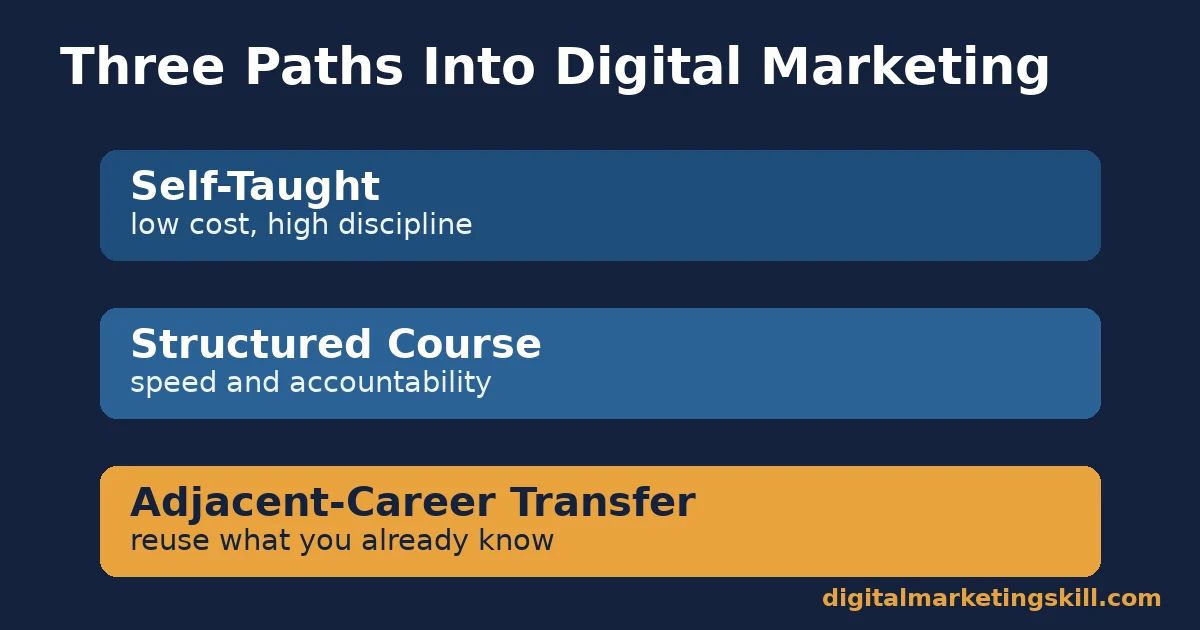
Almost everyone who sets out to become a digital marketer takes one of three paths in. None is inherently better than the others. Each is built for a different starting point and a different budget of time or money.
The Self-Taught Path: Built For Low Cost And High Discipline
Free platform documentation, official certifications and public case studies can teach the fundamentals of SEO, paid ads and content at little or no cost. The tradeoff is structure. Without a curriculum or a deadline, momentum is easy to lose.
There is also no one checking whether what you built actually works, which means mistakes can go uncorrected for months. This path rewards people who are comfortable setting their own milestones and asking for feedback instead of waiting for it.
It suits someone with more time than money: a student, a career-changer still employed elsewhere, or anyone testing interest before committing a budget. The risk for anyone trying to become a digital marketer this way is drifting for a year without a finished project to show for it.
The Structured Course Path: Built For Speed And Accountability
A guided course compresses the learning curve with a sequence, feedback and a deadline. It costs money and time upfront. In exchange, you get a finished portfolio piece, coaching on what employers specifically ask for, and fewer dead ends than self-teaching through trial and error.
The tradeoff runs the other way from self-study: less flexibility. The cost only pays off if you actually finish and apply what you learned, rather than collecting another certificate and stopping there.
It suits someone who needs a hard deadline to stay consistent. It also suits anyone who tried self-teaching before and stalled without feedback. The risk here runs the opposite direction from self-study: paying for structure, then still not finishing the one project that proves it worked.
The Adjacent-Career Transfer Path: Built For Reusing What You Already Know
Sales, customer support, writing, teaching and admin roles all build skills digital marketing uses directly: persuasive writing, reading data, managing a calendar of deliverables, talking to customers under pressure.
This path is fastest when the transferable skill is named explicitly in applications, not left for a hiring manager to infer from a job title that looks unrelated on paper.
What To Lead With On Each Path
Picking a path is easy. What you do first on it decides whether it actually leads anywhere.
Self-Taught: Lead With One Finished Project, Not Ten Half-Started Ones
Pick one channel and one small business, cause or personal project you can genuinely help. Finish a complete campaign for it: a content calendar, three real ads, or a full SEO audit with fixes. One finished project beats five abandoned courses on a resume every time.
Structured Course: Lead With The Assignment You Can Show A Stranger
Not every course assignment belongs in a portfolio. Pick the one piece of coursework a stranger could look at and immediately understand: what you did, why you did it, and what happened. Polish that one piece instead of submitting everything you made.
Adjacent Career: Lead With A Translation, Not A Reset
Rewrite your existing resume in marketing language before you apply anywhere. “Resolved customer complaints” becomes “managed client communication and retention.” Don’t present yourself as starting from zero when you are not; frame prior experience as a head start, not a blank slate.
People who transfer in from sales or support often become a digital marketer faster than expected. They skip the step everyone else struggles with: talking to real customers under real pressure. That skill transfers directly to campaign messaging and client reporting.
Common Mistakes People Make Trying To Become A Digital Marketer
Three habits quietly slow people down more than any skill gap does.
- Learning everything before applying to anything. Waiting to feel “ready” across every channel delays your first real feedback, which is the fastest way to actually get ready. Apply once you can do one thing well, not ten things adequately.
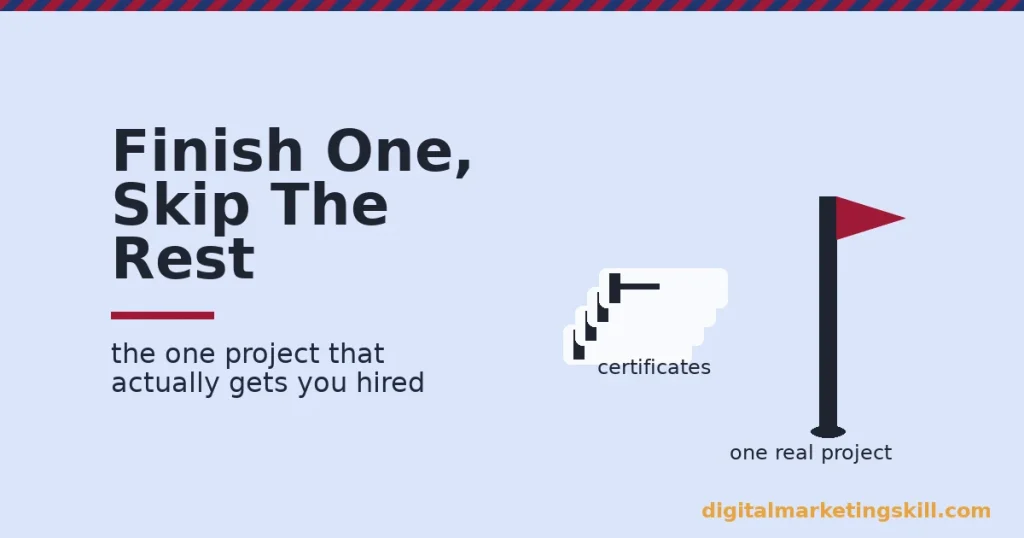
- Treating certificates as the finish line. A certificate proves you sat through material. A project proves you can use it. Employers weigh the second far more than the first, per the evidence on what actually moves hiring decisions above.
- Specializing too early or never specializing at all. Going deep in nothing leaves you generic. Locking into one niche before you’ve tried the others can close doors you didn’t need to close yet. Sample two or three areas before committing to one.
None of these fixes cost money. They cost a willingness to apply before you feel fully ready, and to finish one thing instead of starting several.
A fourth, quieter mistake compounds the first three: comparing your unfinished work to someone else’s finished portfolio online. That comparison measures the wrong thing. The question is not whether your work matches a stranger’s polish. It is whether your one project proves you can do the job.
How To Know If You’re Actually Job-Ready
Four signals matter more than how many courses you’ve finished:
- Portfolio pieces with a result attached. Not just “I wrote this,” but “I wrote this, and it did this.” A number, even a modest one, beats a plain description every time.
- Application-to-reply ratio. If you’re sending applications and hearing nothing back, the issue is usually the portfolio or the resume translation, not your skill level. Fix the proof before you fix the pitch.
- Tool fluency you can demonstrate live. Naming a tool on a resume is not the same as being able to open it and solve a real task during an interview.
- One person who would vouch for your work. A single genuine reference, a client, mentor or course instructor, carries more weight than a long list of self-reported skills.
None of these numbers need a formal tracker. A monthly check against these four is enough to tell whether the last month moved you forward or just kept you busy. Anyone trying to become a digital marketer without a job yet can run this same check solo, before a manager or mentor ever reviews the work.
The One Rule: Ship Before You Apply
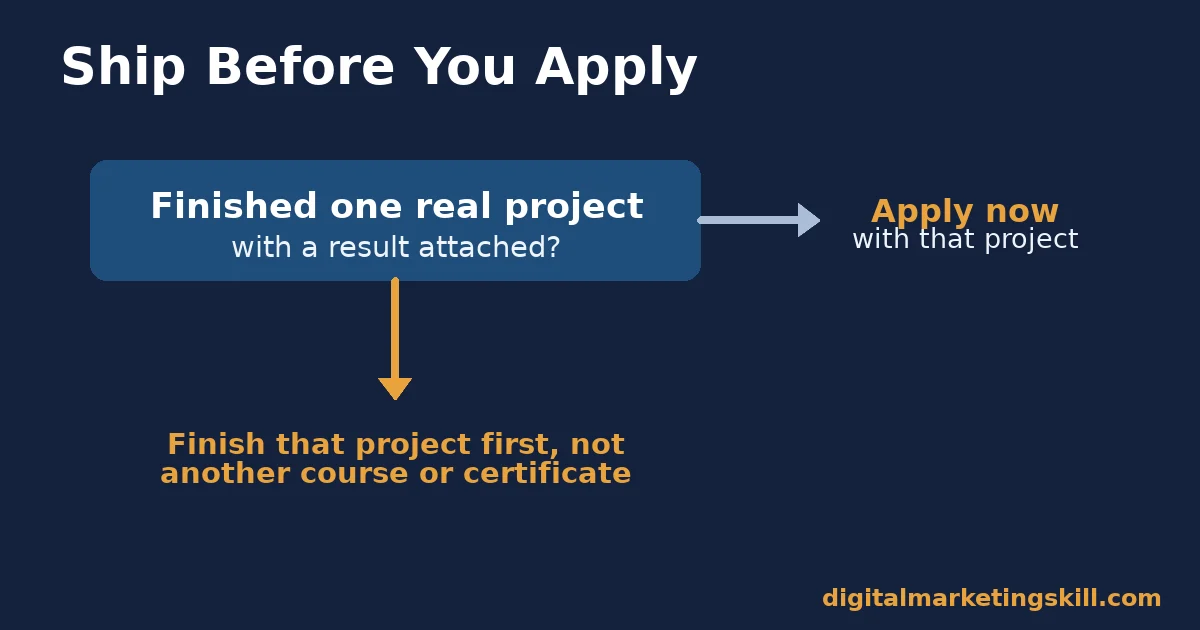
Here is the single most useful filter before you send your first application to become a digital marketer. Have you finished one real piece of work you can point to, with a result attached, however small? If not, that is the actual next step, not another course or certificate.
Illustrative, invented example: two people study the same SEO fundamentals for a month. One spends the second month taking more courses. The other spends it auditing a real local business’s website and documenting three fixes with reasoning.
In an interview, the second person has something to show. The first has a longer list of course completions and nothing to point to.
Same starting skill, different outcome. Only one of them shipped something real, and that single difference is usually what separates an application that gets a reply from one that doesn’t.
What Doing This Right Looks Like
Real outcomes are the best evidence that a path works. Ayooluwa Osemi, a Digital Marketing Skill Institute graduate, describes an early paid-ads project this way: “Spent $14 on Facebook and Instagram ads and made $878,” as published on the Institute’s reviews page.
That is a single project result, not a guaranteed formula. Ad performance varies widely by market, offer and audience, and most first campaigns will not post that exact ratio.
The underlying skill behind it, running a small, measured test and reading the result honestly, applies far beyond paid ads. The same habit works for a cold email subject line test, a landing page headline test, or a content posting schedule test. Small, measured and honest beats large, vague and unverified every time.
What makes the example useful here is not the dollar figure. It is the pattern: one small, real, measurable project, documented clearly enough to describe in an interview. That is exactly the kind of proof the evidence above says actually moves a hiring decision.
See the Institute’s earnings disclaimer for the full context; individual results are not typical or guaranteed, and a project like this is best understood as a learning exercise with a documented outcome, not a repeatable income strategy.
Frequently Asked Questions About How To Become A Digital Marketer
How long does it take to become a digital marketer?
Enough to apply, often a few months of focused study plus one finished project. Enough to feel strong in the role, usually a year or more of real client or campaign work. The finished project matters more than the calendar time around it, which is why two people starting the same week can end up applying months apart.
Do I need a degree to become a digital marketer?
No. Most entry routes weigh a working portfolio and demonstrable skill more heavily than a formal degree, though a degree can still help at larger, more traditional employers that screen applicants by credential first.
What is the best first skill to learn in digital marketing?
Whichever one you can turn into a finished, measurable project fastest. For most beginners that is SEO fundamentals, basic paid ads, or content writing, because each produces something concrete to show within weeks, not months.
Is digital marketing a good career with AI growing so fast?
Yes, with a condition. AI literacy is now a baseline expectation, not an advantage, per LinkedIn’s skills data. Becoming a digital marketer today means learning the AI tools alongside the fundamentals, not instead of them.
Can I become a digital marketer without any experience?
Yes, by creating your own experience: a real project for a local business, a cause, or a personal brand, documented with a result. That project becomes the experience employers ask about in an interview.
Should I specialize in one area of digital marketing right away?
Not immediately. Sample two or three areas, SEO, paid ads, content, social, before committing. The strongest specialists usually know which area they are good at from direct comparison, not guesswork at the start.
What’s the biggest mistake beginners make?
Collecting certificates instead of finishing one real, documented project. A project is proof of what you can do. A certificate is only a record of attendance.
Is it worth paying for a course, or should I just learn for free?
It depends on your budget and your discipline. A free path can get you to the same skill level, but it usually takes longer and offers less feedback. A paid course buys back time and reduces the chance of practicing a mistake for months before anyone corrects it.
Start With One Project, Not One More Course
Becoming a digital marketer comes down to proof: one real skill, one finished project, and a clear sense of what employers are actually paying for right now. Pick one path from this guide, finish one project on it, then apply.
Structured coaching toward that first real project is what the Digital Marketing Skill Institute’s Master Diploma in Digital & AI Marketing is built around, across AI-powered tracks for social media, lead generation and email, Google specialism, and WordPress and SEO.
It includes a Full Stack option to complete all four tracks, unlimited 1-on-1 coaching, a U.S. Project Internship with a verified U.S. Work Reference Letter, and dual US and UK accreditation recognised in more than 100 countries.
It runs entirely online, so you can build your first real project from anywhere in your country, through digitalmarketingskill.com. Explore the full program at the Master Diploma in Digital & AI Marketing, browse more guides on the digitalmarketingskill.com blog, read outcomes like Ayooluwa’s on the reviews page, or apply to start at digitalmarketingskill.com today.
Every figure in this guide was checked against its original source before publication. Figures marked as illustrative are invented examples, not real results.
![9 Amazing Digital Marketing Skills to Make Money Online [With Proof]](https://digitalmarketingskill.com/wp-content/uploads/2019/07/9-Amazing-Digital-Marketing-Skills-to-Make-Money-Online-With-Proof-17.png)






