
The best freelance websites are not one single site. They are whichever platform matches your skill level and the kind of client you want. A beginner on a crowded general marketplace competes with thousands of other new profiles. A specialist on a niche platform competes with far fewer. That smaller pool is usually the better tradeoff once you have something to show.
Key Takeaways
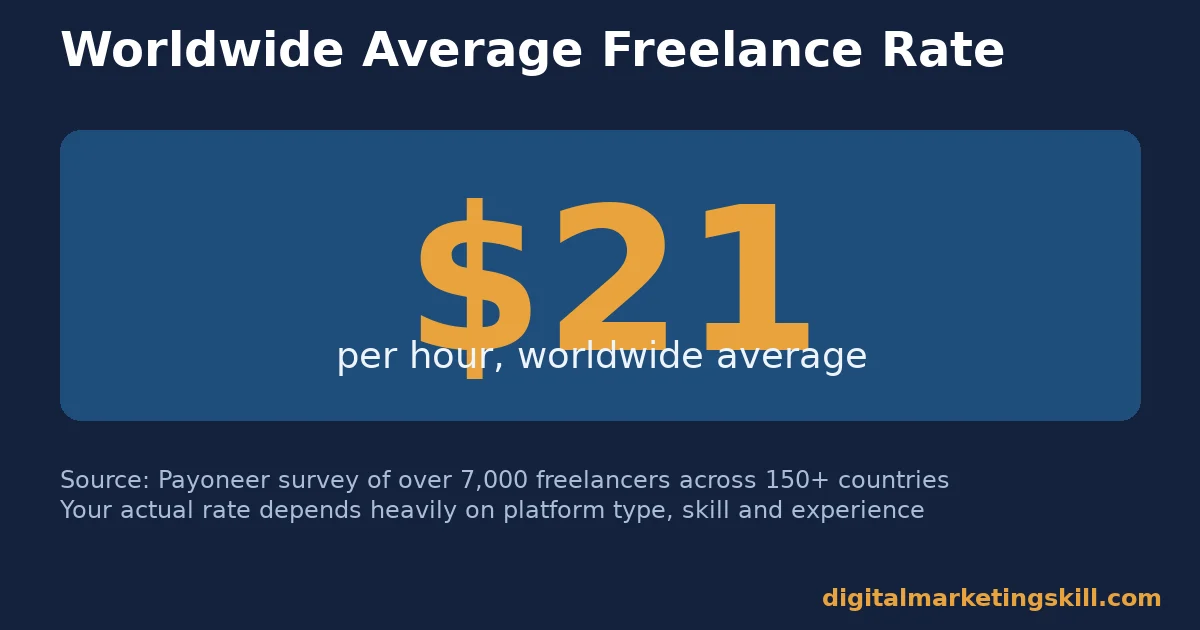
- Freelance pay varies hugely by platform type and skill. Payoneer’s own survey of over 7,000 freelancers across more than 150 countries found a worldwide average hourly rate of $21.
- The best freelance websites fall into three types. General marketplaces, vetted premium platforms, and niche community platforms each reach a different kind of client.
- More competition does not mean more opportunity. A general marketplace reaches the most clients but also the most competing freelancers for every single posting.
- Fees eat into every platform’s earnings differently. Compare effective hourly rate after fees, not the headline rate you set, before judging whether a platform is worth it.
- Two numbers decide whether a platform is working for you. Effective hourly rate after fees and proposal-to-hire rate, tracked together, tell the real story.
In this guide
- What Most “Best Freelance Websites” Lists Get Wrong
- Why Picking the Right Freelance Website Type Matters
- How Freelance Websites Actually Pay You
- What Differs by Freelance Website Type
- How to Start Strong on Each Freelance Website Type
- How to Measure Whether a Freelance Website Is Working
- The One Rule: Match the Platform Type to Your Proof, Not Your Ambition
- A Real Case: Turning a Low-Cost Start Into a Scaled Service
- Frequently Asked Questions About the Best Freelance Websites
- Pick One Freelance Website Type and Build Proof First
What Most “Best Freelance Websites” Lists Get Wrong
Most lists of the best freelance websites are just a long menu of platform names. Thirty logos, no guidance on which one fits a beginner versus an established specialist. That approach treats every freelancer as identical, when the right platform depends entirely on your stage and your skill.
A word on the ground rules first. The Payoneer figure below is a worldwide average across very different skills and regions, so treat it as a reference point, not a target for any specific niche. Every number here is a snapshot from when it was measured, not a permanent ranking of any platform.
None of this means picking one platform and never trying another. It means picking the type of freelance website that matches where you are today. Prove it works. Then add a second platform once the first is measured and stable.
Why Picking the Right Freelance Website Type Matters
The platform decision is not a small detail. It is the single biggest factor in how much competition you face for every job you apply to. Your skill or pricing does not even enter the picture yet.
Two equally skilled freelancers can have very different results purely because of where they started. One joins a crowded general marketplace with no reviews yet. They compete against hundreds of similar profiles. The other joins a smaller niche platform suited to their exact skill. They might face only a handful of competitors for the same kind of work.
This is why the best freelance websites are not a fixed ranking. The right answer changes as your portfolio and reviews grow, which is the whole premise of the decision rule later in this guide.
How Freelance Websites Actually Pay You
A freelance website is really a matching system with a fee attached. First, a client posts a job or browses profiles. Then a freelancer applies, bids, or gets invited. The platform takes a cut of the pay. A review score then decides who gets the next job.
Most freelancers judge the best freelance websites only by headline earning potential. That misses the two things that actually decide your income. One is how much competition you face for each job. The other is how much the platform’s fee reduces what you actually keep.
Payoneer’s own survey of over 7,000 freelancers across more than 150 countries found a worldwide average hourly rate of $21. That average blends brand-new freelancers on crowded platforms with specialists on vetted ones. That is exactly why the platform you choose changes your realistic starting point.
The fee a platform charges is not just a cost. It is a filter. A platform with a higher bar to join, or a narrow niche, usually has less competition per job. That is often worth more than a lower fee on a crowded general site.
This is also why the best freelance websites for one person can be the wrong choice for another. A beginner chasing the lowest fee can end up on a crowded platform instead. A hundred other new profiles might compete for the same posting. That costs far more in lost time than the fee ever would.
What Differs by Freelance Website Type
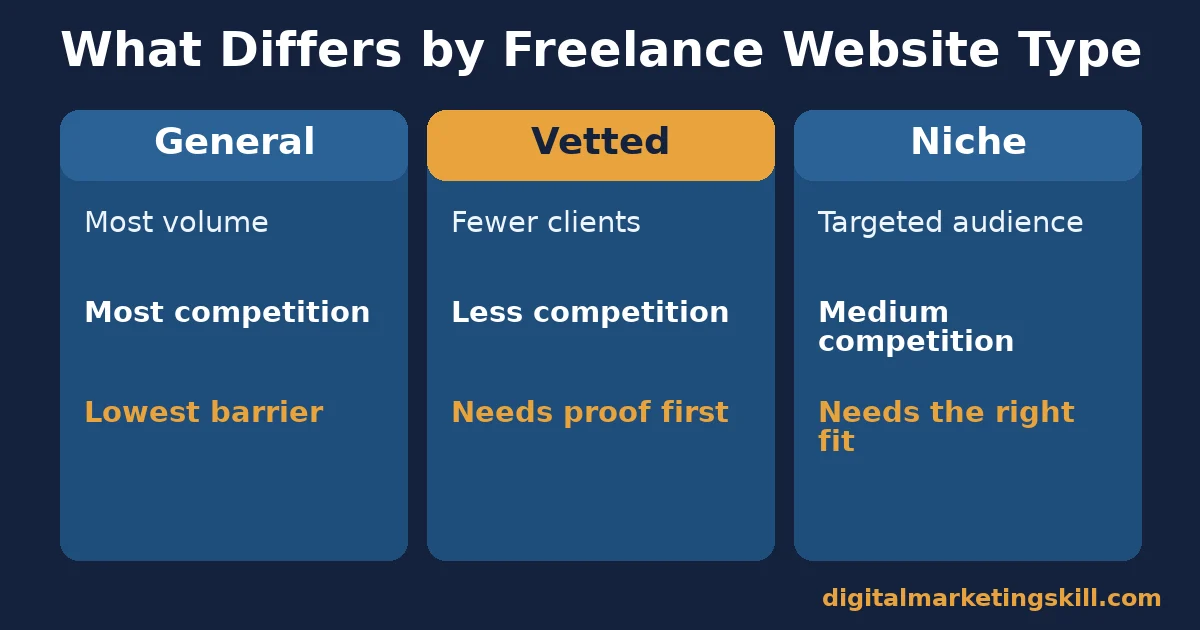
Three realistic types cover most of the best freelance websites: general marketplaces, vetted premium platforms, and niche community platforms. Each trades reach, competition and trust differently. Most freelancers move through more than one type over a career, rather than staying on the same platform forever.
None of the three is universally better. A general marketplace reaches the most clients but puts you against the most competing freelancers. Vetted platforms have fewer clients but far less competition once you are accepted. A niche platform sits in between, with an audience that already wants your specific skill.
General Marketplaces: Built Around Volume
General marketplaces, like Fiverr, Freelancer.com or PeoplePerHour, list almost every freelance skill in one place and let clients post a job or search profiles directly. The appeal is sheer volume. There is always a new posting to apply to, and anyone can create a profile the same day.
The tradeoff is competition. A single posting on a general marketplace can draw dozens of proposals within hours. A new profile with no reviews has to work harder to stand out than it would on a smaller, more targeted platform.
Vetted Premium Platforms: Built Around a Screening Bar
Vetted platforms, like Toptal, screen every freelancer before letting them bid on work, often through tests, interviews or a portfolio review. Toptal’s own screening page says that of the thousands of applications it sees each month, typically fewer than 3% are accepted. The appeal is less competition once you are in. You also gain access to clients who already expect to pay a premium for pre-screened talent.
The tradeoff is the barrier to entry itself. A beginner with no portfolio or track record usually cannot pass the screening. That makes vetted platforms a better fit once you already have proof of your work, not a starting point.
Niche Community Platforms: Built Around a Specific Skill
Niche platforms serve one skill or working style. RemoteOK focuses on remote-only roles, and Contra focuses on commission-free freelance work. Their client base arrives already knowing what they want. The appeal is relevance: every client browsing a focused platform is looking for exactly that kind of freelancer, not a generalist.
The tradeoff is smaller volume. A niche platform has fewer total postings than a general marketplace. It usually works best as a second channel alongside a broader one, not the only place you look for work.
How to Start Strong on Each Freelance Website Type
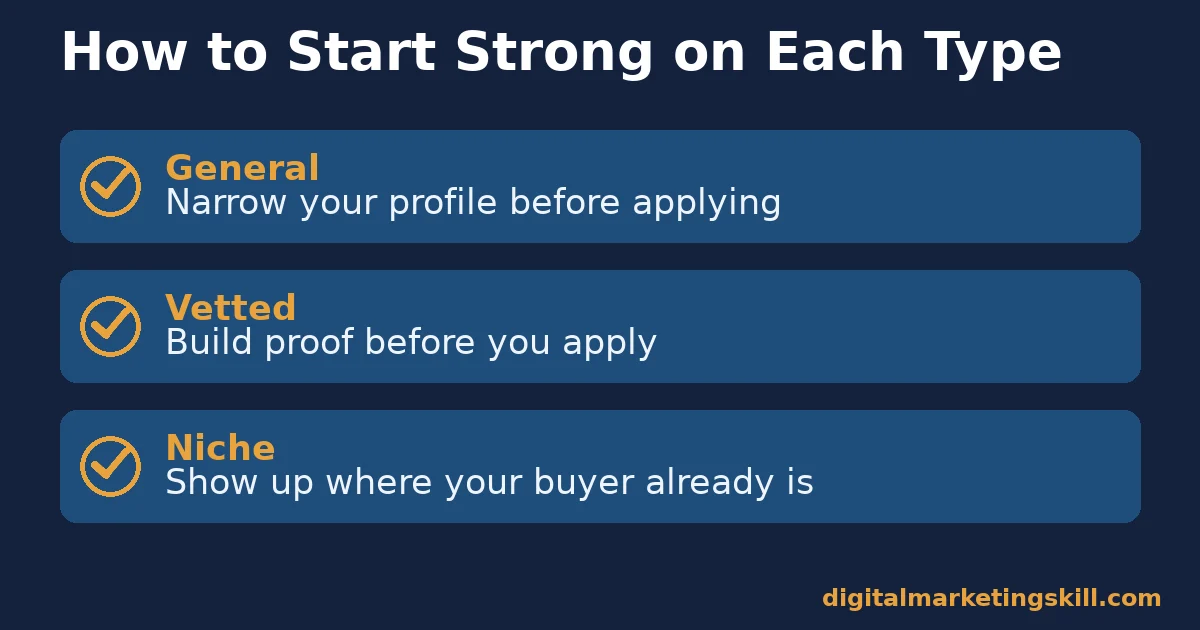
Pick the type that matches where you are today. The sections below mirror the three types above. Think of each platform’s fee less as a price and more as a tradeoff against competition. A platform that charges slightly more, but filters out the weakest applicants, can still leave you with a far better effective rate. That holds once you count the hours lost applying on a crowded platform instead.
General Marketplaces: Narrow Your Profile Before You Apply Widely
Write your profile around one clear service, not a long list of everything you can do. A narrow, clear profile reads as more credible to a client scanning dozens of similar applicants.
Apply with a short proposal that names the exact job, not a copy-pasted pitch. Clients scanning a crowded inbox notice the proposal that clearly read their posting, in its first two sentences.
Take your first few jobs at a lower rate than you want long-term, specifically to earn reviews. Reviews are the filter that lets you compete for better jobs later. Treat the first few jobs as an investment, not the final price.
Respond quickly to new postings. On most of the best freelance websites, a client sees proposals in the order they arrive. The first few credible applicants get the most attention, before the posting fills up with dozens more.
Vetted Platforms: Build Proof Before You Apply
Assemble a small portfolio of real, finished work before applying to a vetted platform. Include it even if some of it was done at a lower rate elsewhere. Screening processes look for evidence you can already do the work, not potential.
Expect the application process itself to take real time and possibly more than one attempt. Most vetted platforms reject the majority of applicants. Treat a first rejection as a reason to build more proof, not a sign to give up on the platform type entirely.
Price higher once you are accepted than you did on a general marketplace. Clients on a vetted platform already expect to pay a premium for pre-screened talent. Pricing too low here can actually read as a lack of confidence, rather than good value.
Niche Platforms: Show Up Where Your Exact Buyer Already Is
Pick the one or two niche platforms where your actual target client already looks for your specific skill. Do not join every niche community that exists. A profile spread across ten niche sites, with no activity on any of them, helps nobody.
Keep the niche profile updated with your most recent, most relevant work. A niche audience notices stale work faster than a general audience does. They are comparing you directly against other specialists in the same narrow field.
Engage with the community itself, not just your own listing. Many of the best freelance websites in the niche category rank or recommend active members more visibly than inactive ones. A comment, a share or a reply can matter almost as much as the profile itself.
How to Measure Whether a Freelance Website Is Working
Track the same two numbers regardless of which platform type you use. Both are easy to skip when the activity itself feels productive.
Two Numbers That Tell the Real Story
- Effective hourly rate after fees. What you actually keep, divided by every hour spent, including time spent applying and messaging, not just billable work. This is the number that compares fairly across platforms with different fee structures.
- Proposal-to-hire rate. The share of applications or bids that actually turn into paid work. A platform with a low effective rate but a high hire rate may still beat a platform with better pay but constant rejection.
What the Numbers Tell You to Change
If your proposal-to-hire rate is low on a general marketplace, look at your profile and proposals first. The fix is usually a narrower profile or sharper proposals, not more applications. Sending more of the same pitch rarely fixes a weak pitch.
If your effective hourly rate stays low even with a good hire rate, look beyond your work itself. The platform’s fee structure or your pricing is more likely the problem. Consider moving toward a vetted or niche platform once you have the reviews to qualify.
Review both numbers monthly, by platform, if you work across more than one. A platform that feels busy can still pay less per real hour than a quieter one with better-fit clients. Write both numbers down somewhere you will actually check again. A platform that feels productive day to day can still quietly underperform a quieter alternative over a full month.
The One Rule: Match the Platform Type to Your Proof, Not Your Ambition
If you remember one decision rule from this guide, make it this one. Someone with no reviews and no portfolio should start on a general marketplace. The barrier to entry there is low enough to get a first job at all. Someone with real, finished work should move toward vetted or niche platforms, where competition is lower and rates are usually higher.
Here is an illustrative example, with invented numbers. A beginner designer starts on a general marketplace. They take a handful of smaller jobs at a modest rate, and use every one to build a portfolio and reviews.
After a few months, the same designer applies to a vetted platform with that portfolio in hand. They pass the screening and start picking up fewer but better-paying projects. The general marketplace was never the end goal; it was the proof-building step that made the vetted platform possible.
The lesson generalizes beyond freelance websites. Matching the platform to the proof you actually have beats chasing the platform with the best reputation, before you can realistically get accepted onto it. A strong profile on a platform that will actually accept you outperforms a weak application to a platform that will not. That holds true every time.
A Real Case: Turning a Low-Cost Start Into a Scaled Service
Damola Akanbi, a Digital Marketing Skill Institute student, started by taking on smaller digital marketing projects to build a track record. As published in the Institute’s own student reviews, Akanbi now averages $1,500 per client running digital marketing campaigns.
The useful detail is the progression, not just the end number. Akanbi did not start by pitching $1,500 clients directly. The early, smaller projects built the proof needed to credibly charge more later, the same pattern that moves a freelancer from a general marketplace toward better-paying platforms and clients.
That progression matters more than which specific site or platform gets the credit. The skill being sold, the proof behind it, and the willingness to start smaller all mattered more than the exact name of the first client’s source.
Keep the limits in mind. This is one published, named result, not a guarantee of similar income for anyone else. See the Institute’s earnings disclaimer for the full context. Treat it as evidence that starting small and building proof can work, not as a promise of a specific outcome on any freelance website.
Frequently Asked Questions About the Best Freelance Websites
What are the best freelance websites for beginners?
General marketplaces usually work best for beginners, since the barrier to entry is low and there is no screening process to pass before you can apply for work. Expect more competition per posting than on a vetted or niche platform.
What are the best freelance websites for experienced freelancers?
Vetted premium platforms and niche community platforms tend to pay better once you have a portfolio and reviews, because they filter out much of the competition a general marketplace exposes you to. Among the best freelance websites for an experienced specialist, a narrow niche platform in your exact field often beats a famous general name.
How much do freelance websites take in fees?
Fee structures vary by platform. Check each platform’s own help pages directly before committing, since fees change the effective hourly rate you actually keep. Compare the effective rate after fees, not the rate you set.
Is it better to use one freelance website or several?
Most freelancers do best starting with one platform, measuring it properly, and adding a second once the first is stable. Spreading thin across many platforms at once usually produces a weak presence on all of them.
How much can I realistically earn on a freelance website?
Payoneer’s own worldwide survey found an average hourly rate of $21 across all freelancers surveyed. Treat that as a broad reference point; your actual rate depends heavily on your skill, platform type and experience. A specialist on a vetted or niche platform typically earns well above that average, while a beginner on a crowded general marketplace often starts below it.
Do I need a portfolio before joining a freelance website?
Not for a general marketplace, where you can start with no track record. A portfolio becomes necessary once you apply to a vetted platform, since the screening process specifically looks for evidence of past work.
How do I get my first client on a freelance website?
Write a narrow, specific profile and send short proposals that clearly reference the exact job posting. Being willing to take a lower rate for your first few jobs, specifically to earn reviews, speeds this up considerably.
Can a niche freelance platform replace a general marketplace?
Usually not on its own, since niche platforms have far less total volume. Most freelancers use a niche platform alongside a general marketplace rather than instead of one. That changes only once the niche platform alone produces enough steady work to rely on. Many established freelancers eventually drop the general marketplace entirely. They rely instead on niche platforms and repeat clients, once referrals start replacing cold applications.
Pick One Freelance Website Type and Build Proof First
Choose the platform type that matches the proof you actually have today, not the one with the best reputation. Track your effective hourly rate and proposal-to-hire rate from the first week. Revisit the choice every few months as your portfolio grows, since the best freelance websites for a beginner are rarely the same ones that serve you once you have real reviews.
Give the platform at least a few weeks before judging whether it is working. If you want to build the broader skill set behind winning clients, see our guides to getting clients as a freelancer and freelancing for beginners.
The best freelance websites can only do so much without a real, marketable skill behind the profile.
If you want the underlying skills built properly, Digital Marketing Skill Institute runs its Master Diploma in Digital & AI Marketing across four AI-powered tracks and ten total courses, or all four as Full Stack. It comes with unlimited 1-on-1 mentoring and coaching, plus a U.S. project internship with its partner company from day one. The diploma is dual US and UK accredited, and recognized in more than 100 countries.
The program is fully online, so you can study and freelance from anywhere in your country. Browse more guides on the Digital Marketing Skill Institute blog, and when you are ready, apply for the Master Diploma or start from the Digital Marketing Skill Institute homepage.
Every figure in this guide was checked against its original source before publication. Figures marked as illustrative are invented examples, not real results.
![9 Amazing Digital Marketing Skills to Make Money Online [With Proof]](https://digitalmarketingskill.com/wp-content/uploads/2019/07/9-Amazing-Digital-Marketing-Skills-to-Make-Money-Online-With-Proof-17.png)






