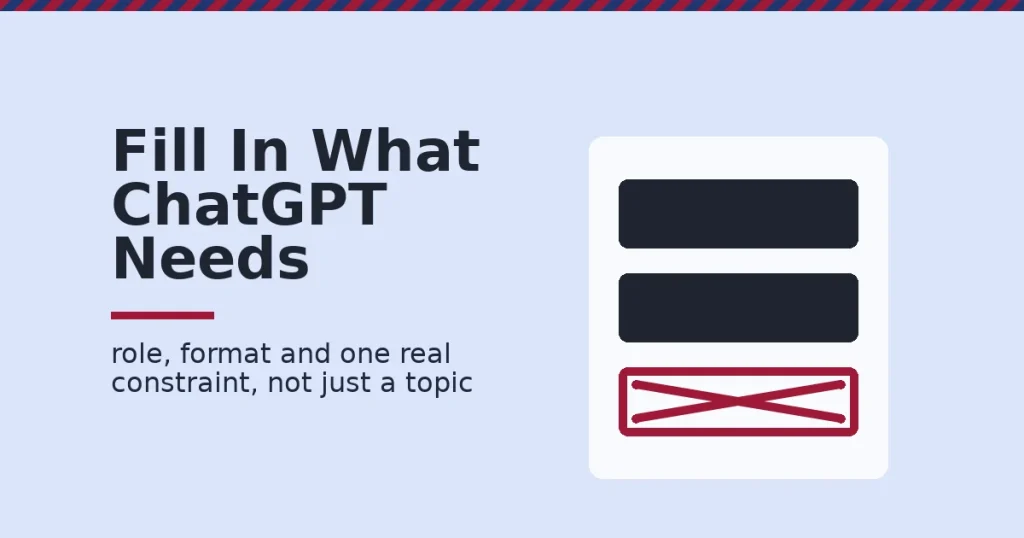
ChatGPT prompts for marketers work when they name a role, a format and a real constraint, not just a topic. A vague prompt like “write a social post” returns generic filler. A prompt that states the platform, the audience and the word count returns something you can actually publish. This guide shows the structure behind good ChatGPT prompts for marketers and gives role-specific examples you can copy today.
Key Takeaways
- Nearly 90% of marketers have used generative AI tools at work, and 71% use them weekly or more, according to the American Marketing Association’s survey with Lightricks (over 1,000 marketers).
- 85% of marketers who use AI say it has increased their productivity, per the same AMA/Lightricks survey.
- 84% of high-performing marketing organizations use generative AI for creative development, according to Gartner research reported by Marketing Dive, making content creation the most common generative AI use case for marketers.
- Personalized email subject lines are opened 26% more often than generic ones, according to Campaign Monitor’s research, a constraint worth building into any email prompt.
- OpenAI’s own prompt engineering guidance confirms that specificity and structure, not length, separate a working prompt from a generic one.
In this guide
- Why Most ChatGPT Prompts for Marketers Underperform
- How ChatGPT Prompts for Marketers Actually Shape the Output
- What Changes a ChatGPT Prompt by Marketing Role
- How to Lead With Each Role’s Prompt
- A Working ChatGPT Prompts Library for Marketers, by Role
- Common Mistakes Marketers Make With ChatGPT Prompts
- A Quick-Start Checklist for ChatGPT Prompts
- How to Measure Whether Your ChatGPT Prompts for Marketers Are Working
- The One Decision Rule for Writing a ChatGPT Prompt
- A Real Case: What OpenAI’s Own Guidance Says About ChatGPT Prompts
- Frequently Asked Questions About ChatGPT Prompts for Marketers
- Put the ChatGPT Prompts for Marketers Framework to Work
Why Most ChatGPT Prompts for Marketers Underperform
Most people treat ChatGPT like a search box. They type a topic, get a vague answer, and conclude the tool isn’t that useful for real marketing work. The tool isn’t the problem. The prompt is.
This is a practical framework, not a settled science. OpenAI’s own guidance changes as models improve. The AMA/Lightricks productivity figures are self-reported by marketers, not independently measured. Treat every number here as a current signal, not a permanent ranking.
The real gap is specificity. A prompt without a role, a format and a constraint forces ChatGPT to guess at all three, and a guess rarely matches what you actually needed.
That gap shows up constantly in how marketers describe their own experience with the tool. Nearly 90% say they have used generative AI at work, yet plenty still describe the output as “close but not quite right.” The difference between those two groups usually isn’t the model. It’s the prompt.
Good ChatGPT prompts for marketers are learnable, not a talent some people happen to have. The rest of this guide breaks the skill into parts you can practice on your next real request.
How ChatGPT Prompts for Marketers Actually Shape the Output
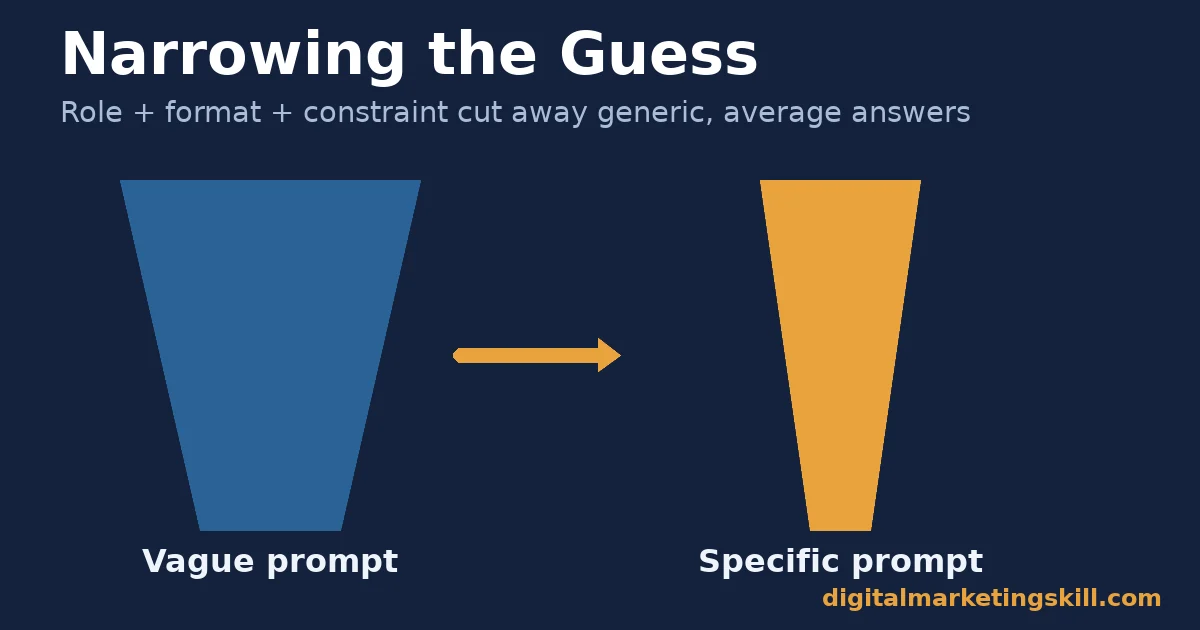
ChatGPT predicts the next most likely words based on everything in your prompt. A vague prompt gives it almost nothing to anchor on. So it defaults to the most generic, average response for that topic.
A specific prompt narrows that space. Naming a role (“as a B2B email marketer”), a format (“a 150-word product description”) and a constraint (“avoid exclamation marks”) each cut away a huge slice of generic possible answers. What’s left is something closer to what you actually need.
The Three Ingredients Every Working Prompt Has
Role tells ChatGPT whose voice and expertise to write in. Format tells it the shape of the output: a list, a script, a specific word count. Constraint tells it what to avoid or what rule to follow, such as a tone, a banned word, or a required detail to include.
Leave any one of the three out and ChatGPT fills the gap with an average guess. Include all three and the first draft usually needs editing, not rewriting from scratch.
This structure is also why generic “prompt libraries” you copy from a blog post often disappoint. A template without your own role, format and constraint filled in is still a vague prompt. It just looks more official. Fill in all three blanks yourself before you trust any copied template, including the ones in this guide.
What Changes a ChatGPT Prompt by Marketing Role
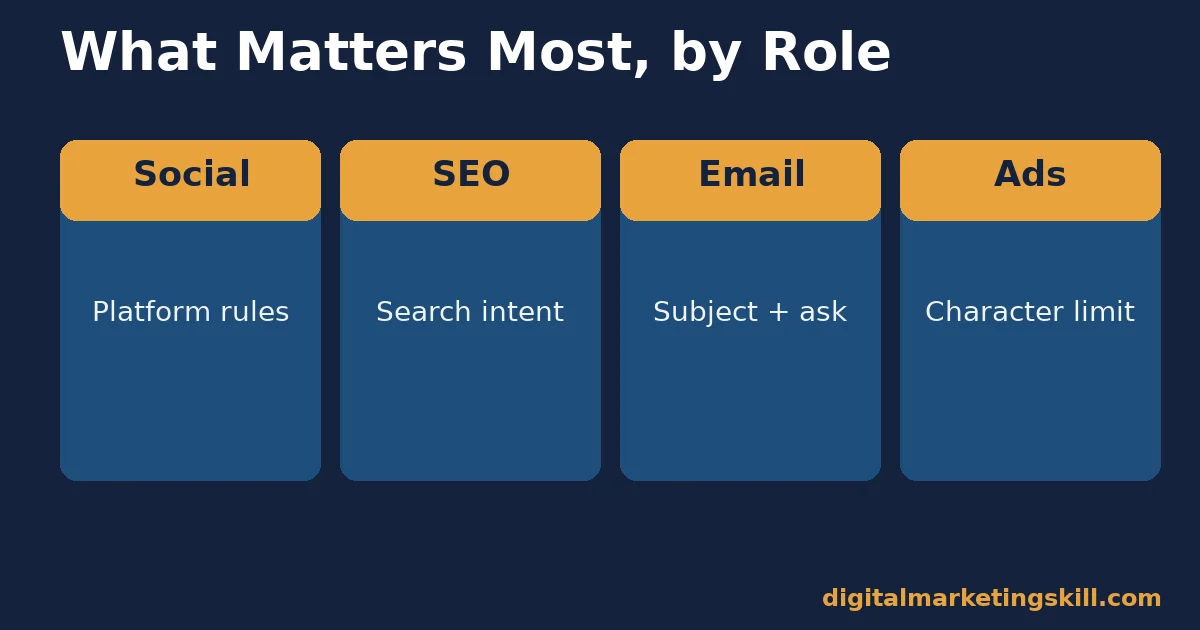
The three ingredients stay the same across roles. What changes is which constraint matters most for each job.
Social Media Prompts: Built For Platform Constraints
A social post lives or dies by its platform’s format rules: character limits, hashtag conventions, and what a scroll-stopping first line looks like on that specific app. The constraint that matters most here is the platform itself.
SEO and Content Prompts: Built For Search Intent
Content written for search has to answer a specific query, at a specific depth, for a specific stage of the buyer’s journey. The constraint that matters most is the keyword and the intent behind it, not just the topic.
Google’s own guidance on creating helpful, people-first content asks whether a reader leaves “feeling they’ve learned enough” to solve their problem. That question is a useful filter for judging any AI-assisted draft before you publish it.
Email Prompts: Built For the Subject Line and the Ask
An email prompt lives or dies on two lines: the subject line that earns the open, and the single call to action at the end. The constraint that matters most is keeping both of those sharp while everything in between stays short.
Paid Ad Prompts: Built For the Character Limit
Ad copy has the least room for error of any format here, since most platforms enforce a hard character limit that cuts off anything over the line. The constraint that matters most is writing to the limit first, then polishing, instead of writing long and cutting later.
This is where ChatGPT prompts for marketers running paid campaigns differ most from the other three roles. There is no partial credit for an ad headline that runs one character over the limit; the platform simply rejects it, so the constraint has to be exact, not approximate.
How to Lead With Each Role’s Prompt
Each section below gives a prompt template you can copy and fill in, plus one filled-in example.
Social Media Prompts: Lead With the Platform Name
Template: “Write [number] [platform] post ideas for [business type] that [specific goal]. Keep each under [character count].” Example: “Write 5 Instagram caption ideas for a sustainable skincare brand that highlight a new product launch. Keep each under 150 characters.”
SEO and Content Prompts: Lead With the Keyword and the Searcher’s Question
Template: “Write a [word count]-word [content type] targeting the keyword [keyword], written for someone who [specific intent].” Example: “Write a 150-word meta description targeting the keyword ’email deliverability,’ written for someone trying to fix a spam-folder problem today.”
Email Prompts: Lead With the Subscriber’s Situation
Template: “Write a [word count]-word email to [subscriber segment] that [goal], ending with a single call to action to [specific action].” Example: “Write a 150-word email to subscribers who abandoned their cart that reminds them what they left behind, ending with a single call to action to complete checkout.”
Ask for two or three subject line options in the same prompt. Personalized subject lines open 26% more often than generic ones, so naming the subscriber’s situation in the prompt carries directly into a better subject line too.
Paid Ad Prompts: Lead With the Exact Character Limit
Template: “Write [number] versions of a [platform] ad headline for [product], under [character count] characters, that lead with [the main benefit].” Example: “Write 5 versions of a Google Ads headline for a project management tool, under 30 characters, that lead with time saved.”
A Working ChatGPT Prompts Library for Marketers, by Role
Use the templates above to adapt any of these on the fly. Replace the bracketed detail with your own product, audience or topic.
More Social Media Prompts for Marketers
- Outline a 2-week social content calendar for [business type] launching [product], with one post per platform per day.
- Write 3 versions of the same announcement, one for LinkedIn, one for Instagram, one for X, keeping the core message identical but the tone matched to each platform.
- Suggest 5 ways to turn this blog post into short-form video scripts under 30 seconds: [paste excerpt].
More SEO and Content Prompts for Marketers
- List 15 long-tail keyword variations for the primary keyword [keyword], grouped by search intent (informational, commercial, transactional).
- Write 8 subheadings for a blog post titled [title], each one a question a reader at [experience level] would actually search.
- Audit this introduction for keyword placement and clarity against the keyword [keyword]: [paste text].
More Email Prompts for Marketers
- Write 5 subject line variations for an email announcing [offer], each testing a different angle: urgency, curiosity, benefit, social proof, and a plain statement.
- Outline a 4-email welcome series for new subscribers to [business type], with one clear goal per email.
- Rewrite this email to cut it by a third without losing the call to action: [paste text].
More Paid Ad Prompts for Marketers
- Write 10 Google Ads headline options for [product], each under 30 characters, testing a different angle (price, speed, trust, outcome).
- Propose 5 Facebook ad concepts to drive [specific action] for [product], each with a headline, primary text and one-line visual idea.
- Rewrite this ad to lead with the strongest benefit in the first 5 words: [paste text].
Common Mistakes Marketers Make With ChatGPT Prompts
These five mistakes come up constantly, across every role covered above. Each one has a simple fix, and most take less time to apply than the mistake takes to repeat.
Asking for a finished piece in one shot. A single giant prompt for an entire blog post or campaign usually produces something generic. Break the request into an outline first, then draft each section with its own role, format and constraint.
Skipping the constraint entirely. A prompt with a role and a format but no constraint still leaves too much room for ChatGPT to guess at tone, length and what to avoid.
Accepting the first draft. The first output is a starting point, not a final answer. Asking ChatGPT to revise against a specific note, such as “make the second paragraph punchier,” usually improves the result faster than starting over.
Never giving it your own examples. Pasting one or two samples of your own past copy teaches ChatGPT your voice far faster than describing your brand’s tone in the abstract.
Reusing one prompt across every role. A single generic template cannot serve social, SEO, email and paid ads equally well, since each role’s constraint is different. Keep a separate short template for each, as in the library above, rather than one all-purpose prompt.
None of these five mistakes require a new tool or a paid upgrade to fix. They are habits. Swapping a bad habit for the three-ingredient structure covered earlier in this guide is usually enough on its own.
A Quick-Start Checklist for ChatGPT Prompts
Keep this list next to ChatGPT while you work. It turns the framework above into something you can check off in under a minute per prompt.
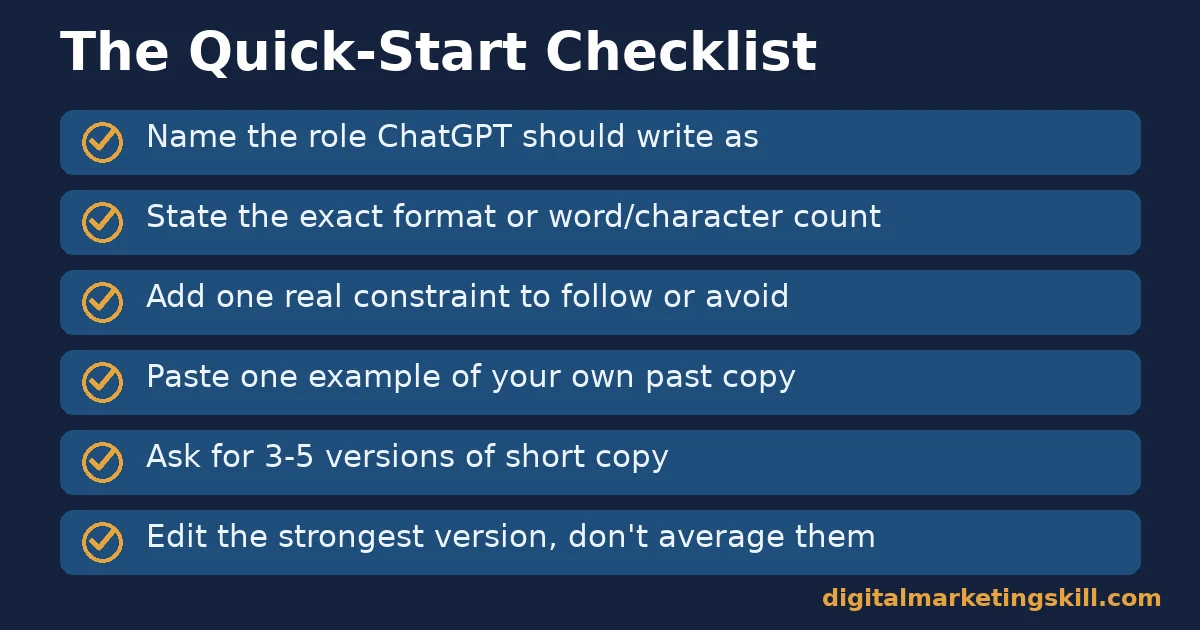
- Name the role ChatGPT should write as.
- State the exact format: word count, character limit, or structure.
- Add one real constraint: a tone, a banned phrase, or a detail that must appear.
- Paste one example of your own past copy, if you have one that fits.
- Ask for 3 to 5 versions when the output is short, such as a headline or subject line.
- Edit the strongest version rather than averaging the weakest parts of several.
Run a handful of your own ChatGPT prompts for marketers through this checklist, and the pattern from the earlier sections becomes obvious fast: the prompts that work are never missing more than one of the six items above.
Print it, pin it above your desk, or save it as a note next to ChatGPT itself. The goal is to make the checklist automatic, so you stop thinking about it after the first few weeks.
How to Measure Whether Your ChatGPT Prompts for Marketers Are Working
A prompt is only as good as what happens after you use its output. Track these against your usual content metrics, not in isolation.
Edit distance is a simple gut check: how much of the ChatGPT draft survives into your final version. A prompt that needs a full rewrite every time isn’t saving you real time, even if it feels fast.
Time to first usable draft is how long it takes from prompt to a draft you’d actually send for review. Compare this against your pre-AI baseline for the same content type.
Output consistency is whether the same prompt template produces a similarly usable result each time you reuse it. A template that only works once is a lucky prompt, not a reusable one.
Downstream performance is whether the content the prompt produced actually performs: open rate for an email subject line, click-through rate for an ad headline, engagement for a social post. A prompt that saves drafting time but produces weaker results isn’t actually a win.
The One Decision Rule for Writing a ChatGPT Prompt
Before you send any prompt, check that it names a role, a format and a constraint. If any one of the three is missing, add it before you hit enter, rather than fixing a vague output after the fact.
Illustrative, invented numbers: a marketer sends 20 vague prompts in a week and spends roughly 15 minutes editing each result, about 5 hours total. After switching to the three-ingredient rule, the same 20 requests take 5 minutes each to edit. That cuts the weekly editing time to under 2 hours.
A Real Case: What OpenAI’s Own Guidance Says About ChatGPT Prompts
OpenAI’s own prompt engineering guidance recommends putting instructions at the start of a prompt, separating instructions from supporting context with a clear delimiter, and showing the model an example of the format you want rather than describing it in the abstract.
The limit worth naming: this is general guidance from the company that builds the model, not a study of marketing outcomes specifically. It describes mechanism, not proof of a specific productivity gain.
Still, it lines up closely with the three-ingredient rule in this guide. Role and instructions come first. Format gets shown through an example. A clear constraint states what to avoid. The overlap between OpenAI’s own documentation and the rule marketers use in practice is itself a useful signal.
That overlap matters because it means the framework in this guide isn’t a trick specific to one model version. The same three ingredients apply whether you’re writing ChatGPT prompts for marketers today or adapting the same structure to whatever model your team uses next year.
Frequently Asked Questions About ChatGPT Prompts for Marketers
What makes ChatGPT prompts for marketers good instead of generic?
A good prompt names a role, a format and a constraint. Without those three, ChatGPT defaults to the most average, generic answer for the topic you gave it.
How long should a ChatGPT prompt be?
Long enough to include the role, format and constraint, and no longer. A short, specific prompt usually beats a long, vague one.
Can I reuse the same prompt template for different topics?
Yes. That is the point of a template: write the structure once, then swap the bracketed details, such as topic, audience or word count, for each new request.
Should I always ask ChatGPT for multiple versions?
For short copy like subject lines or captions, yes. Asking for 3 to 5 versions and picking or combining the best parts usually beats accepting the first draft.
Does a more polite or detailed tone change the output quality?
Politeness does not meaningfully change output quality. Specificity does. Spend your effort naming the role, format and constraint rather than the tone of your request.
What is the biggest mistake marketers make with ChatGPT prompts?
Treating it like a search engine: typing a bare topic and expecting a finished, on-brand result. ChatGPT needs the same brief a human writer would need.
Should I give ChatGPT examples of my brand’s past content?
Yes, when you can. Pasting one or two examples of your own past copy, alongside the format request, helps the output match your existing voice far more closely than a tone description alone.
Is one AI tool enough, or should marketers use more than one?
Most marketers settle on one primary tool and a backup for second opinions. The three-ingredient prompt structure in this guide works the same way across ChatGPT, Claude and similar tools, so the skill transfers even if the tool changes.
Where should a beginner start with ChatGPT prompts for marketers?
Start with one role and one recurring task, such as writing social captions or email subject lines. Build one reusable template for that task using the three-ingredient structure, then expand to other roles once that first template works reliably.
Do ChatGPT prompts for marketers work the same way for video scripts?
Yes, with one addition: state the exact runtime alongside the role, format and constraint, since a script written for 90 seconds reads very differently from one written for 15. Everything else in the three-ingredient structure carries over unchanged.
Put the ChatGPT Prompts for Marketers Framework to Work
Writing good ChatGPT prompts for marketers is a skill you build the same way you build any marketing skill: with practice, feedback and real campaigns. If you want structured practice turning AI tools like ChatGPT and Claude into a repeatable part of your workflow, Digital Marketing Skill Institute teaches this hands-on.
The Master Diploma in Digital & AI Marketing is built from four AI-powered tracks covering social media management and advertising, lead generation and email automation, Google specialism, and WordPress and SEO, totalling ten practical courses, with a Full Stack option for completing all four. Every track includes unlimited 1-on-1 coaching and mentoring and a U.S. Project Internship with a verified U.S. Work Reference Letter.
The diploma is dual US and UK accredited and recognised in more than 100 countries. The program runs 100% online, so you can study from anywhere in your country.
Explore the full curriculum on the Master Diploma program page, read outcomes on the reviews page, and browse more guides on the blog. When you’re ready, apply here. Visit digitalmarketingskill.com any time you want another evidence-based guide like this one.
Every figure in this guide was checked against its original source before publication. Figures marked as illustrative are invented examples, not real results.