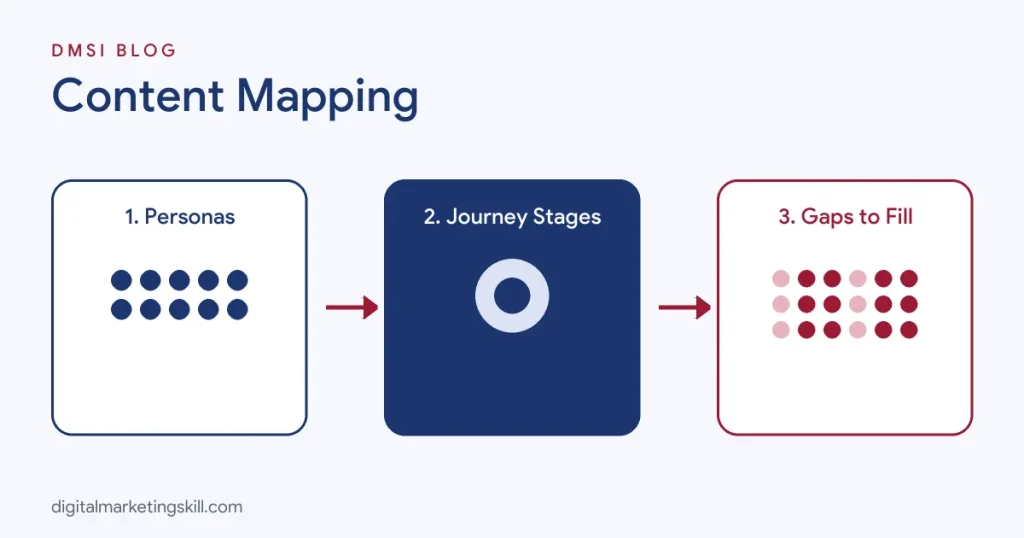
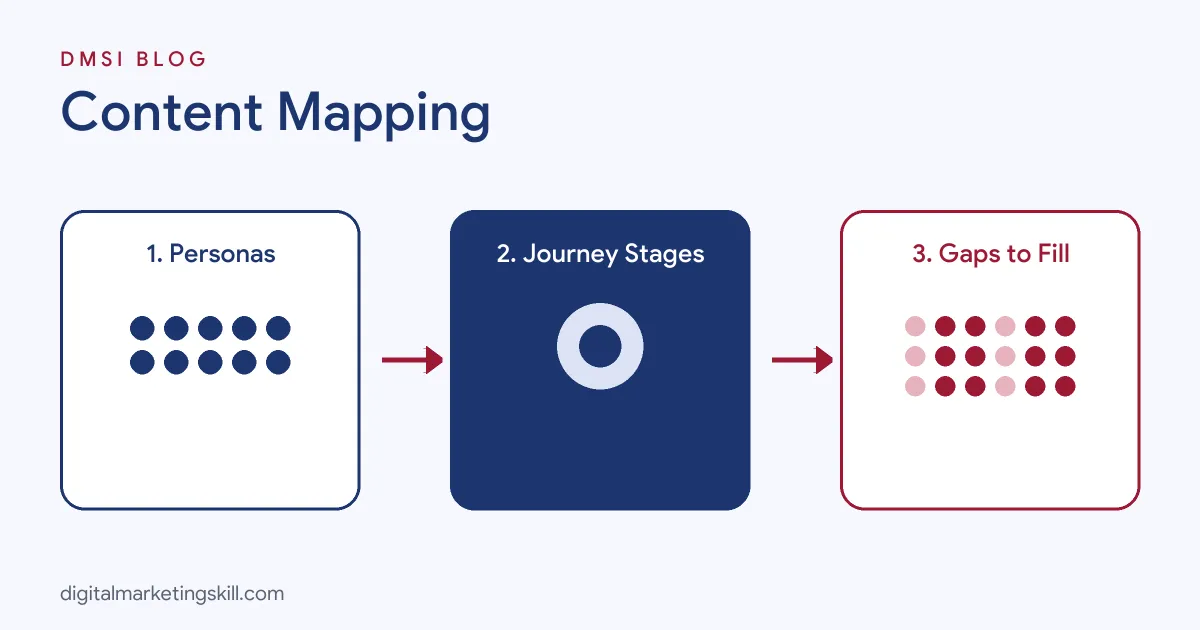
Content mapping is the process of matching each piece of content to a specific audience and a specific stage of their buying journey, so people get the right information at the right moment. A content map is the document, usually a spreadsheet, that records those matches. It shows which content you have for each persona at each stage, where the gaps are and what to create next. This guide explains how content mapping works, how to build a content map in six steps, which content suits each stage, a ready-to-copy template, how AI can speed up the work and the mistakes to avoid.
Key Takeaways
- Content mapping aligns content with buyer personas and journey stages. Mailchimp and Contentful both describe it as matching content to the audience and stage it serves.
- Search Engine Land frames the process as who (personas), what (stages), where and when (content types per stage) and how (audit and plan).
- Most maps use three to five stages, such as awareness, consideration, decision, retention and advocacy.
- A content map is both an audit of what exists and a plan for what to create, so it reveals gaps and wasted effort.
- AI can help cluster questions, audit existing pages and draft ideas, but real customer research must drive the map.
- What Is Content Mapping?
- Why Content Mapping Matters
- Content Mapping vs Journey Mapping vs Keyword Mapping
- Content for Each Stage
- How to Create a Content Map in 6 Steps
- Content Map Template
- Using AI for Content Mapping
- FAQ
What Is Content Mapping?
Content mapping is a planning method. You start with the people you want to reach, work out the steps they go through before and after they buy, and then decide what content will help them at each step. The aim is to stop producing content at random and instead build a set of pieces that guide people from first learning about a problem to choosing a solution, and then to becoming loyal customers.
A content map is the output: a table or diagram that lists your personas, the journey stages, the questions people have at each stage and the content that answers them. It usually includes the format, the channel, the main keyword, the call to action and how you will measure success. Some teams draw it as a grid with stages across the top and personas down the side; others keep a simple spreadsheet with one row per content piece.
Think of it like planning a route. You would not give a traveller directions to the final destination only; you would show them each turn. Content mapping does the same for buyers: each piece of content is a signpost that helps them take the next step.
What Most Content Mapping Guides Miss
Most guides explain the funnel stages and stop there. Three practical points often get left out:
- Start with questions, not formats. Teams often decide “we need an ebook” before knowing what the buyer actually asks. The best maps list real questions first, then choose the format that answers each one best.
- Map what you already have before creating more. An audit of existing content usually reveals useful pieces that just need updating, linking or repositioning, plus duplicate pieces that compete with each other.
- Connect pieces to each other. A map is not just a list. Each piece should point to the logical next step, through internal links, calls to action or email follow-ups. Without those links, people stall.
Why Content Mapping Matters
More relevant content
When you know exactly who a piece is for and what stage they are at, you write with more focus. A beginner researching a problem needs a different message from someone comparing suppliers.
Clear gaps and priorities
Laying content out by stage quickly shows where you are thin. Many businesses have lots of awareness blog posts but almost nothing to help people decide, or nothing at all for existing customers.
Less wasted effort
Mapping stops teams creating pieces that duplicate each other or serve nobody in particular. Every new piece has a defined job.
Better conversion
Because each piece leads to the next, more readers move forward instead of leaving after one visit. Clear calls to action matched to the stage feel helpful rather than pushy.
Alignment between teams
Sales, marketing and support can all see what content exists for each stage. Sales teams can send the right piece to a prospect, and support teams can share helpful guides with customers.
Better SEO
Mapping content to search intent at each stage helps you cover a topic thoroughly and avoid several pages competing for the same keyword. It also supports organised topic clusters. Our guide to content pillars shows how to group related content.
Content Mapping vs Journey Mapping vs Keyword Mapping
These three terms are related but answer different questions.
| Method | Main question | Output |
|---|---|---|
| Customer journey mapping | What steps, feelings and touchpoints does the customer go through? | A journey map of stages, actions, emotions and pain points |
| Content mapping | What content will help each persona at each stage? | A content map linking pieces to personas and stages |
| Keyword mapping | Which page should target which search term? | A list matching keywords to URLs |
In practice they build on each other. A customer journey map tells you what the stages are and what people need. The content map decides which content meets those needs. Keyword mapping then makes sure each page targets the right search terms without overlap. You can do content mapping without a full journey map, but it is much stronger with one.
What Content Works at Each Stage
Most content maps use the classic funnel stages, sometimes with retention and advocacy added. Our guide to the marketing funnel explains the stages in more depth.
| Stage | What the buyer is thinking | Useful content | Typical call to action |
|---|---|---|---|
| Awareness | “I have a problem or question.” | Blog posts, short videos, social posts, guides, checklists | Read more, subscribe, follow |
| Consideration | “What are my options?” | Comparison guides, webinars, how-to tutorials, templates | Download, sign up, join a webinar |
| Decision | “Which one should I choose?” | Case studies, demos, pricing pages, reviews, FAQs | Book a call, start a trial, buy |
| Retention | “How do I get the most from this?” | Onboarding emails, help articles, tutorials, newsletters | Learn a feature, attend training |
| Advocacy | “I want to share this.” | Referral programmes, community, user stories | Refer a friend, leave a review |
Awareness content
At this stage people may not know your brand or even the name of the solution they need. Content should be educational and focused on their problem, not your product. Answer common questions clearly and make it easy to find in search and on social media. Avoid hard selling; the goal is to be useful and memorable.
Consideration content
Now people understand their problem and are exploring options. Help them compare approaches, understand trade-offs and see what good looks like. This is a good stage for content that captures email addresses in return for real value, such as a template or a detailed guide.
Decision content
People are close to choosing. They want proof, detail and reassurance: case studies, clear pricing, answers to objections, honest comparisons and easy next steps. Keep friction low and make contact options obvious.
Retention and advocacy content
Many content maps stop at the sale, but keeping customers is usually cheaper than finding new ones. Onboarding guides, tips, updates and community content help customers succeed, which leads to renewals, repeat purchases and referrals.
How to Create a Content Map in 6 Steps
Step 1: Define your personas (who)
Start with the people you want to reach. A buyer persona is a short profile of a typical customer based on research: their role or situation, goals, challenges, the questions they ask and where they look for information. Interview customers, talk to sales and support staff, read reviews and look at search data. Most businesses need two to four personas; more than that becomes hard to manage. If you sell to businesses, remember that several people may be involved in one purchase, such as a user, a manager and a finance approver, and each may need different content.
Step 2: Map the journey stages (what)
Decide which stages your map will use, such as awareness, consideration, decision, retention and advocacy. For each persona, write down what they are trying to do at each stage, what they are worried about and what would help them move forward. A short sentence per stage is enough. If you already have a customer journey map, use it here.
Step 3: List the questions at each stage
This is the heart of content mapping. For each persona and stage, list the actual questions people ask. Sources include sales calls, support tickets, emails, chat logs, search queries, “People also ask” boxes in search results, comments and community discussions. Group similar questions together. Each group usually becomes one piece of content.
Step 4: Audit your existing content
List the content you already have: blog posts, videos, guides, emails, case studies, landing pages and help articles. A content audit records, for each piece, the persona and stage it serves, the question it answers, how well it performs and whether it is still accurate. Mark each piece to keep, update, merge or remove. Then place every piece you keep on the map.
Step 5: Find gaps and plan new content (where and when)
Compare the questions in Step 3 with the content from Step 4. Empty cells are gaps. Prioritise based on how many people ask the question, how close it is to a purchase and how much effort the content would take. For each new piece, decide the format, channel, keyword, call to action and the next piece it should link to. Add the plan to your content calendar.
Step 6: Connect, measure and update (how)
Link pieces together so readers can move to the next stage: internal links, calls to action, email sequences and retargeting. Set a success measure for each piece based on its stage, then review the map regularly, for example every quarter. Products, customers and search results change, so the map should too. Our guide to content distribution covers how to get each piece in front of the right people.
Content Map Template
You can build a content map in any spreadsheet. Use one row per content piece and these columns:
| Column | What to record |
|---|---|
| Persona | Who the piece is for |
| Stage | Awareness, consideration, decision, retention or advocacy |
| Question or need | The specific question the piece answers |
| Title and URL | The content piece, existing or planned |
| Format | Blog post, video, email, case study, webinar and so on |
| Channel | Search, social, email, sales, community |
| Main keyword | The search term the piece targets, if any |
| Call to action | The next step for the reader |
| Next piece | The content it links to |
| Status | Live, update, merge, planned |
| Success metric | How you will judge it |
| Owner and review date | Who looks after it and when |
Keep the first version simple. A map with twenty well-chosen rows that the team actually uses is better than a beautiful diagram that nobody opens.
Metrics for Each Stage
Judge content by what its stage is meant to achieve. An awareness post should not be called a failure because it did not produce direct sales, and a pricing page should not be judged on social shares.
- Awareness: organic traffic, new visitors, reach, time on page, social shares.
- Consideration: email sign-ups, downloads, webinar registrations, return visits, clicks to deeper content.
- Decision: demo or call requests, trials, purchases, conversion rate, assisted conversions.
- Retention: product use, support tickets avoided, renewals, repeat purchases, email engagement.
- Advocacy: referrals, reviews, user-generated content, community activity.
Assisted conversion reports in analytics tools help show how early-stage content contributes to later sales, even when it is not the final click.
Using AI for Content Mapping
AI tools can save a lot of time in content mapping, especially for teams with large content libraries. Used well, they handle sorting and drafting while people make the decisions.
- Clustering questions. Paste in support tickets, survey answers or search queries and ask an AI tool to group them into themes and suggest which journey stage each theme fits.
- Auditing existing content. Give AI a list of titles, summaries or URLs and ask it to tag each piece with a likely persona, stage and main question. Then check the tags yourself.
- Spotting gaps. Ask AI to compare your list of questions with your tagged content and list stages or personas with no coverage.
- Drafting outlines. Once a gap is chosen, AI can suggest outlines, angles and calls to action for the stage.
- Personalising. AI can help adapt one core piece into versions for different personas or channels.
Be careful about two things. First, AI does not know your customers; personas and questions must come from real research, not invented profiles. Second, do not paste personal or confidential customer data into tools that are not approved for it. Remove names and contact details first.
Common Mistakes
- Personas based on guesses. If personas come from assumptions, the whole map is built on sand. Use real customer research.
- Only mapping awareness content. Many businesses have plenty of top-of-funnel posts and almost nothing for decision or retention.
- Too many personas. Ten personas multiplied by five stages is fifty cells to fill. Start with the most important two or three.
- Forgetting calls to action. Each piece needs a next step that suits its stage.
- Treating the map as finished. A map that is never updated quickly goes stale.
- Creating instead of updating. Often the fastest win is improving and linking content you already have.
- Several pages for one question. Overlapping pages compete with each other in search. Merge them.
One Rule to Remember
Every piece of content should have one reader, one stage and one next step. If you cannot name all three, the piece does not belong on the map yet.
An Illustrative Example
This example is illustrative and not a real business. A small accounting software company had over a hundred blog posts but few trial sign-ups. The marketing lead mapped every post against two personas, freelancers and small agency owners, across five stages. Almost all the posts were awareness content for freelancers, while agency owners had nothing at the decision stage and existing customers had only a help centre. The team merged several overlapping posts, added clear next-step links to the strongest ones and created three new pieces for agency owners: a comparison guide, a case study written with a customer’s consent and a pricing FAQ. They also built a short onboarding email series. Over the next few months, more readers clicked through from blog posts to the trial page, and the sales team began sending the new comparison guide to prospects.
The lesson: mapping often shows that the problem is not too little content, but content in the wrong places with no path between pieces.
Content Mapping as a Career Skill
Content mapping sits at the heart of content strategy, SEO and marketing planning. Employers value people who can explain why each piece of content exists and how it helps the business. If you are building marketing skills in your country or anywhere else, practise by creating a content map for a business you know: choose two personas, list their questions at each stage, audit the business’s existing content and identify five gaps. It makes a strong portfolio piece. Our guide to building a content marketing plan shows how the map fits into a wider strategy.
Frequently Asked Questions
What is content mapping?
The process of matching content to specific audiences and stages of the buying journey so people get relevant information at the right time.
What is a content map?
A document, usually a spreadsheet or grid, that lists content pieces by persona and journey stage, along with format, channel, call to action and status.
What are the stages of content mapping?
Most maps use awareness, consideration and decision, and many add retention and advocacy for existing customers.
How do I create a content map?
Define personas, map journey stages, list the questions at each stage, audit existing content, find gaps and plan new pieces, then connect, measure and update.
What is the difference between content mapping and customer journey mapping?
A customer journey map shows the steps, feelings and touchpoints a customer goes through. A content map decides which content supports each step.
What is the difference between content mapping and keyword mapping?
Content mapping matches content to people and stages. Keyword mapping matches search terms to specific pages so they do not overlap.
How many personas should a content map have?
Usually two to four. Start with the most valuable personas and add more later if needed.
What is an example of content mapping?
A software company might map a beginner guide to awareness, a comparison article to consideration, a case study to decision and onboarding emails to retention.
Can AI help with content mapping?
Yes. AI can cluster questions, tag existing content and suggest gaps and outlines, but real customer research should drive the map.
How often should I update my content map?
Review it at least every quarter, and whenever your product, audience or search results change significantly.
What tools can I use for content mapping?
A spreadsheet is enough for most teams. Whiteboard tools, project management tools and content marketing platforms can help larger teams.
Your Next Step
Want to learn how to plan content, SEO and campaigns that turn readers into customers? The Master Diploma in Digital & AI Marketing at Digital Marketing Skill Institute covers AI-powered Social Media Management and Advertising, Lead Generation and Email Automation, Google, and a WordPress and SEO track where you build and rank a real website.
From day one, you work on a real U.S. company’s project through the U.S. Project Internship, so you finish with real results and a verified U.S. work reference letter. You also get unlimited one-on-one coaching. The program carries dual US and UK accreditation, is recognised in more than 100 countries, and runs 100% online over three months.
You can build those skills wherever you live, anywhere in your country. Read student reviews, then apply for the 65% partial scholarship to see if you qualify.
Sources checked November 2026: Mailchimp, “Content Map”; Contentful, “Content mapping explained”; Search Engine Land, “Content mapping: Who, what, where, when, why and how”; and the current top-ranking pages for this search, including HubSpot (not reachable when checked), read for coverage only.