
Content marketing client questions decide whether a project runs once or gets rewritten three times. Most lists hand you ten questions with no reason attached. You ask them, write down the answers, and still miss the brief. This guide explains why each question matters, what breaks when you skip it, and how to turn the answers into a document your client actually checks against.
Key Takeaways
- Most budget loss happens before anyone writes a word. The BetterBriefs global study of more than 1,700 marketers and agency staff across 70+ countries found that 33% of marketing budget is wasted on poor briefs and misdirected work.
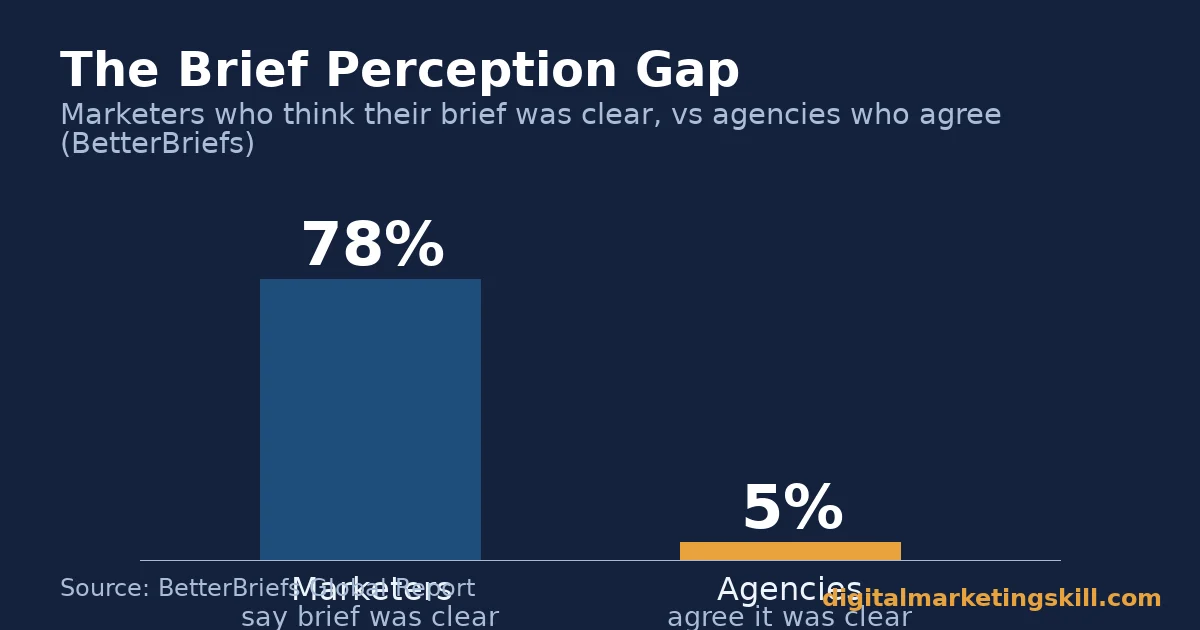
- Clients and the people serving them rarely agree a brief worked. In that same study, 78% of marketers believed their brief gave clear strategic direction, but only 5% of agencies agreed.
- A documented answer beats a remembered one. Content Marketing Institute’s benchmark research found 65% of the most successful B2B content marketers have a documented content strategy, against 14% of the least successful.
- Unclear goals is the single biggest reason content underperforms. In CMI and MarketingProfs’ B2B research, 42% of marketers named a lack of clear goals as the top reason their content strategy fell short.
- Skipping the audience question wastes the writing anyway. Ahrefs studied about 14 billion pages and found 96.55% get no traffic from Google, which is what happens to content built for no one in particular.
In this guide
- What Most Content Marketing Client Questions Lists Get Wrong
- Why Content Projects Break Without These Answers
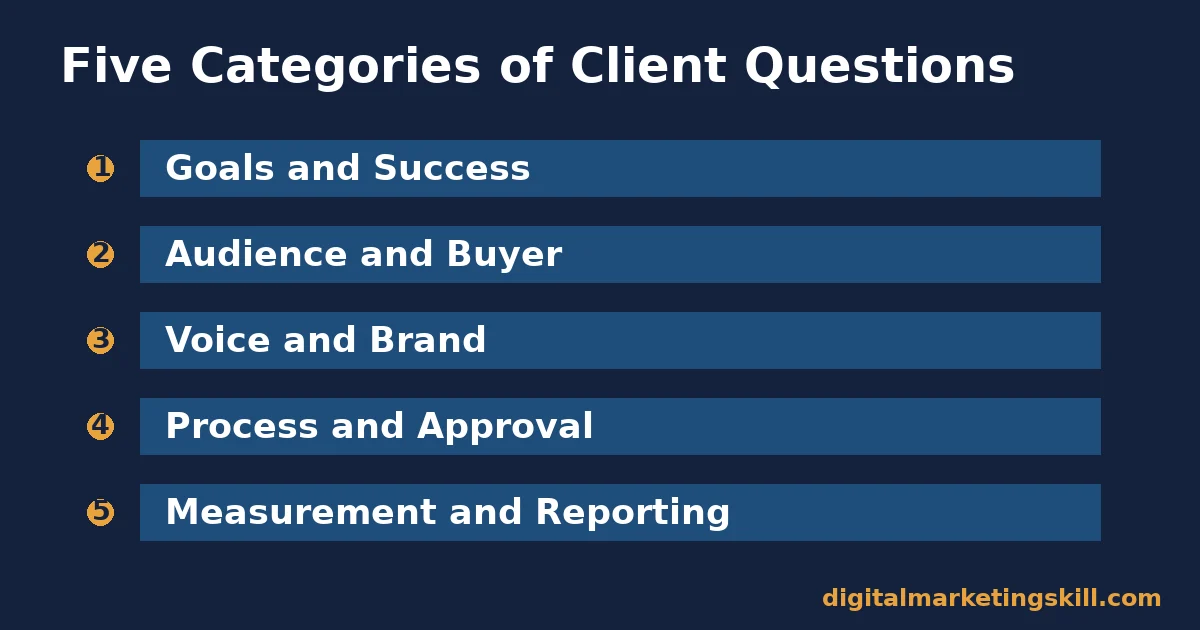
- Content Marketing Client Questions Fall Into Five Categories
- The Exact Questions to Ask in Each Category
- How to Measure Whether Your Discovery Questions Worked
- Three Mistakes That Undo Good Questions
- The One Question to Ask Before Any Other
- A Real Case: Clarity Before the First Draft
- Frequently Asked Questions About Content Marketing Client Questions
- Start With One Client, Then Build Your Template
What Most Content Marketing Client Questions Lists Get Wrong
Search for content marketing client questions and you will find the same ten items. What is your goal. Who is your audience. What is your budget. The questions are fine. What is missing is the reason each one exists, and what happens when a client’s answer is vague.
This guide closes that gap. It groups the real questions into five categories. It explains the failure each category prevents. Then it gives you the follow-up to ask when the first answer is too thin to use. The goal is a short document both sides sign off on, not a checklist you file and forget.
A few ground rules first. The BetterBriefs figures come from one large global survey, so treat them as a strong signal, not a universal law for every market. The CMI figures are self-reported by the marketers surveyed, which is normal for this kind of research but worth remembering. Everything else here is a practical framework built from that evidence. That makes it an informed approach, not a settled formula.
Why Content Projects Break Without These Answers
A content project rarely fails because the writing is weak. It fails because the brief left room for two different readings, and nobody caught the gap until the first draft landed. One side expected a specific outcome, while the other honestly produced something different from the information they were given.
The Brief Gap Is a Budget Leak, Not a Formality
Researchers behind the BetterBriefs Project surveyed over 1,700 marketers and agency staff in more than 70 countries about how briefs actually perform. Respondents estimated that 33% of marketing budget is wasted on poor briefs and the rework that follows.
The full BetterBriefs global report breaks that figure down in more detail. It includes the drafts nobody uses, the meetings called to clarify a sentence that should have been clear the first time, and the hours spent explaining, after the fact, what was actually wanted.
The same study found a sharp perception gap. Seventy-eight percent of marketers believed their own brief gave clear strategic direction. Only 5% of agencies receiving those briefs agreed. The person asking the questions and the person answering them often leave the conversation holding two different documents in their heads.
This gap is why a content marketing client question needs a written answer, not just a nod on a call. A spoken “yes, that sounds right” can mean five different things depending on who is listening. A written sentence, read back and confirmed, means one thing.
A Documented Answer Beats a Remembered One
Content Marketing Institute’s ongoing benchmark research keeps finding the same pattern. Teams that write their strategy down outperform teams that carry it in conversation. 65% of the most successful B2B content marketers have a documented content strategy, compared with 14% of the least successful.
A documented answer survives staff turnover. It survives long gaps between projects. It survives the client forgetting what they said three weeks ago. A remembered answer does none of those things. So the real output of asking content marketing client questions is not the conversation itself. It is the one-page document both sides can reopen before every piece of content.
Content Marketing Client Questions Fall Into Five Categories
Every content marketing client question worth asking fits one of five jobs. It protects the goal, the audience, the voice, the approval process, or the way results get reported. Miss a category and a specific failure shows up later, usually after the budget is already spent.
Goals and Success: Built to Stop Scope Creep
Goal questions exist to stop a project from drifting. In CMI and MarketingProfs’ B2B research, 42% of marketers pointed to a lack of clear goals as the top reason their content strategy underperformed, ahead of every other factor measured. A goal that changes mid-project is the single most common source of scope creep.
Without a written goal, “more engagement” can mean comments one month and shares the next. Neither you nor the client notices the target moved, because nobody wrote down where it started.
Audience and Buyer: Built to Stop Generic Content
Audience questions exist because generic content reads like it was written for everyone, which means it persuades no one in particular. Google’s own guidance on helpful, people-first content asks whether a specific reader would “leave feeling they’ve learned enough” to do what they came to do. That bar is impossible to hit without knowing who that reader is.
A client who only names a demographic, not a person with a question, usually gets content that sounds like a brochure. Push past the demographic and you get a sentence you can actually answer.
Voice and Brand: Built to Stop Rewrite Loops
Voice questions exist to stop the “make it sound more like us” revision loop. A client who cannot describe their voice in adjectives can usually point to writing they like and writing they would rewrite. That comparison is more useful than any adjective they could offer.
Skip this question and every draft risks a vague note back: “this isn’t quite us.” That note costs a full revision round and still leaves you guessing what “us” means.
Process and Approval: Built to Stop Delay
Process questions exist because a draft with no named approver sits in an inbox indefinitely. Ahrefs’ search traffic study of around 14 billion pages found that 96.55% get no traffic from Google at all. Some of that is content that sat unpublished so long its research went stale before it ever shipped.
A project with no named approver also hides scope creep, because “let me check with the team” can quietly rewrite the brief one small comment at a time.
Measurement and Reporting: Built to Stop Guesswork
Measurement questions exist because “did this work” needs an answer before the next invoice, not a guess. HubSpot’s State of Marketing research found that measuring marketing return is the top obstacle for 33% of marketers. A third of the industry is already guessing, because this question was never answered at the start.
The Exact Questions to Ask in Each Category
Knowing the five categories of content marketing client questions matters less than knowing exactly what to ask inside each one. Here is the specific question for every category, plus the follow-up to use when the first answer is too vague to act on.
Goals and Success: Ask This First
Ask: “In plain numbers, what does success look like in 90 days?” A client who says “more visibility” has not answered yet. Push with: “If this works, what changes on your dashboard, your inbox or your sales calls?” Write the number down, date it internally, and revisit it at the agreed check-in instead of letting it quietly move.
Audience and Buyer: Ask for a Real Person, Not a Demographic
Ask: “Describe the one real person you most want to read this, and the question in their head right before they find it.” A demographic, such as “business owners, 30 to 50,” describes a market, not a reader. A real question in a real person’s head is something you can answer directly in your opening paragraph.
Voice and Brand: Ask for Examples, Not Adjectives
Ask: “Send me three pieces of writing you love, and three from your own brand you’d rewrite if you could.” Adjectives like “professional but friendly” mean something different to every person who says them. Examples remove the guesswork, because you can point at one sentence and say “like this.”
Process and Approval: Ask Who Signs Off and When
Ask: “Who personally approves this, and what is the longest they’ll need to respond?” Name one person, not a committee, and attach a number of business days. Without that answer, “I’ll check with the team” can quietly add a week to every single piece of content you deliver.
Measurement and Reporting: Ask What Gets Reported and How Often
Ask: “What number do you want to see in a monthly report, and who else reads that report besides you?” The second half matters, because a report built for a marketing manager looks nothing like one built for a founder who only wants to know whether revenue moved.
A One-Page Template for Your Answers
Illustrative, invented numbers: a workable template needs no more than five short lines, one per category. Goal: “20 qualified demo requests in 90 days, confirmed by the sales lead.” Audience: “an operations manager who already Googled ‘reduce onboarding time’ once this month.” Voice: “direct, short sentences, one example attached.”
Approver: “the marketing director, three business days.” Reporting: “one number, in a monthly email, no dashboard login required.” Five lines like these, filled in with the client’s real answers to your content marketing client questions, do more work than a ten-page intake form nobody rereads.
How to Measure Whether Your Discovery Questions Worked
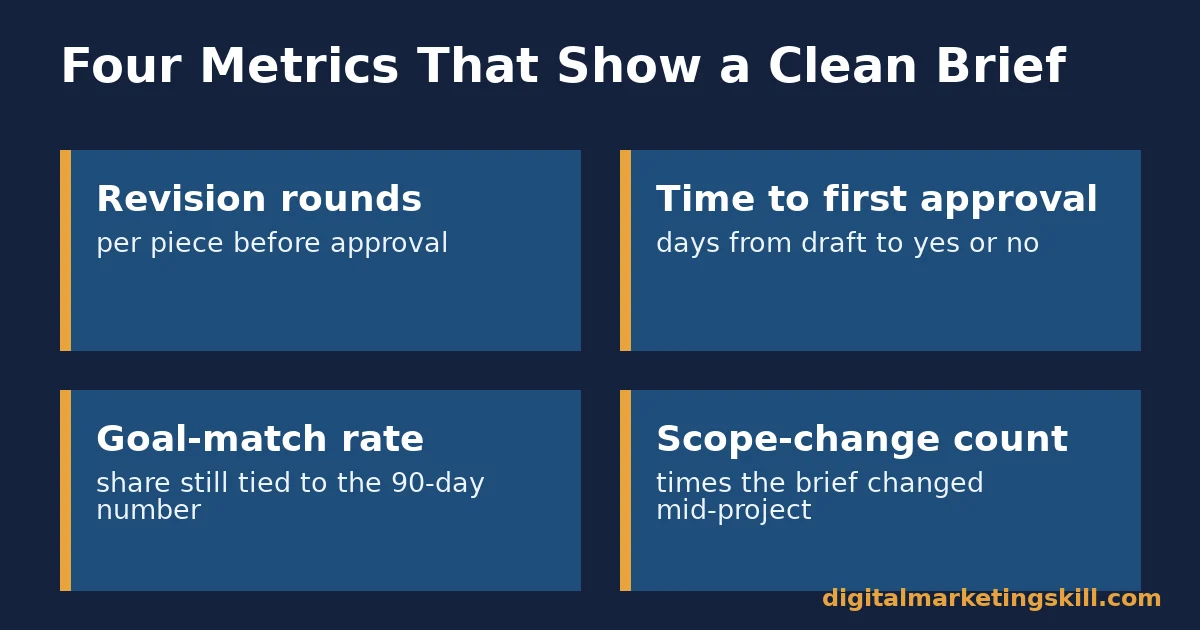
Asking better content marketing client questions is only half the job. The other half is checking, with numbers, that the answers actually prevented the problems they were meant to prevent. Four metrics show this clearly across a project.
Four Metrics That Show a Clean Brief
Revision rounds per piece counts how many rewrite cycles a draft needs before approval. A clean brief usually settles this at one or two rounds. Time to first approval measures the days between a draft going out and a clear yes or no coming back. A named approver should keep this short and predictable.
Goal-match rate is the share of published pieces that still point at the 90-day number you agreed on, rather than a goal that drifted. Scope-change count tracks how many times the brief itself changed after work began. A well-run project keeps this at zero, or logs each change as a new, separately agreed task.
How to Read These Numbers Together
Read these four metrics for your content marketing client questions together, not alone. A low revision count paired with a low goal-match rate often means the client approved content fast because it felt comfortable, not because it was working. A high scope-change count alongside slow approvals usually means the wrong person is signing off, or no one was named at all.
When all four numbers look healthy at once, your content marketing client questions did their job. When one looks off, go back to the category it belongs to and ask the sharper follow-up version, not a brand-new question.
Three Mistakes That Undo Good Questions
Even a strong list of content marketing client questions fails if you handle the answers badly. These three mistakes show up most often, and each one is easy to fix once you can name it.
They matter most for people newer to client work. The Mighty Marketer’s freelance survey of 267 freelance marketers found that 99% call getting and keeping the right clients a genuine challenge. Unclear scope, built on thin content marketing client questions, is a large part of why that challenge persists.
Skipping the Written Summary
A good call still needs a written recap. Send a short summary within a day, in plain sentences the client can scan in thirty seconds, and ask them to confirm or correct it. Skip this step and both sides drift back toward their own memory of the call within a week.
Treating It as a One-Time Event
Many teams ask these questions once, at kickoff, and never again. Goals shift. Budgets get cut. A new stakeholder joins and quietly changes the approval chain. Revisit the five categories at every major check-in, not only at the start.
Asking the Same Questions the Same Way Every Time
A returning client does not need the full intake again. Ask what changed since the last project instead, and only re-ask a full category if the answer suggests it moved. This keeps the process fast without skipping the check that protects the work.
These three mistakes share one root cause: treating content marketing client questions as paperwork rather than as a working tool. A checklist filed away after kickoff protects nobody. A document both sides reopen before every deliverable protects the budget, the deadline and the relationship, in that order.
The One Question to Ask Before Any Other
If you only have time for one content marketing client question, make it this: “What does success look like in 90 days, in your own numbers, and who personally confirms we got there?” It combines the goal question with the approval question, the two categories most responsible for scope creep and stalled drafts.
As a worked example: a client says success means “more leads.” Pushed on numbers, they settle on 20 qualified demo requests in 90 days, confirmed monthly by their sales lead. That single exchange now gives you a number to write toward, a date to check it against, and a named person who can say yes or no. Nothing else on the intake form carries that much weight on its own.
A Real Case: Clarity Before the First Draft
Clear scoping pays off most visibly in client-facing freelance work generally, even outside pure content writing. Digital Marketing Skill Institute student Damola Akanbi reported charging $1,500 per client for digital marketing campaign work after learning to scope projects properly before starting them.
That figure is one student’s self-reported result, not a guaranteed income, and results vary by market, niche and client type. See the earnings disclaimer for the full context. The lesson is directional, not universal: pricing and repeat work both get easier once the scope is written down before work starts, instead of negotiated piece by piece after a client is already frustrated.
Frequently Asked Questions About Content Marketing Client Questions
What is the most important content marketing client question to ask first?
Ask for a 90-day success number before anything else. Every other question, including audience and voice, becomes easier to scope once you know what the client is actually trying to achieve.
How many questions should a content marketing client intake include?
Ten to fifteen questions across the five categories is usually enough. More than that and clients rush their answers. Fewer, and you will be back asking follow-ups mid-project instead of upfront.
Who should answer content marketing client questions: the whole team or one person?
One decision-maker should give the final answer on goals and approval, even if several people contribute input. A committee answer to “what does success look like” usually means nobody actually agreed on it.
What happens if a client refuses to answer a specific question?
Write down your best assumption in plain words and share it back. Ask them to confirm or correct it. A stated assumption they can challenge is safer than silence you might misread as agreement.
Should content marketing client questions be asked in writing or on a live call?
Both. Ask open questions live, where tone and hesitation show you when an answer is thin. Then send a written summary for the client to confirm, since that version becomes the document you both check against later.
How often should you repeat these questions during a long engagement?
Revisit the goal and measurement questions at every reporting check-in, since those two drift fastest. Voice and audience usually hold steady unless the client’s own business changes significantly.
Can these questions work for internal marketing teams, not just outside clients?
Yes. An internal stakeholder requesting a campaign is answering the same five categories as an external client, even if the conversation feels more informal. Skipping the written answer causes the same scope creep either way.
Start With One Client, Then Build Your Template
Pick your next client and run through the five categories before you write a single draft: goals, audience, voice, process and measurement. Turn the answers into a one-page brief they sign off on, then reuse that structure for the client after that.
If you want structured practice turning client answers into a working content plan, the Digital Marketing Skill Institute’s Master Diploma in Digital & AI Marketing includes AI-Powered Lead Generation and AI-Powered Social Media Marketing & Advertising among its ten execution-first courses across four AI-powered tracks. Both walk through turning a client’s answers into a working content and campaign plan, not just a list of deliverables.
The program also includes unlimited 1-on-1 coaching and mentoring, and a project-based internship with a U.S. company that comes with a verified U.S. Work Reference Letter. It is dual US and UK accredited, recognised in more than 100 countries, and 100% online, so you can study from anywhere in your country.
Browse the digital marketing blog for more practical guides, check real outcomes on the reviews page, or go straight to the application page to get started. Wherever you live, these content marketing client questions cost nothing to ask and save far more than they cost. Visit Digital Marketing Skill Institute to learn more, or start today at digitalmarketingskill.com.
Every figure in this guide was checked against its original source before publication. Figures marked as illustrative are invented examples, not real results.
![9 Amazing Digital Marketing Skills to Make Money Online [With Proof]](https://digitalmarketingskill.com/wp-content/uploads/2019/07/9-Amazing-Digital-Marketing-Skills-to-Make-Money-Online-With-Proof-17.png)






