
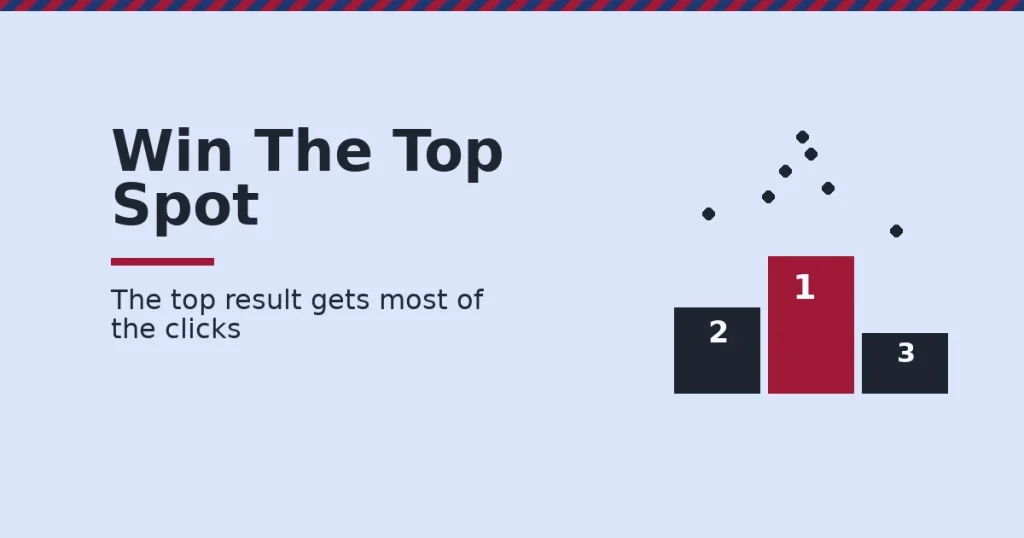
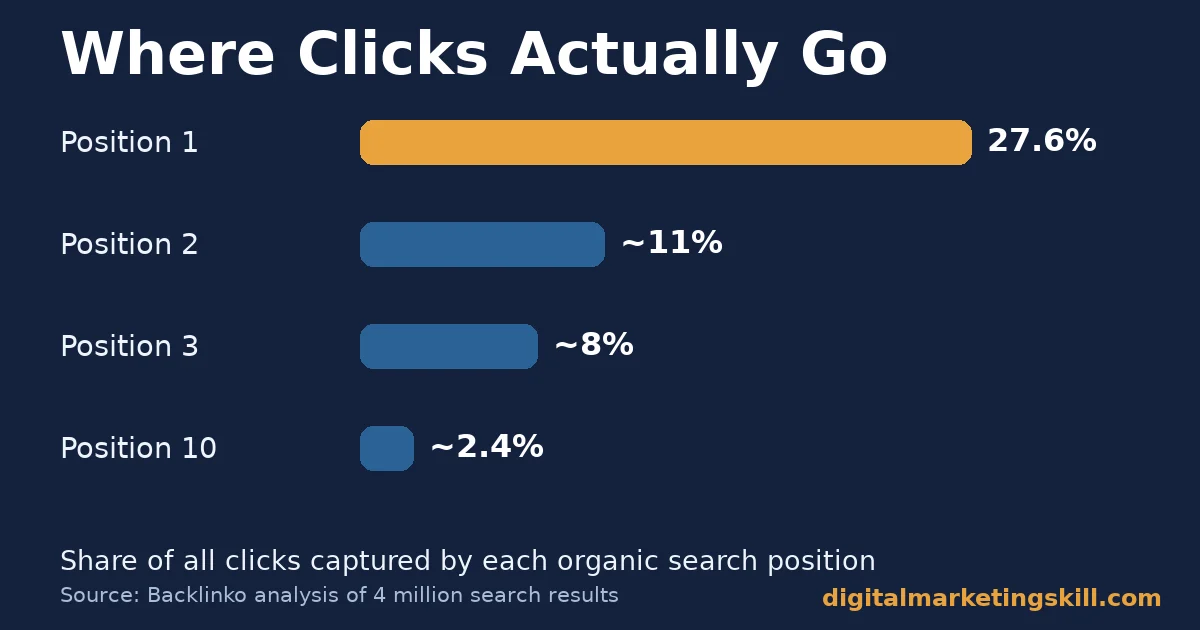
Content promotion is what decides whether your very best work gets read or disappears without a trace. The top Google result alone captures 27.6% of all clicks. The top three results together take 54.4%, per Backlinko’s analysis of 4 million search results. Publishing without a distribution plan wastes most of the effort that went into creating the content.
This guide, from the Digital Marketing Skill Institute, breaks down exactly where that effort should go.
Key Takeaways
- The #1 Google result gets 27.6% of clicks. The top three results together capture 54.4% of all clicks, per Backlinko’s analysis of 4 million search results.
- 49.4% of marketing teams reuse the same content across platforms rather than tailoring it for each one. That is per HubSpot’s State of Marketing report of 1,500+ marketers.
- Short-form video is now the single most impactful content distribution format. 48.6% of marketers named it in that same report.
- 85% of marketers call influencer promotion effective, per a separate HubSpot survey of 1,100+ marketers. Effective content promotion still rarely depends on just one channel.
- Tuesday produces the highest email open rates, per Omnisend’s analysis of roughly 26 billion emails. 9-11am is the most reliable open window across the week.
In this guide
- The Gap Most Content Promotion Advice Ignores
- Why Content Promotion Decides What Gets Seen
- What Differs Across Content Promotion Channels
- How To Promote Content Effectively
- Common Mistakes That Waste a Content Promotion Budget
- Measuring Whether Content Promotion Is Working
- The One Decision Rule For Content Promotion
- A Real Case: Turning One Client Into a Full Service Line
- Frequently Asked Questions About Content Promotion
- Your Next Step
The Gap Most Content Promotion Advice Ignores
Most “promote your content” checklists list ten channels and tell you to use all of them. That advice ignores the real constraint most teams face: time. Posting to ten channels badly beats posting to three channels well in theory, but rarely in practice.
For example, a small team spread across ten channels usually produces a thin, inconsistent presence on every one of them. The same team focused on three channels usually builds a real, recognizable presence on each. Depth beats breadth almost every time outside of a well-staffed enterprise team.
So before adopting any tactic below, name the two or three channels where your current audience already engages. That short list, confirmed by your own traffic and reply data, matters more than any general ranking of which channel is “best” this year for marketers in general.
Two ground rules before the data. Channel performance numbers below are survey snapshots and platform averages, not a guarantee for your specific content. They also shift as platforms change their algorithms, so revisit this plan periodically instead of treating it as fixed.
Why Content Promotion Decides What Gets Seen
Search and social feeds both concentrate attention at the very top. On Google, that concentration is stark. The first result alone gets more clicks than positions four through ten combined, according to Backlinko’s study of 4 million search results.
Social feeds work the same way, just faster. A post earns a short window of initial engagement. The algorithm then decides whether to extend its reach based on how people respond in that window. Content with no promotion plan gets no early engagement, so it never earns the extended reach in the first place.
That is the real mechanism behind content promotion. It is not about being everywhere. It is about winning the first few minutes, or the first page of results, because that is what earns everything after it.
The Real Constraint Is Attention, Not Content Volume
Consequently, publishing more content is rarely the fix for weak reach. A team that already struggles to promote five pieces a month will not solve the problem by producing ten. In other words, the bottleneck usually sits in distribution capacity, not creative output, so that is where the fix belongs too.
This guide was researched by the Digital Marketing Skill Institute team using the sources named throughout, not from an anonymous panel, so every figure here can be traced back to where it came from.
What Differs Across Content Promotion Channels
Four channels drive most of the measurable results in content promotion. Each is built around a different mechanism, so each needs a different approach.
Search Placement: Built For Patience, Not Speed
Search traffic compounds slowly. A page optimized well can keep earning clicks for years, but it rarely produces results in its first week. On-page SEO, internal links, and earned backlinks move a page from page two toward the top three results. Those top spots, in turn, capture most of the clicks.
Repurposed Formats: Built For Reach, Not Original Effort
The same core idea reaches different audiences depending on its format. Short-form video is now the single most impactful distribution format at 48.6%, per HubSpot’s own survey. Even so, 49.4% of teams still just repost identical content everywhere instead of adapting it.
Owned Email: Built For Timing, Not Volume
Email performance depends heavily on when it lands, not just what it says. Tuesday produces the strongest open rates. The 9-11am window performs most reliably across the week, per Omnisend’s email data.
Paid Reach: Built For Speed, Not Compounding
Paid promotion is the inverse of search. It produces results immediately and stops the moment spend stops. Therefore, it is the right tool when content is time-sensitive, not a replacement for slower channels that keep paying off after the campaign ends.
Community and Forums: Built For Trust, Not Broadcast
Forums and niche communities reward genuine participation, not drive-by links. A post that only promotes gets ignored or removed, while a post that adds real value earns the credibility to mention relevant content naturally. Moderators and long-time members notice patterns quickly, so a short history of helpful answers pays off well beyond any single promoted link.
How To Promote Content Effectively
Each channel above has a mirrored fix. The pattern repeats: match the tactic to what the channel actually rewards. Stop applying one generic promotion checklist everywhere.
Search Placement: Lead With On-Page Fundamentals
Target one primary keyword per page. Use it naturally in the title and first paragraph, and build 2-3 genuine internal links to and from related pages. Earn backlinks by publishing something worth citing, like an original figure, a clear framework, or a useful tool. Do not ask for links to average content.
Before chasing new backlinks, check whether an older page already ranks on page two. A moderate SEO improvement to an existing page that search engines already trust often moves it into the top three faster than starting a brand-new page from zero.
Keep guest post expectations realistic: Ahrefs’ analysis of 239 guest posts found average referral traffic of only about 50 visits per post. The real payoff is usually the backlink itself, not a traffic spike, since that backlink keeps contributing to rankings long after the referral traffic fades.
Repurposed Formats: Lead With the Platform’s Native Style
Turn one long article into a short video script, a carousel, and a thread, instead of posting the same paragraph everywhere. Each format should feel native to its platform, not like a copy-pasted excerpt. That is what separates the 39.5% of teams who tailor content from the 49.4% who do not.
Start the repurposing process with your single best-performing piece, not a random one. A piece that already proved it resonates is far more likely to perform well again in a new format than content nobody has ever validated yet.
Owned Email: Lead With a Tested Send Window
Default to Tuesday morning as a starting point, then test your own list against it. Published averages describe the median subscriber, not yours specifically. Use a clear subject line that states the value inside. Keep the email itself short enough to read in under a minute.
Segment your list by interest or past behavior where possible, instead of sending one identical email to everyone every single time. A smaller, relevant send consistently beats a larger, generic one on both open rate and the actions people take afterward.
Paid Reach: Lead With a Narrow Audience
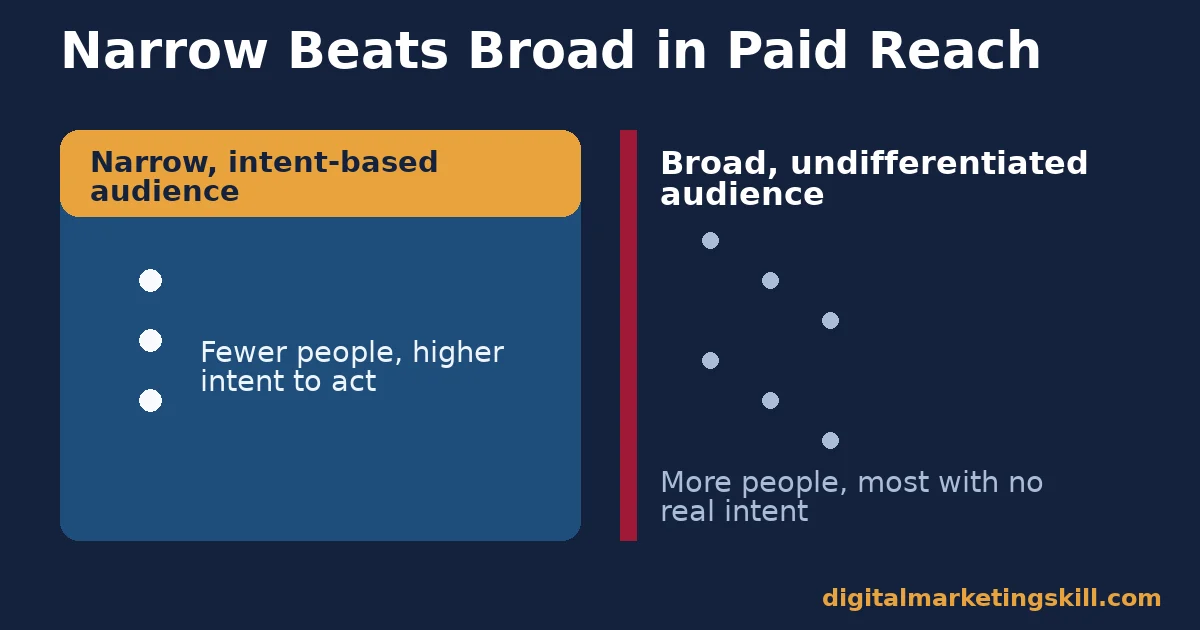
Spend first on the audience most likely to act, not the broadest possible reach. A small, well-targeted budget aimed at people who already show intent outperforms a larger budget. That larger budget, spread thin across an undifferentiated audience, usually wastes itself.
Retargeting people who already visited the content is often the single highest-return paid tactic available, because they have already shown some interest. Spend there first, before expanding to cold audiences who have never encountered your brand through broader ads or influencer partnerships.
Community and Forums: Lead With Context, Not a Link
Answer the actual question being asked in a forum or group before mentioning your own content at all. If your piece genuinely adds value, say why in a sentence or two, then link it, instead of leading with the link itself. Communities notice the difference quickly, and it decides whether future posts get a fair hearing, so treat each contribution as building reputation, not just driving one click.
Common Mistakes That Waste a Content Promotion Budget
A handful of recurring mistakes quietly waste promotion effort, even when the underlying content is genuinely good. None of these require extra budget to fix, just a sharper review before a piece goes live.
Promoting Once and Stopping
Many teams share a piece once on launch day and never return to it. Because most audiences miss any single post, resharing strong content on a staggered schedule, mapped out in a content calendar, reaches people who missed it the first time. A good piece can reasonably support three or four resurfacing passes across different angles before it genuinely runs its course.
No Clear Next Step for the Reader
Content that informs but asks nothing of the reader ends the interaction there. Adding one clear next step, a related read, a sign-up, or a reply prompt, turns a passive read into a small action that compounds over time. Keep the ask singular and specific, since a list of five different calls to action usually gets none of them taken.
Optimizing for Reach Instead of the Right Outcome
Reach looks impressive on a report but does not always map to the actual goal. If the goal is leads, optimize promotion toward conversion-focused channels like email, not just toward whichever channel produces the biggest reach number.
Ignoring When Your Specific Audience Is Active
Published averages like “Tuesday mornings” describe a blended dataset, not your account specifically. A B2B audience may engage most during work hours, while a consumer audience may engage most in the evening after work. Check your own platform analytics before assuming a published average applies directly to your audience.
Measuring Whether Content Promotion Is Working
Track a short list of numbers tied to the channel that produced them. One blended total hides which channel is actually working.
Choosing the Right Promotion KPI
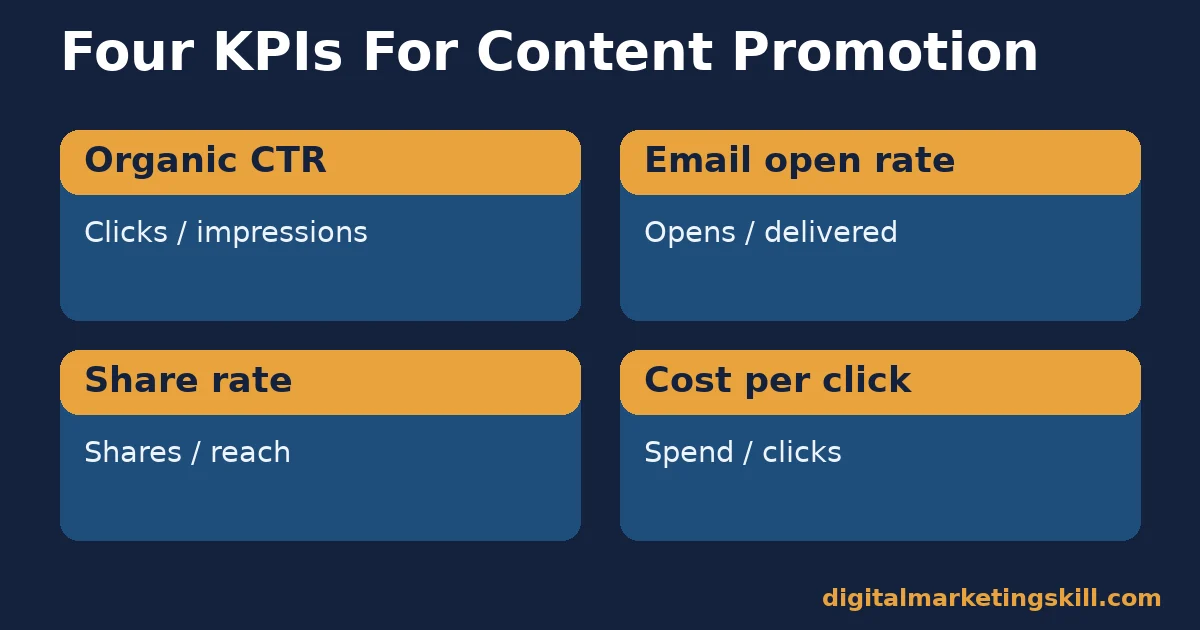
Which number matters most depends on the channel’s job, not on which is easiest to pull from a dashboard. A search goal leans on organic CTR. An email goal leans on open rate. A social goal leans on share rate, and a paid goal leans on cost per click. Mixing these together in one report usually buries the number that actually needs attention.
- Organic CTR is clicks divided by impressions in search results. A low CTR at a decent ranking position usually means the title or meta description needs a sharper promise.
- Email open rate is opens divided by emails delivered. A falling open rate over time usually points to subject lines going stale, not your list going cold.
- Share rate is shares divided by reach on social platforms. It shows whether content is compelling enough that people spread it for you, beyond the initial push.
- Cost per click is total paid spend divided by clicks generated. Rising cost per click with flat conversion usually means the targeting has grown too broad.
The One Decision Rule For Content Promotion
Decision rule: before publishing anything, name the two channels you will actively promote it through in the first 48 hours. If you cannot name two, the piece is not ready to publish yet.
Illustrative, invented example: a team finishes a guide and has a choice. Option A publishes it with no promotion plan and hopes search traffic arrives eventually. Option B schedules one email send and three native social posts before publishing. Under the rule, Option B is the minimum bar, and Option A gets delayed until a real plan exists.
Notice what the rule does not require: a huge promotion budget or a dozen channels. Two well-chosen channels, planned in advance, clear the bar. The rule exists to stop content from publishing with no plan at all, not to demand an elaborate one, and it works equally well for a solo creator and a full marketing team.
A Real Case: Turning One Client Into a Full Service Line
Olajire Jacob, a graduate featured on the Digital Marketing Skill Institute reviews page, charged an average of $500 to set up email marketing flows for clients. That initial work expanded into a full service line that now scales to $5,000 a month.
The growth came from promoting a specific, repeatable service consistently to a defined audience, not from being active everywhere at once. It describes one person’s results, not a guaranteed income, and outcomes vary by market, skill, and effort. See the Institute’s earnings disclaimer for full context behind any student income figure.
For Contrast: The Same Service, No Consistent Promotion
Illustrative, invented example: picture a second freelancer offering the identical $500 email flow service, with similar skill, but promoting it only when they happen to remember. Referrals arrive occasionally, but growth stalls far short of $5,000 a month. The service was never the differentiator; the consistent promotion plan running quietly in the background was.
Frequently Asked Questions About Content Promotion
What is the fastest way to start content promotion with no budget?
Start with owned email and native social posting, since both cost time rather than money. Pair each new piece with at least one email send and two or three platform-native posts. Worry about paid reach later.
How many channels should a small content promotion plan use?
Two or three channels, done well, beat ten channels done poorly. Pick the channels where your actual audience already spends time, confirmed by where your current traffic and replies come from.
Does content promotion still matter if the content is genuinely excellent?
Yes. Excellent content with no promotion plan still depends entirely on luck to be found. Promotion is what gives quality content a fair chance to reach the audience it was built for.
How soon after publishing should content promotion start?
Immediately. The first hours after publishing shape how much initial engagement a piece gets. That early engagement influences how far algorithms extend its reach afterward. Waiting days to promote a piece wastes that early window.
Is paid promotion worth it for a small budget?
Yes, if the audience is narrow and well-targeted. A small, focused paid budget aimed at people showing real intent typically outperforms a larger, broader one. Spreading the same money across an undifferentiated audience usually wastes most of it.
Should every piece of content be repurposed into video?
Not every piece, but consider it for your best-performing content first. Short-form video is currently the most impactful distribution format for many audiences. Repurposing proven content into it is lower risk than creating a new video from scratch.
How do I know if my content promotion plan is actually working?
Compare results against your own past content, not against an industry benchmark that may not match your audience. A steady upward trend in organic CTR, email opens, and shares over several pieces is a healthier signal than any single post’s performance, since one outlier piece can skew a single snapshot.
Can content promotion fix content that genuinely is not very good?
No. Promotion can only earn content a fair first look, not sustained engagement it does not deserve. If a heavily promoted piece still underperforms, the content itself, not the promotion plan, is usually the real problem.
Should content promotion efforts differ between B2B and B2C audiences?
Yes. B2B audiences respond more to email, LinkedIn, and search, since buying decisions take longer and involve research. B2C audiences respond more to short-form video and paid social, where purchase decisions happen faster and more impulsively.
How do I prioritize content promotion when I have limited time each week?
Rank upcoming content by its potential business impact, not by how recently it was published. Spend most of your limited promotion time on the handful of pieces most likely to drive leads or sales, and let lower-priority content get a lighter, automated push instead of competing for the same limited hours.
Your Next Step
Effective content promotion is a skill the Digital Marketing Skill Institute’s Master Diploma in Digital & AI Marketing teaches directly, not as an afterthought. The AI-Powered Lead Generation and Email Automation track covers distribution, email timing, and conversion in depth. The AI-Powered Social Media Management and Advertising track covers paid and organic social promotion.
Both combine with the other AI-powered tracks through the Full Stack option for a complete, ten-course program, which also covers Google and WordPress and SEO skills.
Every track includes unlimited one-on-one coaching and mentoring, a U.S. Project Internship with a verified U.S. Work Reference Letter, and dual US and UK accreditation recognised in more than 100 countries, 100% online. You can apply what you learn anywhere in your country.
Why Direct Feedback Beats a Generic Channel List
Instead of guessing which channels fit your specific audience, you get direct feedback on your own distribution plan. Coaches who have already built working content promotion systems for other businesses review your plan directly. That feedback turns a list of tactics into a plan that actually fits your content, your audience, and the time you realistically have available.
Explore the full Master Diploma program, read more student reviews, browse the digital marketing blog for more practical guides, or go straight to the application page to start. Wherever you live, you can start building a real content promotion plan today, on digitalmarketingskill.com.
Every figure in this guide was checked against its original source before publication. Figures marked as illustrative are invented examples, not real results.
![9 Amazing Digital Marketing Skills to Make Money Online [With Proof]](https://digitalmarketingskill.com/wp-content/uploads/2019/07/9-Amazing-Digital-Marketing-Skills-to-Make-Money-Online-With-Proof-17.png)






