
Blog SEO is the practice of structuring and writing a post so search engines can find it, understand it, and rank it for the right query. It covers titles, headings, internal links and page speed. Done well, it turns a post into a page that keeps attracting readers long after publication, without ongoing ad spend to keep sending traffic its way.
Key Takeaways
- Most posts never get found at all. Ahrefs studied about 14 billion pages and found that 96.55% get zero organic traffic from Google.
- Title length has a real, measured effect. Backlinko’s analysis of 4 million search results found titles between 40 and 60 characters earn an 8.9% better click-through rate than titles outside that range.
- Blogging still pays off for most marketers. HubSpot’s survey of over 500 marketers found 93% rate blogging as important or very important to their strategy.
- Page experience matters, but relevance wins first. Google’s own documentation states ranking systems use Core Web Vitals, but “Search always seeks to show the most relevant content, even if the page experience is sub-par.”
- One rewrite can double a site’s traffic. Backlinko’s founder documented a case where improving one outdated, popular post and reaching out to its linkers doubled organic traffic to the entire site within 14 days.
In this guide
- What Most Blog SEO Advice Gets Wrong
- How Blog SEO Actually Works
- Where Blog SEO Effort Pays Off Most
- How to Fix Each Element
- Common Blog SEO Mistakes to Avoid
- How to Measure Blog SEO
- The One Decision Rule: Optimise Before You Publish More
- A Real Case: Doubling Traffic by Rewriting One Post
- Frequently Asked Questions About Blog SEO
- Put Blog SEO to Work on Your Existing Posts
What Most Blog SEO Advice Gets Wrong
Most blog SEO checklists read the same way: use your keyword, add headings, write a meta description. None of that is wrong. But it treats every element as equally important, when they are not. Some elements decide whether your post is seen at all, while others only matter once a reader has already clicked through.
This guide ranks the work by where it actually moves results. It starts with the elements that decide whether anyone finds your post at all, then moves to the ones that only matter once they do.
Ground Rules and Limits
A few ground rules first. Search engine behaviour changes constantly, so treat every figure below as a snapshot from its own study, not a permanent rule. Every statistic was checked against its named source before publication. The research here is credited to Digital Marketing Skill Institute’s editorial team, not any invented author.
Blog SEO also cannot fix a weak topic. If nobody searches for what you wrote about, no amount of title tweaking will create demand that does not exist. Choosing the right topic in the first place still matters more than any single tactic in this guide.
This guide also will not promise any specific ranking position or exact traffic number for your own site. Search results change constantly, and every site starts from a different level of existing authority. What follows is a method for finding and fixing the weakest part of your own blog SEO, not a formula with a guaranteed outcome.
Why This Order Matters
Treating the three jobs as a fixed order, rather than a checklist, changes how you spend your time. Fixing a crawl or indexing problem before touching relevance work is usually the highest-leverage move, since nothing else matters if a page is never discovered. Clicks matter next, and only once both of those are solid does deeper content work pay off at full value.
How Blog SEO Actually Works
A search engine has to do three things before a reader ever sees your post. It has to crawl the page, understand and index its content, then decide where to rank it against every other page on the same topic. Blog SEO is the set of choices that make each of those three steps go your way, instead of working against you by accident.
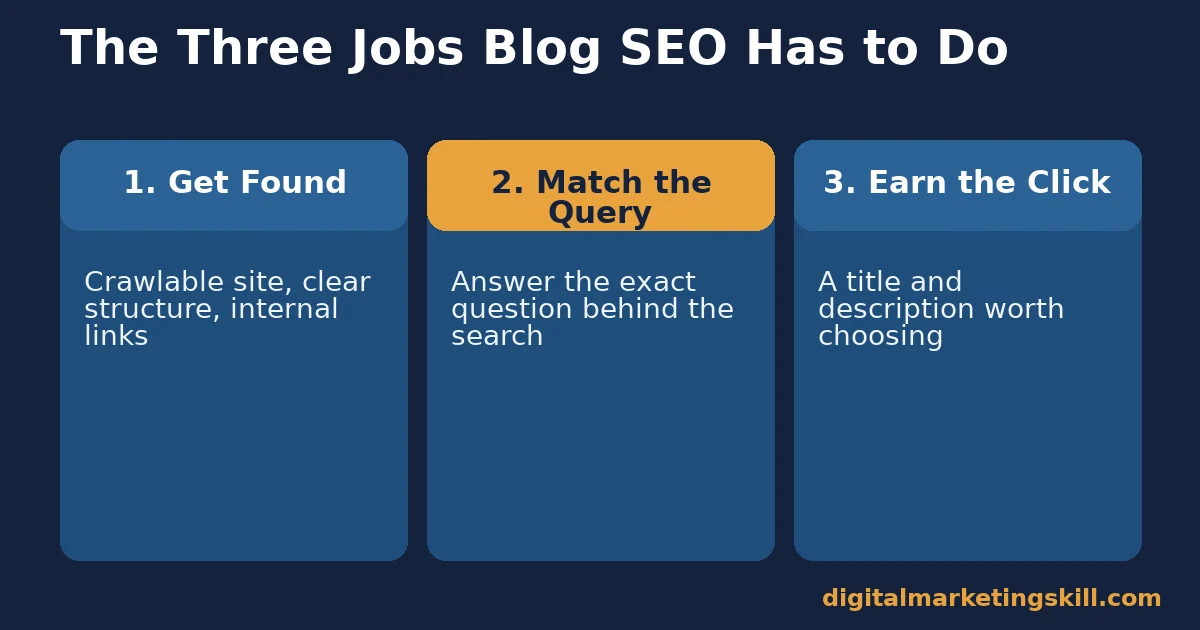
The Three Jobs Blog SEO Has to Do
- Get found. Search engines need a clear path to your page and a clear signal of what it covers, through structure, internal links and a crawlable site.
- Match the query. Your content has to answer the specific question behind a search term, not just mention the topic in passing.
- Earn the click. Even a well-ranked post needs a title and description that convince a searcher to choose it over the other results on the page.
Most blog SEO advice focuses only on the second job. But a post that is perfectly optimised for relevance still fails if search engines cannot find it, or if nobody clicks the listing once it appears.
A Common Mistake: Optimising the Wrong Job
Writers who struggle with blog SEO often spend hours polishing one job while ignoring the other two. A perfectly keyword-matched post with no internal links can sit unindexed for weeks. A fast, well-linked post with a vague title can rank well and still get skipped in the results. Diagnosing which job is actually weak matters more than optimising harder on the job you already understand.
Where Blog SEO Effort Pays Off Most
Titles, structure and internal links each do a different job in the three-step process above. Treating them as interchangeable is the most common blog SEO mistake.
Titles and Meta Descriptions: Built on the Click
A title and meta description are the only parts of your post most searchers ever see before clicking. Their job is narrow: confirm relevance and earn the click, in the space of one or two lines.
That narrowness is also why small changes here move numbers fast. Unlike a full rewrite, a new title can be tested and measured within days. It changes nothing about the content search engines already know and rank, so results show up fast.
Headings and Structure: Built on the Scan
Once a reader lands, headings and structure decide whether they stay. A reader scans before they commit to reading, so the structure has to prove the post delivers within the first screen. A mobile-friendly website matters here too, since most of that scanning now happens on a phone.
Structure also feeds back into relevance. Clear, descriptive headings help search engines understand what each section covers, which supports the second job of matching a query, not only the reader’s own scan path.
Internal Links: Built on the Site
Internal links do their job quietly, over time. They help search engines find and understand every page on your site, not just the one a reader is currently viewing.
A new post with zero internal links pointing to it can take far longer to get discovered and indexed than one linked from several existing, already-indexed pages. Links from inside your own site are the fastest, cheapest signal you control directly.
How to Fix Each Element
Each element needs a different first move. The sections below mirror the three elements above, so you can match the fix to whichever one is actually weak on your site.
Titles and Meta Descriptions: Lead With the Match
Put the search term, or a close natural variant, at or near the start of the title. Keep the title between 40 and 60 characters where possible, matching the range Backlinko’s data found performs best.
Write the meta description as a genuine promise of what the post delivers, not a restatement of the title. Our guide to finding effective SEO keywords covers how to choose the right term before you ever write the title.
Headings and Structure: Lead With the Scan Path
Write headings that make sense on their own, without the paragraph underneath them. A reader skimming only the headings should be able to follow the shape of the whole post. Keep paragraphs short, since long blocks of text fail the scan test on both desktop and mobile.
Internal Links: Lead With Descriptive Anchors
Use anchor text that describes the destination page on its own, out of context. Google’s own guidance says good anchor text is “descriptive, reasonably concise, and relevant to the page that it’s on and to the page it links to.” Link out to older, related posts on your own site every time you publish something new.
Where the Work Actually Shows Up
None of this means every post needs the same amount of attention. A post on a competitive, high-value term earns far more from careful title testing and internal linking than a low-traffic post ever will. Spend the limited time you have on the posts most likely to move real numbers, not evenly across everything you have published.
Common Blog SEO Mistakes to Avoid
Most blog SEO problems trace back to one of a few repeated mistakes. Checking your own posts against this list is often faster than a full audit.
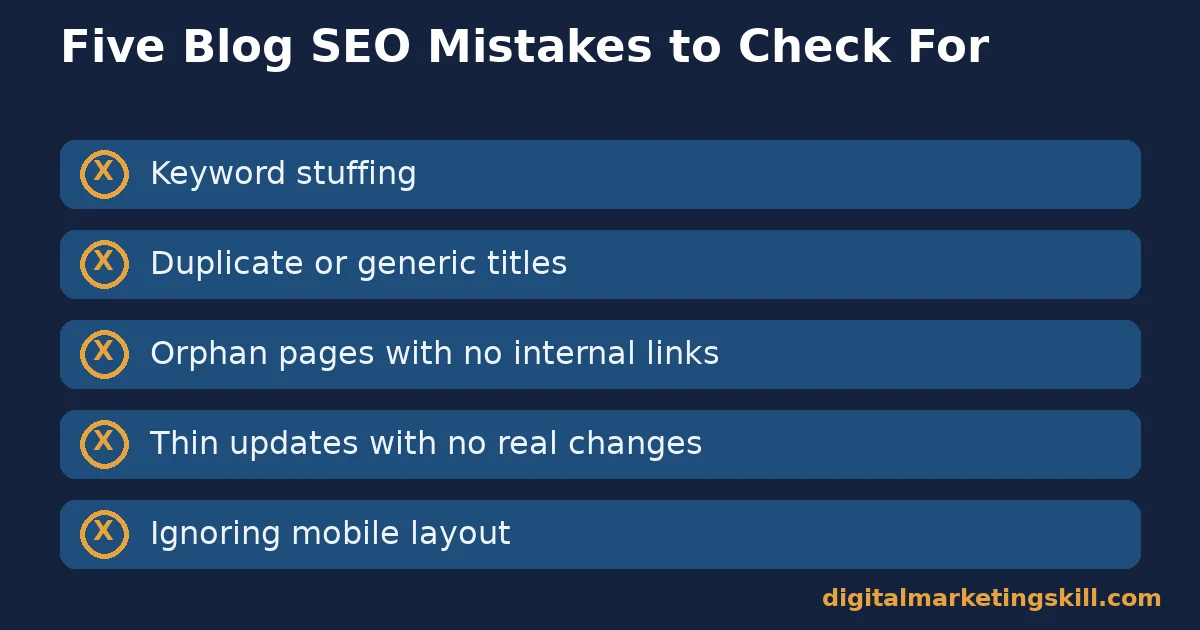
Five Mistakes Worth Checking For
- Keyword stuffing. Repeating the exact phrase unnaturally throughout a post reads badly and can hurt rankings rather than help them. Use natural variations instead.
- Duplicate or generic titles. Several posts competing for the same title confuses both readers and search engines about which page to show.
- Orphan pages. A post with no internal links pointing to it is genuinely harder to find, both for readers and for crawlers.
- Thin updates. Changing a publish date without meaningfully improving the content rarely earns the ranking boost that a real update does.
- Ignoring mobile layout. A post that reads well on desktop but breaks or clutters on a phone loses readers before structure or content even matter.
Most of these mistakes are quick to check and quick to fix. A short monthly review of your top posts against this list usually catches problems long before they cost meaningful traffic.
How to Measure Blog SEO
Blog SEO has to be measured in stages, because a weak number can come from any of the three jobs above. Each metric below is defined in one sentence.
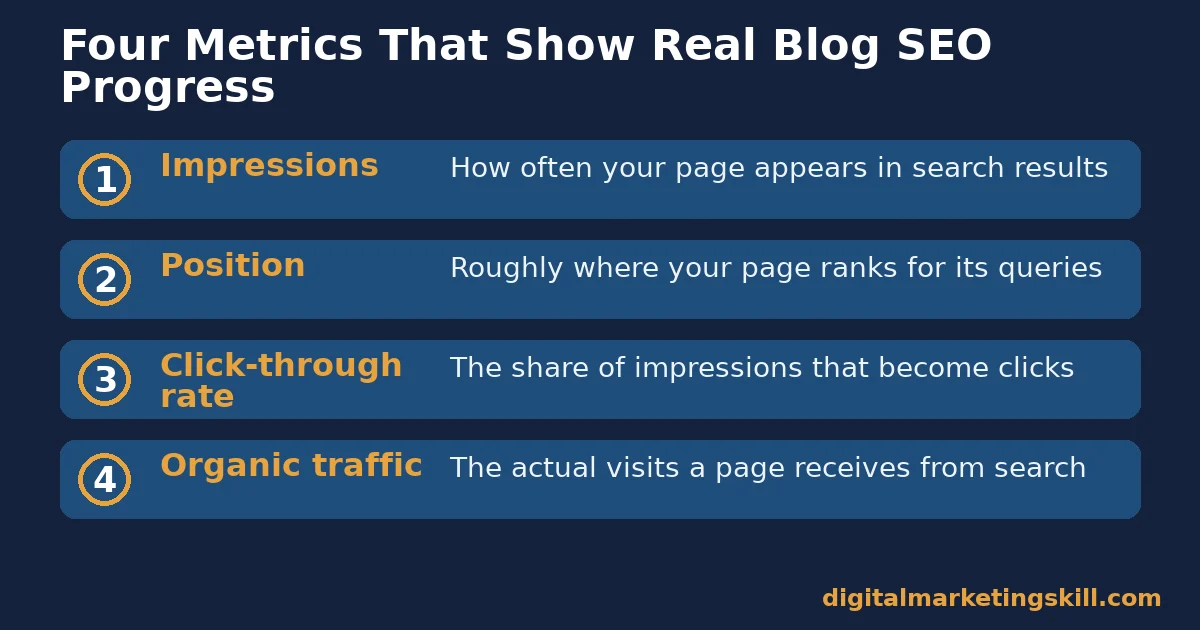
Four Metrics That Show Real Progress
- Impressions. How often your page appeared in search results, shown in Search Console. Rising impressions mean search engines are finding and surfacing the page more often.
- Average position. Roughly where your page tends to rank for the queries it appears for. This shows whether your relevance signals are strong enough to compete.
- Click-through rate. The share of impressions that turn into clicks. A low rate at a decent position usually points to a weak title or description, not a relevance problem.
- Organic traffic. The actual number of visits a page receives from search. This is the outcome metric the other three feed into.
How to Read These Numbers Together
Read the four metrics in order. Low impressions mean search engines are not finding or ranking the page at all, so fix structure and links first. Decent impressions with a low average position point to a relevance gap. Good position with a low click-through rate points squarely at the title and description.
Only look at organic traffic last. Treat it as the combined result of the other three. Chasing traffic directly, without checking which stage is actually weak, usually wastes effort on the wrong fix. Our guide to website traffic analysis covers how to read these numbers inside Google Analytics specifically.
Keep a simple record of each post’s numbers over time, rather than relying on memory. Note the date whenever you change a title or add internal links. That record lets you compare the weeks before and after, instead of guessing whether a change actually worked.
Check these numbers monthly rather than daily. Search rankings and impressions can swing from week to week for reasons unrelated to your changes. A competitor publishing new content, or a temporary algorithm test, can both move the numbers. A single week of data rarely proves anything on its own.
The One Decision Rule: Optimise Before You Publish More
If you take one rule from this guide, make it this one. Before writing a new post, check whether your existing posts with real impressions are actually converting those impressions into clicks and rankings. Fixing a post that already gets found is usually faster than starting a new one from zero.
Here is an illustrative example, with invented numbers. A post ranks in position 6 for its target term and gets 2,000 impressions a month, but only a 1.5% click-through rate. Rewriting its title and meta description to better match the search term is often enough to double that click-through rate within a few weeks. The body of the post does not need to change at all.
A Real Case: Doubling Traffic by Rewriting One Post
Backlinko’s founder, Brian Dean, wanted to rank for a competitive SEO term that an existing, outdated post already ranked for. Rather than starting from nothing, he built on what was already working.
His method had three steps, documented on Backlinko’s own site. First, find content that already attracts links. Then build something more complete than it, and contact the sites linking to the original to point them to the improved version.
He compiled a list of 200 Google ranking factors, far more thorough than anything else published on the topic at the time. He then emailed 160 sites that linked to the older, thinner post, and landed 17 new links, an 11% success rate.
None of the three steps required new content ideas from scratch. Every part of the method reused signals that already existed. That included an existing ranking post, an existing list of linking sites, and a relationship built through a simple, relevant email.
What Generalises and What Doesn’t
The reported result was dramatic: organic search traffic to the entire site, not just that one post, doubled within 14 days. Treat the speed and scale of that result as specific to one experienced SEO practitioner with an established site and audience. It is not a guaranteed timeline for every blog.
What generalises is the method. Find a post that already has some authority, make it genuinely more complete, then tell the people already linking to the old version. That sequence works regardless of your site’s size. Our roundup of free SEO tools covers ways to find that kind of opportunity without a paid subscription.
Frequently Asked Questions About Blog SEO
How do I prioritise blog SEO fixes with limited time?
Start with posts that already have real impressions but a weak click-through rate or weak average position, since those are closest to paying off. A brand-new post with zero impressions needs a different kind of attention, usually more internal links and time to get indexed.
How many keywords should I use in a blog post for SEO?
There is no fixed count that works for every post. Focus on using your target term naturally in the title, the opening, a few subheadings and the body, rather than hitting a specific number of repetitions.
How long should a blog post be for good SEO?
Long enough to fully answer the search intent behind the term, and no longer. Thin posts that skip real detail tend to underperform longer, more complete answers to the same question. That said, padding a post with filler does not help rankings either.
Does page loading speed actually affect blog SEO?
Yes, but as one factor among several. Google’s own documentation confirms Core Web Vitals are used by ranking systems. It also notes that highly relevant content can still outrank a faster page with a sub-par but adequate experience.
How often should I publish new blog posts for SEO?
Consistency usually matters more than raw frequency. HubSpot’s survey found two to three posts a week is the most common pace among marketers who blog. A slower, higher-quality schedule can still outperform a faster, thinner one.
Should I update old blog posts instead of writing new ones?
Often, yes. A post that already has impressions and some ranking history is usually faster to improve than a brand-new post is to rank from scratch. That is the core idea behind this guide’s one decision rule.
What is the difference between on-page and technical blog SEO?
On-page blog SEO covers what is inside the post itself: titles, headings, content and internal links. Technical SEO covers the underlying site: crawlability, page speed and mobile usability. Both feed into the same three jobs described in this guide, so neither one alone is enough on its own.
Can I do blog SEO without any paid tools?
Yes. Search Console and the search results themselves show you impressions, position and real competing content for free. Paid tools speed up research, but the three jobs in this guide do not require them.
Why did my blog SEO stop working after it used to rank well?
Search results change as competitors publish newer or more complete content, and as search engines update how they weigh different signals. Treat a ranking drop as a prompt to check whether your post is still the most complete answer available, not as a permanent penalty.
Put Blog SEO to Work on Your Existing Posts
Blog SEO improves fastest when you fix what is already close to working. Pick one post with real impressions but a weak click-through rate. Rewrite its title and meta description to match the term more precisely, then measure the change over the following month.
If you want structured, hands-on practice with search optimisation across real content, Digital Marketing Skill Institute teaches it inside live project work.
The Master Diploma in Digital & AI Marketing is built from four AI-powered tracks: AI-Powered Social Media Management and Advertising, AI-Powered Lead Generation and Email Automation, AI-Powered Google Specialist, and AI-Powered WordPress and SEO Specialist. Together they cover ten courses, with a Full Stack option to complete all four.
It includes unlimited 1-on-1 coaching and mentoring, plus a U.S. Project Internship with a verified U.S. Work Reference Letter. It is also dual US and UK accredited, and recognised in more than 100 countries.
The programme runs 100% online, so you can apply these blog SEO skills to real projects from anywhere in your country. Browse more guides like this one on our digital marketing blog, see outcomes on our reviews page, or apply for the Master Diploma when you are ready. You can also start exploring from the Digital Marketing Skill Institute homepage.
Every figure in this guide was checked against its original source before publication. Figures marked as illustrative are invented examples, not real results.
![9 Amazing Digital Marketing Skills to Make Money Online [With Proof]](https://digitalmarketingskill.com/wp-content/uploads/2019/07/9-Amazing-Digital-Marketing-Skills-to-Make-Money-Online-With-Proof-17.png)






