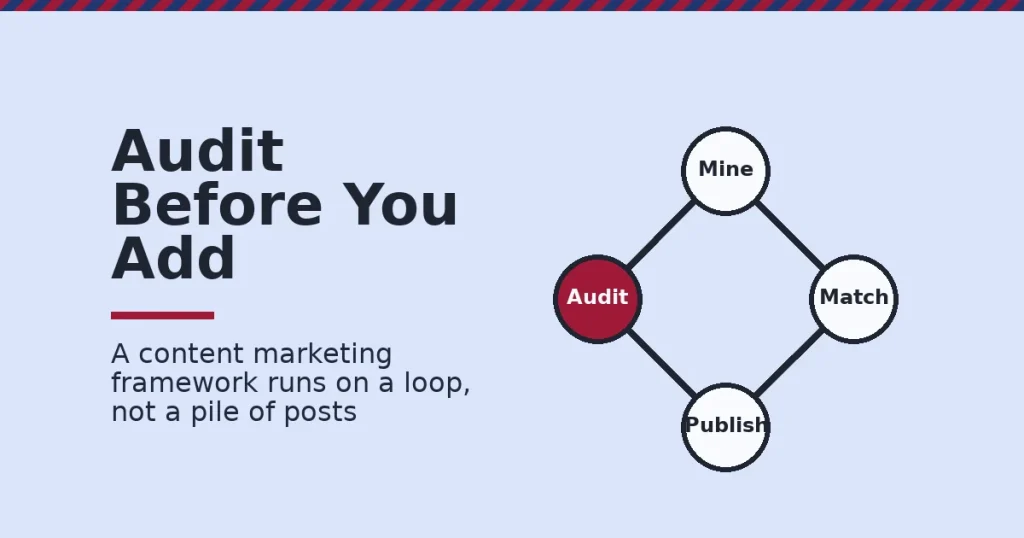
A content marketing framework turns random blog posts into a system. You find the real questions buyers ask, match each one to a funnel stage, write the honest answer, then measure attention instead of raw traffic. Most teams skip the system and judge content by volume alone. This guide shows the four steps that make a content marketing framework actually work.
Key Takeaways
- Most content never gets found. Ahrefs studied roughly 14 billion pages and found that 96.55% get no organic traffic from Google. A content marketing framework has to include discovery, not just writing.
- Strategy is now nearly universal, but results lag behind. The Content Marketing Institute’s B2B benchmark survey of 1,015 marketers found 97% work from a documented content strategy. Only 59% rate their content marketing as effective.
- Blogging still pays off for most teams that keep at it. HubSpot’s State of Blogging survey of over 500 marketers found 50% saw higher blog ROI than the prior period, and 93% call blogging important to their marketing.
- AI has changed the workflow, not the judgment call. The same CMI survey found 95% of B2B marketers now use AI somewhere in their content process, with 87% reporting a productivity gain.
- Auditing beats adding. When CNET pruned thousands of underperforming articles instead of publishing more, its estimated organic traffic rose by about 29% within two months. This guide covers that case and its limits in full later on.
In this guide
- What Most Content Marketing Advice Skips
- How a Content Marketing Framework Actually Works
- What Changes by Funnel Stage
- How to Lead With Each Stage
- How to Measure a Content Marketing Framework
- The One Decision Rule: Audit Before You Add
- A Real Case: What Happens When Teams Audit First
- Frequently Asked Questions About Content Marketing Frameworks
- Build Your Framework, Starting With One Content Pillar
What Most Content Marketing Advice Skips
Most content marketing advice gives you a checklist. Write for your audience. Post consistently. Promote on social media. None of that is wrong, but it treats every piece of content the same way. A comparison post and a beginner’s definition post do not earn trust the same way. Judging them with one checklist misses the point.
A real content marketing framework assigns a job to each piece of content before anyone writes a word. It asks what question the reader is holding, what they need to believe next, and what proof will move them. That planning step gets shortcut constantly, because a checklist feels faster than thinking it through.
Here are the limits of what follows. The statistics below come from named surveys and studies, each with its own sample and its own bias. Read them as snapshots, not permanent rankings. The four-step framework itself is this guide’s own model, built from that evidence. It is an informed structure, not a settled formula every business must follow exactly.
None of the research cited here was commissioned by the Digital Marketing Skill Institute. None of it measures this specific framework directly either. It supports the separate pieces: question-driven content, funnel-aware structure, and auditing instead of only adding.
How a Content Marketing Framework Actually Works
A content marketing framework runs on a loop, not a calendar. Four steps repeat in order: mine real questions, match each one to a funnel stage, publish the honest answer, then audit what you already have before adding more.
The Four Steps in the Loop
Step one is question mining. Instead of guessing topics in a meeting, pull the exact phrases customers use. Support tickets are one source. Sales call notes are another. The search terms report inside your analytics tool is a third. These sources show what people actually ask, not what sounds good on a whiteboard.
Step two is stage matching. A question like “what is X” sits at the top of the funnel, while “X versus Y” sits in the middle. Near the bottom sits a narrower question, such as “does X work for my specific case.” Each stage needs a different kind of answer, which the next section covers in detail.
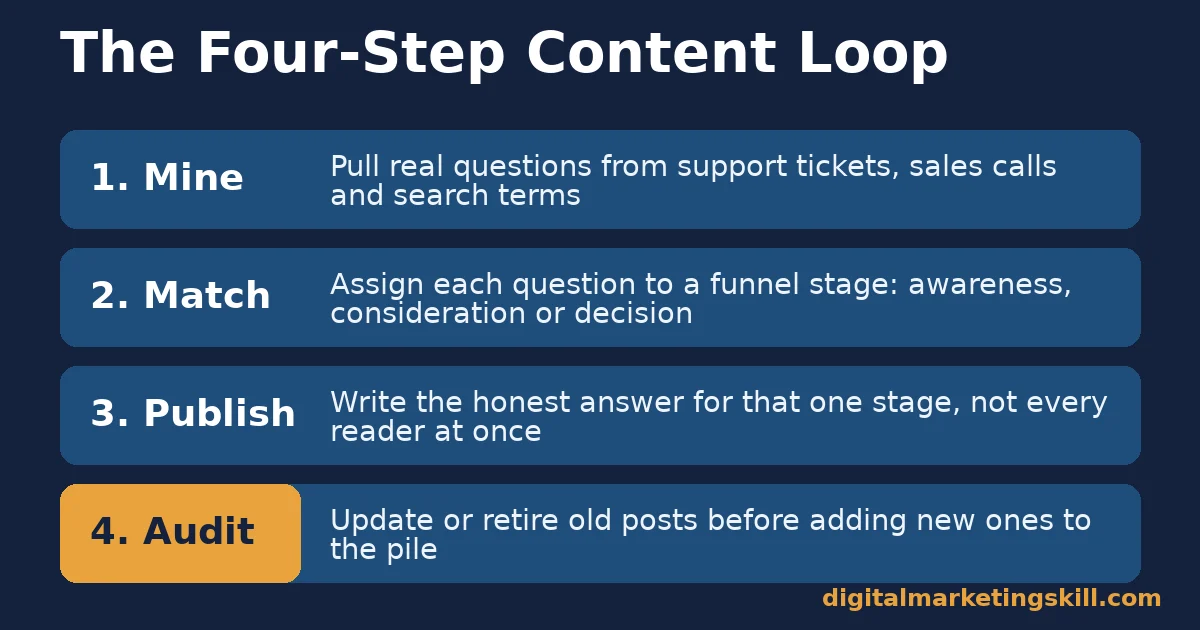
Step three is publishing with intent. The piece is built to satisfy one stage well, instead of trying to serve every reader at once with a vague, do-everything post. Step four is the audit, and it is the step most teams drop first when deadlines tighten.
Why Question Mining Beats Guessing
Readers also scan before they commit to reading, which changes how step three should be written. Nielsen Norman Group recorded how 232 users looked at thousands of web pages in its eye-tracking research. It found that readers move across the top of the content first, then down the left side, in a pattern often called an F-shape.
A post built around one mined question can put that answer exactly where scanning eyes land first. A vague, do-everything post has nothing specific to place there, so the scan finds nothing worth stopping for.
Ahrefs’ search traffic study of about 14 billion pages found that 96.55% receive no organic traffic from Google at all. Most published content never completes the loop it was meant to run.
That silence is usually a sign the post was never built around a real, specific question in the first place. Before you write anything new, a content audit tells you whether an old post can be fixed instead of buried under a brand-new one that will likely join that same silent majority.
What Changes by Funnel Stage
A content marketing framework fails when every post reads like a sales pitch. Readers at different stages want different things from you, and the three funnel stages below need different structures, different proof, and different calls to action.
Writing one generic style for all three stages is the single fastest way to waste the question mining you did in step one. A perfectly researched question still fails if the answer arrives wrapped in the wrong tone for where that reader actually stands.
Awareness Content: Built to Earn a First Click
Awareness content answers a plain question with no assumption that the reader has heard of your brand before. It has to win on search intent alone, since the reader usually arrives from a query rather than a referral or a prior visit.
This is also the stage where question mining pays off fastest, because search intent is almost always visible in the exact phrase someone typed. A title that mirrors that phrase closely, then answers it honestly in the first sentence, out-competes a cleverer title that makes the reader guess.
Google’s own guidance on creating helpful, people-first content asks whether a reader would leave your page feeling they learned enough to reach their goal. That is the bar for awareness content specifically, because there is no existing trust to fall back on if the answer disappoints.
Consideration Content: Built to Compare Honestly
Consideration content sits between two or more real options, so it has to name trade-offs instead of hiding them behind soft language. A reader at this stage already knows the category exists. They are deciding which path fits their own situation, not whether the category is worth exploring.
This content type breaks fastest when it turns into disguised marketing copy. If every comparison conveniently favors your product, readers notice quickly. AI systems that summarize your page notice too, since named, checkable trade-offs are exactly what makes a comparison worth citing or quoting.
Decision Content: Built to Answer the Last Objection
Decision content exists to clear the final doubt before someone acts. It needs specific proof: a number, a real case, a guarantee, or a direct answer to “what happens if this does not work for me.”
Vague reassurance fails here, because the reader is already close to committing. They are looking for a reason to stop worrying, not a fresh reason to keep researching and delay the decision further.
How to Lead With Each Stage
Knowing what each stage needs is only half a content marketing framework. The other half is how you open the piece. The first few sentences decide whether the reader keeps going at all, no matter how good the rest of the post is.
Awareness Content: Lead With the Question, Not the Brand
Open with the reader’s exact question, answered in plain words, before you mention your product at all. A content pillar built around one core topic gives you a home base for several awareness posts. That beats scattering them across unrelated subjects with no shared structure.
Write a content brief before drafting, naming the one question this specific post answers. If a writer cannot state that question in a single sentence, the post will drift into generic advice. That is the same mistake the one-size-fits-all checklist makes.
Consideration Content: Lead With a Real Comparison
State the trade-off in the opening paragraph, instead of saving it for a conclusion that most readers never reach. Name both options. Say what each one is actually built for. Let the reader self-select based on their own situation, not on which option you quietly prefer.
Back every claim with something checkable: a feature that exists or does not, a cost that is public, a limit you can demonstrate with a screenshot. Readers forgive an honest “it depends” far more than they forgive a comparison that quietly tips toward one side.
Decision Content: Lead With Proof, Not Persuasion
Open with the strongest piece of evidence you have. That might be a verified result, a documented case, or a specific guarantee with clear terms. Persuasive language without evidence reads as pressure at this stage, and pressure makes careful readers hesitate instead of commit.
Close with one next step, not five competing options. A reader who has reached the decision stage already knows what they want. Your job is to remove friction, not add more choices for them to weigh at the worst possible moment.
Here is an illustrative example, with invented numbers. A software page tests two closing paragraphs: one listing five possible next actions, and one naming a single next step with a specific result attached. In the test, the single-step version converts at a noticeably higher rate. The reader never has to decide what to do with the proof they just read.
How to Measure a Content Marketing Framework
A content marketing framework is only as good as what you choose to measure. Tracking the wrong number will make genuinely weak content look fine, and it will hide the posts that are quietly working.
Pageviews alone cannot carry this job. A post can draw heavy traffic from a misleading headline and still fail every reader who clicks it, so the five metrics below look past the click to what happens after it.
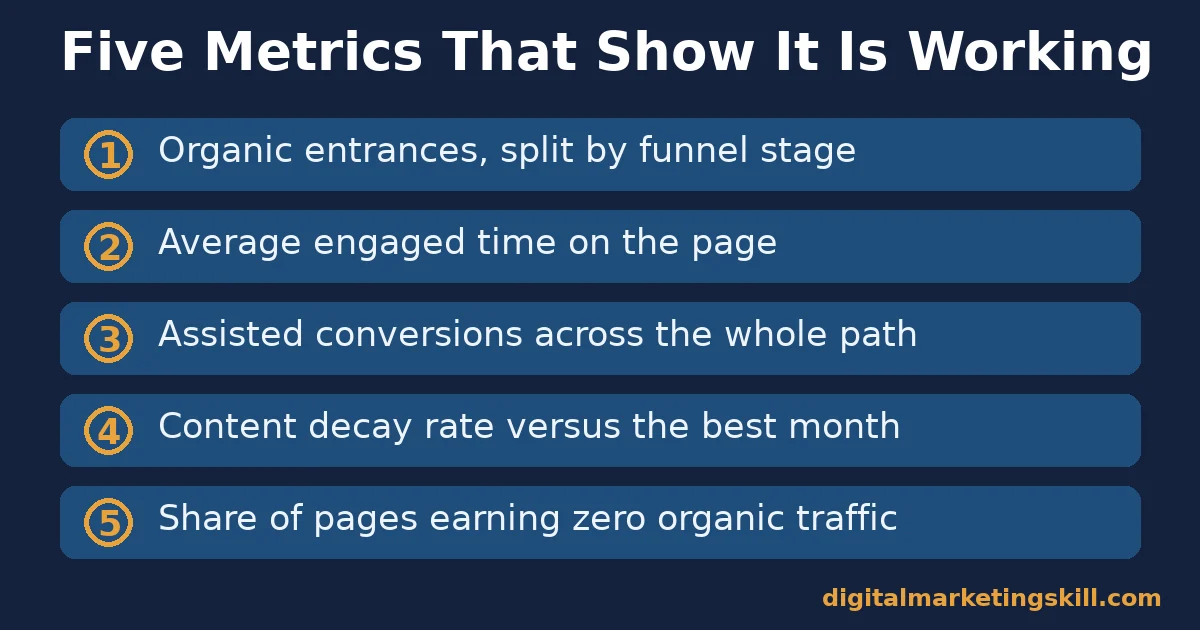
Five Metrics That Show the Framework Is Working
- Organic entrances by stage. How many visits each piece gets from search, split by the funnel stage you assigned it. This shows whether awareness content is actually earning clicks, not just existing.
- Average engaged time. How long a typical reader stays actively on the page, not just how long the browser tab stayed open in the background. This is the number that separates real reading from a quick bounce.
- Assisted conversions. How often a piece of content appears somewhere in a multi-touch conversion path before someone converts, even when it was not the last page they visited. This credits consideration and decision content fairly for the work they do.
- Content decay rate. How much organic traffic a post loses over time, compared with its best-performing month. This flags when a post needs an update rather than a full replacement from scratch.
- Share of pages with zero traffic. The percentage of your published posts earning no organic visits at all. Ahrefs found this figure sits near 96.55% across the open web, so your own number is the one that matters for your content marketing framework.
How to Read These Numbers Together
No single metric tells the whole story on its own. A post with high traffic and low engaged time is probably winning the wrong readers. A post with low traffic and high engaged time might simply need better distribution, not a rewrite.
Read decay rate alongside the zero-traffic share. If decay is rising across many posts at once, the cause is usually a search algorithm shift, not a sudden drop in quality. The fix is a focused review, not a rewrite of everything you have ever published.
The One Decision Rule: Audit Before You Add
Here is the single most useful rule in a content marketing framework. Before approving a new post, check whether an existing post on a close topic could be updated instead of left alone.
Apply it with a simple test. Pull up the past twelve months of published posts and sort by organic traffic. List anything sitting in the bottom third. For each one, ask whether the topic still matters and whether the content is simply outdated, thin, or poorly matched to its funnel stage. If the topic still matters, update it. If demand for the topic is gone, retire it instead.
Here is an illustrative example, with invented numbers, to show the arithmetic plainly. A team has 40 posts in one topic cluster. Twelve of them sit in the bottom third by traffic.
The team updates seven that are outdated but still relevant. It merges three thin posts into one stronger guide, and retires two with no remaining demand. They publish zero new posts that period and spend the saved writing hours on those updates instead.
That trade almost always beats writing a forty-first post. An update starts with an existing search ranking and an existing backlink profile, while a brand-new post starts with neither of those advantages.
A Real Case: What Happens When Teams Audit First
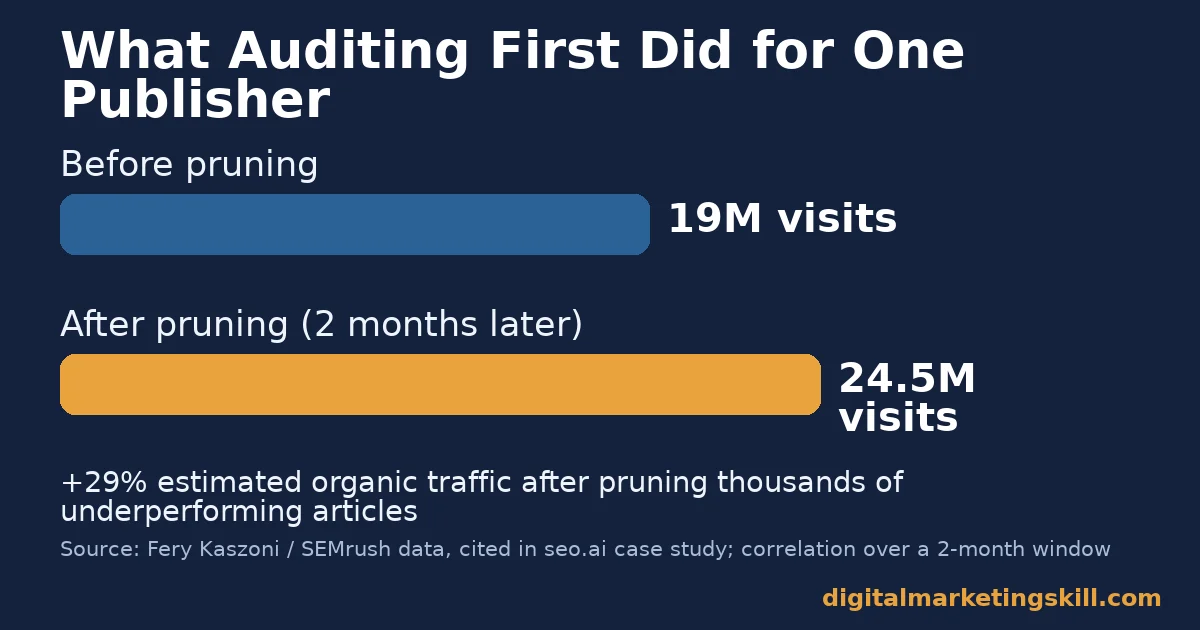
CNET, the technology publisher, deleted or updated thousands of underperforming articles instead of only publishing new ones. Analyst Fery Kaszoni tracked the change using SEMrush data in a widely cited content pruning case study. Estimated monthly visits rose from about 19 million to roughly 24.5 million within two months, a 29% increase.
The limits matter here. A separate review by analyst Scott Rogers-Jones checked for other causes. It found that a social-platform launch and a retail shopping event explained only a small slice of that jump, around 60,000 of the millions of added visits.
Most of the gain is not fully explained by those outside events. Even so, the result is still one media site’s correlation over a short window, not a controlled test with a comparison group.
A large publisher’s traffic patterns also differ from a smaller business blog’s. Even with those limits, the direction lines up with the decision rule above. Treating existing content as an asset to manage, not a pile to keep adding to, is the part of a content marketing framework most teams skip under pressure.
Frequently Asked Questions About Content Marketing Frameworks
What is a content marketing framework?
It is a repeatable system for deciding what to write, who it serves, and when to update it instead of replacing it outright. It swaps a content calendar built on guesses for one built on real customer questions and clear funnel stages, so every post earns its place before it gets written.
How is a content marketing framework different from a content calendar?
A content calendar schedules when posts go out. A content marketing framework decides what each post’s job is before it ever gets a date. The calendar then fills with posts that already have a clear purpose, rather than slots waiting for whatever topic comes up that week.
How often should a content marketing framework be reviewed?
Review the full content library at least twice a year, and check your newest posts again after the first ninety days. Search rankings tend to move slowly enough that monthly full reviews rarely turn up anything genuinely new.
Does AI change how a content marketing framework works?
It changes drafting speed more than it changes the underlying logic. The Content Marketing Institute found 95% of B2B marketers already use AI somewhere in content production. Question mining, stage matching, and auditing still need a human decision at the center.
What is the biggest mistake teams make with a content marketing framework?
Treating every post as awareness content. Many teams default to broad, top-of-funnel topics because those feel safer to write. That habit leaves the consideration and decision stages thin, exactly where buyers need the most specific help.
Can a small team run a full content marketing framework?
Yes, at a smaller scale that still works. One person can mine questions from customer emails, write a single post per stage each month, and audit the back catalog once a quarter instead of monthly. The loop still holds even at one post a week, as long as every post gets a stage assigned before it gets written.
How do you know if a content marketing framework is working?
Track engaged time and assisted conversions by funnel stage, not only total traffic. A framework is working when decision-stage content shows up in more conversion paths over time, even if its raw traffic number stays modest.
Build Your Framework, Starting With One Content Pillar
A content marketing framework does not need a full rebuild to start working. Pick one topic cluster. Mine the real questions behind it. Sort your existing posts by funnel stage, then plan how you will promote whatever you update, and audit before you add anything new.
Want structured practice building this kind of system? The Master Diploma in Digital & AI Marketing at Digital Marketing Skill Institute includes an AI-Powered WordPress and SEO Specialist track. It covers content planning and on-page optimization directly, not as a side note in a broader course.
The program pairs unlimited one-on-one mentoring with project-based work experience on a real U.S. partner company’s marketing budget. You practice this framework on an actual account, with a real audience watching, rather than a hypothetical one.
The diploma is dual accredited in the US and UK and recognised in more than 100 countries, and it runs 100% online. You can apply the framework in this guide from anywhere in your country. Read student outcomes on the reviews page, or browse more guides on the blog. Go straight to the application page when you are ready to build your own content system at Digital Marketing Skill Institute.
Every figure in this guide was checked against its original source before publication. Figures marked as illustrative are invented examples, not real results.
![9 Amazing Digital Marketing Skills to Make Money Online [With Proof]](https://digitalmarketingskill.com/wp-content/uploads/2019/07/9-Amazing-Digital-Marketing-Skills-to-Make-Money-Online-With-Proof-17.png)