
Content marketing tactics only matter if they move a reader from curious to convinced. Most content gets read once and forgotten, because it entertains or informs without ever asking for the sale. This guide covers the tactics that turn a reader into a lead. It moves step by step, from audience research through to the offer itself.
Key Takeaways
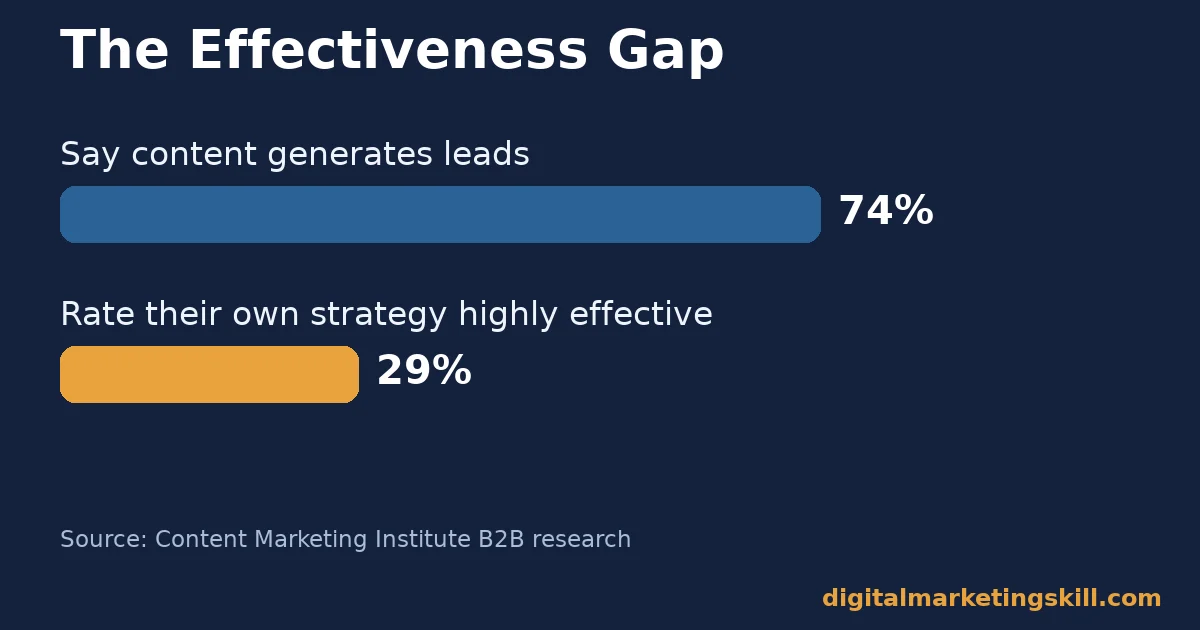
- Content marketing works, but effectiveness is rare. Content Marketing Institute’s B2B research found 74% of marketers say content marketing helped generate demand or leads, yet only 29% rate their own content strategy as extremely or very effective.
- Lead generation is still hard. HubSpot’s State of Marketing data found generating leads remains a top challenge for 30% of marketers, even though 55.7% say it is easier than it was a decade ago.
- Length does not guarantee rankings. Backlinko’s analysis of 11.8 million search results found no direct relationship between word count and ranking position, even though the average top-10 result runs 1,447 words.
- Long-form content still earns more links. A separate Backlinko and BuzzSumo analysis of 912 million blog posts found content over 3,000 words earned 77.2% more backlinks than content under 1,000 words, though social shares peaked at a shorter 1,000 to 2,000 words.
- Quality is improving even where volume struggles. HubSpot’s data found 93.8% of marketers say their lead quality improved over the past year, suggesting the fix is often precision, not output.
In this guide
- What Most Content Marketing Tactics Guides Get Wrong
- Why Most Content Never Converts
- Content Marketing Tactics: Choosing the Right Format
- Six Content Marketing Tactics That Lead to Conversion
- Content Marketing Tactics: Mistakes That Quietly Kill Conversion
- How To Measure Whether Your Tactics Are Working
- The One Rule: Every Piece Needs One Job
- Content Marketing Tactics for Getting Content Seen
- A Real Case: Converting Interest Into a Paying Client
- Frequently Asked Questions About Content Marketing Tactics
- When To Update Old Content Instead Of Writing New
- Start With One Piece, Then Repeat What Works
What Most Content Marketing Tactics Guides Get Wrong
Most content marketing tactics guides focus entirely on production: post more, post consistently, cover more topics. Production matters, but it is not the gap. Content Marketing Institute’s own research shows most marketers are already doing this work. The gap is that only 29% rate their strategy as highly effective.
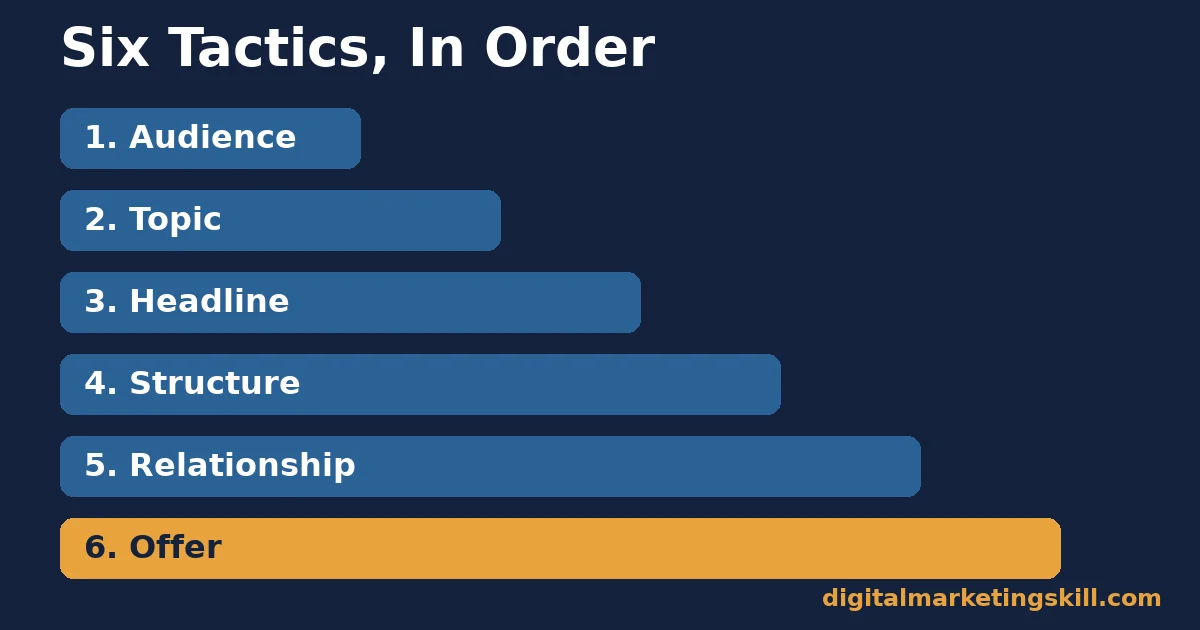
That gap is usually a conversion problem, not a production problem. This guide focuses on the tactics that turn an informed reader into a lead: audience research, topic selection, headlines, structure, relationship building, and the offer itself.
A quick note on the evidence. The figures below come from named research organisations, each with its own scope and sample. Treat them as a snapshot of what tends to work, not a guarantee for any single piece of content.
Why Most Content Never Converts
Content converts when it matches a reader’s actual question, proves it understands that question, and then asks for something specific. Most content fails at the third step. It informs well. Then it ends without a clear next action.
Why Word Count Is the Wrong Place to Start
Backlinko’s analysis of 11.8 million search results found no direct relationship between word count and ranking position. The average top-10 result still runs 1,447 words. Length is a side effect of covering a topic thoroughly. It is not a cause of ranking well on its own.
A separate Backlinko and BuzzSumo study of 912 million blog posts found a real pattern worth knowing. Content longer than 3,000 words earned 77.2% more referring-domain backlinks on average than content under 1,000 words. That gap is large enough to matter for any piece built to attract citations.
Articles between 1,000 and 2,000 words earned 56.1% more social shares than content under 1,000 words, making that range the sweet spot for shares specifically. Match length to the goal of the specific piece. Do not chase one target word count for everything you publish.
Why So Few Marketers Rate Their Own Strategy Highly
Content Marketing Institute’s B2B research found 87% of marketers say content marketing built brand awareness. Only 49% say it helped generate sales or revenue. That gap between awareness and revenue is where most content marketing tactics quietly fail. Readers finish the piece feeling informed, then leave with no clear next step to take.
Content Marketing Tactics: Choosing the Right Format
Format shapes what a reader expects before they read a single word. Match the format to the stage of the reader’s decision, not to whichever format you find easiest to produce.
- How-to guides and tutorials. Best for readers who already know what they want and need the steps to get there. These convert well because the reader arrives with clear intent.
- Comparison and listicle content. Best for readers still deciding between options. This format works well when it names real trade-offs instead of simply ranking options by preference.
- Case studies and real examples. Best for readers who understand the problem already but need proof the solution works. A named result, even a small one, builds more trust than a general claim.
- Explainer or definition content. Best for readers early in a topic who need grounding before they can evaluate anything else. This format rarely converts directly, but it earns trust that pays off later.
Pick one format per piece and commit to it. Content that tries to explain a concept, compare five tools and share a case study in a single post usually serves all three readers poorly. If your content calendar already has strong how-to coverage but almost no case studies, that gap is often where conversion is leaking. Proof tends to move a decided reader faster than another explanation.
Six Content Marketing Tactics That Lead to Conversion
These content marketing tactics apply whether you write for a blog, a newsletter, or a client’s site. The order matters more than any single tactic on its own.
These six tactics follow the order a writer actually builds a piece of content in. Skipping an early one weakens everything that comes after it.
1. Start With the Audience, Not the Topic
Every piece of content marketing that converts starts with a specific reader in mind, not a general topic. Google’s own guidance on helpful, people-first content asks whether a piece demonstrates first-hand expertise for a real audience, not whether it covers a topic broadly.
Writing for your peers, rather than your actual customer, is one of the most common content marketing mistakes. A freelance writer explaining the craft of writing will not win new clients. A freelance writer explaining how content grows a business will.
2. Choose a Topic Your Audience Already Cares About
The clearest signal that a topic is worth writing about is that your audience is already searching for it, asking about it, or struggling with it. A real, specific pain point earns more trust than a topic chosen because it is easy to write about.
3. Write a Headline That Earns the Click
A headline’s only job is to get the content read. Losing readers before the content even has a chance to convert anyone usually comes down to a vague or overly clever headline. State the specific outcome or answer the piece delivers, in plain language, rather than teasing it.
4. Structure the Piece So Skimmers Still Get the Point
Most readers scan before they commit to reading. Nielsen Norman Group’s eye-tracking research found readers scan web content in an F-shaped pattern. Attention concentrates across the top of the page, then down the left side.
Subheadings, short paragraphs and a clear opening answer let a skimming reader follow the argument even without reading every sentence. Our guide to blog content strategy covers structuring a post for both skimmers and deep readers.
5. Build Trust Before You Ask for Anything
Content marketing tactics work because content builds a relationship before a sale is ever requested. Use the same words and phrases your audience uses to describe its own problems, rather than industry jargon. Readers who feel understood convert more easily than readers who feel marketed at.
6. Make One Specific, Low-Friction Offer
Every piece of converting content ends with exactly one clear next step: a newsletter signup, a downloadable guide, or a direct contact option. Content that ends with several competing calls to action usually converts fewer readers than content that offers just one.
Content Marketing Tactics: Mistakes That Quietly Kill Conversion
A few habits undercut otherwise solid content. Check for these before you blame the topic or the format. In practice, these content marketing tactics matter most once a piece already has decent traffic, because fixing the conversion layer is faster than rebuilding the audience.
Burying or Skipping the Call to Action
A strong piece of content with no clear next step wastes its own momentum. State the offer plainly near the end, rather than hoping an interested reader will go find your contact page on their own.
Competing Calls to Action
A post that asks readers to subscribe, download a guide and book a call all in the same breath dilutes all three asks. Pick the one action that matters most for this specific piece and this specific reader.
Writing for Peers Instead of Customers
Industry jargon signals expertise to other marketers, but it often confuses the customer you are actually trying to convert. Use the plain words your audience already uses to describe their own problem.
Using the Same Proof Point in Every Piece
Repeating one testimonial or one statistic across every post makes your content marketing tactics feel formulaic rather than genuinely evidence-led. Rotate in different sourced figures and different real examples as you publish, so a reader who sees several of your pieces does not notice the repetition.
How To Measure Whether Your Tactics Are Working
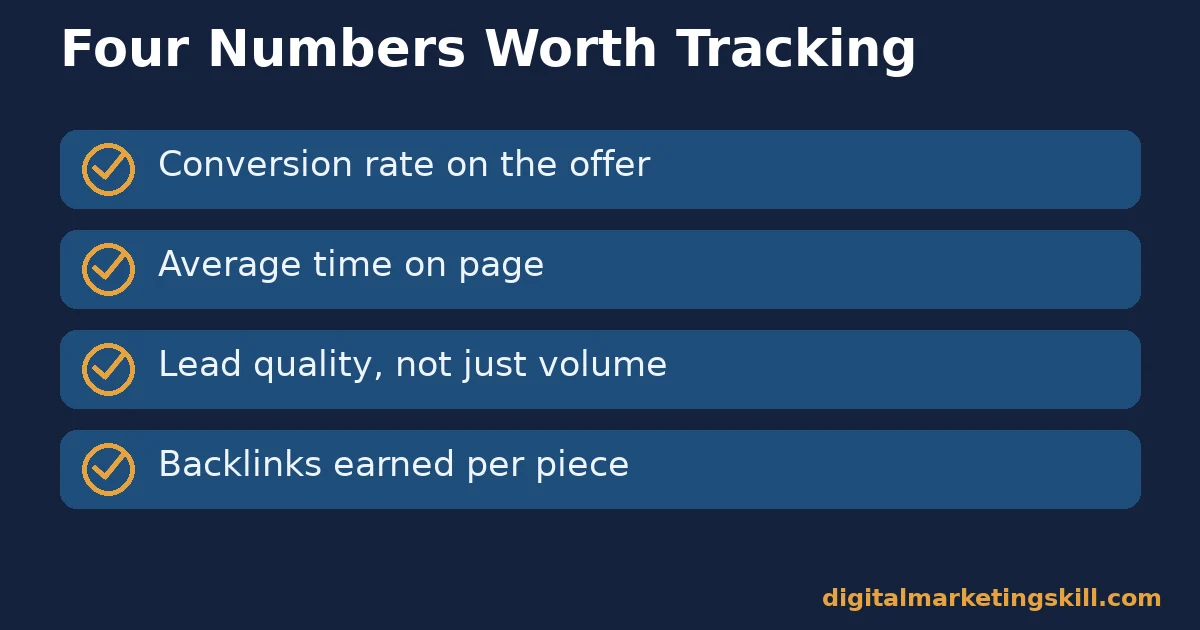
Content marketing tactics are only as good as what you can measure from them. These four numbers show whether a piece of content is actually converting, not just attracting readers.
Four Numbers Worth Tracking
- Conversion rate on the offer. The share of readers who complete the single call to action at the end of the piece. This is the most direct signal that content, not just traffic, is working.
- Average time on page. A rough proxy for whether readers are actually engaging with the content, not just landing and leaving. Pair it with scroll depth where you can measure it.
- Lead quality, not just lead volume. HubSpot’s research, cited above, found 93.8% of marketers reported improved lead quality over the past year. Track whether your content leads convert further down the funnel, not just whether they exist.
- Backlinks earned per piece. A sign that other sites consider the content a worthwhile reference, which compounds its reach well beyond the original publish date.
Reading These Numbers Together
High traffic with a low conversion rate usually means the content and the offer do not match. High conversion rate with low traffic usually means the offer works, but discovery is the real problem. Work out which half of that equation is broken before you change the other.
The One Rule: Every Piece Needs One Job
If you only change one thing about your content marketing tactics, give every piece exactly one job before you write it. Decide whether this piece exists to build awareness, answer a specific question, or convert a warm reader, and write toward that one goal only.
Here is an illustrative, invented example to show the logic, not a real campaign’s numbers. A blog post tries to do three jobs at once: explain a broad topic, compare five tools, and pitch a product. Each reader type gets a diluted version of what they came for, and the piece converts poorly for all three.
Splitting it into three focused pieces, each with one job, fixes this. You can then measure and improve each piece on its own terms.
Content Marketing Tactics for Getting Content Seen
The best piece of content converts nobody if nobody finds it. Distribution deserves as much planning as the writing itself, especially in the first few days after publishing.
Owned Channels First
Send new content to your email list and post it on the social channels where your actual audience spends time. These channels cost nothing extra per send and reach people who already opted in to hear from you.
Search as a Long-Term Channel
A piece built around a topic your audience searches for keeps earning visits long after the publish date, unlike a social post that fades within days. This is also why topic selection, covered earlier, matters more than almost any other tactic in this guide.
Earned Attention From Other Sites
A piece that earns backlinks, as the longer-form content discussed above tends to, also earns referral traffic from the sites linking to it. Reach out directly to sites that have covered a similar topic, and point them to the specific, useful angle your piece adds.
A Real Case: Converting Interest Into a Paying Client
Numbers mean more with a real example attached, even a small one. Olajire Jacob, a Digital Marketing Skill Institute student, built a service charging an average of $500 to set up email marketing flows for clients, later scaling that work to $5,000 a month, as published on the Institute’s reviews page.
That result is one student’s outcome, not a guarantee. Income results vary by skill, market and effort; see the Institute’s earnings disclaimer for the full context.
What the case does show is the mechanism this guide describes: content and outreach that speak directly to a specific client problem can convert interest into paying work. The same six tactics covered above apply whether the goal is a blog subscriber, a lead form submission, or a paying client.
Frequently Asked Questions About Content Marketing Tactics
How long should a piece of content marketing be?
It depends on the goal. Aim for 1,000 to 2,000 words if social sharing matters most, and 3,000 words or more if earning backlinks and ranking for a competitive topic matters most. Never pad length just to hit a number.
Should every piece of content try to convert a reader directly?
No. Some content exists to build awareness or answer a simple question, and forcing a hard sell onto every piece can damage trust. Reserve a direct, specific offer for content aimed at readers who are already close to deciding.
Is there a reliable formula for writing headlines?
No single formula works everywhere, but headlines that state a specific, concrete outcome consistently outperform vague or clever alternatives. Write the headline after the piece is finished, once you know exactly what it delivers.
Should I repurpose old content instead of writing new content?
Both have a place. Updating a piece that already ranks or converts well is often faster than starting from zero, but repurposing cannot fix a piece that was aimed at the wrong audience or topic in the first place.
What is the simplest way to know if a piece of content is working?
Check whether it completes the one job you gave it. A piece meant to build awareness should get read and shared; a piece meant to convert should produce measurable leads. Judging an awareness piece by lead volume, or a lead piece by shares, misreads its own purpose.
Does AI-written content still work for conversion?
It can, but only when it is edited toward a specific audience and a specific offer, the same way any other content needs to be. Unedited AI output tends to read generically, which undermines the trust this guide’s tactics rely on.
Which content marketing tactic should I fix first?
Start with the offer. A well-researched, well-structured piece that ends with no clear next step wastes everything that came before it, so fixing the offer usually produces the fastest visible improvement in conversion rate.
When To Update Old Content Instead Of Writing New
Not every content marketing tactic requires starting from zero. A piece that already ranks or attracts steady traffic, but converts poorly, is often cheaper to fix than to replace.
Signs a Piece Is Worth Updating
Look for a post with decent traffic but a weak or missing offer, outdated statistics that still get real search visits, or a strong topic buried under a confusing structure. Any of these can be fixed without a full rewrite, which makes updating a far faster path to better conversion than starting over.
Signs a Piece Needs a Fresh Start Instead
If a post targets the wrong audience entirely, or the core topic no longer matches what your business offers, updating it wastes effort. Retire it, redirect its URL to a more relevant piece, and put the effort into new content aimed correctly from the outset.
Start With One Piece, Then Repeat What Works
Content marketing tactics compound when you apply them consistently to one piece at a time, rather than trying to fix your entire content library at once. Pick your best-performing post, give it one clear job, tighten its headline and its offer, and measure the result before moving to the next piece.
Once that first piece shows a real improvement, repeat the same process on the next-best-performing post. A handful of pieces fixed this way, over a few months, usually moves the needle more than publishing a large volume of unfocused new content.
If you want structured help turning content into a real pipeline of leads and clients, the Digital Marketing Skill Institute’s Master Diploma in Digital & AI Marketing includes an AI-Powered Lead Generation and Email Automation track. It is one of four AI-powered tracks making up ten courses in total, with a Full Stack option for completing all four.
It comes with unlimited 1-on-1 coaching and mentoring, a U.S. Project Internship with a verified U.S. Work Reference Letter, and dual US and UK accreditation recognised in more than 100 countries. It is delivered 100% online, so you can study from anywhere in your country.
Explore the programme at Digital Marketing Skill Institute, or browse more practical guides like this one on the Digital Marketing Skill Institute blog. When you are ready, apply here. Wherever you write from, these tactics work the same way, and the training travels with you anywhere in your country. Learn more at digitalmarketingskill.com.
Every figure in this guide was checked against its original source before publication. Figures marked as illustrative are invented examples, not real results.
![9 Amazing Digital Marketing Skills to Make Money Online [With Proof]](https://digitalmarketingskill.com/wp-content/uploads/2019/07/9-Amazing-Digital-Marketing-Skills-to-Make-Money-Online-With-Proof-17.png)






