
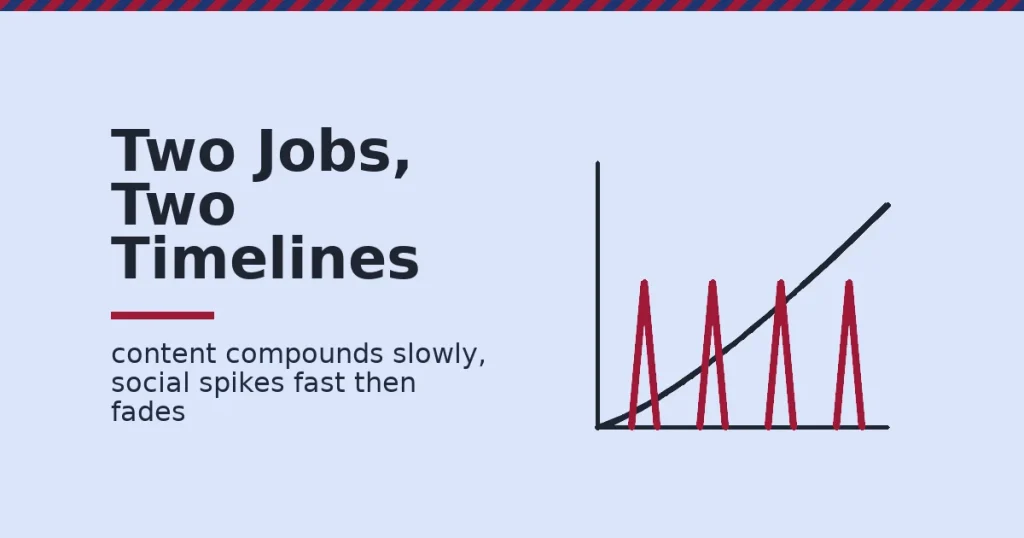
Content vs social media is really a question of two different jobs. Content marketing builds owned assets that earn search traffic over time. Social media marketing borrows attention on platforms you do not own, in the moment. Most businesses need both. They rarely need them in equal amounts, at the same time.
Key Takeaways
- Almost every B2B marketer uses both already. Content Marketing Institute’s survey of 980 B2B marketers found 95% have a content strategy. 89% use organic social platforms as part of their distribution.
- Having a strategy is not the same as it working. The same CMI survey found only 29% rate their content strategy as extremely or very effective. “Lack of clear goals” was the top reason cited.
- Social ROI is usually measured the easy way, not the useful way. Sprout Social’s research found 68% of teams limit ROI measurement to engagement metrics, rather than revenue.
- Leadership wants a tighter link to business results. The Sprout Social Index found 65% of leaders want direct connections between social campaigns and business goals.
- A real content-plus-social campaign can post huge, hard-to-verify numbers. Chipotle’s Lid Flip Challenge reports 110,000 video submissions in six days and 104 million views, per its own award submission. That submission admits no independent verification of the figures.
In this guide
- What Most Content vs Social Media Advice Gets Wrong
- How Content and Social Media Actually Work
- What Differs Between Content and Social Media
- How to Lead With Each Channel
- How to Measure Content vs Social Media Honestly
- The One Decision Rule: Match the Channel to Your Timeline
- A Four-Week Plan to Balance Content and Social Media
- A Real Case: Chipotle’s Lid Flip Challenge
- Frequently Asked Questions About Content vs Social Media
- Pick the Job, Then Pick the Channel
What Most Content vs Social Media Advice Gets Wrong
Most articles on content vs social media list differences in a table, then suggest doing both. That is not wrong. It is just not useful on its own. It does not say which one deserves your next hour of work.
This guide treats content and social as two tools with different jobs, not two competing channels. It covers what each is actually built for, how to lead with each one’s strength, how to measure both honestly, and the one rule that tells you where to invest next. By the end, the content vs social media question should feel less like a debate and more like a simple routing decision.
A few ground rules first. The CMI figures describe B2B marketers specifically. Treat them as a strong signal for B2B, not universal truth for every business type. The Chipotle numbers come from the brand’s own award submission, with no independent verification stated. Read them as a best case, not a typical result.
How Content and Social Media Actually Work
Content marketing and social media marketing move attention in different directions. Content pulls people in through search and shared links, usually to a page you own. Social pushes a message out to people already on a platform you do not own.
So the content vs social media question is really a question about direction and ownership. Content earns visits you keep finding later, through search. Social borrows visits you have to keep renewing, through new posts. Neither direction is wrong; they just solve different problems.
What Content Marketing Actually Builds
Content marketing is the creation of articles, guides, videos or tools that answer a real question your audience searches for, covered in more depth in our guide to what content marketing actually is. Each piece lives on your own site. It keeps earning traffic and links long after you publish it. That compounding effect is content marketing’s core advantage.
The cost is time. A single strong guide can take days to research and write well. Orbit Media’s survey of 1,042 content marketers found the average blog post now takes over three hours to write, and it may still take months before it ranks and earns steady traffic.
What Social Media Marketing Actually Does
Social media marketing is the creation and posting of content built for a specific platform’s feed; our guide to building a social media marketing strategy covers the platform-by-platform detail. It is built to earn attention in the moment. A post can reach people within minutes of publishing, which content marketing almost never does.
The cost here is different. Most social posts stop earning attention within days. The channel needs a constant, ongoing supply of new posts to keep working at all.
Platform choice matters too, and it is regional. Pew Research’s survey of more than 5,000 US adults found 84% use YouTube and 71% use Facebook, with Instagram the only other platform used by at least half. Treat these figures as US-specific; usage and platform popularity vary by country, so check your own audience before you commit a posting rhythm to one platform.
What Differs Between Content and Social Media
Four practical differences matter more than the dictionary definition. Where the asset lives. How fast it pays off. How long it lasts. What it is best built for. Keep these four in mind whenever a content vs social media decision comes up, and the right channel usually becomes obvious.
Content Marketing: Built for Compounding, Owned Search Traffic
Content marketing is built for traffic that keeps arriving without new spend. A guide that ranks well can bring in readers every week for years. There is no extra publishing cost once it is written.
It is a poor fit when you need visibility today. New content usually takes weeks or months to rank. It cannot solve an urgent, short-term attention problem.
Social Media Marketing: Built for Speed and Real-Time Reach
Social media marketing is built for immediate reach and real-time conversation. It is the right tool for a time-sensitive announcement, a trending moment, or direct, fast interaction with your audience.
It is a poor fit for compounding returns. Sprout Social’s own finding, that most teams only track engagement rather than revenue, is itself a symptom of how hard it is to tie a single post to a lasting business result.
How to Lead With Each Channel
Once you know the job each channel is built for, lead with its strength. Then manage around its weak point. The sections below mirror the two channels above.
Content Marketing: Lead With Search Demand, Not Just Topics You Like
Start from what people actually search for, not from what feels interesting to write. Our guide to the best free keyword research tools covers how to check real search demand before you commit the days it takes to write a strong guide.
Plan for the slow payoff honestly. Treat a new piece of content as a multi-month investment. Measure it against that timeline, not against last week’s social post.
Social Media Marketing: Lead With a Posting Rhythm You Can Actually Sustain
Pick a posting rhythm you can keep up for months, not the most ambitious one you can imagine in week one. A smaller, consistent rhythm beats a large burst that stops after a month.
Measure past the easy metrics. CMI found that only 29% of B2B marketers rate their content strategy as highly effective. A lack of clear goals was the top reason given. Set a specific goal for social, beyond likes and views, before you start posting.
How to Measure Content vs Social Media Honestly
Measure each channel against the job it is actually built for. Judging content by its first-week traffic, or judging social by its six-month compounding return, misreads both channels.
Five Metrics That Separate Real Results From Noise
- Organic traffic growth, month over month. The right measure of content’s compounding effect. A single month tells you very little on its own.
- Returning organic visitors to a specific page. Shows whether a piece of content keeps earning attention on its own, without new promotion.
- Engagement rate per social post. A useful short-term signal. Treat it as a leading indicator, not a result in itself.
- Click-through rate from social to your site. Shows whether social posts are actually sending people anywhere, not just collecting likes.
- Revenue or lead attribution by channel. The metric most teams skip. Sprout Social found 68% of teams stop at engagement instead of reaching this step; our deeper guide to measuring content marketing covers how to build that attribution step by step.
How to Read These Numbers Together
Read content and social metrics on different timescales. Judge content over months, using organic traffic growth and returning visitors. Judge social over days or weeks, using engagement and click-through rate.
Push both channels toward the same final metric eventually: revenue or lead attribution by channel. That is the number that tells you which one actually deserves more of your time next quarter.
Review all five metrics together once a month, on a fixed schedule rather than only after a campaign ends. A shared spreadsheet, with one row per channel, keeps the comparison honest over time.
The One Decision Rule: Match the Channel to Your Timeline
If you take one rule from this guide, make it this one. Choose content marketing when you can wait months for a compounding return. Choose social media marketing when you need attention this week. Most real plans need both, on purpose, not by accident. So the real content vs social media decision is not which channel wins; it is which one gets your next free hour.
Here is an illustrative example, with invented numbers. A five-person team has ten hours a week for marketing. They split it evenly. Five hours go to one in-depth guide a month. Five hours go to daily social posts.
After six months, the guides are bringing in steady organic traffic with no extra cost. Social still needs its five weekly hours to keep performing. Neither result is a failure. The company now has two different kinds of return. It can decide, with real numbers, whether to shift more hours toward content or keep the split as it is.
A Short Checklist Before You Split Your Time
Before you divide your hours between content and social, answer a few quick questions. First, which goal is actually most urgent this month, visibility now or traffic later? Next, who owns each channel, so nothing sits unattended for weeks? Then, what is the one metric you will check for each channel next month? Finally, does your current split match your answers, or did it just happen by habit?
If your answers point one way but your calendar points the other, trust the answers. A split that happened by accident rarely matches what the business actually needs right now.
A Four-Week Plan to Balance Content and Social Media
You do not need a full strategy document to start balancing content and social media properly. This plan takes a few hours a week and works for a small team.
- Week one: audit your current split. Count the hours your team actually spent on content versus social media last month, not the plan you intended to follow.
- Week two: pick one content topic with real search demand. Use a keyword tool to confirm people actually search for it, then outline one guide you can finish within the month.
- Week three: set a sustainable social rhythm. Choose a posting frequency you can keep up for the next three months, even in a busy week, and write it down.
- Week four: set one honest metric for each channel. Pick organic traffic growth for content and click-through rate for social, then check both again in a month.
At the end of the month, compare the two channels using the metrics above, not gut feeling. Keep whatever split is actually working, and adjust the rest. This cycle, repeated every quarter, keeps the content vs social media balance honest instead of accidental.
Write the result down somewhere the whole team can see, even if it is just a shared document. A visible record of what the content vs social media split actually was, and what it produced, makes the next quarter’s decision faster and less political.
A Real Case: Chipotle’s Lid Flip Challenge
Chipotle built a short-form video challenge. It asked customers to film themselves flipping a burrito bowl lid, tied to a digital-order promotion. The idea itself was simple content: a clear, repeatable format anyone could copy. Social media, specifically TikTok, was the distribution engine that carried it.
Chipotle’s own award submission reports 110,000 video submissions within six days, 104 million views in that period, and 230 million views a month later. It also claims a record-breaking digital sales day.
Read the limits honestly. This is Chipotle’s own submission for an industry award, so the numbers are presented in the best possible light. The submission does not explain how “impressions” were calculated. It does not link views to actual purchases. It offers no independent, third-party verification of any figure. Treat it as a real, large campaign with real reported numbers, not as a formula you can repeat with certainty.
The lesson for smaller teams is about structure, not scale. Chipotle paired one simple, repeatable content idea with one platform built for speed. That same pairing, content idea plus one social platform, works at any budget, even without a celebrity creator attached.
Notice, too, what the case does not prove. It does not show that social media marketing beats content marketing in general; it shows one brand using both together well, for one specific, time-limited goal. A different goal, like steady search traffic for a how-to question, would call for the content-first approach covered earlier in this guide instead.
Frequently Asked Questions About Content vs Social Media
What is the main difference between content marketing and social media marketing?
Content marketing builds owned assets, like guides and articles, that earn search traffic over time. Social media marketing posts to platforms you do not own, aimed at quick, in-the-moment attention.
Which is more effective, content marketing or social media marketing?
Neither is more effective in general. They are built for different jobs. Content marketing suits goals you can wait months for, like steady organic traffic. Social media marketing suits goals you need this week, like a time-sensitive announcement.
Can a small business do both content marketing and social media marketing?
Yes, and most should, even with a small team. Splitting time between one long-term content piece and a sustainable social posting rhythm, as in the example above, is a realistic starting point.
How long does content marketing take to show results?
Often weeks to months before a new page ranks well and earns steady traffic. That slow start is normal. It is not a sign the content has failed.
Why do so many marketers struggle to measure social media ROI?
Sprout Social’s research found 68% of teams limit ROI measurement to engagement metrics, like likes and views, rather than revenue or leads. Revenue and leads are harder to track back to a single post.
Is social media part of content marketing, or a separate channel?
Both views are used in practice. This guide treats them as separate channels with different strengths. CMI found 89% of B2B marketers already use organic social specifically to distribute their content, which makes social a delivery channel for content as often as its own strategy.
Does content vs social media mean I have to choose only one?
No. Most real marketing plans run both at once, in different proportions. The decision rule in this guide is about where your next hour of effort goes, not about abandoning one channel for the other.
What is the biggest mistake businesses make with content vs social media?
Treating both channels on the same timeline is the most common mistake. Judging a new guide by its first week of traffic, the way you would judge a social post, almost always makes content marketing look like it failed when it has barely started.
Pick the Job, Then Pick the Channel
Content vs social media is not a competition to win. It is a choice to make for each specific goal. Pick your most urgent marketing goal this month. Decide honestly whether it needs a fast channel or a compounding one. Put your next block of hours there.
Revisit the split every quarter, not just once. As your business changes, the right content vs social media balance changes with it, so what worked this quarter may need a different split next quarter.
Where to Get Hands-On Support
If you want structured, hands-on practice with both sides of this guide, Digital Marketing Skill Institute teaches them inside the Master Diploma in Digital & AI Marketing. The diploma is built around four AI-powered tracks, including AI-Powered Social Media Management and Advertising and AI-Powered Lead Generation and Email Automation, and it totals ten courses, with a Full Stack option for completing all four.
It also comes with unlimited 1-on-1 coaching and mentoring, plus a U.S. Project Internship with a verified U.S. Work Reference Letter. On top of that, it is dual US and UK accredited and recognised in more than 100 countries.
The programme is 100% online, so you can study and practise wherever you live in your country. Browse more guides on the Digital Marketing Skill Institute blog, and when you are ready, apply for the Master Diploma or start from the Digital Marketing Skill Institute homepage.
Every figure in this guide was checked against its original source before publication. Figures marked as illustrative are invented examples, not real results.
![9 Amazing Digital Marketing Skills to Make Money Online [With Proof]](https://digitalmarketingskill.com/wp-content/uploads/2019/07/9-Amazing-Digital-Marketing-Skills-to-Make-Money-Online-With-Proof-17.png)






