Most content does not fail because it is badly written. It fails a simple test: it does not earn the next few seconds of attention. To create engaging content, you need a sharp hook, a clear payoff, and a format that fits how people scroll, watch, or scan. This guide shows the mechanics behind that test, with checked figures and one simple rule you can apply today.
Key Takeaways
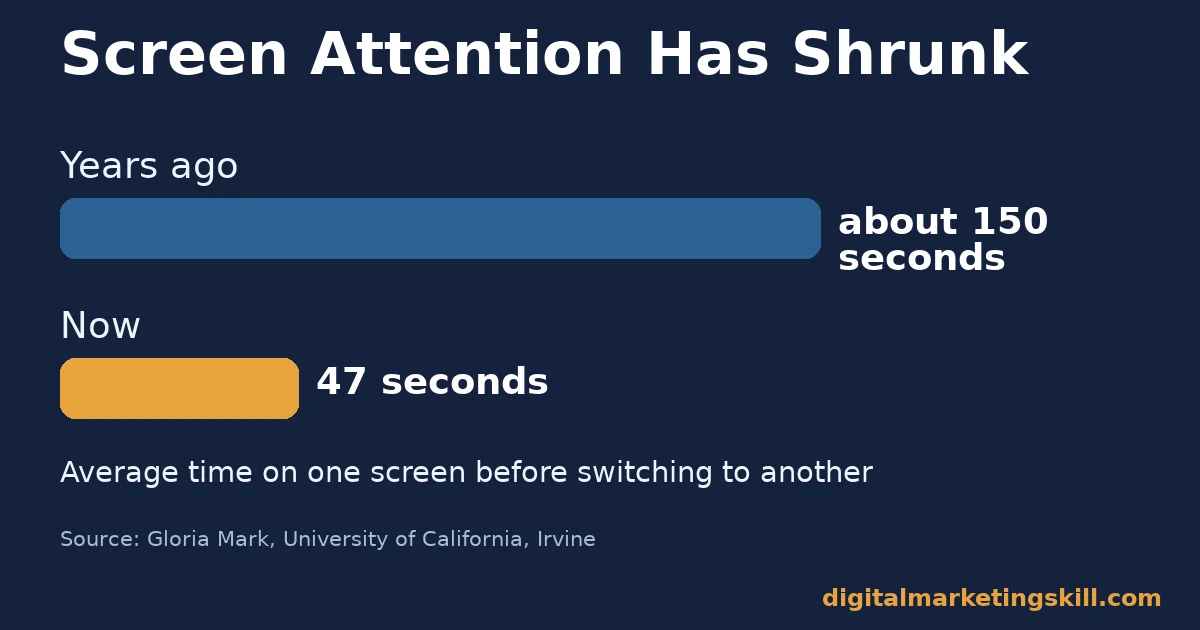
- The average screen-attention span before someone switches away is now about 47 seconds, and half of all periods last 40 seconds or less (Gloria Mark, UC Irvine).
- The average first-page Google result runs about 1,447 words, and long-form posts earn more backlinks than short ones in a 912-million-post study (Backlinko).
- 92% of people say they trust word-of-mouth and other earned recommendations above paid advertising, against 47% who trust paid media (Nielsen).
- A personalised email subject line can lift open rates by up to 50% over a generic one (Litmus, citing Yes Lifecycle Marketing).
- Only 59% of B2B marketers rate their own content as at least somewhat effective, and one in five still name audience understanding as a top challenge (Content Marketing Institute).
In this guide
- Why So Much Content Gets Ignored
- The Mechanism: How Attention Actually Works
- How Engagement Differs By Content Format
- How To Lead With Engagement In Each Format
- How To Measure Whether Content Is Actually Engaging
- The One Decision Rule To Create Engaging Content
- Five Mistakes That Stop You From Create Engaging Content
- A Real Case: Duolingo’s TikTok Account
- Frequently Asked Questions About Engaging Content
- Learn To Create Engaging Content With Expert Mentoring
Why So Much Content Gets Ignored
Most advice on this topic is a list of formats. Write a blog. Post on social. Send an email. Record a video. That list answers “what to make.” It does not answer the harder question: why do people stop reading, watching, or scrolling past.
The real gap is attention, not format. People decide fast whether a piece is worth their time. If it fails that fast test, the format barely matters.
A few ground rules before the detail. A lab figure on attention is an informed estimate, not a law that holds for every reader. Every number below is checked against the source named beside it. Each one states what it does and does not cover.
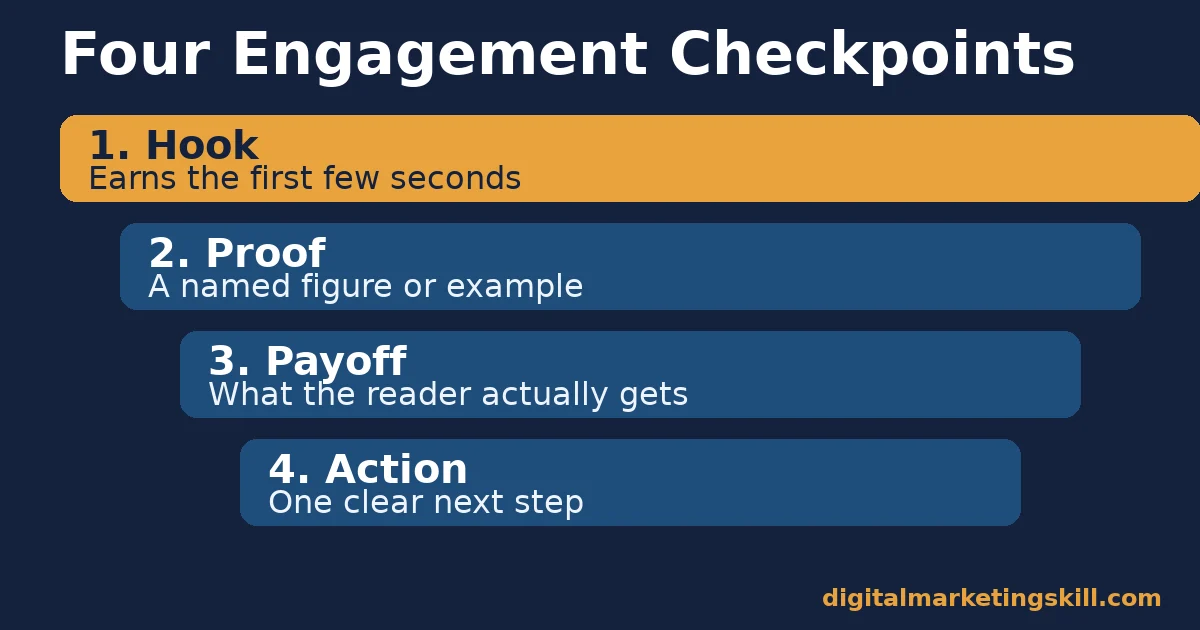
None of this guarantees a result. It narrows the range of what tends to work when you create engaging content on a deadline. Treat every piece as a short chain of checkpoints: the hook, the first proof point, the payoff, and the call to act. Lose a reader at any checkpoint, and the rest of the piece goes unread, however good it is.
The Mechanism: How Attention Actually Works
Gloria Mark’s research team at the University of California, Irvine tracks how long office workers stay on one screen before switching to another. Years ago that average sat near two and a half minutes. It has since fallen to roughly 47 seconds, with half of all recorded periods lasting 40 seconds or less.
The study tracks screen-switching, not a fixed biological limit on reading. Still, the direction is clear across more than a decade of data.
That trend explains why a slow opening line now costs more. A reader who finds no reason to stay in the first lines of an article, or the first seconds of a video, simply leaves. People decide if a piece is “for them” almost at once, then settle in or move on.
Three things make that first checkpoint pass. First, a specific subject: not “content tips,” but “a hook that survives a 47-second attention window.” Second, a visible payoff: what the reader gets if they keep going. Third, a format that matches the channel. A dense paragraph works well inside an article. The same paragraph fails as the opening line of a social caption.
Once the opening earns attention, the second checkpoint is proof. A reader who stays past the hook is testing whether the piece delivers on it. A named figure, a worked example, or a specific step proves that; a vague line like “quality matters” does not.
This is where many writers who set out to create engaging content lose the thread. They open strong, then drift into generic statements with nothing concrete behind them. Fixing that one habit is often the fastest way to create engaging content without redesigning your whole process.
How Engagement Differs By Content Format
The checkpoints above apply everywhere. What counts as a fast failure changes by format, though. Treating an article, a video, a caption, and an email the same way wastes each format’s own strengths and makes it harder to create engaging content in any of them.
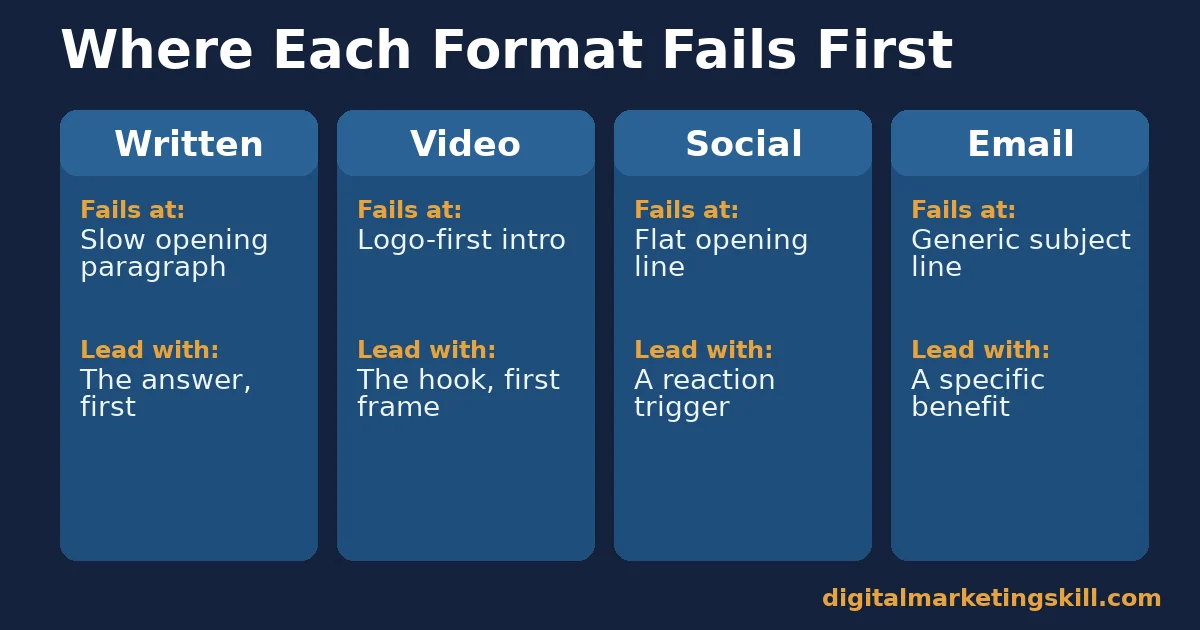
Written Content: Built For Depth And Search
Long articles are built for depth, not speed. Backlinko’s analysis of roughly 11.8 million Google results found that the average page on the first page of results runs about 1,447 words.
A separate Backlinko study of 912 million blog posts found that posts over 3,000 words earned more backlinks, on average, than posts under 1,000 words. Length alone does not cause a ranking. It tends to correlate with a piece thorough enough to earn links and hold a reader for a longer visit.
Video: Built For A Few Seconds
Video gives far less runway than text. A viewer decides within the opening seconds whether a clip is going anywhere. A slow, logo-first intro loses people before the message even starts.
The fix is not a shorter video. It is moving the payoff to the first frame, then holding the explanation for after you have proven the clip is worth watching. You can check this yourself using the audience-retention report described in YouTube’s own analytics help pages.
Social Posts: Built For Reaction
A social caption is judged in the time it takes to scroll past it. It needs a reaction trigger in the first line: a question, a specific number, or a claim worth pausing for. Long explanations belong in a comment thread or a linked article, not the caption itself.
Email: Built For A Single Click
Email succeeds or fails at the subject line, before the body is ever opened. Litmus, citing data from Yes Lifecycle Marketing, reports that personalising a subject line can lift open rates by up to 50% compared with a generic one. Everything written in the body is wasted work if the subject line does not earn the open first.
How To Lead With Engagement In Each Format
Knowing where each format tends to fail only helps if you change how you open, not just what you cover. Here is the fix, mirrored against each format above, for anyone who wants to create engaging content consistently rather than by accident.
Still deciding which formats to prioritise? Our guide to types of digital content breaks down what each one is actually built for.
Written Content: Lead With The Answer First
Open with the direct answer to the reader’s question, in the first sentence or two. Use the rest of the piece to support, qualify, and expand on it.
A reader who gets the answer first tends to read on, to see how you support it. A reader forced to scroll past throat-clearing before the point arrives often leaves instead. Save the build-up for the body, after the payoff is already visible on the page.
Video: Lead With The Hook
Put the strongest visual or claim in the first frame. Skip the logo, the music sting, and the scene-setting. State what the viewer will know, or be able to do, by the end, in one short sentence, inside the first few seconds. If you can cut the first five seconds of a video and lose nothing, cut them.
Social Posts: Lead With A Reaction Trigger
Write the first line as if it is the only line anyone will read. For most scrollers, it is. A specific number, a direct question, or a contrarian claim earns a pause far better than a flat opener like “Here are some tips.” Put the context and the explanation after that first line, never before it.
Email: Lead With The Subject Line
Treat the subject line as its own piece of writing, tested apart from the body copy. A specific, personalised, benefit-led subject line beats a generic announcement most of the time. Keep the preview text working as a second hook, not a repeat of the subject line you already wrote.
How To Measure Whether Content Is Actually Engaging
Measuring well only matters once you already create engaging content worth measuring. Engagement itself is not a feeling; it is a small set of signals you can track. Define each one before you open a dashboard, so the same number means the same thing every time you check it.
- Average time on page: how long a visitor stays, in seconds. Read it next to word count: a short page with a low time on page can be fine, but a long page with that same low number usually means readers are leaving early.
- Scroll depth: the share of a page a visitor scrolls through, tracked as percentage markers inside a tool such as Google Analytics. It shows which section of a long article to tighten or cut next.
- Engagement rate (social): likes, comments, shares, and saves, divided by reach or followers. It shows whether a post earned a reaction, separate from how many people simply saw it scroll by.
- Completion rate (video): the share of viewers who watch to a given point, often the end. A steep early drop points to a weak hook. A steady decline across the middle points to pacing problems instead.
- Open rate and click-to-open rate (email): open rate shows whether the subject line worked. Click-to-open rate, clicks divided by opens rather than sends, shows whether the body then delivered on that promise.
Check these numbers against your own content’s history, not against someone else’s benchmark list. A rate that looks low in one niche can be strong in another. The trend across your last ten pieces tells you more than any single outside number.
The One Decision Rule To Create Engaging Content
If the opening line, frame, or subject does not earn attention on its own, no amount of polish further into the piece will fix it. Fix the opening before you touch anything else.
Illustrative, invented example: a blog post about budgeting opens with “In today’s world, managing money is more important than ever.” That line tells the reader nothing new. Many will leave before the next sentence.
Rewrite the opening to “One simple rule cuts money stress in half: spend from three accounts, not one.” Now the reader has a specific claim worth testing, and a concrete reason to read on. The body of the post can stay almost identical. Only the opening line changed, and that line does all the work of keeping the reader past the first checkpoint.
Apply that rule to any format. Rewrite the first line, frame, or subject until it states a specific, checkable claim. Then test whether the rest of the piece earns the promise that opening line made. This single habit does more to create engaging content than any list of formats or tools ever will.
Five Mistakes That Stop You From Create Engaging Content
These five mistakes show up again and again in content that reads well on a line-by-line basis but still underperforms, no matter how hard the writer tried to create engaging content from the outline stage.
Burying the payoff. Writers often save the most useful point for the end, like a punchline. Readers who are deciding whether to stay never see it. Move your best point to the top, then explain it below.
Writing for everyone. A piece aimed at “anyone interested in marketing” speaks to no one directly. Name the exact reader and the exact problem in the first line, and the right audience recognises itself immediately.
Skipping the proof. A claim without a number, an example, or a named source reads as an opinion, not information. Readers skim past opinions. Add one concrete, checked detail to every claim you make.
Forgetting the next step. A piece that ends without a clear action leaves the reader to decide what to do with what they just read. Most will do nothing. Tell them the one next step you want them to take.
Chasing every format at once. Spreading one idea thinly across five formats, badly, usually performs worse than doing one format well. Pick the format your audience already uses most, master its opening checkpoint, then expand once that one is working.
A Real Case: Duolingo’s TikTok Account
The case below shows one brand that managed to create engaging content at scale on a single, fast-moving platform, which is useful context before you try to copy any part of it.
After relaunching its TikTok account, the language-learning app Duolingo grew it to roughly 6.6 million followers, ahead of established consumer brands such as Disney on the same platform, according to reporting on the account’s strategy. The content leaned on short, specific, high-reaction clips built around a single recurring character and current platform trends, rather than long explanations of the product itself.
The limits of this case matter. It is one brand, in one category, on one fast-scrolling platform. The exact follower and engagement figures keep moving as the account keeps posting, so treat the number as a snapshot, not a permanent ranking.
It does not prove that humour or a mascot works for every brand on every platform. What it does show, in line with the attention research above, is that short, specific, reaction-first content held attention better than longer, brand-led content on a format built for a quick scroll. Treat it as one data point to learn from, not a template to copy line for line.
Frequently Asked Questions About Engaging Content
What actually makes content engaging rather than just well-written?
Engaging content earns a reaction, not just a read: a comment, a share, a click, or a longer visit. Well-written content can still fail to engage if it opens slowly or lacks a specific hook that matches what the reader came looking for. That gap between well-written and engaging is the core problem anyone trying to create engaging content has to solve first.
How long should a piece of content be to hold attention?
There is no single ideal length. Backlinko’s research puts the average first-page Google result at around 1,447 words, but length should follow the topic’s depth, not a fixed target. A thorough 900-word answer can outperform a padded 2,000-word one.
Why does my content get views but almost no comments or shares?
Views measure reach. Comments and shares measure reaction. A piece can be seen widely and still lack a specific claim, question, or stance worth responding to. Add one direct question or a position the reader can agree or disagree with.
Does posting more often automatically increase engagement?
Not on its own. Research from Content Marketing Institute shows many marketers who publish frequently still rate their results as only somewhat effective, often because the content was never built around a clear audience need. Consistency helps distribution. It does not replace a strong hook.
How do I find out what my audience actually wants to read or watch?
Read the comments and questions you already receive, run a short survey, and check which existing pieces earned the most time on page or the most shares. Audience research is the step most marketers admit to skipping, and fixing it is usually the fastest way to improve a weak piece.
Should every piece of content include a call to action?
Yes, and it should be a single, specific action, not a vague “learn more.” A reader who finishes a piece without being told what to do next usually does nothing at all with what they just read.
Is content made by an audience more engaging than content made by a brand?
It often performs better on trust, because people tend to trust recommendations from other people over brand messaging. Nielsen’s global research found that 92% of people trust earned, word-of-mouth recommendations above paid advertising. That does not make brand-made content worthless. It means a genuine audience voice, where you can find one, is worth featuring rather than replacing entirely.
What is the single biggest change I can make this week to create engaging content?
Rewrite your opening lines before you write anything else. Take your last five published pieces, rewrite only the first sentence of each to state a specific, checkable claim, and republish them. That one edit, repeated, usually moves the needle faster than any new topic or format.
Does creating engaging content work differently for business audiences than for consumers?
The checkpoints stay the same, but the proof changes. A consumer reader responds to emotion and a quick payoff; a business reader responds to a named figure, a process, or a result they can justify to a colleague. Either way, the opening line still has to earn the next sentence before any of that proof matters.
Learn To Create Engaging Content With Expert Mentoring
Everything above, the hook, the format-specific lead, and the measurement, is a skill built through practice and feedback, not a checklist you apply once and forget.
If you want structured practice across writing, video, social, and email, alongside the AI tools now used across content teams, the Master Diploma in Digital & AI Marketing at Digital Marketing Skill Institute builds exactly that skill. It runs through four AI-powered tracks built from ten execution-first courses: AI-Powered Social Media Management and Advertising, AI-Powered Lead Generation and Email Automation, AI-Powered Google Specialist, and AI-Powered WordPress and SEO Specialist, with a Full Stack option for completing all four.
The program adds unlimited one-on-one coaching and mentoring, a U.S. Project Internship with a verified U.S. Work Reference Letter, and dual US and UK accreditation recognised in more than 100 countries, 100% online. You can study and apply it from anywhere in your country.
See the full track breakdown on the Master Diploma program page, read real outcomes on the student reviews page, or browse more practical guides on the digital marketing blog. Wherever you live, the skill to create engaging content that people actually finish is one you can start building today at Digital Marketing Skill Institute. Apply here to get started.
Every figure in this guide was checked against its original source before publication. Figures marked as illustrative are invented examples, not real results.