
A digital marketing business turns a marketing skill into billable, repeatable client work. Most people start one with a single freelance gig. The ones that last pick a narrow niche early, price for profit from the first invoice, and track client results instead of vanity metrics. This guide covers the paths in, the numbers that predict survival, and a plan to launch one in 90 days.
Key Takeaways
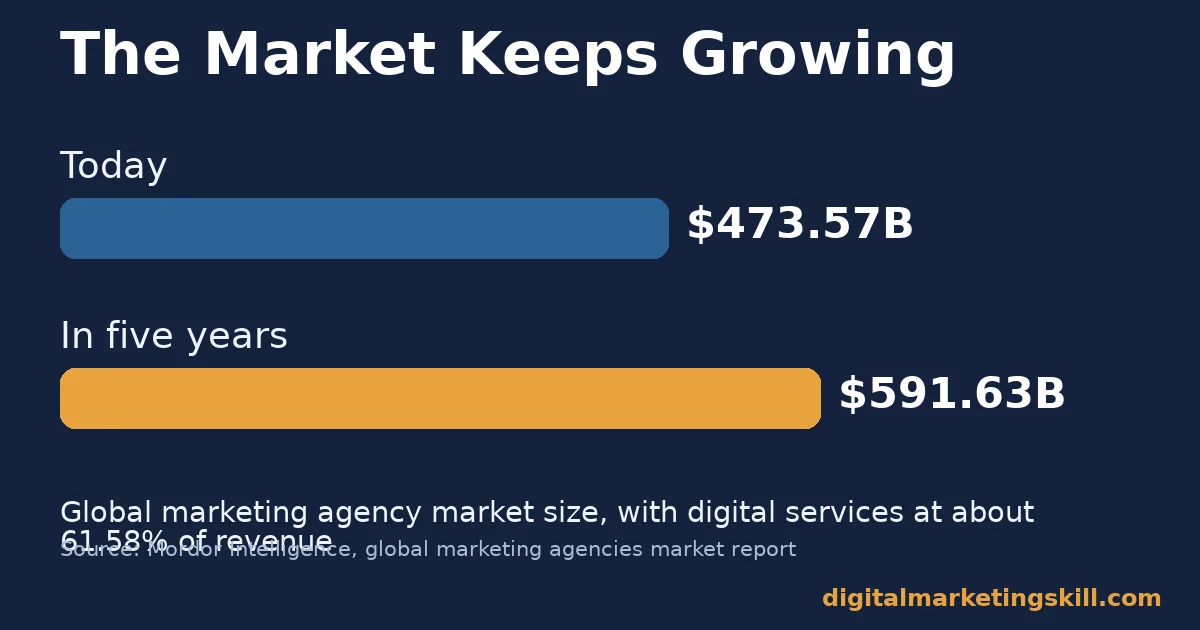
- The market is large and still growing. The global marketing agency sector is valued at about $473.57 billion today. It is forecast to grow to $591.63 billion within five years, a 4.55% annual growth rate, with digital services making up roughly 61.58% of agency revenue (Mordor Intelligence).
- Launching is easy; surviving is the real test. 77.9% of new US business establishments survive their first year. Only 51.4% of a tracked cohort were still operating five years after opening (US Bureau of Labor Statistics).
- Most digital marketing businesses stay small by design. Among more than 71,000 digital agencies evaluated across North America, 87% employ fewer than 50 people (Promethean Research), so staying lean is normal, not a failure to scale.
- A documented plan beats a vague one. 47% of the most successful B2B marketers point to a documented strategy as a reason for their results (Content Marketing Institute), a habit that applies just as directly to running your own agency.
- Pricing has no single global number. Median freelance and marketing-consultant hourly rates run from roughly $30 in parts of Asia to about $85 in North America (Clockify), so a workable price depends on who you serve, not a flat industry rate.
In this guide
- What Most “Start a Digital Marketing Business” Advice Skips
- How a Digital Marketing Business Actually Earns Money
- Three Paths Into a Digital Marketing Business
- How to Make Each Path Work
- Five Reasons New Digital Marketing Businesses Stall
- How to Measure a Growing Digital Marketing Business
- The Most Useful Rule: Make One Client Profitable Before You Chase Five
- A 90-Day Plan to Launch a Digital Marketing Business
- A Real Case: Turning One Skill Into Recurring Income
- Frequently Asked Questions About Starting a Digital Marketing Business
- Start With One Service, Then Expand
What Most “Start a Digital Marketing Business” Advice Skips
Most guides to starting a digital marketing business cover the same checklist. Pick a name, build a website, post on social media, and wait for clients. None of that is wrong. But it skips the part that actually decides whether the business survives: getting one client to a result good enough that they pay again, refer someone, or both. That survival question is real: government survival-rate data puts the one-year survival rate for new US business establishments at 77.9%, and only 51.4% of a tracked cohort were still open five years after opening.
This guide treats that moment as the center of the whole plan. It covers how the money actually moves and the three common paths people take into the work. It also covers what to change for each path, plus the numbers worth tracking once real clients exist.
Ground rules first. The market figures below come from named research firms, and the survival figures come from the US Bureau of Labor Statistics’ Business Employment Dynamics program, which tracks survival rates for every private-sector establishment born in a given year. Read all of it as the best available estimate, not a prediction for any one business. The three-path framework is this guide’s own way of grouping common approaches: an informed way to organize the evidence, not a settled classification. Pricing and survival both vary by country and category, so figures below are labeled by region where that matters.
How a Digital Marketing Business Actually Earns Money
A digital marketing business sells one of three things: time, a process, or an outcome. Clients pay for time-based work hourly or per project. A monthly retainer covers process-based, ongoing management work. Outcome-based work ties some or all of the fee to a result, such as a share of ad spend or revenue. Most new businesses start on time or retainer pricing, then move toward outcome pricing once they can prove results consistently.
Where the Revenue Comes From
The category is large enough to support many small operators rather than a few giants. The global marketing agency sector is valued at about $473.57 billion today. It is growing toward $591.63 billion within five years, at a 4.55% compound annual growth rate, and digital services already make up around 61.58% of that revenue (Mordor Intelligence). That growth spreads across search, social, email, and website work rather than concentrating in one channel. That spread is a key reason most small operators specialize in one slice of it instead of trying to offer everything at once.
Why Clients Buy Before They Compare Price
Small-business buyers rarely start with a price comparison. They start with a problem: no leads this month, a website nobody finds, or an ad budget with no clear return. A digital marketing business earns its first dollar by naming that problem back to the client more clearly than the client could name it themselves. It then shows a plausible way to fix it. Price gets compared only after that trust exists. That is why a vague “we do digital marketing” pitch converts poorly next to a specific one. Google’s own guidance on helpful, people-first content asks whether a reader will “leave feeling they’ve learned enough” to reach their goal. The same test applies to a sales page written for a specific, named problem.
Three Paths Into a Digital Marketing Business
Almost everyone who starts a digital marketing business enters through one of three doors. Each suits a different starting point, and each fails in a different way. Naming the path honestly before you start saves months of chasing the wrong kind of growth.
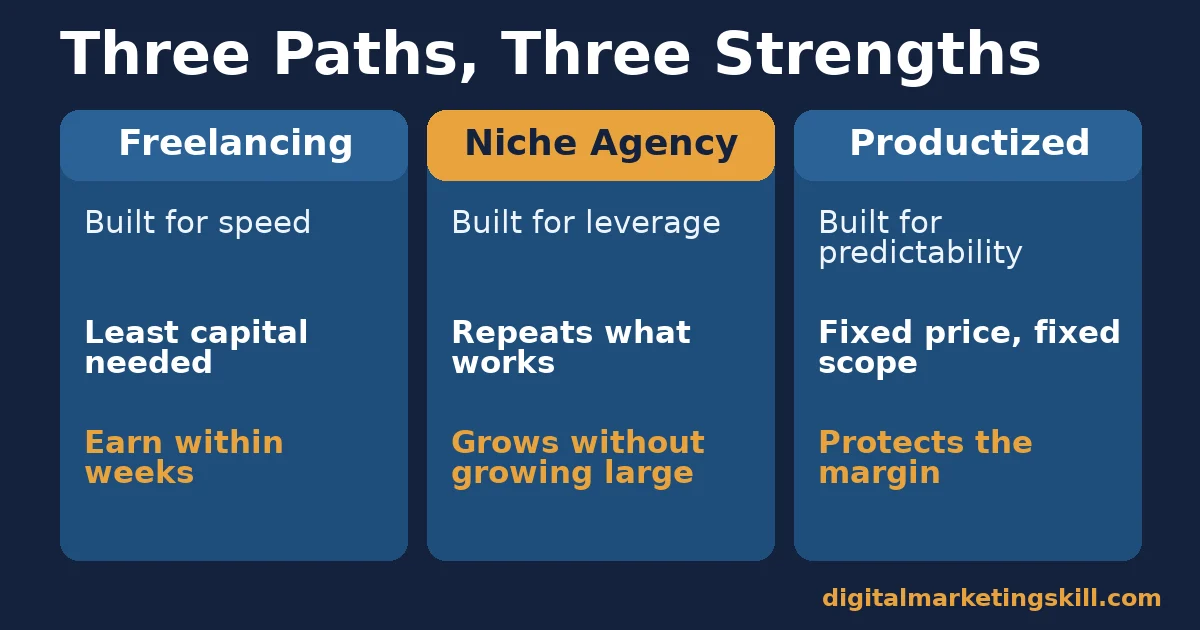
Freelancing: Built for Speed
Freelancing is one person selling a specific skill, such as running ad accounts or writing email sequences, directly to clients. It needs the least capital. It can start earning within weeks, because there is no team to build first. The ceiling is time. A freelancer can only sell as many hours as exist in a week, so income growth depends on raising prices or narrowing scope, not on adding more hours. Median hourly rates for marketing and advertising work vary widely by region, from roughly $30 in parts of Asia to about $85 in North America (Clockify). A sustainable freelance rate has to start from local buying power, not a number copied from somewhere else.
Niche Agency: Built for Leverage
A niche agency serves one type of client, such as dental practices or local restaurants, with a defined set of services delivered by a small team. The niche focus means every new client is easier to win and deliver than the last. The pitch, the process, and the proof all repeat. Among the more than 71,000 digital agencies evaluated across North America, 87% employ fewer than 50 people (Promethean Research), so a niche agency rarely needs to grow large to be viable. It needs to grow repeatable instead.
Productized Service: Built for Predictability
A productized service sells a fixed package, such as “12 SEO-optimized blog posts a month” or “one ad creative set a week,” at a fixed price with a fixed process. It trades flexibility for predictability. Clients know exactly what they get, and the owner knows exactly what delivery costs, which makes margins easier to protect than in custom, scope-creeping work.
How to Make Each Path Work
Each path above needs a different first move, not a generic “get more clients” plan. The sections below mirror the three paths, in the same order, so you can jump straight to the one that matches where you are starting from.
Freelancing: Lead With One Narrow Offer
Replace “I do digital marketing” with one sentence naming the exact result you deliver and for whom. For example: “I set up email flows that recover abandoned carts for small online stores.” A narrow offer is easier to refer, easier to price, and easier to prove, because there is only one thing to measure.
Niche Agency: Lead With a Repeatable Process
Write down the exact steps used for the first client before taking on the second one. A documented approach is one of the clearest differences between operators who grow and those who stay stuck re-explaining the basics to every new hire. 47% of the most successful B2B marketers cite a documented strategy as a reason for their results (Content Marketing Institute). The same discipline applies directly to a small agency’s delivery process.
Productized Service: Lead With a Fixed Scope
Write the scope document before writing the sales page. List exactly what is included, what triggers an extra charge, and how fast delivery happens. A fixed scope protects margin. The biggest risk to a productized service is quietly expanding the deliverable for free until the fixed price no longer covers the real work involved.
Five Reasons New Digital Marketing Businesses Stall
When growth stalls, the cause is usually one of five problems. Check each one honestly against your last three months, because the pattern usually shows up fast.
- The offer is too broad. Trying to serve every type of client with every service makes the pitch forgettable and the delivery inconsistent. Narrow the offer until it is easy to describe in one sentence.
- Pricing does not cover the real cost of delivery. Underpricing to win the first few clients often becomes permanent, because raising prices on existing clients is harder than pricing correctly from the start.
- There is no proof to show new prospects. A business with no case study, screenshot, or testimonial asks a stranger to take on the entire risk. Document the first result properly, with the client’s permission.
- Delivery is not written down. Every project gets re-invented from scratch, so quality stays inconsistent and nothing can be delegated later. Document the process after the second client, not the twentieth.
- There is no plan for referrals or renewals. Clients who got a good result rarely refer on their own; they need to be asked. A business that never asks leaves its cheapest source of new clients untouched.
Which Problem to Fix First
Start with whichever problem your own evidence points to. If prospects go quiet after hearing the price, the offer or the proof is the issue, not the pricing. Projects that convert but lose money point to a delivery-cost problem instead. And when clients are happy but never refer or renew, the missing piece is the follow-up step. Fixing the wrong problem first wastes months on a business that was already pointed the right way.
How to Measure a Growing Digital Marketing Business
A new digital marketing business should track its own health, not just client-facing metrics. Each number below gets defined once, with a note on how to read it, so you can check them monthly without needing a finance background.
Six Numbers That Show Real Growth
- Monthly recurring revenue (MRR). The total value of active retainers this month, excluding one-off projects. Rising MRR means income is becoming predictable rather than dependent on finding a new client every month.
- Client acquisition cost. What you spend, in time or money, to win one new client, divided by the number of clients won in that period. Compare it with what one client is worth over their time with you.
- Client lifetime value. The average total revenue one client generates before they leave. A rising lifetime value means retention or pricing is improving, or both.
- Delivery hours per client. The actual time spent delivering for one client in a month. Rising hours against flat pricing is the clearest early sign of margin trouble.
- Retention rate. The share of clients still active after a set period, such as six months. A low retention rate usually means results, communication, or scope expectations need fixing before new sales will help.
- Referral rate. The share of new clients who arrived through an existing client’s introduction. A rising referral rate signals that delivered results, not marketing spend, are driving growth.
How to Read These Numbers Together
Read the numbers in sequence. If acquisition cost is high but lifetime value is low, the business is spending more to win clients than those clients are worth. That cannot continue for long. If delivery hours are climbing while MRR stays flat, pricing or scope needs to change before taking on another client. If retention and referral rates are both low, the problem sits in the work itself, not the marketing around it.
Track one metric change at a time. When you change a price, a niche, or a process, note the date and compare the following three months with the three months before. That turns a feeling that “it’s working now” into something you can actually check.
The Most Useful Rule: Make One Client Profitable Before You Chase Five
If this guide leaves you with one decision rule, make it this one. Before spending time or money finding more clients, confirm your current delivery is profitable on at least one real client at your current price. Adding clients to an unprofitable model only multiplies the loss.
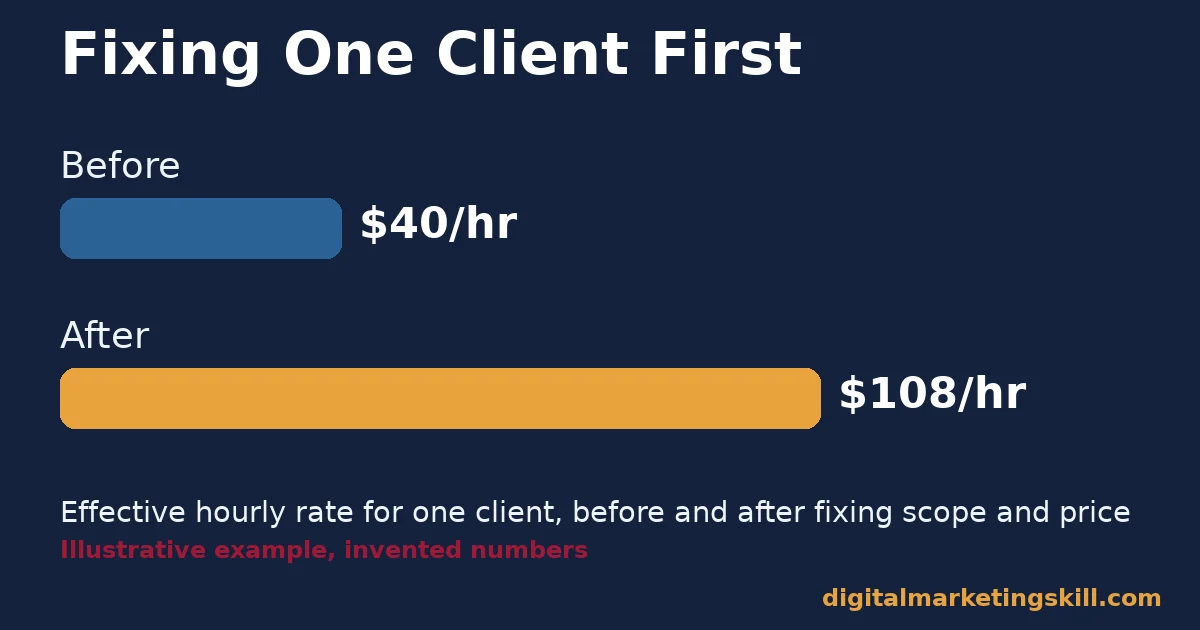
Here is an illustrative example, with invented numbers. A freelancer charges $400 a month for social media management but spends 10 hours delivering it, which works out to $40 an hour before taxes or tools. After tracking hours honestly for one client, they raise the price to $650 and cut delivery to 6 hours by templating the reporting step. That moves the effective rate to about $108 an hour. Only after that client is clearly profitable do they start looking for a second one at the new price.
The lesson is about sequence, not effort. Fixing the economics of one client first means every client added afterward starts out profitable, instead of repeating the same underpriced mistake five times over.
A 90-Day Plan to Launch a Digital Marketing Business
You do not need a business plan document to start. This plan uses roughly the same few hours a week most people already have around a job or studies.
- Weeks 1-2: pick one narrow offer. Choose one service for one type of client, and write the one-sentence version of what you do and for whom.
- Weeks 3-4: deliver one result for free or at a steep discount. Use a real project, your own account, or a friend’s small business, so you have genuine proof before asking strangers to pay full price.
- Weeks 5-8: find three paying clients through your existing network. Warm introductions convert far better than cold outreach at this early stage, because some trust is already built.
- Weeks 9-12: write down the delivery process and set your real price. Document each step while it is still fresh, and price the next client using your tracked hours, not a guess.
At the end of the 90 days, check client acquisition cost and delivery hours per client against your price. Keep whatever worked, fix the weakest number, and repeat the cycle with the next three clients.
A Real Case: Turning One Skill Into Recurring Income
Olajire Jacob, a student whose story is published on Digital Marketing Skill Institute’s reviews page, started by offering freelance email marketing setup work. He describes charging an average of $500 to set up email flows for clients. He then scaled that single service to about $5,000 a month in recurring work as more clients signed on.
The pattern matches the guide above. One narrow, well-defined service, a fixed price per setup, and growth that came from adding clients to a model that already worked, rather than constantly changing the offer. Treat this as one documented example, not a guaranteed outcome. Results vary by niche, effort, and market, and DMSI’s earnings disclaimer sets out those limits in full.
Frequently Asked Questions About Starting a Digital Marketing Business
How much money do I need to start a digital marketing business?
Very little compared with most businesses. A laptop, internet access, and a handful of tools cover a freelance start, since the main cost is time rather than equipment or inventory.
What is the easiest digital marketing business to start with no experience?
Social media management and basic email marketing setup tend to have the lowest skill barrier to a first paid client. The deliverables are easy to show, and the tools are inexpensive or free to start with.
How do I get my first client with no portfolio?
Deliver one real result first, even for free or at a steep discount, using your own project or a contact’s small business. That result becomes the proof your first paying client needed to say yes.
Should I start as a freelancer or build an agency right away?
Start as a freelancer. It needs less capital and proves the offer works before you take on the added cost and complexity of hiring. Move to a small team only once demand is steady.
How many clients do I need to replace a full-time income?
That depends entirely on your price and delivery cost, not a fixed number. Use client lifetime value and delivery hours per client to calculate your own number, rather than copying someone else’s.
Why do new digital marketing businesses fail?
Most often because the offer is too broad, pricing does not cover real delivery cost, or there is no system for referrals and renewals. Fixing the right one of these matters more than adding more marketing effort on top.
Do I need certifications to start a digital marketing business?
No certification is required by law to offer these services. Structured training can still shorten the time it takes to build a reliable, repeatable process and a portfolio of real work.
Start With One Service, Then Expand
A digital marketing business grows fastest when the first service is narrow, priced correctly, and proven on a real client before it gets sold to a second one. Pick the one path from this guide that matches where you are today, then run the 90-day plan. Track client acquisition cost and delivery hours before you decide to expand.
If you want structured, hands-on practice rather than building this alone, Digital Marketing Skill Institute teaches these skills through real client-style work. The Master Diploma in Digital & AI Marketing is built around four AI-powered tracks, including AI-Powered Social Media Management and Advertising and AI-Powered Lead Generation and Email Automation. A Full Stack option covers all four tracks across ten courses. It includes unlimited 1-on-1 coaching and mentoring and a U.S. Project Internship with a verified U.S. Work Reference Letter. The diploma is dual US and UK accredited and recognised in more than 100 countries.
The programme runs 100% online, so you can study and start your own digital marketing business from anywhere in your country. Browse more guides on the Digital Marketing Skill Institute blog, and when you are ready, apply for the Master Diploma or start from the Digital Marketing Skill Institute homepage.
Every figure in this guide was checked against its original source before publication. Figures marked as illustrative are invented examples, not real results.
![9 Amazing Digital Marketing Skills to Make Money Online [With Proof]](https://digitalmarketingskill.com/wp-content/uploads/2019/07/9-Amazing-Digital-Marketing-Skills-to-Make-Money-Online-With-Proof-17.png)






