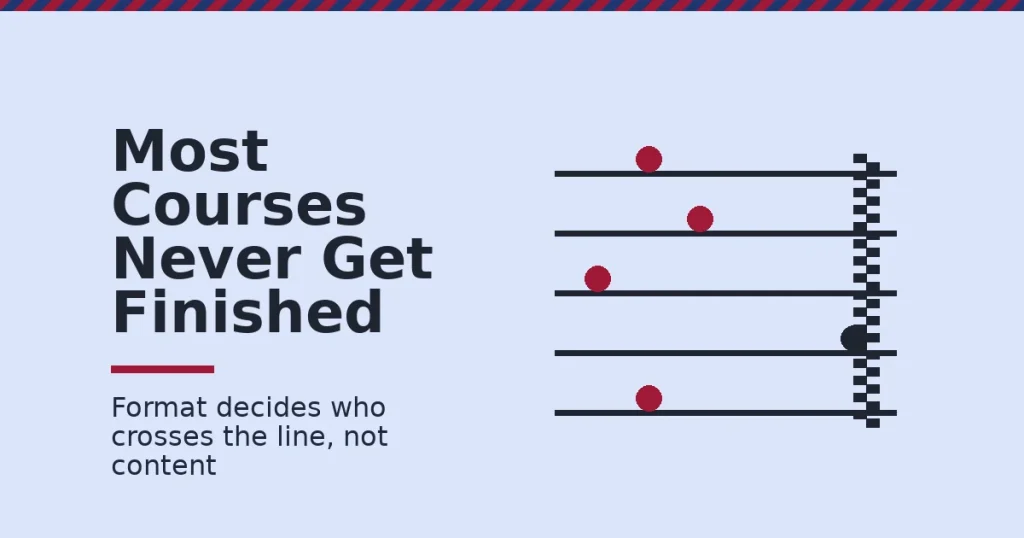
Digital marketing courses only pay off if you finish them and apply what you learned. Most self-paced courses are never finished at all. The format you pick, and whether it forces you to practice, matters more than the course description promises.
Key Takeaways
- Digital marketing tops the skills gap list. The American Marketing Association’s own survey of over 1,200 marketing practitioners found digital marketing itself was the largest current competency gap organizations report.
- Digital already dominates ad spend. DataReportal found that digital channels take in roughly 73% of worldwide ad investment, more than $790 billion.
- Most self-paced courses go unfinished. An academic analysis of 29 MOOCs found an average completion rate of just 6.8%, with some courses finishing under 1%.
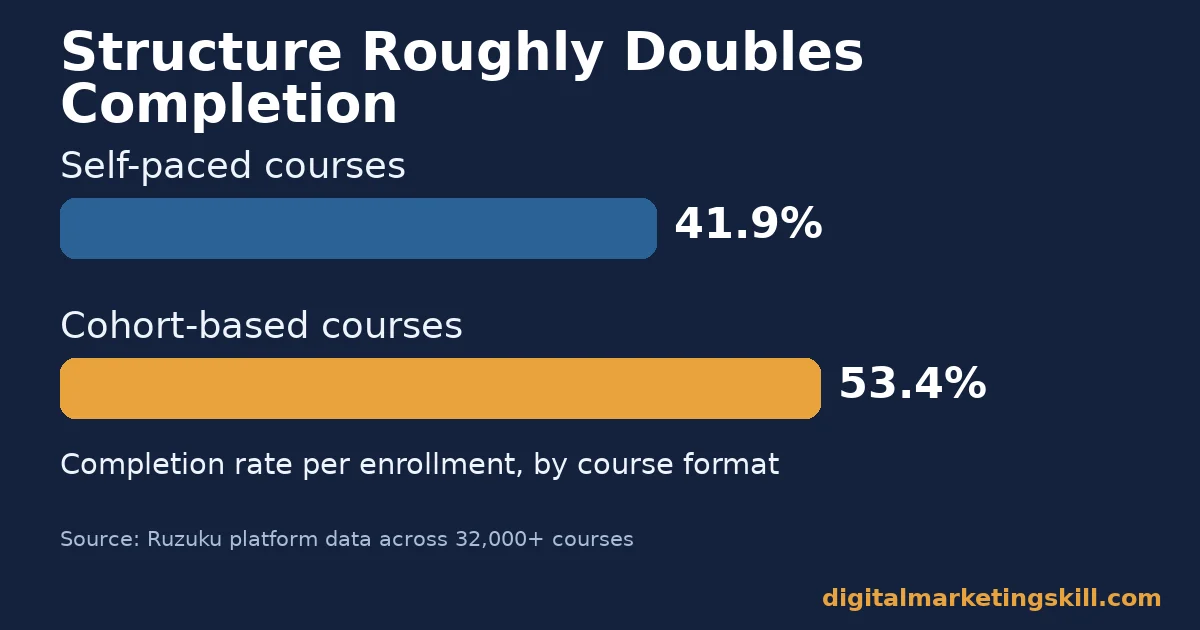
- Structure roughly doubles completion. Platform data from over 32,000 courses found cohort-style courses finished at 53.4%, against 41.9% for self-paced ones.
- Demand for the skill keeps growing. The U.S. Bureau of Labor Statistics projects market research analyst and marketing manager roles to grow roughly twice as fast as the average occupation over the coming decade.
In this guide
- What Most “Best Digital Marketing Courses” Lists Miss
- Why Digital Marketing Courses Still Matter
- Why So Many Digital Marketing Courses Go Unfinished
- What Differs by Course Format
- How to Get the Most From Each Format
- How to Measure Whether a Course Actually Worked
- The One Rule: Match the Format to Your Own Finishing Rate
- A Real Case: What One Platform’s Own Data Shows
- Frequently Asked Questions About Digital Marketing Courses
- Start With One Course You Will Actually Finish
What Most “Best Digital Marketing Courses” Lists Miss
Most lists of digital marketing courses just rank platforms by price or star rating. However, they rarely mention the one thing that decides whether a course changes your career. That one thing is whether you actually finish it and practice the skill. So a cheap course you never complete is worth less than a short one you complete twice.
This guide skips the ranking. It focuses on format instead. Specifically, it explains why most courses go unfinished, what separates the formats people finish from the ones they do not, and how to measure whether a course actually built a skill.
A word on the ground rules first. The completion-rate figures below come from specific, named analyses. They are not a universal law for every course ever made. Treat every number here as a snapshot from when it was measured, not a permanent ranking of any platform or format.
Why Digital Marketing Courses Still Matter
The skill gap behind this topic is real, not assumed. The American Marketing Association surveyed over 1,200 marketing practitioners for its own skills report and found digital marketing itself was the single largest current competency gap organizations face.
Demand follows the same pattern. DataReportal’s global advertising analysis found that digital channels already take in roughly 73% of worldwide ad investment, more than $790 billion. The U.S. Bureau of Labor Statistics projects market research analyst and marketing manager roles to each grow roughly twice as fast as the average occupation over the coming decade.
None of that guarantees a course pays off, though. A real skills gap still will not close itself from an unfinished course. Instead, the format question below is what decides whether the opportunity actually gets captured, for a beginner or for someone already working in the field.
Why So Many Digital Marketing Courses Go Unfinished
A course is really two products bundled together. One is the content. The other is the structure that gets you through the content. However, most marketing of digital marketing courses sells the content alone, because the structure is harder to show off in a sales page. As a result, few courses are honest about how much of the outcome actually depends on it.
Content alone rarely finishes itself. Researcher Katy Jordan analyzed 29 massive open online courses and found an average completion rate of 6.8%. The best course in her sample finished at 19.2%. The worst finished at 0.8%. Courses that used automatic grading finished at 7.7% on average, against 4.8% for courses that relied on peer assessment.
The gap is not really about subject matter. Instead, it is about whether anything outside the learner keeps them moving. So that is the single most useful filter to apply before you enroll in any digital marketing course.
Automatic grading beat peer assessment in Jordan’s sample, too, and the reason fits the same pattern. Automatic grading gives instant, structured feedback the moment a learner submits work, while peer assessment often leaves a learner waiting on someone else’s schedule. Therefore, the faster and more certain the feedback loop, the more likely a learner is to keep going.
What Differs by Course Format
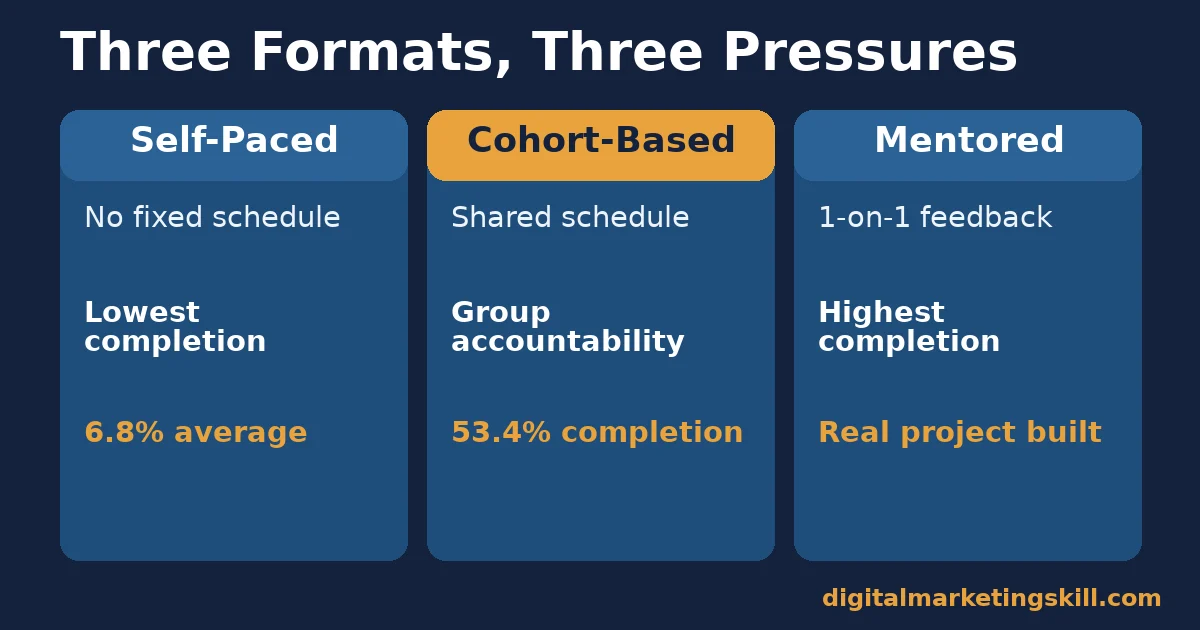
Three formats cover most digital marketing courses on the market today. They are self-paced, cohort-based and mentored. Each is built around a different source of momentum, and each fails in a different way when that momentum goes missing.
None of the three formats of digital marketing courses is universally better. Rather, each one trades price and flexibility for a different kind of pressure. Self-paced courses usually cost the least and ask the most of the learner.
Mentored programs usually cost the most and ask the least, because the structure is built in rather than self-supplied. Cohort-based courses sit between the two, trading a fixed schedule for a lower price than full mentoring.
Self-Paced: Built for Flexibility, Not Pressure
A self-paced digital marketing course has no fixed schedule. You can start any day and move at any speed. That flexibility is real. However, it also removes the one thing that pushes most people to finish: a date they are expected to show up.
Jordan’s completion data reflects exactly this weakness. Self-paced courses ask the learner to supply all of their own urgency. Most people simply do not, no matter how good the content is.
Cohort-Based: Built for Shared Momentum
A cohort-based course moves a group of learners through the same material on the same schedule. Everyone starts together. Everyone is visibly a little behind or ahead of everyone else, and that visibility matters.
Course platform Ruzuku’s own analysis of more than 32,000 courses found that cohort-style courses finished at 53.4% per enrollment, against 41.9% for open-access, self-paced courses. The gap is not proof that scheduling alone caused the difference. Cohort courses often attract more motivated learners too. But the direction matches what a shared deadline would predict.
Mentored: Built for Individual Feedback
A mentored digital marketing course adds one-on-one feedback from someone who already does the job. Instead of just watching lessons, a learner submits real work. Then someone tells them, specifically, what is wrong with it.
This format solves a problem neither of the other two does. It tells you whether your own output is actually good. After all, a learner can finish every lesson in a self-paced or cohort course and still have no idea if their ad copy, their email sequence or their analytics dashboard would survive contact with a real client.
Mentored programs usually cost more precisely because they trade scale for attention. A self-paced course can serve unlimited learners from the same recorded lessons. A mentor, however, can only review so much real work in a week. That is the tradeoff: fewer learners per mentor, but a far higher chance that each one actually finishes with something usable.
How to Get the Most From Each Format
Pick the format that matches how you actually work. Do not pick the one that sounds the most impressive on a landing page. The sections below mirror the three formats above.
Self-Paced: Add Your Own Deadlines
If a self-paced course is your only option, build the structure yourself. Put each module on your calendar with a real date. Tell one other person your deadline. Jordan’s data suggests the missing ingredient is usually external pressure, not content quality.
Pair the course with a real, small project from the start. Watching a lesson on paid ads means little until you have actually set a budget and written the copy yourself. Otherwise, the content simply never gets tested against a real situation, and testing is what turns a lesson into a skill.
Cohort-Based: Show Up for the Schedule, Not Just the Content
Treat the live sessions and the group deadlines as the actual product. They are not an optional extra. The lesson videos alone would just be a self-paced course with extra steps. The schedule is what is buying you a better completion rate.
If you fall behind one week, catch up before the next session starts. Otherwise, cohorts lose most of their value once a learner drops out of sync with the group. Also, use the other learners, not just the instructor, since a peer who is one step ahead often explains a sticking point more plainly than a lesson video can.
Mentored: Come With Questions and Real Work
Get the most from a mentor by bringing unfinished, imperfect work. Do not wait for a polished final draft. Instead, the feedback that changes your skill level usually comes from a mentor catching a mistake early, before you have repeated it fifty times on your own.
Ask for feedback on the parts of digital marketing that are hardest to self-check. Does an analytics report actually tell a clear story? Would a campaign strategy survive a client’s first tough question? A mentor can answer both, since that kind of judgment is exactly what a beginner cannot yet see in their own work.
How to Measure Whether a Course Actually Worked
A certificate only proves attendance. Instead, measure the course against what it was supposed to change. Four checks cover most of what actually matters, and they apply whether the course cost nothing or cost a great deal.
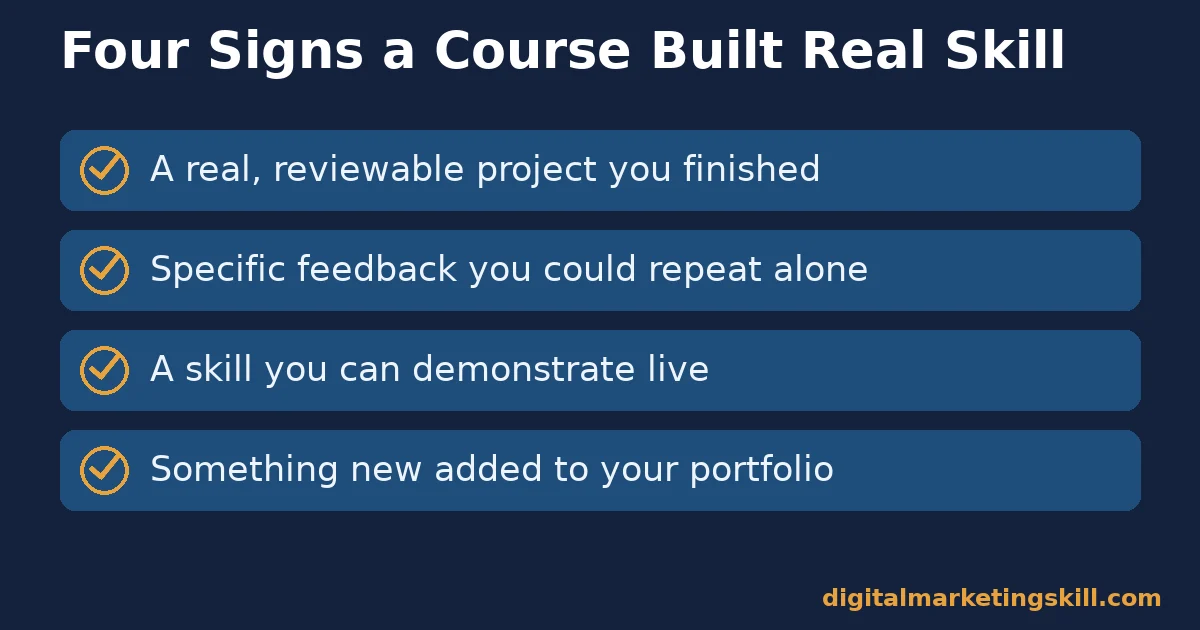
Four Signs a Course Built Real Skill
- A real, reviewable project. A finished campaign plan, a live landing page or an analytics report you could show an employer, not just a slide deck.
- Specific feedback you can repeat. Notes on your own work, not general praise, that you could apply again on a different project without help.
- A skill you can demonstrate live. The ability to build a report, set up a campaign or write ad copy in front of someone, without pausing to rewatch a lesson.
- Something added to a portfolio. One more real piece of work that shows a hiring manager or client what you can actually do, not just what you have watched.
Which Check to Run First
Run the project check before the other three, since it is the fastest to answer honestly. If you cannot name a specific piece of work the course produced, the course did not work yet, regardless of how the other three checks would come out.
Once a project exists, move to the feedback check. A project nobody ever reviewed is a draft, not proof of skill. Someone with real experience in the field needs to have looked at it and said, specifically, what was wrong, before it counts as validated work rather than a guess.
What to Do If a Course Fails These Checks
Say you finished a course but cannot point to a project. If so, go back and build one before moving to the next course. Otherwise, adding a fourth certificate on top of three unused ones will not close the gap that is actually holding you back, no matter how reputable the new course looks.
Say you never finished the course at all. The honest fix is usually format, not willpower. Move to a format with more built-in structure before blaming yourself for a design flaw in the course.
Either way, check these four signs after every course, not just the ones that feel disappointing. A course that passes all four quietly, without drama, is often the one actually worth repeating with a friend or recommending to a colleague.
The One Rule: Match the Format to Your Own Finishing Rate
If you remember one decision rule from this guide, make it this one. Be honest about how many self-paced courses you have actually finished in the past. If the number is low, pay for structure. If the number is high, self-paced will save you money without costing you completion.
Here is an illustrative example, with invented numbers. Someone has started four self-paced marketing courses and finished none of them. So they switch to a mentored program with weekly check-ins and a required project.
This time, they finish it in ten weeks, walking away with a campaign plan and an analytics report they can show a client. The content was not radically different from the courses they abandoned. The structure was.
That lesson stretches beyond digital marketing courses, too. Buying better content rarely fixes a completion problem. Buying better structure usually does, because structure is what actually gets opened and finished.
This is also why comparing two courses purely on syllabus length or topic coverage misses the point. Two courses can teach nearly identical material and still produce very different outcomes, simply because one builds in a deadline, a mentor or a group, and the other leaves all of that to the learner.
A Real Case: What One Platform’s Own Data Shows
Course platform Ruzuku looked at its own data, not a hypothetical, to compare formats directly. Its analysis covered more than 32,000 courses and roughly 920,000 student enrollment records on its own platform.
The finding was specific. Scheduled, cohort-style courses recorded a 53.4% completion rate per enrollment. Open-access, self-paced courses on the same platform finished at 41.9%. Meanwhile, courses that added a discussion component saw completion rise further, to 65.5%, against 42.6% for courses without one. So each added layer of social structure, a schedule and then a discussion thread, lined up with a further rise in completion.
Keep the limits in mind. This is one platform’s own observational data, not a controlled experiment. It cannot prove that scheduling alone caused the gap, rather than the type of learner each format attracts.
Still, the size of the dataset is hard to dismiss. Few independent studies compare course formats across tens of thousands of real courses rather than a handful. So treat it as strong, named evidence that structure correlates with finishing, not as a guaranteed result for any specific course.
Frequently Asked Questions About Digital Marketing Courses
What is the best format for digital marketing courses?
There is no single best format for everyone. Self-paced courses work if you can hold yourself to a deadline. Otherwise, cohort-based and mentored courses work better for most people, because the structure supplies the accountability that self-paced formats leave entirely to you.
How long should digital marketing courses take to finish?
Length matters less than whether the course ends with something real. That could be a campaign you built, a report you can explain, or a project you could show a client. So a short course you finish and apply beats a long one you never complete, every time.
Are free digital marketing courses worth taking?
They can be, if they end with a real project and not just a certificate. The format matters more than the price. A free self-paced course with no structure carries the same low completion risk this guide describes.
Do digital marketing courses actually help you get hired?
A certificate alone rarely does. What a hiring manager or client can actually evaluate is a project you can show, built during the course. Choose a course that forces you to build something real, not just watch lessons.
Why do so many people not finish digital marketing courses?
Mostly because self-paced formats ask the learner to supply all of their own structure. Named research on MOOCs found average completion under 10%. Formats with a schedule and mentor feedback finished at far higher rates in platform data.
Should I pick a broad digital marketing course or a specialized one?
Start broad only if you genuinely do not know which channel fits your strengths. Once you have a direction, specialized, practice-heavy courses in that one area tend to build deeper, more demonstrable skill than another broad overview.
How many digital marketing courses should I take?
Fewer than you think, finished more completely. One course finished with a real project, applied to real work afterward, builds more skill than five courses partially watched and never used.
Does the subject matter more than the format?
Not as much as most people assume. The completion data in this guide spans many subjects, not just marketing. Therefore, format predicts whether you finish a course more reliably than the topic does.
Is a more expensive digital marketing course always better?
Not automatically, but price often tracks structure. A higher price usually buys more mentor time, smaller groups or a firmer schedule, rather than better lesson content on its own. So before paying more, check what the extra money actually buys. If it buys structure, it is probably worth it for someone who struggles to finish things alone.
Can I switch formats partway through a digital marketing course?
Often, yes, and it can be the right move. If a self-paced course has stalled for weeks, adding a study partner or a paid mentor session partway through can restore the pressure that was missing from the start, without starting the whole course over.
Start With One Course You Will Actually Finish
Pick one digital marketing course. Choose the format that matches your own finishing rate. Commit to one real project inside it. Add that project to a marketing portfolio before you enroll in anything else, and use it on your digital marketing resume once it is done.
If you want the structure built in from day one, Digital Marketing Skill Institute runs its Master Diploma in Digital & AI Marketing as nine practical courses. It comes with unlimited 1-on-1 coaching and mentoring, plus real project work inside a U.S. company. It is dual US and UK accredited, and recognized in more than 100 countries.
The program is fully online, so you can study from anywhere in your country. See what skills actually matter first in our guide to job-ready digital marketing skills. Browse more guides on the Digital Marketing Skill Institute blog, and when you are ready, apply for the Master Diploma or start from the Digital Marketing Skill Institute homepage.
Every figure in this guide was checked against its original source before publication. Figures marked as illustrative are invented examples, not real results.
![9 Amazing Digital Marketing Skills to Make Money Online [With Proof]](https://digitalmarketingskill.com/wp-content/uploads/2019/07/9-Amazing-Digital-Marketing-Skills-to-Make-Money-Online-With-Proof-17.png)