
These digital marketing internship tips focus on what actually gets you hired. Build a focused application. Build a small portfolio of real work. Give interview answers that show judgment, not memorized definitions. Most guides list generic steps. This one shows what employers screen for at each stage, and how to pass it.
Key Takeaways
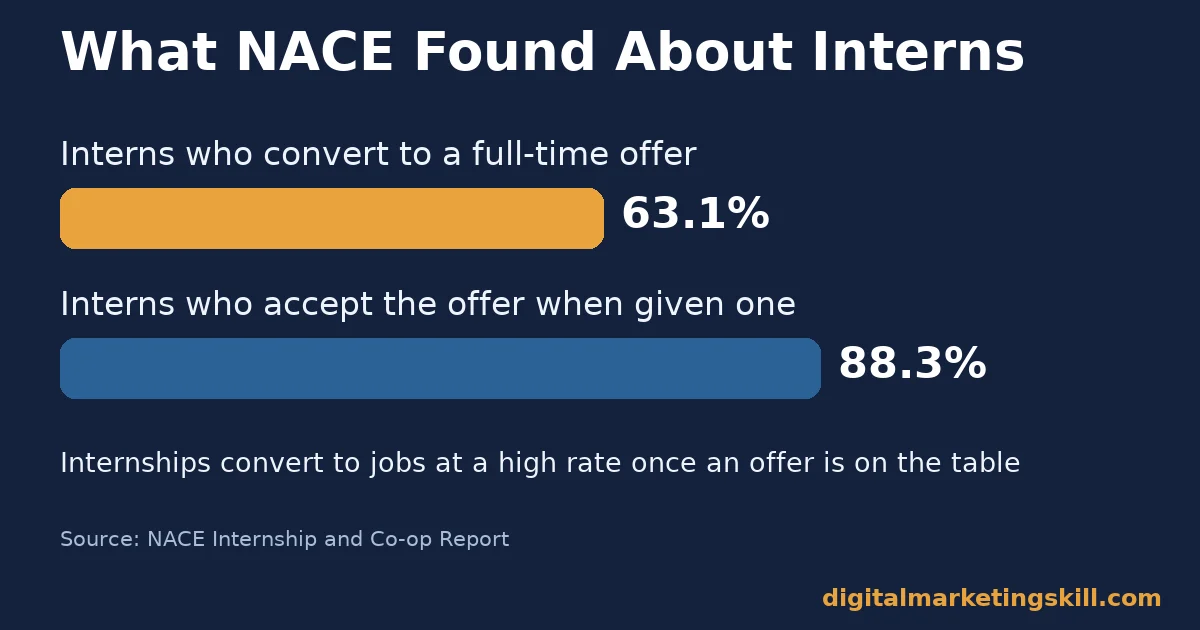
- Internships convert to jobs at a high rate. NACE’s Internship and Co-op Report, covering 284 employer organizations, found a 63.1% conversion rate from intern to full-time hire.
- Interning with an employer builds real loyalty. The same NACE research found more than three-quarters of new hires who interned with that employer were still there after one year. Less than half stayed among hires with no internship experience at all.
- Employers weigh internship experience heavily. NACE’s research on hiring decisions rated “has interned with our organization” 4.4 out of 5 for influence on a hiring choice, against 3.3 for “has no work experience.”
- Acceptance rates are rising too. NACE found 88.3% of interns who received a full-time offer accepted it, up from the year before.
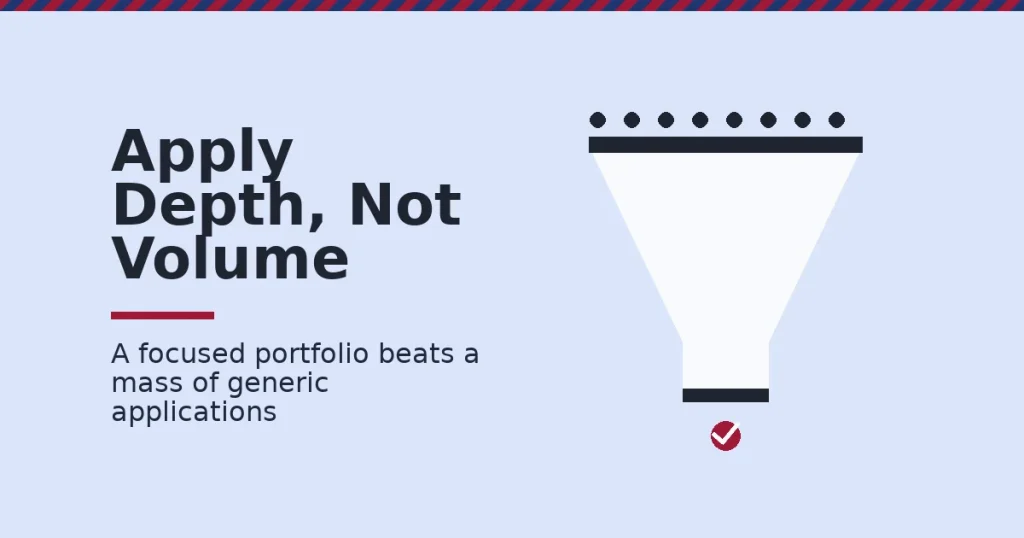
- Volume is not the strategy. A handful of tailored, well-researched applications with a small proof-of-work portfolio beats dozens of generic ones. Digital marketing internship tips that focus only on applying more miss this entirely.
In this guide
- What Most Digital Marketing Internship Tips Get Wrong
- Why A Digital Marketing Internship Is Worth The Effort
- Digital Marketing Internship Tips: What Employers Screen For At Each Stage
- How To Win Each Stage
- Five Mistakes That Sink Digital Marketing Internship Applications
- Sample Digital Marketing Internship Interview Questions
- More Digital Marketing Internship Tips: How To Measure Your Search
- The Most Useful Rule: Apply Depth Beats Apply Volume
- A Real Case: Turning An Internship Into A Full-Time Role
- Frequently Asked Questions About Digital Marketing Internship Tips
- More Digital Marketing Internship Tips: When To Start Applying
- Red Flags To Watch For Before You Accept
- Start With One Small Portfolio Piece
What Most Digital Marketing Internship Tips Get Wrong
Most internship advice is generic. It works for any field: polish your resume, network, apply early. None of that is wrong. It misses what is specific to digital marketing hiring, though.
Digital marketing roles are unusually easy to prove with real work. You can show a real social post, a real landing page audit, or a real ad mockup before anyone hires you. This guide focuses on that advantage, plus what to do at each stage of the process.
One ground rule: the figures below come from NACE’s own employer surveys. Read them as an industry snapshot, not a guarantee for any single company or country.
Why A Digital Marketing Internship Is Worth The Effort
An internship is the fastest route into digital marketing for someone without a job history in the field. NACE’s research found a 63.1% conversion rate from intern to full-time hire. That is the highest rate in five years of its tracking. Most interns who want to stay, do stay.
The loyalty effect compounds further. More than three-quarters of new hires who interned with their eventual employer were still there a year later. That is a far stronger retention rate than hires with no internship background at all.
NACE’s acceptance-rate data tells the same story from the other side. 88.3% of interns who received a full-time offer accepted it, up from the year before. When an internship goes well, both sides tend to follow through on it.
Employers notice this too. Internship experience rated 4.4 out of 5 for its influence on a close hiring decision. Having no work experience rated only 3.3. That gap is exactly why digital marketing internship tips focused on proof-of-work matter more than generic resume advice.
Digital Marketing Internship Tips: What Employers Screen For At Each Stage
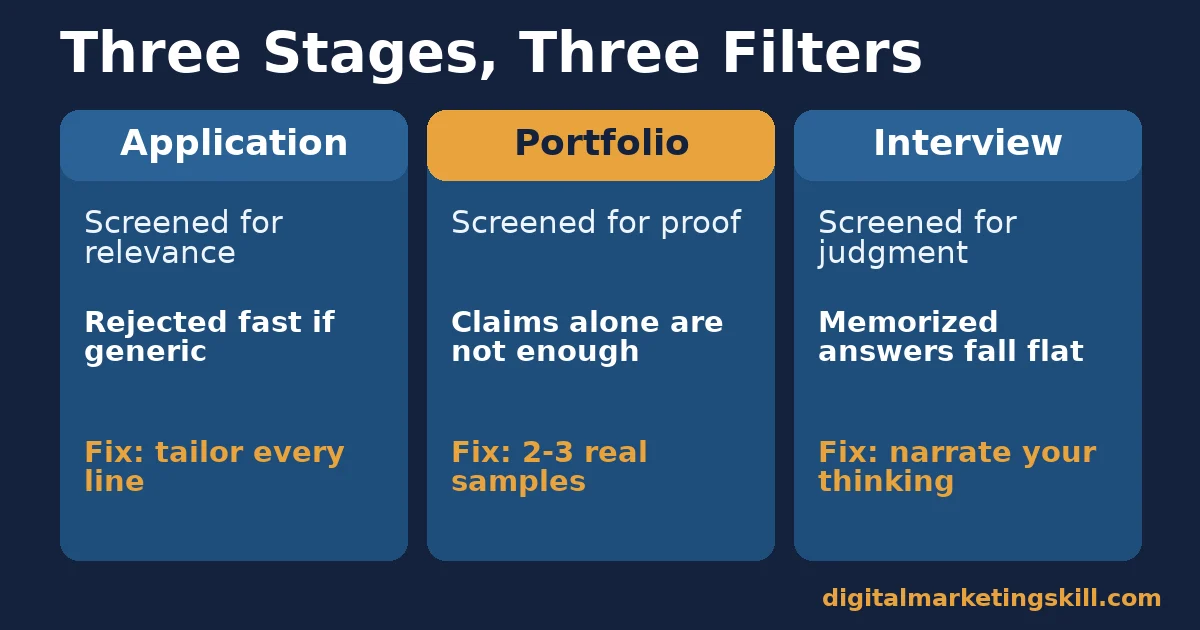
Application: Screened For Relevance
At the application stage, employers are mostly filtering, not evaluating depth. Many use applicant tracking software to do an initial scan before a person reads anything. SHRM’s overview of applicant tracking systems explains how these tools filter by keyword match to the job posting, which is one reason a generic resume sent to fifty companies rarely survives this first filter. A mismatched application is usually rejected in seconds.
Portfolio: Screened For Proof
Once you pass the filter, employers look for evidence you can do the actual work. A portfolio of two or three small, real examples proves far more than a list of software you claim to know. A sample social calendar, an SEO audit of a real small business site, or a mock ad campaign all work well here.
Interview: Screened For Judgment
The interview stage tests judgment, not memorized definitions. Interviewers want to see how you would approach a real, slightly ambiguous problem. A client with a shrinking budget, or a campaign underperforming its goal, is closer to the actual job than any textbook question.
How To Win Each Stage
Application: Lead With Relevance
Rewrite your resume’s top three bullets for each specific internship. Name the company’s actual product, audience or channel where you can. Keep your cover letter to three short paragraphs: why this company specifically, one proof point, and a clear call to interview you.
Indeed’s guidance on internship resumes covers the format basics, such as length and section order, that most applicant tracking systems expect. Of all the digital marketing internship tips in this guide, this rewrite step is the one most candidates skip, because it takes longer than sending the same resume everywhere.
Apply to fewer roles with more care, rather than mass-applying. Our guide on building a marketing portfolio covers how to put proof-of-work front and center, even before you have a formal job.
Portfolio: Lead With Proof You Can Explain
Build two or three small projects you fully understand and can explain out loud. Know what you did, why you did it, and what you would improve with more time. A smaller portfolio you can defend beats a large one you cannot.
Use real or realistic scenarios. Audit an actual small business’s SEO. Draft a week of social posts for a real local brand, with their permission, or clearly marked as a sample. Mock up a simple ad campaign with a stated budget and goal.
Interview: Lead With Judgment, Not Just Answers
When asked a scenario question, narrate your thinking, not just your conclusion. Interviewers are usually scoring how you reason through an ambiguous problem. They rarely care whether you reach the exact answer they had in mind.
Prepare two or three real examples from your portfolio or coursework. Practice walking through each one in under two minutes. Practice this out loud, not just in your head. The gap between knowing an answer and saying it clearly under pressure is real.
Five Mistakes That Sink Digital Marketing Internship Applications
Most rejections trace back to one of these five mistakes. Check your own applications against this list before you send the next batch.
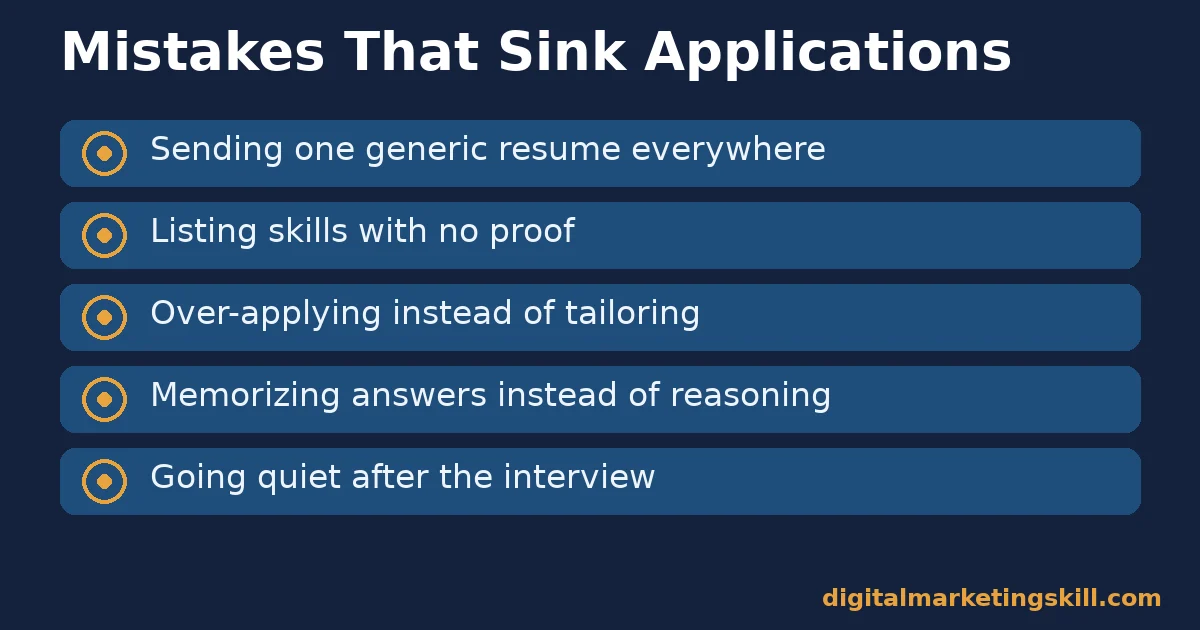
- Sending one generic resume everywhere. A resume with no company-specific detail reads as mass-sent, and most hiring managers can tell within seconds.
- Listing skills with no proof. Claiming “SEO” or “social media” as a skill means little without a sample that shows you applying it.
- Over-applying instead of tailoring. Sixty generic applications usually convert worse than fifteen tailored ones, because the filter stage rejects mismatches fast.
- Memorizing answers instead of practicing reasoning. Interviewers notice when an answer sounds recited rather than reasoned through live.
- Going quiet after the interview. A short, specific thank-you note referencing something from the conversation keeps you visible while a decision is made.
Sample Digital Marketing Internship Interview Questions
These five questions come up often in digital marketing internship interviews. Practice a short, structured answer for each one before your first interview, not during it. Sites like Glassdoor’s interview question database also let you search for a specific company’s past interview questions, when available, which is worth checking before any interview.
“Walk me through a campaign or project you worked on.”
Pick one piece from your portfolio. State the goal in one sentence, what you did, one number or outcome if you have it, and one thing you would change. This structure works whether the project was a class assignment, a volunteer effort or a self-directed audit.
“How would you approach a client whose budget just got cut in half?”
This is a judgment question, not a trick question. A strong answer names a clear priority, such as protecting the best-performing channel, and explains the trade-off out loud, rather than listing every possible tactic at once.
“What digital marketing trend are you following right now?”
Pick one trend you can actually discuss in depth, rather than naming several you only know by headline. Think with Google and major platform blogs are reasonable, free places to find something current and well-sourced to discuss.
“Why do you want to work here specifically?”
Reference something concrete about the company: a campaign you noticed, a product you used, or their specific audience. A generic answer about “loving marketing” signals a mass-applied candidate, which is exactly what this stage filters out.
“Do you have any questions for us?”
Always have two or three ready. Asking about what a typical first project looks like, or how the team measures success, shows you are thinking about the actual job, not just trying to get through the interview.
More Digital Marketing Internship Tips: How To Measure Your Search
Treat your search like a small funnel. Track it, so you know which stage to fix if results stall.
Five Numbers That Show What Is Working
- Application response rate. The share of applications that get any reply, including a rejection. A very low rate often means your resume or cover letter is not getting through the initial filter.
- Interview rate. The share of applications that lead to a first interview. If this is low despite a decent response rate, your materials get attention but do not yet convince.
- Second-round rate. The share of first interviews that lead to a second round. A drop here usually points to the interview itself, not your materials.
- Offer rate. The share of final interviews that lead to an offer. Reaching final rounds often but rarely getting an offer usually points to weak judgment-style answers.
- Time to first interview. How many days, on average, between sending an application and hearing back. This tells you how long to wait before following up.
Reading These Numbers Together
A low response rate points you back to your resume and targeting. A low interview-to-offer rate points you back to interview practice, not more applications. Fixing the wrong stage wastes weeks. Always check which number is actually weak before you change your approach.
The Most Useful Rule: Apply Depth Beats Apply Volume
If you take one decision rule from this guide, make it this one. Ten tailored applications, each backed by a small, relevant portfolio piece, will usually outperform fifty generic ones. Depth gets you past the filter. Volume alone does not.
Here is an illustrative example, with invented numbers. A student sends 60 generic applications. They get 2 interviews and no offers.
They stop, build three small portfolio pieces tailored to a narrower list of 12 companies, and rewrite each application to reference that company by name. From those 12, they get 5 interviews and 2 offers. Fewer applications, far better odds, because each one was built to pass the actual filter.
A Real Case: Turning An Internship Into A Full-Time Role
Digital Marketing Skill Institute’s published student reviews include graduates who used a project built during training as the proof-of-work that won them an interview. In some cases, that led to a first paid role in marketing. These are individual results, not typical or guaranteed outcomes, as the Institute’s own earnings disclaimer makes clear.
The pattern matches NACE’s own data. A real, demonstrable piece of work in hand before the interview changes the odds of winning a digital marketing internship. It answers the proof question before anyone even asks it.
Frequently Asked Questions About Digital Marketing Internship Tips
Do I need a marketing degree to get a digital marketing internship?
No. Many digital marketing skills, such as SEO, social media management and paid ads, can be demonstrated with a self-built portfolio, regardless of your degree field. A relevant project often matters more to employers than the major on your transcript.
How many internships should I apply to?
Quality matters more than raw count. A focused batch of 10 to 15 tailored applications, each with a relevant portfolio piece, usually beats dozens of generic ones.
Are digital marketing internships usually paid?
This varies widely by company, industry and country, so check each listing directly rather than assuming. Where pay is unclear, it is reasonable to ask about it once you reach the interview stage.
What if I have zero marketing experience at all?
Build two or three small, self-directed projects instead. Audit a real website. Draft a sample social calendar. Mock up an ad campaign. These prove capability even with no formal job history.
How long does it usually take to hear back after applying?
This varies by company. Tracking your own time-to-first-interview, as covered above, tells you what is normal for your search and when a polite follow-up is reasonable.
What is the single biggest interview mistake candidates make?
Giving a flat, memorized answer instead of explaining their reasoning. Interviewers are usually testing judgment on an ambiguous scenario. They are rarely checking whether you recite a textbook definition.
Can a digital marketing internship really turn into a full-time job?
Often, yes. NACE’s research found a 63.1% conversion rate from intern to full-time hire, and strong retention among those hires a year later. A good internship is a genuine route into a lasting role.
Where should I look for digital marketing internship listings?
Start with LinkedIn and a direct search of companies you admire, since many internships are posted on a company’s own careers page before they reach a job board. A short, personalized message to someone on the team can also surface unlisted openings.
Should I ask about turning the internship into a full-time job?
Yes, but time it well. A good moment is partway through the internship, once you have delivered something useful, rather than in the first week. Framing it as “what would it take to earn a full-time offer here” tends to land better than asking for a guarantee.
More Digital Marketing Internship Tips: When To Start Applying
Timing matters more than most candidates expect. Many companies, especially larger ones, recruit for summer internships months ahead, so starting your search in the final weeks before you need one limits your options to whatever is still open. These digital marketing internship tips work best when you give yourself enough runway to use them.
Smaller companies and startups often hire on a rolling basis instead, sometimes with only a few weeks’ notice. Because of this mix, it is worth running two tracks at once. Send a small number of early, well-prepared applications to larger, structured programs. Keep an ongoing watch for rolling openings at smaller companies throughout the rest of the search.
Whichever track lands first, the same digital marketing internship tips above still apply: lead with relevance, prove it with a portfolio, and show your reasoning in the interview.
Red Flags To Watch For Before You Accept
Not every internship is worth taking, even if it is the only offer on the table. These digital marketing internship tips would be incomplete without a word of caution: a few warning signs are worth checking before you accept.
- No clear description of daily tasks. If nobody can tell you what you will actually do day to day, the role may be poorly structured or exist mostly to provide free labor.
- No named supervisor or mentor. Internships with a clear point of contact for feedback tend to produce far more usable portfolio material than ones where you are left to figure things out alone.
- Vague or shifting pay terms. Get compensation, even if it is zero, confirmed clearly and in writing before you start, so there is no confusion later.
- No real client or product work. An internship built entirely around busywork, with no exposure to a real campaign, client or product, will not give you the proof-of-work this guide is built around.
Start With One Small Portfolio Piece
Pick one real or realistic project you can finish this week. An SEO audit, a sample social calendar, or a small ad mockup all work. Use it as the proof point in your next application. Apply that same depth-first approach, the core of these digital marketing internship tips, to your next ten applications before you judge whether the strategy works.
If you want structured practice building these skills, Digital Marketing Skill Institute teaches them hands-on. The Master Diploma in Digital & AI Marketing covers four AI-powered tracks, including AI-Powered Social Media Management and Advertising and AI-Powered Lead Generation and Email Automation, totalling ten courses with a Full Stack option to complete all four.
It includes unlimited 1-on-1 coaching and mentoring and a U.S. Project Internship with a verified U.S. Work Reference Letter. That internship doubles as exactly the kind of real proof-of-work this guide recommends.
The diploma is dual US and UK accredited and recognised in more than 100 countries. The programme is fully online, so you can put these digital marketing internship tips into practice from anywhere in your country.
Browse more guides on the Digital Marketing Skill Institute blog, or when you are ready, apply for the Master Diploma or start from the Digital Marketing Skill Institute homepage.
Every figure in this guide was checked against its original source before publication. Figures marked as illustrative are invented examples, not real results.
![9 Amazing Digital Marketing Skills to Make Money Online [With Proof]](https://digitalmarketingskill.com/wp-content/uploads/2019/07/9-Amazing-Digital-Marketing-Skills-to-Make-Money-Online-With-Proof-17.png)






