The most common digital marketing interview mistakes are not knowledge gaps. They are preparation, communication and follow-up errors. They are easy to fix once you can see them. This guide names the mistakes by interview stage. It shows what the data says about each one. It gives you one clear rule for which mistake to fix first.
Key Takeaways
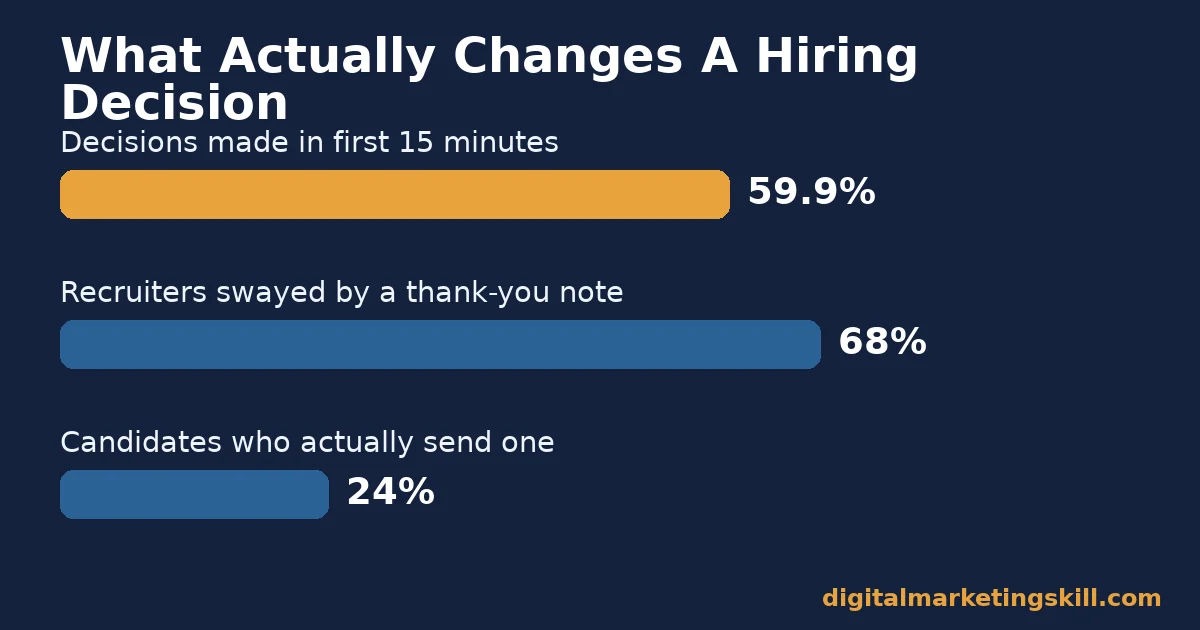
- Interviewers form lasting impressions fast. Research summarised by The Interview Guys found that 59.9% of hiring decisions are made within the first 15 minutes of an interview.
- Thank-you notes still work as a tiebreaker. The same research found 68% of recruiters say a thank-you note affects their decision. Only 24% of candidates actually send one.
- Honesty gaps get noticed. 44% of job seekers admit to lying somewhere in the hiring process. Most employers report they have caught a candidate doing it.
- Portfolios are no longer optional for marketing roles. A Canva-sponsored survey reported in industry research on marketing hiring found 72% of hiring managers prefer candidates who present a portfolio of real work.
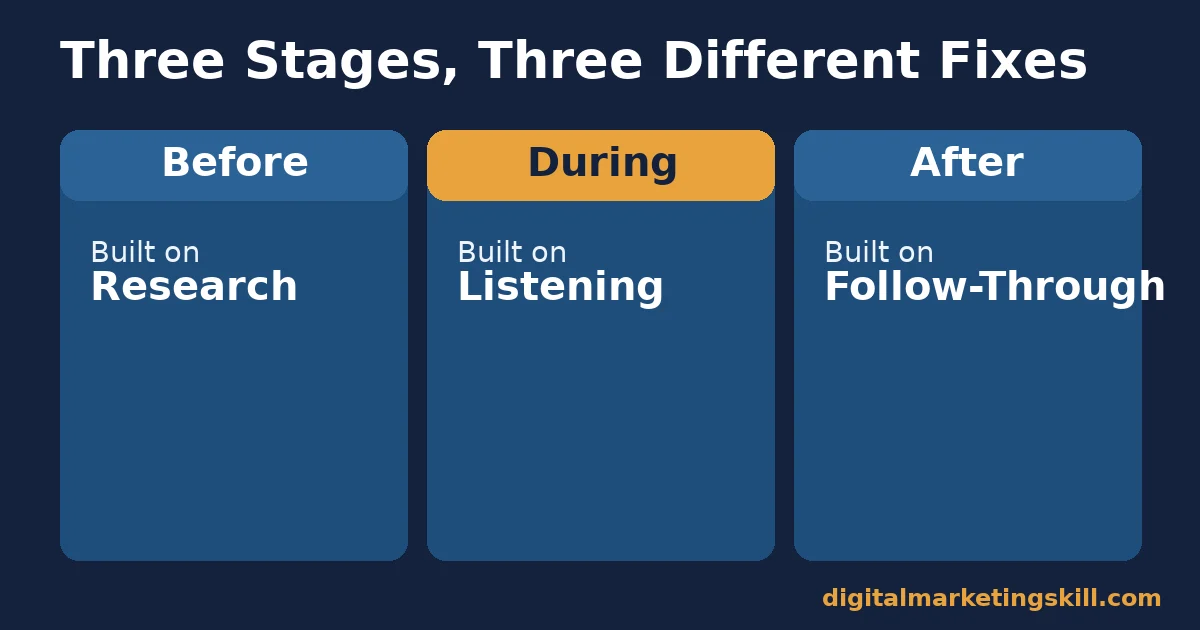
- Most digital marketing interview mistakes cluster in three stages: before the interview (research), during it (communication), and after it (follow-up). Fixing the wrong stage wastes effort.
In this guide
- Why Digital Marketing Interview Mistakes Keep Costing Offers
- How Interviewers Actually Score You
- What Differs By Digital Marketing Interview Mistakes Stage
- How To Fix Digital Marketing Interview Mistakes By Stage
- What Interviewers Focus On By Digital Marketing Role
- How To Measure Your Interview Performance
- The One Decision Rule: Fix The Stage Where You Are Losing Offers
- A Real Case: What One Hiring-Manager Study Found
- Frequently Asked Questions About Digital Marketing Interview Mistakes
- Where To Build Interview-Ready Digital Marketing Skills
Why Digital Marketing Interview Mistakes Keep Costing Offers
Most interview advice lists mistakes without saying which ones matter most for you. That is the real problem. A candidate who over-prepares on research but rushes the follow-up loses offers for one reason. A candidate who is punctual but cannot explain a campaign decision loses offers for a different reason.
This guide treats digital marketing interview mistakes as a diagnosis problem, not a checklist. Find your stage first, then fix it. The figures below describe general hiring behaviour. Your specific interviewer and company will still vary.
Two patterns show up again and again. The first is treating every interview the same way. Candidates reuse one script regardless of the role or company. The second is focusing all preparation on technical knowledge. Candidates ignore communication and follow-up, the two stages where most digital marketing interview mistakes actually happen. Fixing both starts the same way: diagnose which stage is costing you offers, then fix that stage.
How Interviewers Actually Score You
Every interview is really two evaluations at once. The interviewer judges your skills against the job description. At the same time, they judge how easy you will be to work with under pressure. They read small signals: how you handle an unexpected question, how you talk about a past mistake, how closely you listen before answering.
The First Few Minutes Matter More Than You Think
Interviewers do not wait until the end to form an opinion. Most decisions are made early. The rest of the interview either confirms or slowly revises that first impression. A strong opening, a clear introduction and a calm first answer carry more weight than most candidates assume.
What Interviewers Are Really Testing
Interviewers test three things beyond your stated skills. Can you explain your work clearly? Can you take feedback without getting defensive? Will you represent the company well to clients or colleagues? Digital marketing interview mistakes usually trace back to one of these three, not to a lack of technical knowledge.
Non-Verbal Signals Carry More Weight Than Candidates Expect
Tone, posture, eye contact and energy shape an interviewer’s read on you. This is true whether you are interviewing for an in-house role or pitching yourself the way freelancers do when looking for digital marketing clients.
A flat, technically correct answer can land worse than a rougher answer delivered with real enthusiasm. This matters most in the first few exchanges. At that point, the interviewer does not yet have enough detail to judge you on substance alone, so tone and energy are doing most of the work.
None of this means you need to perform. Small, controllable things add up: a clear voice, sitting up straight, looking at the camera or the interviewer rather than your notes.
Nerves make these signals harder to control. That is exactly why rehearsal helps. Practise your opening introduction and your strongest two or three examples out loud, not just in your head. This closes the gap between how prepared you actually are and how prepared you appear. A candidate who sounds calm because they rehearsed reads as more competent than one who is equally skilled but visibly uncertain.
What Differs By Digital Marketing Interview Mistakes Stage
Before The Interview: Built On Research, Not Memorisation
Preparation mistakes happen before you ever speak to the interviewer. They show up as vague answers about the company, no portfolio, or generic responses that could apply to any employer. This stage is built on specific research, not on memorising a script.
A candidate who read the company’s last three campaigns stands out more than one who rehearsed perfect generic answers. Most preparation-stage digital marketing interview mistakes trace back to treating research as optional, something to skim rather than something to actually do.
During The Interview: Built On Listening, Not Performing
Communication mistakes happen live: talking too much, interrupting, dominating the conversation, or not answering the actual question asked. This stage is built on listening, not performing. The interviewer is having a conversation, not watching a monologue. Candidates who treat it as a two-way exchange read as easier to work with. These communication-stage digital marketing interview mistakes are usually fixable with one habit: pause, answer, then stop.
After The Interview: Built On Follow-Through, Not Hope
Follow-up mistakes happen after you leave the room: no thank-you note, no follow-up on promised materials, or going silent and hoping the interview spoke for itself. This stage is built on follow-through, not hope. Most candidates skip this step entirely. That makes it one of the easiest digital marketing interview mistakes to fix for an immediate advantage.
How To Fix Digital Marketing Interview Mistakes By Stage
Before: Lead With Specific Research
Read the company’s last few campaigns, social posts or case studies before the interview. Bring up one specific detail unprompted. Build a short marketing portfolio, even three pieces, with a real outcome attached to each one. A specific example always beats a general claim about your skills.
Research the role, not just the company. If you have time before the interview, revisit how to prepare for a digital marketing interview from the ground up.
An SEO specialist role and a social media manager role test different instincts, even at the same company. Look at the job description line by line. Prepare one concrete example for each requirement listed, rather than a handful of generic achievements you reuse for every application.
During: Lead With Structured Answers
Answer questions in a clear structure: the situation, what you did, and the result. Pause before answering instead of filling silence with filler words. Ask the interviewer a genuine question about their team or their current challenges, not a generic one you prepared in advance.
Watch your talk-to-listen ratio. Dominating the conversation, even with good answers, reads as a warning sign. It suggests how you might behave in team meetings or with clients. Leave space after you finish an answer instead of filling the silence with more explanation.
After: Lead With A Specific Thank-You
Send a thank-you note within 24 hours. Reference something specific from the conversation, not a generic template. If you promised to send a portfolio link or a case study, send it the same day. This single habit separates you from most other candidates, since so few actually do it.
If you do not hear back by the timeline the interviewer gave you, send one polite follow-up, not several. A single, well-timed check-in shows continued interest without crossing into pressure.
What Interviewers Focus On By Digital Marketing Role
Digital marketing interview mistakes often come from preparing generic answers instead of role-specific ones. Different roles test different instincts, even within the same company. Preparing one generic answer for every role is one of the quieter digital marketing interview mistakes, because it rarely feels wrong at the time.
SEO And Content Roles
Expect questions about how you prioritise keyword opportunities and measure content performance beyond traffic. Interviewers may also ask how you would approach a page that has lost rankings. Bring one real example of a page or campaign you improved, with the metric that moved and why you believe your change caused it.
Paid Media And Advertising Roles
Expect questions about budget allocation and how you would respond to a rising cost-per-click. Interviewers want to see that you think in terms of return on ad spend, not just creative ideas. Bring a specific campaign decision and its measurable outcome.
Social Media And Community Roles
Expect questions about handling a negative comment or a brand crisis. Interviewers also probe how you balance posting consistency with genuine engagement. They often test judgment under pressure here more than creative output alone.
Email Marketing And Automation Roles
Expect questions about segmentation, deliverability and balancing personalisation against send volume. Bring an example of a flow or campaign you built. Explain what trigger started it and what metric improved. Specifics here separate candidates who have actually built automations from those who have only read about them.
Coordinator And Generalist Roles
Expect questions about prioritisation and working across multiple channels at once. Generalist roles often support several specialists simultaneously. Interviewers want evidence that you can context-switch without dropping details. An example involving competing deadlines across two or more channels tends to land well.
Across every role above, the underlying test is the same: can you turn a general skill into a specific, remembered example. Preparing one tailored story per requirement is the single habit that separates strong role-specific answers from the generic ones that blend together in an interviewer’s memory by the end of a long hiring day.
How To Measure Your Interview Performance
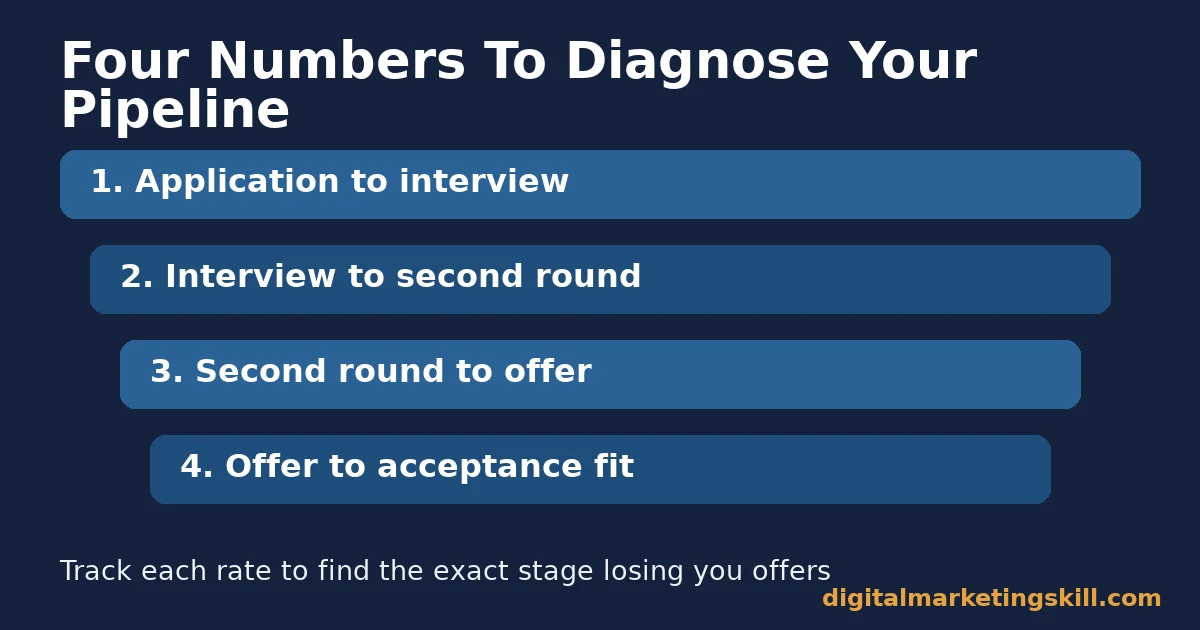
Treat your job search like a pipeline you can diagnose, not a string of unrelated attempts. Track four numbers across your last five to ten applications.
- Application-to-interview rate: interview invitations divided by applications sent. A low rate points to a resume, portfolio or targeting problem, not an interview problem.
- Interview-to-second-round rate: second interviews divided by first interviews. A low rate here usually means a stage-one mistake: preparation or first impression.
- Second-round-to-offer rate: offers divided by second-round interviews. A low rate here points to stage-two or stage-three mistakes: communication depth or follow-up.
- Offer-to-acceptance fit: how often the offers you receive actually match what you wanted. A mismatch here is a targeting problem, not an interview-skill problem.
These four numbers turn a frustrating string of rejections into a specific, fixable problem. Most candidates stop at “I’m bad at interviews,” which is too vague to act on. Knowing which stage is leaking offers tells you what to change next, instead of guessing at which digital marketing interview mistakes might be responsible.
Write these four numbers down after every interview cycle. A pattern across five or more interviews tells you far more than any single result.
A single bad interview is noise. Consistently reaching second rounds but never getting an offer is a different story: that pattern is a signal worth acting on. Review these numbers after every five applications, not after every single one. That way a single unusual interview does not skew your read on where the real problem sits.
The One Decision Rule: Fix The Stage Where You Are Losing Offers
Find the stage where your numbers drop the most. Fix only that stage before you change anything else.
A low application-to-interview rate points to a before-the-interview problem: resume, portfolio or targeting. A low interview-to-second-round rate points to a during-the-interview problem: structure, listening or nerves. The third case is different: a low second-round-to-offer rate often points to an after-the-interview problem, such as follow-up or a final-stage communication gap.
Illustrative, invented numbers: a candidate who gets interviews easily but never reaches a second round is likely making during-interview mistakes, not before-interview ones. A candidate who reaches final rounds consistently but rarely gets an offer is more likely losing it in follow-up. Fix the stage the data points to, not the stage that feels easiest to practise.
Resist the urge to fix everything at once. Changing your resume, your answers and your follow-up habits in the same week makes it impossible to know which change worked.
Fix one stage. Run two or three more interviews. Check your numbers again. Then move to the next stage if needed. Stacking fixes for several digital marketing interview mistakes at once is the fastest way to lose track of what actually worked, and it leaves you unable to repeat whichever single change made the difference.
A Real Case: What One Hiring-Manager Study Found
The Interview Guys research cited earlier surveyed recruiters directly. It asked what actually changes their decision after the interview ends. Two findings stand out: 68% of recruiters said a thank-you note affects their decision. 27% said they have used a thank-you note as the tiebreaker between two equally qualified candidates.
The limit on this research matters. It reflects recruiter self-reporting, not a controlled trial. The exact sample and methodology are described on the source page, not reproduced here in full. It is one study, not a universal rule for every hiring manager. Treat it as strong evidence that follow-up matters, not as a guarantee that a thank-you note alone wins an offer.
The practical takeaway holds even without a precise number. Sending nothing after the interview removes a genuinely low-effort chance to influence a close decision. Follow-up is the stage most candidates skip entirely. That makes it the easiest digital marketing interview mistake to fix immediately, and one of the few that costs nothing but ten minutes of your time to get right.
Frequently Asked Questions About Digital Marketing Interview Mistakes
What is the single most common digital marketing interview mistake?
Arriving without a portfolio or specific examples of past work. Marketing is a visual, results-driven field. Interviewers consistently say they prefer candidates who can show real work rather than only describe it.
How long should I wait before sending a thank-you note?
Within 24 hours, while the conversation is still fresh for both of you. Reference one specific detail from the interview rather than sending a generic template. Specificity is what makes a thank-you note memorable.
Is it a mistake to ask about salary early in a digital marketing interview?
Generally yes, if it is the first thing you bring up. Establish your fit and value first. Discuss compensation once the conversation naturally reaches that stage, or once the interviewer raises it.
Should I admit it if I do not know something the interviewer asks about?
Yes. Say you are not familiar with it, then explain how you would find the answer quickly. Guessing confidently and getting it wrong damages trust more than an honest “I don’t know yet.”
How many portfolio pieces do I need for a digital marketing interview?
Three strong, specific pieces beat ten generic ones. Choose examples where you can clearly describe your role, the decision you made, and the measurable outcome.
What is a common mistake candidates make when discussing past employers?
Speaking negatively about a previous employer or colleague. It reads as a risk signal to interviewers, regardless of whether the criticism is fair. Focus on what you learned instead of what went wrong.
Can over-preparing hurt my interview performance?
Yes, if it turns into reciting memorised answers instead of having a real conversation. Prepare structure and examples, not scripts. That way you can still listen and respond naturally to the question actually asked.
What is a good question to ask the interviewer at the end?
Ask something specific to the team or role, such as what success looks like in the first three months. Avoid questions you could have answered yourself by reading the company website, since that signals a lack of preparation.
How should I handle a question about a campaign that failed?
Answer honestly and focus on what you learned and changed afterward. Interviewers often test self-awareness here, not a perfect track record. A thoughtful answer about a real failure usually lands better than claiming you have never had one.
Do remote digital marketing interviews have different common mistakes?
Yes. The biggest additions are technical: not testing your camera, microphone and internet connection beforehand, poor lighting, or a distracting background. 62% of hiring managers report a candidate’s video interview being derailed by an avoidable technical issue. Join five to ten minutes early to confirm everything works.
Where To Build Interview-Ready Digital Marketing Skills
A strong portfolio and real campaign experience fix most digital marketing interview mistakes before they happen, because you walk in with specific, defensible work to discuss. If you are still building core skills, it is worth taking time to upskill in digital marketing before your next application round.
The Master Diploma in Digital & AI Marketing at the Digital Marketing Skill Institute is built around four AI-powered tracks, drawn from ten execution-first courses in total: AI-Powered Social Media Management and Advertising, AI-Powered Lead Generation and Email Automation, AI-Powered Google Specialist, and AI-Powered WordPress and SEO Specialist, with a Full Stack option for completing all four.
Every track includes a U.S. Project Internship with a verified U.S. Work Reference Letter, unlimited one-on-one coaching and mentoring with CV and interview preparation support, and dual US and UK accreditation recognised in more than 100 countries. The program runs 100% online, so you can build real, interview-ready portfolio work from anywhere in your country.
Explore the Master Diploma page, browse more guides on the digital marketing blog, read real outcomes on the reviews page, or go straight to the application page when you are ready to start. Digital Marketing Skill Institute trains students wherever they live, and you can learn more any time at digitalmarketingskill.com.
Every figure in this guide was checked against its original source before publication. Figures marked as illustrative are invented examples, not real results.