Digital marketing mistakes usually trace back to three habits: no clear business objective, too many channels run at once, and messages aimed at everyone. Fixing all three, in order, lifts results faster than writing more content or buying more ads.
Key Takeaways
- CB Insights found poor product-market fit cited in 43% of 385 recent startup shutdowns with a known cause. Running out of capital led the list at 70%.
- A business that focuses on two or three proven channels tends to report better outcomes than one spread across six or more, per small-business marketing research.
- The “5,000 marketing messages a day” claim has no credible source. Independent counts have found far lower daily exposure.
- Narrower audience targeting tends to raise Google Ads Quality Score. That can lower cost per click, according to Google’s own documentation.
- These three common digital marketing mistakes are fixable with one objective, one or two channels, and one named audience.
In this guide
- Why “Just Market More” Is Not The Real Problem
- What Actually Breaks Without A Business Objective
- What Differs By Mistake
- How To Fix Each Digital Marketing Mistake
- How To Measure Digital Marketing Mistakes And Fixes
- The One Decision Rule For Fixing Digital Marketing Mistakes
- A Real Case: Narrowing The Niche
- Frequently Asked Questions About Digital Marketing Mistakes
- Build A Focused Digital Marketing Skill Set
Why “Just Market More” Is Not The Real Problem
A startup with ten unfinished marketing tasks rarely needs an eleventh task. It needs fewer tasks, done with a clear reason. Most digital marketing mistakes come from activity without a target, not from a lack of effort.
This gap matters because busy work is easy to mistake for progress. A full content calendar feels productive. So does a growing follower count. Neither one proves the business is any closer to its next sale, and neither one is a digital marketing mistake on its own until it replaces a real objective entirely.
Three habits explain most of the gap, and together they form the core set of digital marketing mistakes this guide covers. First, no one named the business objective a channel has to serve. Second, the team spread itself across too many channels at once. Third, every message tried to speak to everyone, so it spoke clearly to no one.
A Popular Statistic That Does Not Hold Up
Older marketing advice often claims the average person sees 5,000 marketing messages a day. That number traces back to an old book and some news reports, not a measured study, according to reporting that traced the claim to its source.
Independent counts tell a different story. An early Harvard study counted about 76 ad exposures a day. A later University of Nebraska study counted about 98.5. A single-day count by the same journalist found 93. None of these numbers come close to 5,000.
The exact number matters less than the lesson here. A business does not need to shout into thousands of exposures. It needs one clear message, reaching the right person, said often enough to be remembered.
Ground Rules Before The Three Mistakes
These mistakes apply worldwide, not to one market or platform. The figures below come from named sources, and each one has its own limits: a self-reported survey, one company’s own dataset, or an official Google explanation.
None of this guarantees a result, because list quality, product and budget all shape the outcome too. Treat every statistic here as a useful signal, not a formula. The goal is naming three specific, fixable digital marketing mistakes, not replacing judgment with a number.
One more rule matters before the detail: fix the mistakes in order. A narrow audience message sent through the wrong channel, with no objective behind it, still fails. Order matters because each fix makes the next one easier to see clearly.
What Actually Breaks Without A Business Objective
CB Insights studied 431 venture-backed startups that recently shut down. Among the 385 with a known cause, 70% ran out of capital, and 43% cited poor product-market fit as a root cause. Many listed more than one reason, since failure is rarely caused by a single factor alone.
Capital Problems Often Start As Objective Problems
Running out of money looks like a finance problem. Often it starts earlier, as a marketing objective problem. A channel that generates likes but no qualified leads still costs time and budget. Multiply that across several channels, and a real capital drain can masquerade as bad luck.
A marketing objective is the one business result an activity has to produce: a sale, a qualified lead, or a booked call. Without one, “we post every day” becomes the goal instead of a means to an end. That single substitution sits behind more digital marketing mistakes than any single tactic.
Objectives also set a deadline for honesty. Once a channel has a named number to hit, the team can tell within weeks whether it works. Without one, a channel can run for months on vague optimism alone, quietly burning budget the whole time.
Naming the objective also changes how a team talks about a channel. Instead of asking whether a post “did well,” the question becomes whether it moved the agreed number. That shift alone removes most of the guesswork from a weekly marketing meeting.
A Funnel Turns Activity Into A Measurable Chain
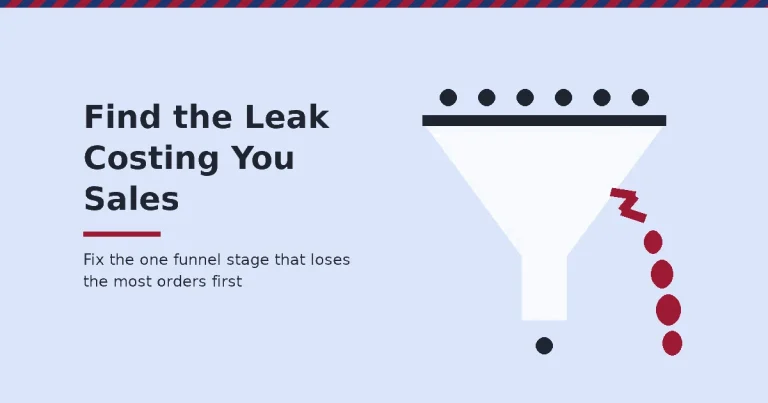
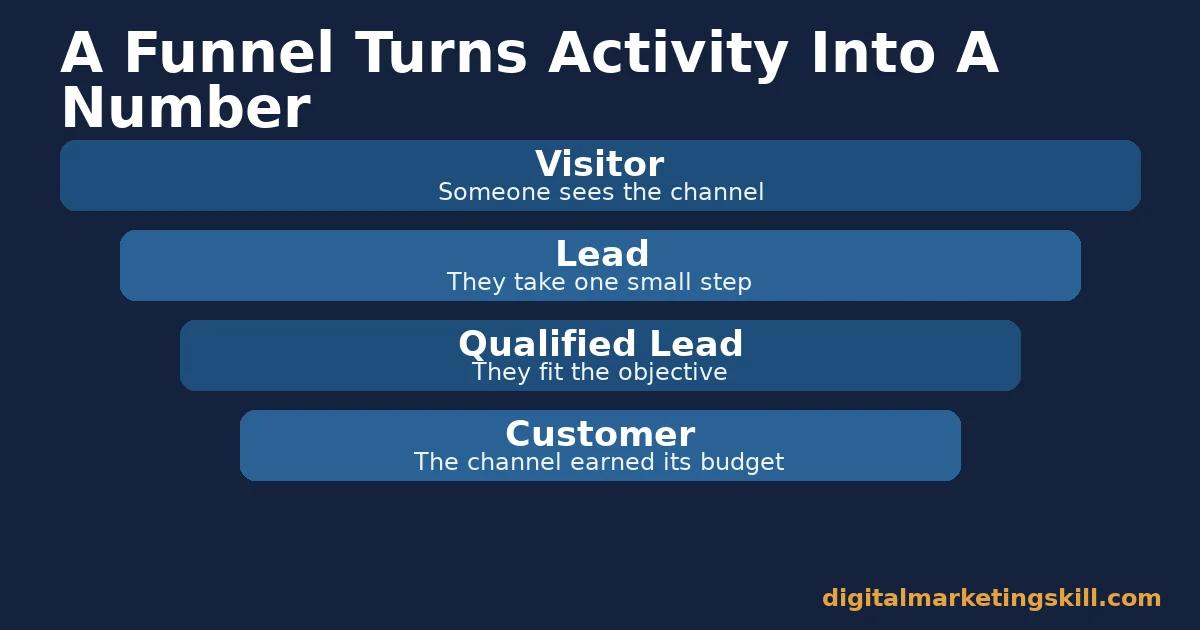
A marketing funnel breaks one big objective into smaller, checkable steps: awareness, a form fill, a qualified lead, then a sale. Each step has its own number. If a channel cannot move anyone from one step to the next, it is not serving the objective, no matter how much activity it produces.
This is also why vanity metrics survive so long inside small teams. A like or a view sits outside the funnel entirely. It never gets tested against a real step, so it feels like progress precisely because nothing holds it accountable.
A funnel does not need to be complex to work. Even a simple three-step version, visitor, lead, customer, forces every channel to answer the same question: did anyone move down this chain because of what we did here? Channels that cannot answer are the ones most likely hiding one of the three digital marketing mistakes in this guide.
What Differs By Mistake
The three mistakes differ in cause, but they share one underlying fix: focus. Naming the fix for each mistake starts with naming what that mistake actually optimizes for.
No Business Objective: Built For Activity, Not Profit
A startup without a stated objective ends up measuring whatever is easiest to see: likes, views, follower counts. Those numbers feel like real progress. They rarely explain whether a channel moved anyone closer to buying, so the team keeps producing content without ever learning what actually works.
This mistake survives because it is comfortable. A weekly content calendar, filled with posts, feels like a finished job. No one has to ask the harder question of whether any of it changed a single business number.
Too Many Channels: Built For Exposure, Not Depth
Spreading a small team across six or more channels looks thorough. In practice, each channel gets only a fraction of the attention it needs. None of them develop the posting rhythm or community fluency that makes a channel genuinely work, so every channel stays shallow at once.
This mistake often comes from fear of missing out, rather than from strategy. Competitors appear on five platforms, so a startup assumes it needs five too, without first asking whether its own customers are even reachable on all five.
Everyone As The Audience: Built For Reach, Not Resonance
Writing for “everyone” produces messages specific enough to offend no one, and compelling enough to move no one. A broad audience also means competing against every other business chasing the same broad group. That is also why generic b2b marketing messages tend to underperform a narrowly written one.
This mistake is often a confidence problem in disguise. Naming one narrow audience feels like turning away customers, so founders keep the language broad to avoid excluding anyone, and end up excluding everyone instead.
How To Fix Each Digital Marketing Mistake
Each fix below follows directly from what the mistake was optimizing for.
No Business Objective: Lead With One Funnel Metric
Pick one number each channel has to move: email signups, demo bookings, or qualified leads. If an activity does not move that number within a set period, pause it or redesign it. A like is not a funnel metric; a qualified lead is. Borrowing from proven lead generation strategies beats inventing a funnel from scratch.
Write the objective down somewhere the whole team can see it, not just in one person’s head. A shared, visible objective is harder to quietly abandon once a channel gets busy or distracting.
Too Many Channels: Lead With Two Channels, Not Six
Small-business marketing research has found that businesses focused on two or three proven channels tend to report better outcomes than ones spread across six or more. Pick the one or two channels your actual customers already use. Get good at them before adding a third, perhaps starting with the marketing strategies for small businesses that match your budget.
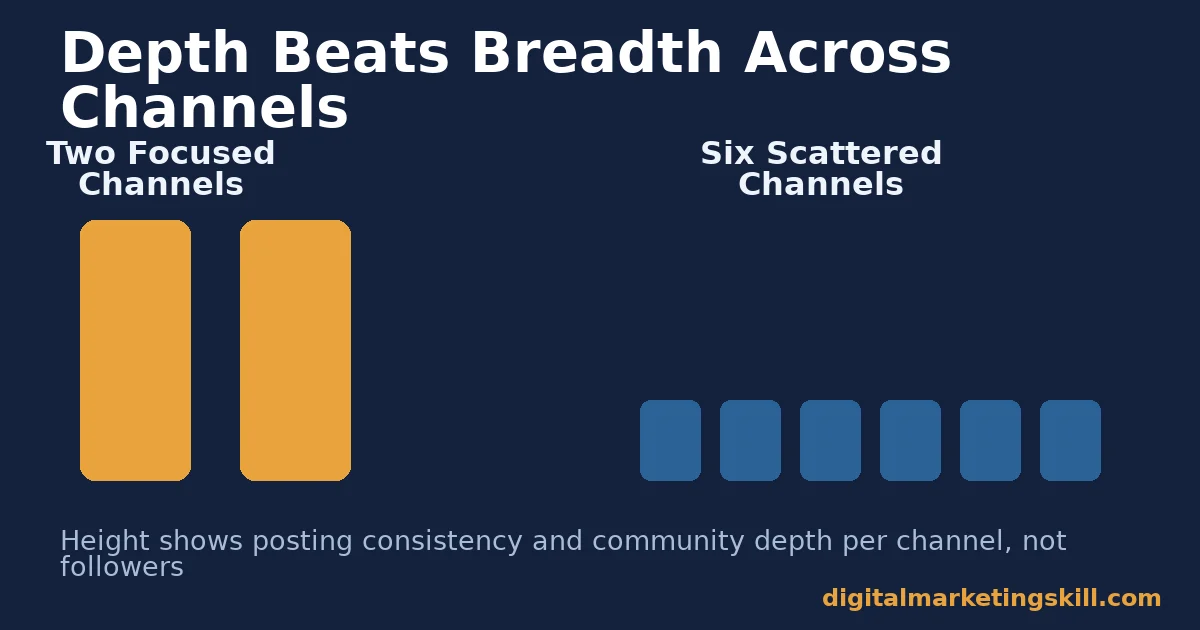
Depth beats breadth here because trust compounds. A community notices a business that shows up consistently with relevant posts. It does not notice one post a month spread across eight platforms, so the consistent business wins attention the scattered one paid for but never collected.
Everyone As The Audience: Lead With A Narrow, Named Buyer
Replace “everyone” with one named buyer: their role, their specific problem, and the outcome they want. A message written for “small business owners juggling their own marketing” lands harder than one written for “businesses,” because the reader instantly recognizes themselves in it.
Narrower targeting pays off in paid channels too. Google’s own documentation on Quality Score explains that it is built from expected clickthrough rate, ad relevance and landing page experience. All three improve when an ad and its audience are closely matched. Google states Quality Score itself is a diagnostic tool, not a direct auction input, but the three factors behind it still shape cost and placement.
How To Measure Digital Marketing Mistakes And Fixes
Three numbers show whether focus is paying off.
- Funnel conversion rate is the share of people who move from one funnel step to the next, such as visitor to lead. A rising rate means the message and the step are aligned.
- Cost per qualified lead is total channel spend divided by qualified leads, not total leads. This number exposes a channel generating cheap, unqualified attention instead of real buyers.
- Channel depth is a simple count: posts or campaigns per channel per month, tracked alongside results. A channel with rising depth and flat results is a strong candidate to cut.
Track these per channel, not only across the whole business. A strong overall number can hide one channel quietly wasting the team’s time. A short list of digital marketing KPIs helps decide which numbers to track first.
Reading The Three Numbers Together
The clearest sign a fix is working is a rising conversion rate paired with a falling cost per qualified lead. Sometimes conversion rises while cost per lead also rises. That usually means the channel reached fewer, better-matched people at a higher price, which is not always bad, but it is worth naming on purpose instead of discovering by accident.
The One Decision Rule For Fixing Digital Marketing Mistakes
If you cannot name the one business objective a channel serves, cut the channel before you cut the budget. A channel without a named objective cannot be optimized. It can only be maintained, and maintaining it quietly drains the same budget a real capital shortage would.
A Worked Example Of The Rule
Illustrative, invented numbers: a startup runs five channels on a combined budget of $2,000 a month. Three channels cannot be tied to a named objective. Together they produce 10 qualified leads a month. The other two channels, tied to a clear lead objective, produce 40 qualified leads on the same combined budget those three channels used.
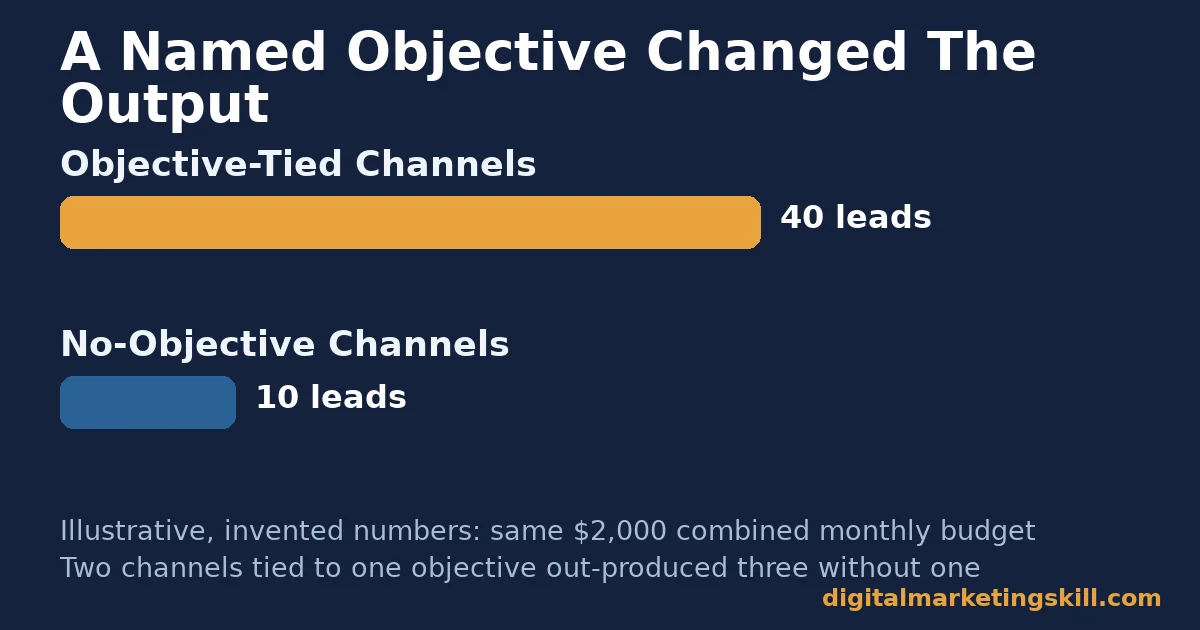
Cutting the three unclear channels and reallocating their budget to the two working ones does more than save money. It can roughly double lead output from the same total spend, because the working channels were previously starved of budget and attention.
The rule names the channel, not the number, as the thing to cut first. A business that only cuts its smallest budget line often cuts a cheap channel that was quietly working. Meanwhile, an expensive channel with no objective survives another quarter untouched.
Apply the same rule before launching a new channel, not only when cutting an old one. If no one can state the objective a new channel is supposed to serve before the first post goes out, that channel is already a future candidate for this same decision rule.
A Real Case: Narrowing The Niche
Digital Marketing Skill Institute graduate Esther Elueme openly describes, on the Institute’s published reviews page, building a website, scheduling social posts, and adding a specific business niche to her Google search presence within a month of starting. The detail worth noting is the word “niche.” She did not optimize for every possible search term. Instead, she optimized for the one term that matched her actual business.
Limits: this is one published, self-reported account, not an independent study, and results vary by market, product and effort. See the Institute’s earnings disclaimer before treating any outcome as typical.
This single detail connects back to all three digital marketing mistakes in this guide. A named niche gives a business a business objective to test against, a reason to pick one or two channels over six, and language specific enough to resonate with a real buyer instead of an imagined average one.
None of that required a large budget or a large team. It required picking one thing to be known for, then building the website, the posts and the search presence around that one thing instead of around every possible thing the business could someday offer. That order, pick the thing first, is exactly what the rest of this guide recommends doing too.
Frequently Asked Questions About Digital Marketing Mistakes
What is the most common digital marketing mistake for a new business?
Running marketing activity without a named business objective. Posting, emailing and advertising all feel productive. None of it compounds, though, without one number each activity is supposed to move.
How many marketing channels should a small business use?
Two or three, chosen because the target audience already uses them. Research on small-business marketing has found that businesses concentrated on a few proven channels tend to outperform ones spread across six or more.
Is it true that people see thousands of marketing messages a day?
No credible study supports the “5,000 a day” figure. Measured counts range from under 100 to a few hundred, depending on what counts as an exposure. Treat any such number as a rough device, not a fact to build a strategy on.
Does targeting a narrow audience limit growth?
Usually the opposite happens. A narrow, well-defined audience converts at a higher rate, which funds growth into adjacent audiences later. A broad audience from day one usually converts poorly everywhere at once instead.
How do I know which channel to cut first?
Cut the channel with no named business objective first, no matter how much time it has absorbed. A channel tied to a real number, even a small one, deserves more testing before it deserves cutting.
Can these digital marketing mistakes affect an established business too?
Yes, because the size of the business changes the budget, not the mistake itself. A larger team spread across too many channels, with no named objective per channel, simply wastes more money making the same mistake at a bigger scale. A bigger budget just buys a bigger, more expensive version of the exact same problem.
Should every channel get an equal share of the marketing budget?
No. Budget should follow evidence, not fairness between channels. Once a channel proves it can move the chosen funnel metric at a reasonable cost, it earns more budget than a channel still waiting to prove itself.
How long should a team wait before judging whether a fix worked?
Give a channel at least one full funnel cycle, long enough for a visitor to become a lead and then, ideally, a customer. Judging too early often kills a channel right before it was about to pay off, while judging too late repeats one of these digital marketing mistakes for another month.
What is the fastest way to spot these mistakes in an existing campaign?
Pull up the last month of activity on each channel and ask one question of each: what business objective did this move, and by how much? A channel that cannot answer in one sentence is very likely carrying one of these three mistakes already.
Do these digital marketing mistakes apply to paid ads, not just organic content?
Yes, often worse there, because every wasted impression has a direct cost attached. A paid campaign with no named objective, running across too many platforms, aimed at too broad an audience, burns real budget on all three mistakes at the same time. Organic content wastes time and attention; paid campaigns waste time, attention and cash together.
Build A Focused Digital Marketing Skill Set
Avoiding these three digital marketing mistakes takes a repeatable system, not a single fix, and that system can be built from anywhere in your country.
Digital Marketing Skill Institute’s Master Diploma in Digital & AI Marketing covers nine practical courses, including strategy and analytics, with unlimited one-on-one coaching and mentoring and real project work inside a US company. The program is dual US and UK accredited, recognised in more than 100 countries, and delivered 100% online, wherever you live.
Explore the Master Diploma in Digital & AI Marketing on digitalmarketingskill.com, read real outcomes on the reviews page, or browse more guides on the digital marketing blog. When you are ready, go straight to apply and start building a focused plan from wherever you are in your country. digitalmarketingskill.com walks you through every course in the program.
Every figure in this guide was checked against its original source before publication. Figures marked as illustrative are invented examples, not real results.
![9 Amazing Digital Marketing Skills to Make Money Online [With Proof]](https://digitalmarketingskill.com/wp-content/uploads/2019/07/9-Amazing-Digital-Marketing-Skills-to-Make-Money-Online-With-Proof-17.png)