
A digital marketing resume has to clear two gates before anyone judges your skills. A tracking system scans for keywords first, then a recruiter skims for about 30 seconds. This guide shows what each gate actually checks, how to pass both without stuffing keywords, and one rule for writing every bullet point.
Key Takeaways
Before you finalise the document, make sure your skills section leads with proof, not adjectives — it is one of the fastest ways recruiters judge a resume.
- Most companies filter before a human looks. Jobscan’s own detection study found a detectable applicant tracking system in use at about 97% of Fortune 500 companies.
- The human read is short. A survey of 418 hiring professionals by ResumeGo found 80% spend less than one minute on an initial resume screen. Only 1% spend under 10 seconds.
- Older eye-tracking data points the same way. A separate, smaller eye-tracking study of 14 recruiters found an average first look of about 7.4 seconds. First impressions still matter even if the 30-60 second range is now more typical.
- Fewer, stronger signals beat more of them. Google found that four structured interviews predicted a hiring decision with 86% confidence. It cut its own process from 15-25 interviews down to four.
- That cut saved real time. Google’s time to hire fell from around six months to 47 days once the shorter, more deliberate process replaced the long one.
In this guide
- What Most Resume Advice Gets Wrong
- How a Digital Marketing Resume Gets Read
- What Differs by Career Stage
- How to Write Each Stage’s Resume
- The Sections Worth Getting Right
- How to Check a Resume Before You Send It
- The One Rule: Replace Every Duty With a Result
- A Real Case: How Google Cut Interviews From 25 to Four
- Frequently Asked Questions About a Digital Marketing Resume
- Start With Your Weakest Section, Not a Full Rewrite
What Most Resume Advice Gets Wrong
Most resume guides are templates. They show one layout and a handful of generic bullet points, then wish you luck.
That approach ignores the two very different readers judging your digital marketing resume. It also treats every career stage the same.
This guide explains how the tracking-system gate and the human-read gate actually work. It covers what changes by career stage, and one rule for writing every bullet point so it survives both gates.
A few ground rules first. The screening-time figures below are self-reported survey data and a small older study. Treat them as informed snapshots, not settled facts.
Every company’s tracking system and every recruiter’s habits differ. Build a resume that passes the gates described here, rather than gaming one specific platform.
How a Digital Marketing Resume Gets Read
A digital marketing resume almost always passes through two separate readers before a decision gets made. The first is software. The second is a person with very little time.
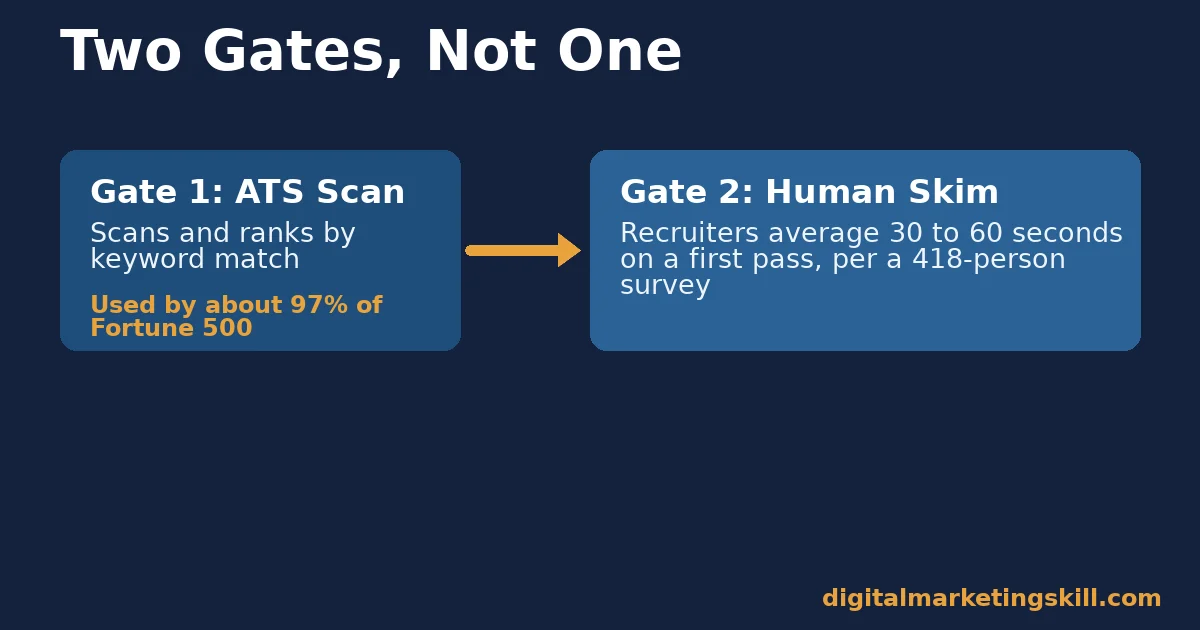
Jobscan’s own research found a detectable applicant tracking system at about 97% of Fortune 500 companies. That figure has stayed in a similar range across several years of its reporting.
That system does not reject a resume on its own in most setups. It parses the text, matches it against the job description, and ranks or sorts candidates for the recruiter who reviews them next.
Then a Human Skims, Fast
Once a resume clears that first pass, a person reads it next, and not for long. ResumeGo surveyed 418 hiring professionals over a two-month window and found that 80% spend less than one minute on an initial screen.
Only 1% spend under 10 seconds on a digital marketing resume, but 33% spend 10 to 30 seconds and 47% spend 30 seconds to a minute.
An older, smaller eye-tracking study of 14 recruiters found an even shorter average, about 7.4 seconds per resume. Treat that number as a caution rather than a rule, since the sample is small and dated.
Both studies point the same direction. The top third of the page decides whether the rest gets read at all.
What Differs by Career Stage
A resume that works for a first internship is the wrong resume for a director role, and the reverse is also true. The two gates above stay the same at every stage. What changes is which evidence actually proves you can do the job.
Entry-Level and Intern: Built on Potential
Without a long work history, an entry-level digital marketing resume has to prove potential through specifics. Coursework applied to a real brief, a personal project with real numbers, or a certification actually used all work well.
Vague enthusiasm reads as filler to both the tracking system and the recruiter. Specifics are what separate a genuine entry-level digital marketing resume from a generic one.
Mid-Career: Built on Repeatable Results
By the mid-career stage, a resume needs to show a pattern, not a single win. One good campaign can be luck. Three campaigns with a similar shape of result, across different budgets or channels, reads as a repeatable skill instead.
Senior and Director: Built on Scope and Judgement
At senior level, the resume has to prove scope. State the size of the budget or team you owned, and describe the judgement calls you made under pressure.
A director-level resume that only lists tasks undersells the role you actually held. Leaving out what you decided, and why, hides the part of the job that mattered most.
How to Write Each Stage’s Resume
The sections below mirror the three stages above. Match the fix to your actual stage rather than copying language meant for a different one.
Entry-Level and Intern: Lead With a Real Project
Put your strongest real project at the top of the experience section, even if it was unpaid or a class assignment. Name the tool you used, the audience you reached, and one number, even an estimate. For the broader case on why this field rewards demonstrated skill over tenure, see our guide on why a digital marketing career is still worth it.
Mid-Career: Lead With a Pattern of Results
List three results that share a shape, such as three campaigns that each lifted a specific metric, rather than three unrelated achievements. A recruiter skimming for 30 seconds should see the pattern without reading every line.
Senior and Director: Lead With Scope, Then One Decision
Open each role with the scope you owned in plain numbers: team size, budget, or number of brands. Follow with one real decision you made and what changed because of it, not a list of responsibilities.
The Sections Worth Getting Right
Instead of memorising a template, it helps to know which sections of a digital marketing resume actually carry weight with both readers.
A template can go out of style as design trends shift, but the underlying sections a parser and a recruiter both look for change far more slowly. Learn the sections once, and you can adapt them to any visual style without losing what actually matters.
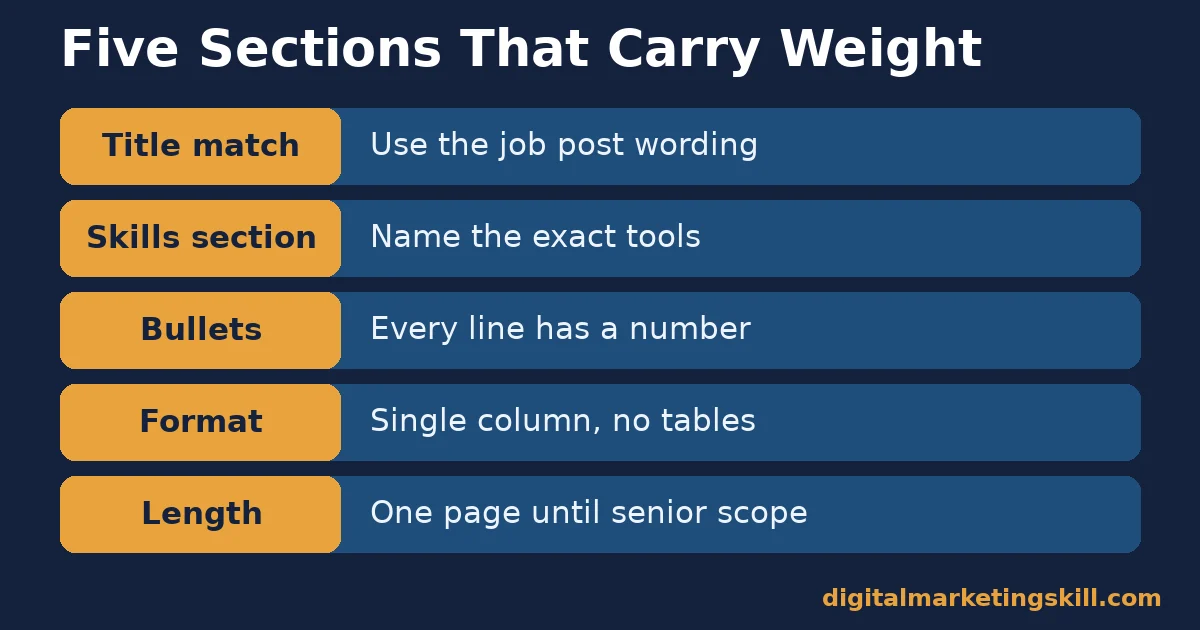
- Job title match. Use the exact or closest sensible title from the job post somewhere in your resume, since tracking systems weight title matches heavily and a mismatch can bury an otherwise strong application.
- Skills section. List the specific tools and platforms named in the job description, in the language the employer used, not a generic synonym. This section is what most tracking systems parse first.
- Quantified bullet points. Every bullet should contain a number: a percentage, a budget, a timeframe, or a count. A bullet with no number reads as a duty, not a result.
- Format and parseability. Use a single column, standard headings, and no text boxes or graphics for the main content, since these commonly break automated parsing even on modern systems.
- Length. One page for entry-level and mid-career, stretching to two only once genuine director-level scope justifies it.
Formatting Mistakes That Quietly Cost You Both Readers
A few formatting habits hurt a digital marketing resume with both the tracking system and the human reader at once, which makes them worth fixing before anything else.
- Tables and columns for content. A two-column layout can look polished, but many systems read it left to right across the whole line, scrambling dates and job titles into nonsense.
- Headers and footers for contact details. Some systems skip header and footer text entirely, which can mean your email and phone number never actually reach the recruiter.
- Images standing in for text. A logo or icon can look nice next to a skill, but any skill name baked into an image is invisible to both the parser and a keyword search.
- Unusual section headings. “My Journey” might read well to a person, but “Experience” is what both systems and recruiters expect and search for.
Which Section to Fix First
If you are not getting interviews at all, fix the skills section and job title match first, since that is almost always a tracking-system problem.
If you get interviews but they go nowhere, the bullet points likely list duties instead of results, which is a human-read problem instead. Diagnose before you rewrite, so you spend the effort on the gate that is actually failing.
How to Check a Resume Before You Send It
Judge a draft against a short checklist rather than a gut feeling. Each check below is defined in one sentence.
Four Checks Before You Submit
- Keyword match. Read the job description and your resume side by side, and confirm the main tools and skills it names also appear in yours, in the same words.
- Thirty-second test. Give the resume to someone for thirty seconds and ask what you do. If they cannot answer clearly, the top third needs work.
- Number count. Count how many bullet points contain an actual number. Aim for most of them, not just one or two standout lines.
- Parse test. Copy and paste the resume text into a plain text file. If the result is garbled or out of order, a tracking system will likely read it the same way.
Reading the Checks Together
Run the keyword match and parse test first, since together they predict whether a tracking system will even surface the resume. Only then run the thirty-second test and number count, since those predict what happens once a human actually opens it.
Treat this as a short cycle, not a one-time pass. Update the keyword match and the thirty-second test for every job application, since the job description changes even within the same title, and a resume tuned for one posting may read as unfocused for the next.
Keep a master version with every project and number you could possibly use, and trim it down for each application rather than writing from scratch each time. That master version also makes updating your digital marketing resume for a promotion or a new role far faster later on.
Store the master version somewhere you can search quickly, since you will return to it far more often than you expect. A simple document with one entry per project, each already written with a number attached, turns a stressful last-minute rewrite into a short trim-and-send task.
Review the master version itself every few months, even when you are not actively job hunting. Add a project or a number as soon as it happens, while the details are still fresh, rather than trying to reconstruct them later from memory.
The One Rule: Replace Every Duty With a Result
Take one rule from this guide and make it this one. Before you write a bullet point, ask what changed because of the work, not what the work involved.
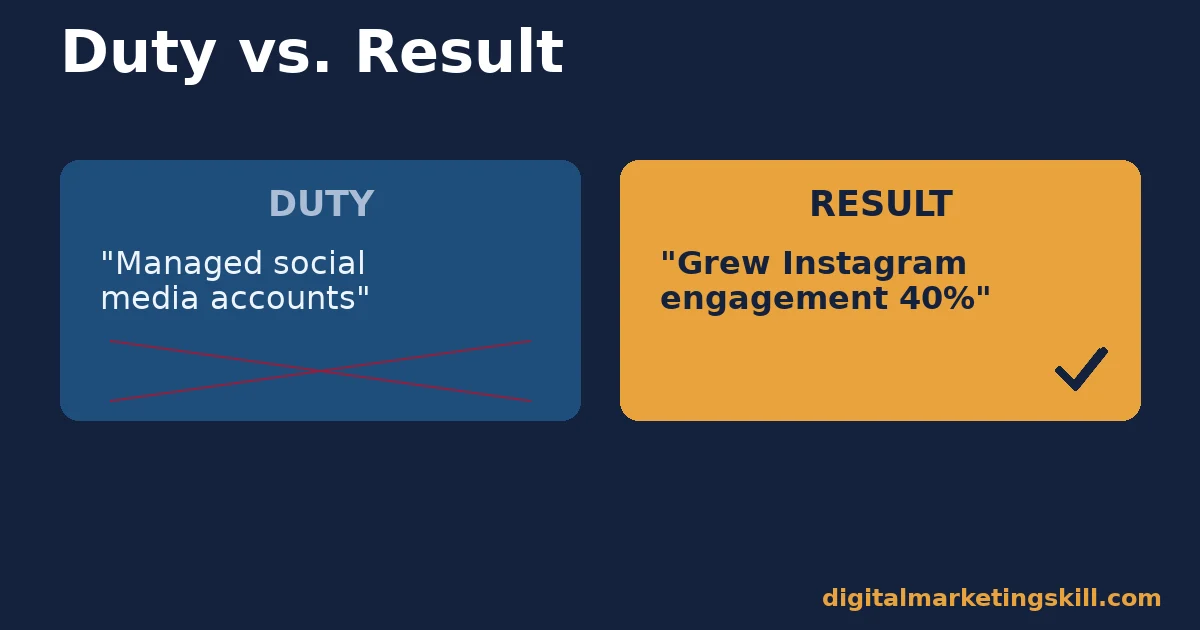
“Managed social media accounts” is a duty. “Grew Instagram engagement by 40% across three accounts in six months” is a result, built from the same work.
Here is an illustrative example, with invented numbers. A candidate’s draft resume lists eight bullet points, all duties: “ran email campaigns,” “managed content calendar,” “assisted with paid ads.” None contain a number.
Rewriting each one to name what changed, even with modest or estimated figures, turns the same eight lines of experience into eight lines of evidence. The work did not change. What the resume proves about that work did.
If you genuinely do not know a number, estimate honestly and say so in your own notes, then verify it before an interview. A reasonable estimate on a digital marketing resume is far better than a vague duty, as long as you can explain how you arrived at it if asked.
A Real Case: How Google Cut Interviews From 25 to Four
Google faced a related problem on the hiring side: too many weak signals, not too few. At one point, candidates could face 15 to 25 interviews before a decision. The process to hire someone stretched to roughly six months.
Laszlo Bock, Google’s former head of people operations, had an analyst on his team study years of interview data. The analysis found that four structured interviews predicted a hiring decision with 86% confidence.
Each interview added after the fourth raised that confidence by less than a single percentage point. Google cut its process to four interviews as a result.
Time to hire fell from around six months to 47 days, without a meaningful drop in hire quality.
Read the limits honestly. This is a hiring-process case, not a resume case, and the dollar and time figures are specific to one very large company.
The transferable lesson still applies directly. A handful of strong, specific signals beats a long list of weak ones, whether those signals are interviews or resume bullet points on a digital marketing resume.
Frequently Asked Questions About a Digital Marketing Resume
What should a digital marketing resume include?
A clear job title match, a skills section naming the exact tools from the job post, and bullet points that each contain a quantified result. Avoid a listed duty with no number attached. Together, these elements let a digital marketing resume pass both gates. Luck plays a far smaller role in the outcome than most job seekers assume it does.
How long should a digital marketing resume be?
One page for entry-level and mid-career candidates. Two pages only once real director-level scope, such as managing a large budget or team, genuinely needs the space.
Do applicant tracking systems automatically reject resumes?
Most do not auto-reject outright. They parse, score and rank resumes for a recruiter, who still makes the final screening call in the large majority of setups.
How can I tell if my resume will parse correctly?
Copy the text into a plain text file. If the content stays in a sensible order with no missing sections, a tracking system will likely parse it correctly too.
Should I use the exact keywords from the job description?
Yes, where they are true of your actual experience. Match the employer’s wording for tools, platforms and the job title itself. A synonym can mean the same thing to a person but miss a parsing system entirely.
What is the biggest resume mistake at the mid-career stage?
Listing one good result instead of a pattern of several. A single standout campaign can look like luck; three similar results across different budgets reads as a repeatable skill.
Does a longer resume help at senior level?
Only if the extra length adds real scope and decisions, not more duties. A senior resume should read as fewer, weightier lines, not simply more of them.
Should a digital marketing resume include a portfolio link?
Yes, whenever you have real campaign work, design samples or a case study to show. A short, well-organised portfolio link often does more to prove skill than another bullet point, especially at entry level and mid-career.
How many times should I tailor my resume per application?
Every time. Even small differences in a job description, such as a named tool or a slightly different title, change what the tracking system and the recruiter are actually looking for.
Is it worth paying for a resume writing service?
Only if the service genuinely understands both gates described in this guide. A well-written resume that ignores keyword matching can still fail the first gate, no matter how polished the prose reads to a person. Ask any service directly how it approaches tracking-system compatibility before you pay for a full rewrite of your resume.
Should a career change show up differently on a digital marketing resume?
Yes. Lead with transferable results from your previous field, stated in digital marketing terms. Do not bury them under an unrelated job title from your old career. A clear skills section does most of the work here, since it is the first place both readers look for proof of relevant ability.
Start With Your Weakest Section, Not a Full Rewrite
Pick the one section identified earlier that matches your current problem. Choose the skills section if you are not getting interviews, or your bullet points if interviews are not converting.
Fix that section first, run the four checks, and only then revise the rest. A focused edit beats a full rewrite almost every time.
Save a dated copy before each round of changes, so you can compare versions and see which edits actually moved your response rate. Treat your digital marketing resume as a living document that improves with every application, not a single finished file. Small, tested changes compound steadily into a noticeably stronger document over time.
Build the Evidence First, Then Write the Resume
If you want structured, hands-on practice building a portfolio and resume that match what employers actually screen for, Digital Marketing Skill Institute teaches it inside the Master Diploma in Digital & AI Marketing.
All four AI-powered tracks include a U.S. Project Internship with a verified U.S. Work Reference Letter. That internship gives you a real, quantified result to put on the resume itself, instead of another listed duty with nothing to measure, built on work you actually completed.
The programme includes unlimited 1-on-1 coaching and mentoring. It is dual US and UK accredited and recognised in more than 100 countries.
If you are still comparing options first, our guide on how to choose a digital marketing course covers exactly what to check carefully before you pay. It applies the same evidence-first approach used throughout this whole guide.
The programme is fully online, so you can build this experience from anywhere in your country. Browse more guides on the Digital Marketing Skill Institute blog, or when you are ready, apply for the Master Diploma or start from the Digital Marketing Skill Institute homepage.
Every figure in this guide was checked against its original source before publication. Figures marked as illustrative are invented examples, not real results.
