

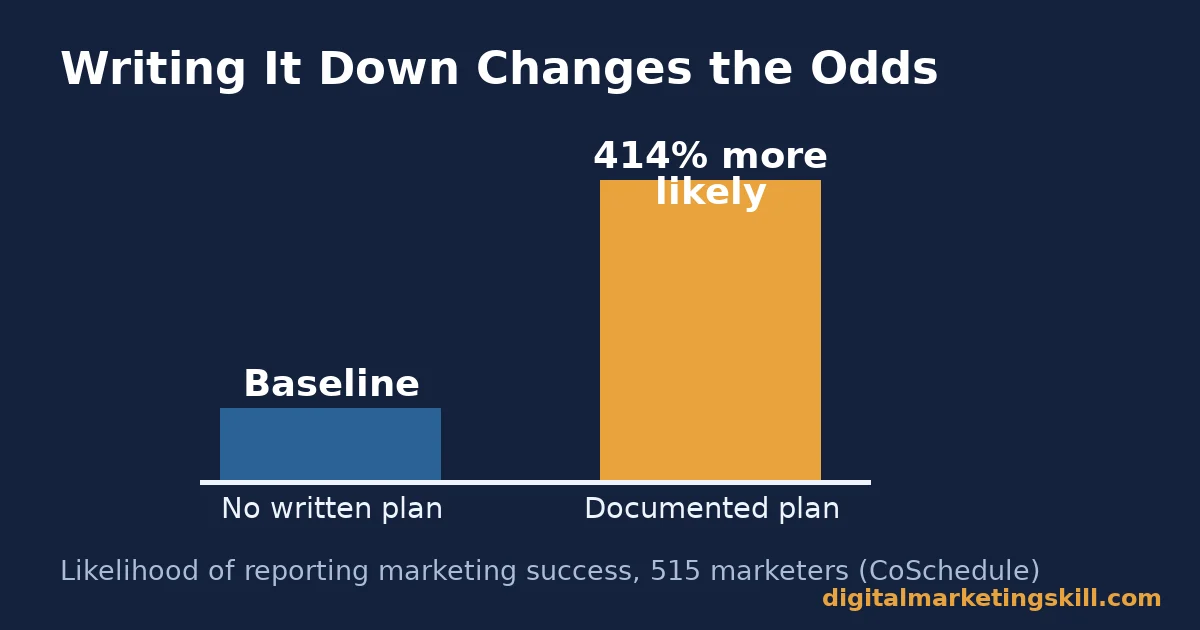
Digital marketing strategies succeed or fail on documentation more than on tactics. CoSchedule’s survey of 515 marketers in 75 countries found documented-strategy marketers were 414% more likely to report success. Pick one or two channels that fit your resources. Write the plan down. Measure it. That beats chasing every new tactic.
Key Takeaways
- Documentation beats more tactics. CoSchedule’s survey of 515 marketers in 75 countries found documented-strategy marketers were 414% more likely to report success.
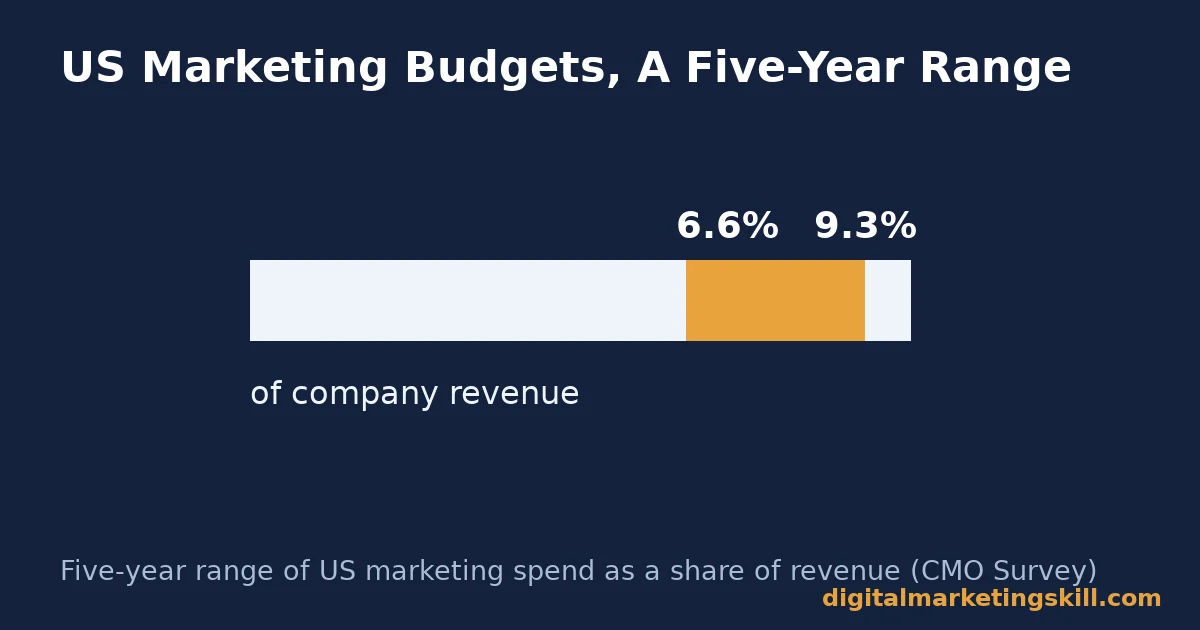
- Budgets are smaller than most guides assume. The CMO Survey, run by Deloitte and Duke, found US marketing spend has run between 6.6% and 9.3% of company revenue over the last five years.
- Email still returns the most per dollar. Litmus’s survey of nearly 500 marketing professionals found 35% see $10-$36 back for every $1 spent on email, and 30% see $36-$50.
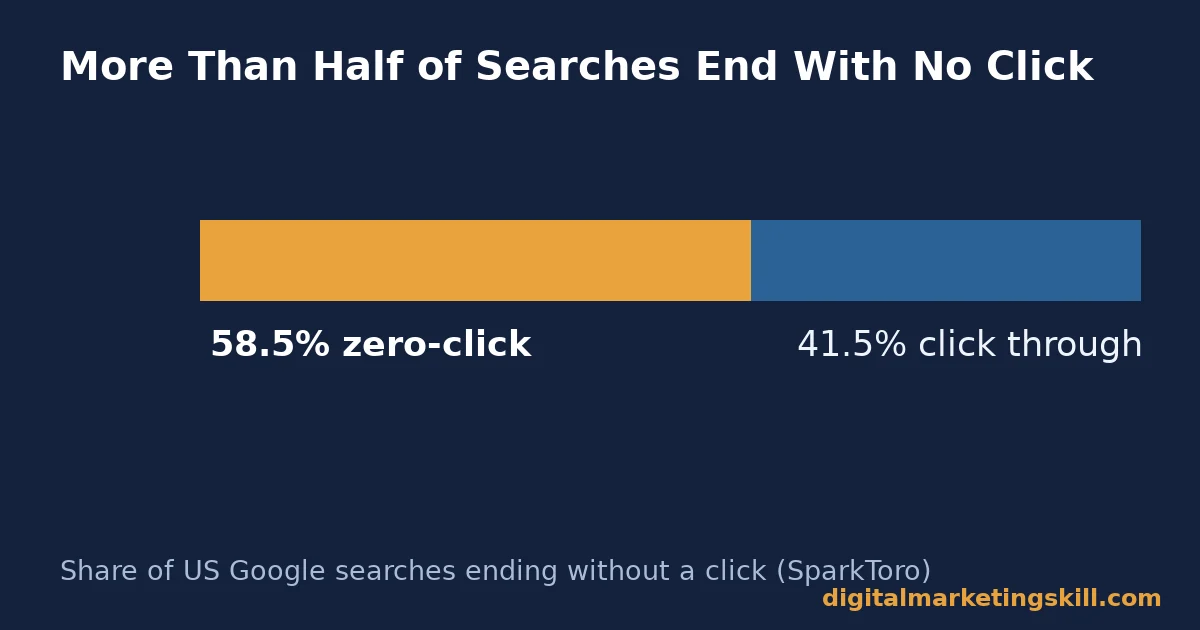
- Search traffic is harder to earn than it looks. SparkToro’s analysis of a large US and EU panel found 58.5% of US Google searches ended without a click.
- Most content never earns the attention strategies assume. A Backlinko and BuzzSumo analysis of 912 million blog posts found 94% earn zero external backlinks, a sign distribution matters as much as creation.
In this guide
- Why Most Digital Marketing Strategies Fail Before They Start
- How a Documented Strategy Actually Drives Results
- Digital Marketing Strategies Compared by Channel
- How to Lead With Each Channel
- How to Measure Whether Your Digital Marketing Strategies Are Working
- The Most Useful Rule: Write the Strategy Down Before You Pick a Channel
- A Real Case: What a 515-Marketer Survey Found About Documentation
- Frequently Asked Questions About Digital Marketing Strategies
- Write the Plan, Then Pick the Channels
Why Most Digital Marketing Strategies Fail Before They Start
Most failed digital marketing strategies were never really strategies. They were lists of tactics: post more, run some ads, send a newsletter. CoSchedule’s research found a clear gap. Marketers who write their strategy down were 414% more likely to report success than those who did not.
That gap shows up early, before a single ad runs or a single post publishes. A team without a written plan tends to add channels reactively, usually whichever one a competitor or a conference speaker mentioned recently. A team with a written plan has already decided, on paper, which channels earn a test and which do not. The second team wastes far less time arguing about direction mid-quarter.
The document itself does not need to be elaborate. A single page naming the goal, the audience, the chosen channels and the review date covers most of what the CoSchedule data appears to reward. Complexity is not the point; the act of committing something to paper, and then checking it against results, is.
Two ground rules keep this guide honest. Keep both in mind before the channel comparisons below. First, no single channel fits every business. A strategy right for an ecommerce brand can be wrong for a B2B service firm. Second, budgets are smaller than most “best practices” content implies. The CMO Survey found US marketing spend running 6.6% to 9.3% of revenue over five years. A strategy built for unlimited budget will not survive contact with a real one.
How a Documented Strategy Actually Drives Results
A digital marketing strategy works by forcing a choice. Without one, teams try to be present everywhere, thinly, and measure nothing well. With one, a team picks a goal. It picks a channel that fits that goal. Then it picks one metric that proves the work actually paid off.
That forced choice is also why documentation itself correlates with success. A written strategy makes trade-offs visible. It is hard to quietly add a fourth channel to a plan that says “two channels, this quarter” in writing. Verbal plans drift. Written ones get checked against reality.
The channel comparison below assumes you already have a goal and an audience defined. If you do not, fix that first. No channel, however well executed, substitutes for knowing who you are trying to reach and why your digital marketing strategies exist in the first place.
Digital Marketing Strategies Compared by Channel
Three channels dominate most small and mid-size budgets: search, email and paid acquisition. Each rewards a different kind of effort. Each has a real limit worth knowing upfront.
SEO: Built for Compounding, Not Speed
Search engine optimisation earns free, repeat traffic over time, but it is slow. The traffic is also harder to win than it used to be. SparkToro’s analysis found 58.5% of US Google searches end without any click, often because the answer appeared directly in the results. SEO rewards patience and genuinely useful content, not volume. However, that same scarcity cuts both ways: a page that does earn a click faces far less competition for the reader’s attention once they arrive, because so few competing pages made it that far.
A related warning belongs here too. A Backlinko and BuzzSumo analysis of 912 million blog posts found that 94% earn zero external backlinks, which strongly correlates with earning little organic traffic either. SEO as a strategy only works when content is actively promoted and linked to, not simply published and left to be discovered.
Email: Built for the Highest Return Per Dollar
Email marketing keeps outperforming other channels on direct return. Litmus’s survey found 35% of marketers see $10 to $36 back for every $1 spent, and another 30% see $36 to $50. The catch: email only works on an audience you already have permission to reach. It rewards list-building more than clever campaigns.
Because of that, email is rarely a first channel for a brand-new business with no audience yet. Instead, it tends to compound fastest once another channel, usually SEO or paid, has already started sending visitors somewhere a sign-up can happen. Treat email less as a standalone strategy and more as a multiplier on whatever traffic your other digital marketing strategies already generate.
Paid Acquisition: Built for Speed, Not Compounding
Among the three core digital marketing strategies compared here, paid acquisition is the only one that produces useful data within days. That speed carries a real cost, though, and the next two paragraphs cover both sides.
Paid search and paid social buy attention immediately. That makes them the fastest way to test a new offer or audience. The trade-off is that the traffic stops the moment the spend stops. Nothing compounds the way an aging piece of content or an email list does.
Still, speed has real value of its own. A new product with no search history and no email list has nothing for SEO or email to compound yet. In that situation, paid acquisition is often the only channel capable of producing meaningful data within weeks rather than months, even though it costs more per result than the other two over time.
How to Lead With Each Channel
Once you know which channel fits your stage and budget, execution determines whether it pays off. The sections below mirror the three channels above.
SEO: Lead With Fewer, Better Pages
Publish fewer pages, each genuinely useful enough to earn a click inside a zero-click-heavy results page. A page that answers a question completely, with real data, has a better shot at the rare click than ten thin pages competing for the same keyword. Consolidate overlapping pages into one stronger page rather than letting several thin ones compete against each other for the same search intent.
Track rankings monthly, not daily. SEO moves slowly enough that daily checks mostly measure noise, not progress toward your digital marketing strategies’ actual goals.
Email: Lead With List Quality Over List Size
Grow your list with a genuinely useful lead magnet. Skip the generic “subscribe for updates” box; it rarely converts well. A smaller, more engaged list produces a higher return than a large, cold one. That is part of why Litmus’s $10-$50 range varies so widely between senders.
Segment before you scale. Sending every email to every subscriber wastes the channel’s main advantage: that you already know something about who you are reaching.
Paid Acquisition: Lead With a Tight Test Budget
Start paid campaigns with a small budget. It should be small enough that a failed test does not hurt, yet large enough to produce a real signal. Treat the first weeks as a test of the offer and audience, not a scaled campaign.
Turn paid winners into organic and email content. A high-performing ad’s message usually works as a blog post headline or an email subject line too, which extends its value past the ad spend. This habit alone can turn a short-lived paid test into material that keeps producing results long after the campaign budget runs out.
How to Measure Whether Your Digital Marketing Strategies Are Working
Judge a strategy by the one metric tied to its original goal, not by activity. Each metric below gets one defining sentence, with a note on how to read it.
Five Metrics That Show Real Progress
- Cost per acquisition by channel. What you spend, divided by the customers or leads that channel produced. Compare it against your actual margin, not an industry average that may not fit your business.
- Organic traffic to money pages. Traffic specifically to pages that lead toward a conversion, not blog traffic generally. Rising general traffic with flat conversions points to a targeting problem.
- Email list growth rate, net of unsubscribes. Gross sign-ups minus the people who leave. A list that looks like it is growing can be flat or shrinking once churn is counted.
- Return on ad spend. Revenue generated, divided by ad spend, for paid channels specifically. Track it weekly during a test and monthly once a campaign is stable.
- Share of revenue from your plan’s stated goal. How much of your actual revenue traces back to the one goal your strategy document named. A low share means the strategy and the business are drifting apart.
How to Read These Numbers Together
Start with cost per acquisition by channel. If one channel costs far less than the others for the same result, that is where more budget should go, not where it sits out of habit today. Review this monthly. A channel’s cost per acquisition can shift quickly as competition in paid auctions changes or as search rankings move. Do not wait for a quarterly review to notice a channel has quietly become unprofitable.
Then check list growth and organic traffic together. If both are flat while ad spend keeps rising, the business is becoming dependent on paid acquisition. That is risky the moment budgets get cut.
Finally, revisit the share of revenue tied to your stated goal every quarter, not just at year-end. Digital marketing strategies drift gradually. A team rarely decides all at once to abandon its documented plan; it happens one small exception at a time, and a quarterly check catches that drift while it is still a small correction rather than a full rebuild.
The Most Useful Rule: Write the Strategy Down Before You Pick a Channel
If you remember one decision rule from this guide, make it this one. Before testing a new channel, write down the goal, the audience and the one metric that will prove success, in a document the whole team can see. CoSchedule’s data suggests this single habit matters more than which channel you ultimately choose.
Here is an illustrative example, with invented numbers. A small B2B software company spends three months adding channels: paid social, then influencer outreach, then a podcast. Nothing compounds, and the team cannot say which effort drove which result. They stop. They write a one-page strategy naming SEO and email as the only two channels for the next quarter, and cut everything else. Within that quarter, qualified leads rise even though total marketing activity falls.
The team also stops reporting on channels they cut. Fewer dashboards mean more attention on the two that remain, and attention is a limited resource exactly like budget is. Spreading it across five half-measured channels produces worse decisions than concentrating it on two well-measured ones.
Focus, Not More Hours, Was the Fix
The lesson is about focus, not cleverness. Among digital marketing strategies, a documented, narrow one consistently outperforms a broad, undocumented one, even when the broad one involves more total effort. The invented example mirrors a pattern many real teams recognise: activity rising while results stay flat, until focus, not more effort, fixes it.
A Real Case: What a 515-Marketer Survey Found About Documentation
CoSchedule ran its own global survey rather than relying on a single market’s data. That makes the finding easier to generalise across different kinds of digital marketing strategies. The team collected responses from 515 marketers across 75 countries through the end of the survey period.
According to CoSchedule’s write-up, marketers who said their strategy was documented were 414% more likely to also report their marketing as successful, compared with marketers who had no written strategy at all.
What the Case Does and Does Not Prove
Treat the finding as a strong correlation, not formal proof that documentation alone causes success. Marketers organised enough to document a strategy may also be more disciplined in other ways. Even so, the size and spread of the survey make it a reasonable habit to adopt, regardless of which channels you choose.
What makes the case useful is the breadth of the sample. A finding limited to one country would be easy to dismiss. A pattern across 75 countries and many company sizes is harder to wave away, even allowing for the usual limits of self-reported survey data. Treat it the way you would treat any single survey: as strong supporting evidence for a habit that also makes sense on its own logic, not as the sole reason to adopt it.
Frequently Asked Questions About Digital Marketing Strategies
What is the most effective digital marketing strategy?
There is no single most effective strategy among all digital marketing strategies; the right one depends on your budget, audience and timeline. CoSchedule’s survey found that documenting whichever strategy you choose matters more than which specific channel you pick, since documented-strategy marketers were 414% more likely to report success.
How much should a small business spend on digital marketing?
The CMO Survey found US marketing spend running 6.6% to 9.3% of company revenue over the last five years, though this varies by industry and company size. Use that range as a starting benchmark, then adjust based on your own margins and growth goals.
Is email marketing still worth it?
Yes. Litmus’s survey of nearly 500 marketing professionals found 35% see $10 to $36 back for every $1 spent on email, with another 30% seeing $36 to $50. It remains one of the highest-return channels, provided you already have permission to reach the list.
Why is SEO traffic harder to get than before?
Search results increasingly answer questions directly, without a click. SparkToro’s analysis of a large US and EU panel found 58.5% of US Google searches ended without any click. SEO still works, but it rewards content thorough enough to earn the click that remains.
Should a small business use paid ads or organic channels first?
Paid channels test faster, since results appear within days. Organic channels like SEO and email compound slowly but do not disappear when spending stops. Many digital marketing strategies use paid channels to validate an offer quickly, then shift budget toward organic channels once the offer is proven.
How many digital marketing channels should a business use at once?
Fewer than most guides suggest. Two well-executed channels, backed by a documented plan, typically outperform five channels run thinly. Add a channel only once the current ones are measured and working. A good sign that you are ready to add a third channel is that your current two already have a clear owner, a clear metric and a track record of hitting it, not just enthusiasm from the team.
Do all digital marketing strategies need a documented plan?
Yes, regardless of size. CoSchedule’s survey found the 414% success gap held across businesses of many sizes and industries, from 75 different countries, which suggests the benefit of documentation is not limited to large companies with big budgets.
Write the Plan, Then Pick the Channels
Digital marketing strategies work when they are documented, narrow and measured against one clear goal. Start by writing down your goal, your audience and the single metric that will prove success. Then choose one or two channels that genuinely fit your budget and timeline.
If you want guided practice, Digital Marketing Skill Institute teaches these skills hands-on. The Master Diploma in Digital & AI Marketing is built from four AI-powered tracks: AI-Powered Social Media Management and Advertising, AI-Powered Lead Generation and Email Automation, AI-Powered Google Specialist, and AI-Powered WordPress and SEO Specialist. Together they total ten courses, with a Full Stack option to complete all four. The diploma includes unlimited 1-on-1 coaching and mentoring and a U.S. Project Internship with a verified U.S. Work Reference Letter. It is dual US and UK accredited, and recognised in more than 100 countries.
The programme runs 100% online, so you can study wherever you live in your country. For a step-by-step planning process, see our guide on creating a digital marketing plan, and for channel budgeting specifically, read our guide to marketing channel mix. Browse more guides on the Digital Marketing Skill Institute blog, and when you are ready, apply for the Master Diploma or start from the Digital Marketing Skill Institute homepage.
Every figure in this guide was checked against its original source before publication. Figures marked as illustrative are invented examples, not real results.
![9 Amazing Digital Marketing Skills to Make Money Online [With Proof]](https://digitalmarketingskill.com/wp-content/uploads/2019/07/9-Amazing-Digital-Marketing-Skills-to-Make-Money-Online-With-Proof-17.png)






