
Email campaign optimization starts with a blunt fact: a brilliant subject line cannot save an email that never reaches the inbox. Fix deliverability first. Fix relevance second. Fix the words on the page last. This guide shows what changes between a broadcast send and a segmented one, how to measure results honestly, and the one rule for where to spend your next hour of effort.
Key Takeaways
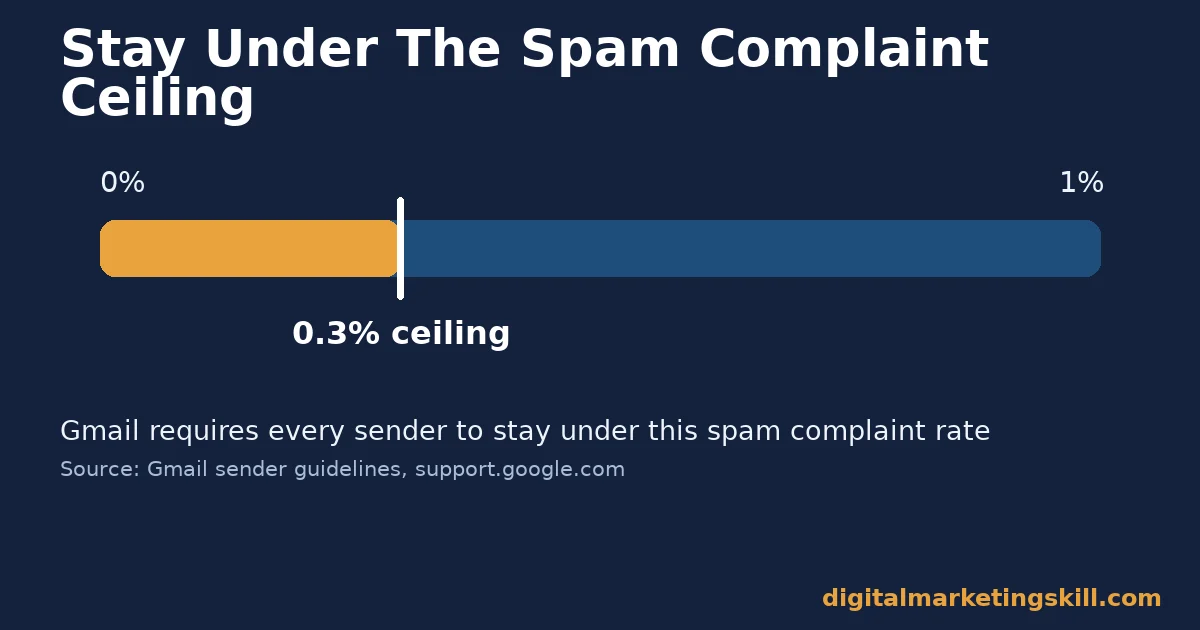
- Deliverability has a hard threshold. Gmail’s own sender guidelines require a spam complaint rate under 0.3%, with authentication (SPF or DKIM) required from every sender.
- Spam filtering is aggressive and effective. Google’s own blog states Gmail stops more than 99.9% of spam, phishing and malware, blocking nearly 15 billion unwanted emails every day.
- Average results are lower than most marketers assume. Mailchimp’s benchmark data, drawn from billions of emails sent through its platform, puts the all-industry average open rate at 35.63% and click rate at 2.62%.
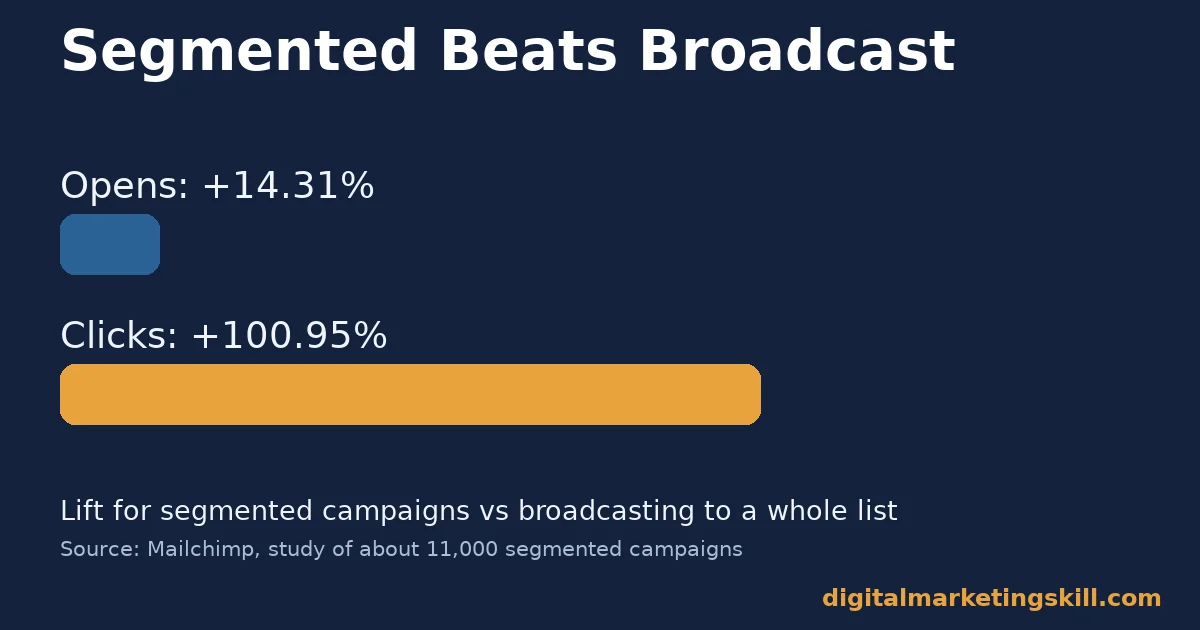
- Segmentation beats broadcasting by a wide margin. A Mailchimp study of about 2,000 users sending roughly 11,000 segmented campaigns found 14.31% higher opens and 100.95% higher clicks than non-segmented sends.
- Compliance rules are not the same everywhere. The US FTC’s CAN-SPAM guide requires honouring opt-outs within 10 business days. The UK’s data protection regulator requires consent before most marketing emails. Check the rule for wherever your subscribers live.
In this guide
- What Most Email Campaign Optimization Advice Gets Wrong
- How Email Campaign Results Are Actually Built
- Email Campaign Optimization Differs by Send Type
- How to Optimize Each Type of Campaign
- How to Measure Email Campaign Optimization Honestly
- The One Decision Rule: Fix Deliverability and Segmentation Before You Touch Subject Lines
- A Real Case: Turning Email Marketing Into a Paid Service
- Frequently Asked Questions About Email Campaign Optimization
- Put Email Campaign Optimization to Work, Anywhere in the World
What Most Email Campaign Optimization Advice Gets Wrong
Most advice on email campaign optimization starts with subject lines and send times. Those matter, but they are the last mile. Picture an email with a great subject line that lands in spam. It never gets a fair test of its wording at all, because nobody sees it.
This guide works in the order that actually matters. Deliverability comes first, because nothing else works if the email never arrives. Relevance comes second, because a relevant email outperforms a clever one. Measurement comes last, so you know whether a change actually helped.
One ground rule before the numbers: every figure below names its source, and none of them are fixed forever. Apple’s Mail Privacy Protection also distorts open-rate figures, since it pre-loads images for many users. Treat open rate as a directional number, not an exact count of people who read your email.
How Email Campaign Results Are Actually Built
A result builds in three stages. Each stage can only improve on what the one before it delivered. First, the email has to reach the inbox rather than get filtered to spam. Second, the recipient has to find it relevant enough to open and act on. Third, the message itself has to make the action easy.
Deliverability is the stage most campaigns fail at quietly. Gmail’s sender guidelines require every sender to use SPF or DKIM authentication. They also cap spam complaints at under 0.3%. Cross that threshold and Gmail starts routing your mail to spam, before a single subscriber ever judges your subject line.
Relevance is the stage segmentation fixes. Mailchimp studied about 11,000 segmented campaigns, sent by roughly 2,000 users to nearly 9 million recipients. Segmented sends produced 14.31% higher opens and 100.95% higher clicks than broadcasting the same message to everyone. That gap is too large to ignore once your list has more than one kind of subscriber.
Wording only starts to matter once an email is delivered and relevant. Many teams begin email campaign optimization with clever subject lines while skipping authentication and segmentation. That usually disappoints, because it polishes the part of the funnel that moves the result least.
Email Campaign Optimization Differs by Send Type
A single broadcast to your whole list behaves differently from a segmented send to part of it. Each needs a different kind of attention.
Broadcast Campaigns: Built for Reach
A broadcast goes to everyone on a list at once. It is simple to plan and fast to send, which makes it the default for small teams. Its weakness is relevance. A message written for your whole list usually fits nobody on it perfectly.
Broadcasts are also where deliverability problems show up fastest. A single irrelevant send to a large list produces the most spam complaints and unsubscribes in one event. So a spam rate that creeps toward Gmail’s 0.3% threshold is often one bad broadcast, not a slow decline.
Segmented Campaigns: Built for Relevance
A segmented campaign splits the list by behaviour, interest or customer type before sending. Each group then gets a message that fits them. Mailchimp’s research found segmenting by a merge field, such as customer type or location, lifted clicks by 54.79%. Segmenting by interest group lifted clicks even further, by 74.53%.
The cost is setup time. Segmentation needs clean data about your subscribers before it can work. That is more effort than writing one email for everyone. This upfront cost is exactly why most teams skip it, even though the research shows it pays back several times over.
How to Optimize Each Type of Campaign
The fix for each send type follows directly from its weak point.
Broadcast Campaigns: Lead With Deliverability Basics
Before writing another broadcast, confirm SPF and DKIM are set up correctly. Then check your spam complaint rate against Gmail’s 0.3% ceiling. Our guide to email deliverability covers the specific checks Gmail, Yahoo, Outlook and Apple each require.
Keep broadcasts honest and narrow in scope. One clear purpose per email helps. So does an accurate subject line and a visible, working opt-out link. Together, these keep complaint rates low, which protects every future send to that list, not just the current one.
Segmented Campaigns: Lead With the Data You Already Have
Start segmenting with data you already collect, such as purchase history, signup source, or engagement with past emails. You do not need a complex model. Mailchimp’s own research found even a simple split by customer type produced a meaningful lift. A first attempt at segmentation beats a perfect one you never ship.
Match the message to the segment, not just the subject line. A segment built around new subscribers should get a different message than one built around lapsed customers, even if the product being promoted is the same. Our introduction to email marketing covers the fundamentals these segments build on, if you are setting up your first list.
How to Measure Email Campaign Optimization Honestly
Three numbers matter, and one of them needs a caveat before you trust it.
Open rate shows the share of delivered emails opened. Apple’s Mail Privacy Protection pre-loads images for many Apple Mail users, which can inflate this number. Read it as a rough trend, not an exact count.
Click rate shows the share of delivered emails that got a click. It is a more reliable signal than open rate, because a click requires real intent, not just a pre-loaded image.
Spam complaint rate shows the share of recipients who marked your email as spam. Keep this well under Gmail’s 0.3% ceiling. It is the number that decides whether your next campaign reaches the inbox at all.
Read all three together. A high open rate with a low click rate suggests the subject line works but the content does not deliver on its promise. A rising spam complaint rate is the one signal that should stop a campaign in its tracks, even alongside decent opens and clicks.
The One Decision Rule: Fix Deliverability and Segmentation Before You Touch Subject Lines
When time is short, resist the urge to A/B test subject lines first. Fix deliverability and segmentation before you touch wording instead. Those two stages move the result more, and they compound with every future send.
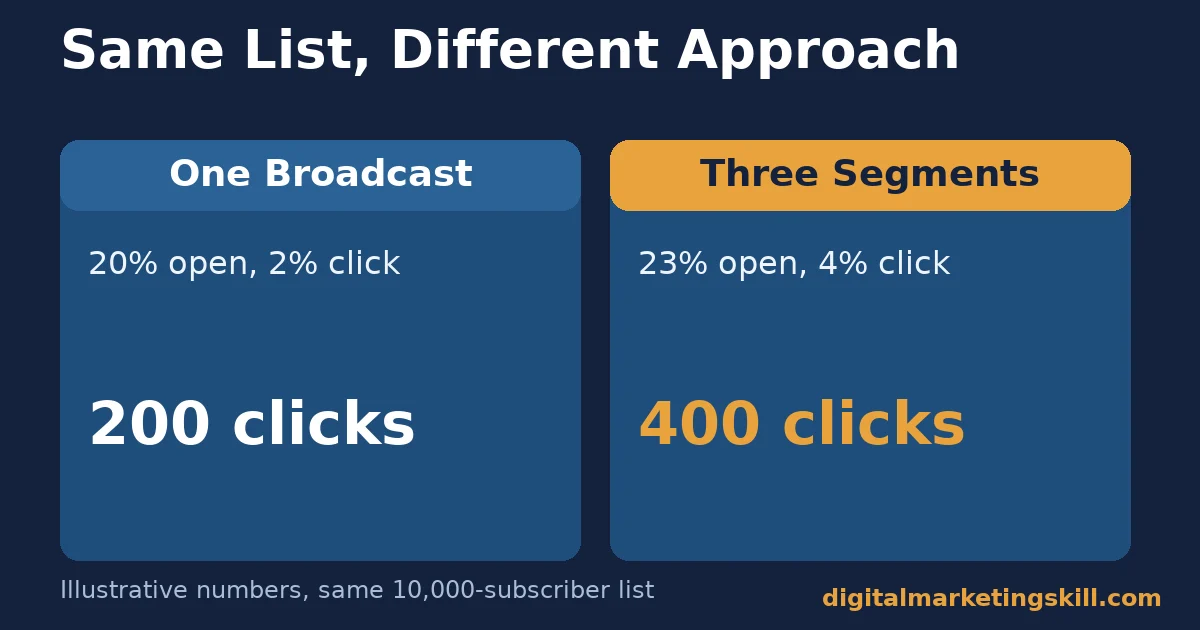
Here is an illustrative example with invented numbers. Say your list of 10,000 subscribers gets a 20% open rate and 2% click rate as one broadcast, producing 200 clicks. Based on Mailchimp’s research, segmenting that same list into three relevant groups could lift opens to roughly 23% and clicks to around 4%. That is closer to 400 clicks from the same list, without changing a single word of subject line.
A Real Case: Turning Email Marketing Into a Paid Service
Email campaign optimization is a skill businesses pay for directly, often alongside lead conversion strategies once a list starts converting. On Digital Marketing Skill Institute’s reviews page, student Olajire Jacob describes charging “$500 to set up email marketing flows for clients in the US, UK & Canada.” Jacob later describes plans to “scale to $5K/mo.” This is one published testimonial, not a guaranteed outcome. It is consistent with the Institute’s earnings disclaimer.
Here is the limit worth naming: results like this depend on the market, the client base and the effort put in. Dollar figures from one person do not predict another’s results. Treat it as a real example of the skill being monetised, not a promise.
Frequently Asked Questions About Email Campaign Optimization
What is the single most important step in email campaign optimization?
Deliverability. An email that lands in spam never gets a fair test of its subject line or content, so authentication and a low spam complaint rate come before anything else.
Is a high open rate still a reliable success metric?
Less reliable than it used to be. Apple’s Mail Privacy Protection can inflate opens by pre-loading images for many subscribers, so pair open rate with click rate before judging a campaign’s real performance.
Does segmentation really make that much difference?
Mailchimp’s research found segmented campaigns produced 14.31% higher opens and 100.95% higher clicks than broadcasting to a whole list, based on roughly 11,000 segmented campaigns. The size of the gap depends on how different your subscriber groups actually are.
What spam complaint rate should trigger concern?
Gmail’s own sender guidelines set 0.3% as the threshold. Crossing it puts your mail at risk of being routed to spam regardless of content quality, so treat anything approaching that number as an immediate priority to fix.
Do the same email marketing rules apply in every country?
No. The US CAN-SPAM Act and rules such as the UK’s PECR regulation set different requirements for consent and opt-outs. Check the rule that applies to wherever your subscribers actually live, not just where your business is based.
Should a small business bother segmenting its list?
Yes, even a simple split is worth it. Mailchimp’s data shows meaningful lift from basic segmentation by customer type alone, so a small list with two or three clear groups is still worth splitting.
Put Email Campaign Optimization to Work, Anywhere in the World
Email campaign optimization pays off in the order you fix it: deliverability first, relevance through segmentation second, and wording last. Check your spam complaint rate, split your list into even a few simple groups, and only then start testing subject lines.
If you want to build this as a skill rather than a one-off fix, Digital Marketing Skill Institute’s Master Diploma in Digital & AI Marketing includes an AI-Powered Lead Generation and Email Automation track. It sits among four AI-powered tracks totalling ten courses, with a Full Stack option for completing all four. It comes with unlimited 1-on-1 coaching and mentoring, a U.S. Project Internship with a verified U.S. Work Reference Letter, and dual US and UK accreditation recognised in more than 100 countries. The program runs 100% online, so you can study and apply it from anywhere in your country.
Wherever you live, the order here holds: fix deliverability, segment before you broadcast, and measure clicks over opens. Explore the training at Digital Marketing Skill Institute, read more on the blog, or apply to get started with Digital Marketing Skill Institute today.
Every figure in this guide was checked against its original source before publication. Figures marked as illustrative are invented examples, not real results.
![9 Amazing Digital Marketing Skills to Make Money Online [With Proof]](https://digitalmarketingskill.com/wp-content/uploads/2019/07/9-Amazing-Digital-Marketing-Skills-to-Make-Money-Online-With-Proof-17.png)






