Email marketing growth comes from existing customers as much as new signups. Retaining a customer costs 5 to 25 times less than winning a new one. A 5% rise in retention can lift profit by 25% to 95%. This guide shows how to use welcome, cart-recovery and win-back emails to grow revenue from people who already know you.
Key Takeaways
- Retention beats acquisition on cost. Harvard Business Review, citing Bain & Company, reports that acquiring a new customer costs 5 to 25 times more than keeping one you already have.
- Most budgets still chase new customers. The CMO Survey of 308 US marketing leaders found acquisition budgets run 26% larger than retention budgets, and 82% of firms spend more on acquisition.
- Recovery emails outperform every other flow. Klaviyo’s benchmark of more than 143,000 abandoned-cart flows found they earn 37.74% more revenue per recipient than welcome emails.
- A real win-back email worked at scale. CNET’s win-back sequence, reported by MarketingSherpa, re-engaged 8.33% of inactive subscribers with one email, then more with two follow-ups.
- Compliance protects the list you already built. The FTC’s CAN-SPAM guide requires honouring opt-outs within 10 business days, with penalties up to $53,088 per violating email.
In this guide
- What Most Email Marketing Advice Misses
- How Email Marketing Growth Actually Compounds
- What Differs by Email Type
- How to Build Each Email for Growth
- How to Measure Email Marketing Growth
- The Decision Rule: Build the Recovery Flow Before Anything Else
- A Real Case: How CNET Reactivated Inactive Subscribers
- Keep the List You Already Built
- Frequently Asked Questions About Email Marketing Growth
- Start With the Flow That Pays Back Fastest
What Most Email Marketing Advice Misses
Most email marketing guides focus on growing the list: more signups, better subject lines, higher open rates. Fewer explain how to grow revenue from the subscribers and customers you already have, even though that group is cheaper to sell to.
That gap matters because the two goals pull in different directions. List growth rewards broad appeal, while email marketing growth from existing customers rewards relevance to a specific person’s history with you. A newsletter optimised for new signups often performs worse at the second job.
This guide fills that gap. It ranks the three automated email types built for retention, shows what the data says about each, and gives one rule for deciding where to spend your next hour on email marketing growth.
Ground rules first. The CMO Survey is a self-reported US survey of senior marketers, so read its budget figures as stated intent, not universal fact. Klaviyo and Mailchimp report their own customers’ campaign data, which is a real signal but not independently audited. Treat every percentage here as a snapshot, not a permanent benchmark, since email benchmarks shift as inbox providers change their rules.
How Email Marketing Growth Actually Compounds
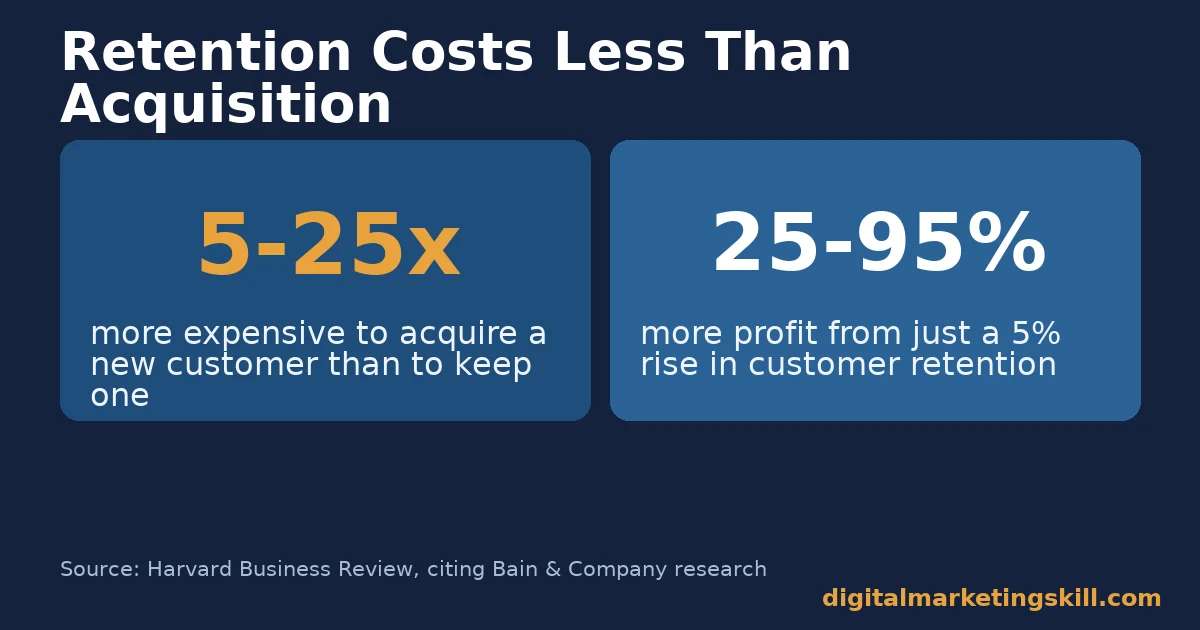
Email marketing growth works because retained customers cost less to sell to and buy more over time. Harvard Business Review, citing Bain & Company’s research, reports that acquiring a new customer costs 5 to 25 times more than retaining an existing one. The same research found that raising retention by just 5% can lift profit by 25% to 95%, because loyal customers buy more, cost less to serve, and refer others.
Most marketing budgets do not reflect that math. The CMO Survey found that acquisition budgets run 26% larger than retention budgets. It also found that 82% of firms spend more on acquisition than retention. Yet the same survey found retention spending grew faster than acquisition spending, 12.8% versus 7.4%, suggesting more companies are starting to correct the imbalance.
Why Email Specifically Drives This Growth
Email is the cheapest channel for closing that gap, because you already have permission to contact these people. The work is choosing the right email for the right moment in a customer’s relationship with you, not sending more generic campaigns. That is the whole idea behind email marketing growth: fewer, better-timed emails that match where a customer already is.
Social media and search advertising can also reach past customers, but both require ongoing spend to keep showing up in front of them. An email sequence, once built, keeps running at close to zero marginal cost per send, which is why it tends to produce the best return among retention channels.
Paid channels have to re-earn attention every time you spend. Email marketing growth does not. The list itself is an asset that keeps paying back, as long as you protect it. That is also why the compliance section later in this guide matters as much as the email copy.
The Three Moments That Drive Email Marketing Growth
Most brands already send some email to each of these three moments, but often as a single generic message instead of a short, automatic sequence. The difference between the two approaches is usually the gap between a list that grows revenue and one that just grows in size, and that gap is where most of the opportunity in this guide sits.
Three moments matter most for email marketing growth. A new subscriber needs a reason to buy for the first time. A shopper who showed interest but left needs a nudge to come back. Someone who used to buy but has gone quiet needs a reason to return. Each moment needs a different email, sent automatically rather than manually.
What Differs by Email Type
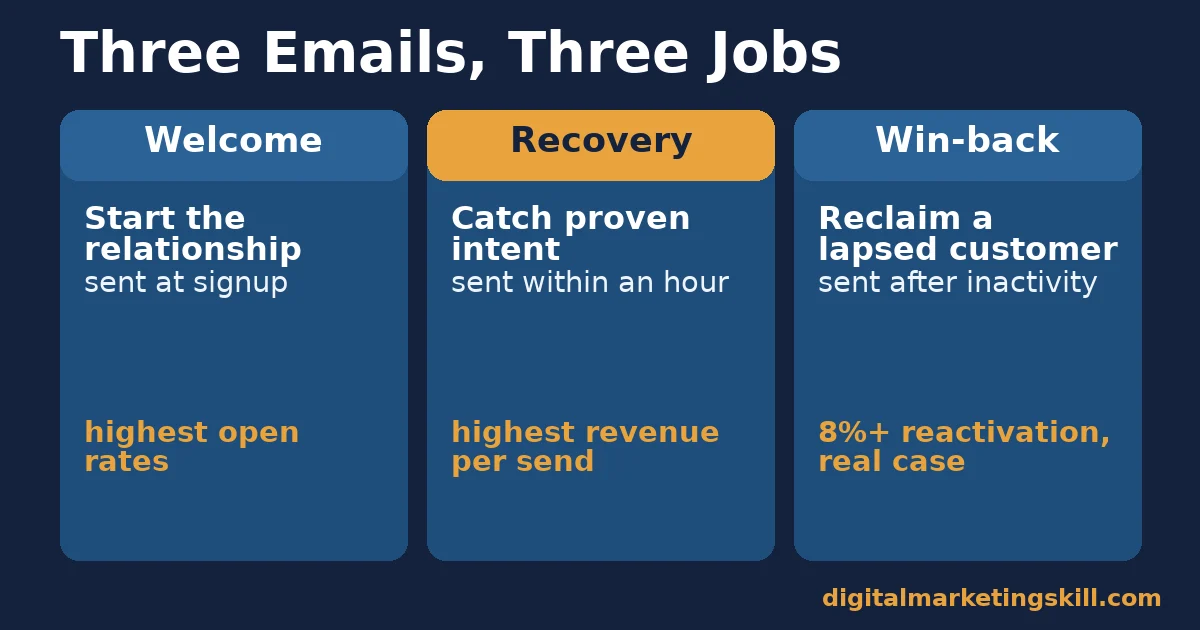
Three automated email types carry most of the retention work: welcome emails, cart and browse recovery emails, and win-back emails. The sections below pair what each type is for with the evidence behind it.
Welcome Emails: Built to Start the Relationship
A welcome email greets a new subscriber while their interest is highest, right after signup. It sets expectations for what you will send and how often, which keeps later emails from feeling unexpected.
Klaviyo’s benchmark of customer flows found that welcome emails are a strong baseline. Recovery flows aimed at people who already showed buying intent out-earn them. That gap points to where the bigger opportunity sits, not that welcome emails are wasted.
Recovery Emails: Built to Catch Intent You Already Earned
A recovery email reaches someone who added an item to a cart, or browsed a product, then left without buying. Their intent is already proven, so the email only has to remove the reason they stopped, whether that was price, shipping cost or a simple distraction.
Klaviyo’s analysis of more than 143,000 abandoned-cart flows found an average open rate of 50.5%, a click rate of 6.25%, and a placed-order rate of 3.33%. Revenue per recipient averaged $3.65, which Klaviyo reports is 37.74% higher than welcome flows. The top 10% of senders reached a 7.69% placed-order rate.
Win-Back Emails: Built to Reclaim a Lapsed Customer
A win-back email targets someone who used to open or buy and has since gone quiet. It needs a stronger reason to act than a regular campaign, because trust has faded.
CNET ran a documented win-back sequence on its inactive subscribers, reported by MarketingSherpa. A sweepstakes email re-engaged 8.33% of them. Two follow-up emails warning of list removal re-engaged a further 6.35% and 2.22%. The case names the company and the exact steps, though it does not disclose the list size or statistical testing, so treat the percentages as one company’s result.
How to Build Each Email for Growth
Each email type above needs a specific first move. These three sections turn the evidence into a build order you can follow this month.
Welcome Emails: Lead With One Clear Next Step
Send the welcome email within minutes of signup, while interest is still high. Give the subscriber exactly one action to take next, such as browsing a specific category, rather than listing everything your brand sells.
Tell new subscribers what to expect, including roughly how often you will email them. That single sentence reduces the unsubscribes that come from surprise later. It is a small step, but it protects the email marketing growth you are trying to build over the following months.
Recovery Emails: Lead With the Exact Item Left Behind
Show the specific product or cart the visitor left, not a generic reminder. Our guide to turning leads into paying customers covers the follow-up once someone clicks back through from this email. Klaviyo’s data shows this flow already earns more per recipient than any other, so the fix is removing friction, not reinventing the message.
Send the first recovery email within an hour, then a second one a day later if needed. Waiting longer lets the original intent fade, which is the one advantage this email type has over a regular campaign. Most email platforms can trigger this automatically from a single cart or browse event, so it only needs to be built once.
Win-Back Emails: Lead With a Real Reason, Then a Deadline
Open with a genuine reason to return, such as what has changed since the customer last engaged. CNET’s sequence shows that a single offer re-engages some subscribers, but a follow-up with a real deadline, such as list removal, re-engages more from the same group.
Set a clear point where you stop emailing someone who never responds. Continuing to send to a permanently inactive address raises your spam rate. That puts the rest of your list’s deliverability at risk. Our guide to email deliverability explains what inbox providers check before they stop delivering your mail.
How to Measure Email Marketing Growth
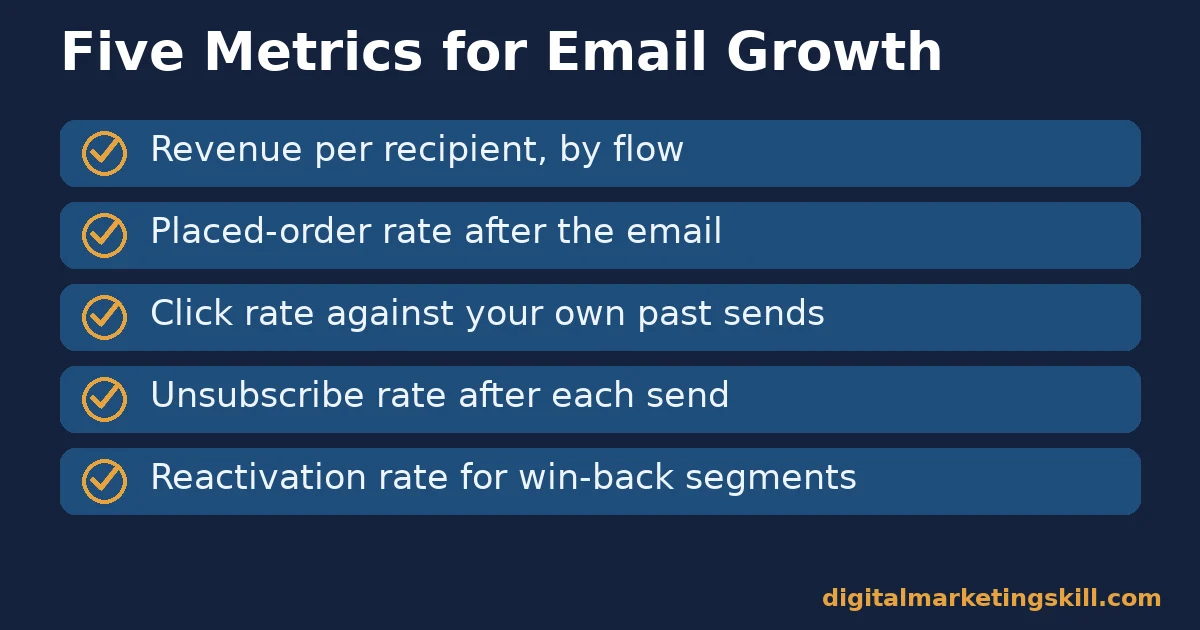
Measure retention emails by revenue and list health, not just opens. Each metric below is defined in one sentence, with a note on how to read it.
Five Metrics That Show Real Growth
- Revenue per recipient. Total revenue from a flow divided by how many people received it. Klaviyo’s $3.65 average for cart recovery is a rough external benchmark; your own flow’s trend over time matters more.
- Placed-order rate. The share of recipients who complete a purchase after the email. This is the clearest signal a recovery or win-back email actually worked.
- Click rate. Mailchimp’s benchmark puts the all-industry average at 2.62%. Compare your own automated flows against this floor, not just your newsletter.
- Unsubscribe rate. Mailchimp’s benchmark puts the average at 0.22%. A spike after a specific email usually means the offer or frequency felt wrong.
- Reactivation rate. The share of a win-back segment that opens or clicks again. CNET’s 8.33% first-email result is one reference point, not a target to hit exactly.
Reading These Metrics Together
Read revenue per recipient first, since it is the number that pays for the programme. If that number is low but open rates are fine, the offer or timing is the problem, not deliverability. If open rates themselves are low, check sender reputation before changing the message.
Review win-back results separately from welcome and recovery results, because a healthy reactivation rate still looks lower than a welcome email’s open rate. Comparing them directly will make a working win-back sequence look like it is failing.
Set a baseline before you change anything. Record each metric for your current emails for a full month, then compare the same metrics after you launch or rebuild a flow. Without that baseline, you cannot tell whether a new flow actually improved email marketing growth or whether the change was seasonal.
The Decision Rule: Build the Recovery Flow Before Anything Else
If you only automate one email this month, make it the cart or browse recovery flow. It reaches people who already showed intent, and Klaviyo’s data shows it consistently out-earns every other automated flow type.
Here is an illustrative example, with invented numbers. A small online store gets 1,200 cart abandonments a month and has no recovery email. Adding a two-email recovery flow converts 3% of those abandoners, worth $90 each on average. That is $3,240 in monthly revenue from traffic the store was already paying to attract.
The welcome and win-back flows still matter, but they depend on having subscribers and customers in the first place. The recovery flow works on people who are already in your store, which is why it pays back fastest.
Most ecommerce platforms and email tools support this kind of automated flow natively, so the barrier is usually time, not cost. Set aside one afternoon to connect your store to your email tool, write the two messages, and turn the flow on. The rest compounds without further manual work.
A Real Case: How CNET Reactivated Inactive Subscribers
CNET, the technology news site, ran a documented win-back sequence on subscribers who had stopped opening its emails, reported by MarketingSherpa. Diana Primeau, CNET’s director of member services at the time, supplied the results directly to the publication.
The sequence had three steps. First, a sweepstakes email offered a trip to a technology trade show in exchange for confirming interest. It re-engaged 8.33% of the inactive group. Then two follow-up emails warned that non-responders would be removed from the list. Those re-engaged a further 6.35% and 2.22%.
Across the three emails, CNET recovered a meaningful share of a list that was otherwise producing nothing. The case study does not report the exact list size or run statistical significance tests, so treat the percentages as one company’s documented result rather than a guaranteed rate for every list. The method, though, generalises well: a genuine offer first, then a real deadline for people who still do not respond.
What makes the case useful is the order of the steps. CNET did not open with a threat to remove people; it opened with something worth responding to.
The removal warning came second, aimed only at people who had already ignored a genuine offer. That sequence protects the relationship with subscribers who simply missed the first email. It still gives the list a reason to shrink to people who actually want it.
Keep the List You Already Built
Growth from existing customers depends on staying welcome in their inbox. The FTC’s CAN-SPAM guide requires every commercial email to include a valid postal address and a working opt-out link. It also requires you to honour that opt-out within 10 business days. Violations can carry penalties up to $53,088 per email, and the rule applies to every commercial message you send, not only win-back campaigns.
Inbox providers enforce their own rules on top of that. Gmail’s sender guidelines ask bulk senders to keep their spam complaint rate below 0.3%. They also require one-click unsubscribe on marketing mail.
A win-back sequence that ignores these rules can damage delivery for your welcome and recovery emails too, since they often share the same sending domain. One careless campaign to a stale list can undo months of email marketing growth built through the other two flows.
Frequently Asked Questions About Email Marketing Growth
What is email marketing growth, exactly?
It means using email to increase revenue from people who already know your brand, through welcome, recovery and win-back emails, rather than relying only on growing your subscriber list.
Which email type should I build first?
Build the cart or browse recovery flow first. Klaviyo’s data on more than 143,000 flows shows it earns more per recipient than welcome or other automated emails, because it reaches people who already showed buying intent.
How often should I send a win-back email?
CNET’s documented sequence used one offer email, then two follow-ups spaced a few days apart, each re-engaging a smaller share of the remaining inactive list. Stop after a fixed number of attempts rather than emailing indefinitely.
Does email marketing growth cost more than list growth?
No. Welcome, recovery and win-back emails run automatically once built, so they cost a few hours of setup rather than ongoing ad spend. Harvard Business Review’s research shows retaining a customer already costs far less than acquiring a new one.
What counts as a good open rate for these emails?
Mailchimp’s all-industry average is 35.63%, but open-rate tracking is affected by privacy features that pre-load images. Compare each flow’s open rate with your own site’s past performance instead of chasing an external number.
Is win-back email worth it if most people do not respond?
Yes, because even a single-digit reactivation rate is profit from subscribers who were about to be worthless anyway. CNET’s sequence recovered a meaningful share of inactive subscribers across three emails.
How do I avoid being marked as spam while sending win-back emails?
Keep your spam complaint rate below Gmail’s 0.3% threshold, honour every opt-out within the FTC’s 10-business-day limit, and stop emailing addresses that never respond after your final attempt.
Can a small business run all three email types at once?
Yes, but build them in order. Start with the recovery flow, since it pays back fastest. Add a welcome flow once new signups are steady. Add a win-back sequence once your inactive segment is large enough to make it worth building.
Do these emails replace a regular newsletter?
No. Welcome, recovery and win-back emails run automatically in the background, while a newsletter is a manual, scheduled send. Email marketing growth usually comes from running both, not from choosing one over the other.
Start With the Flow That Pays Back Fastest
Email marketing growth is fastest when you work on customers you already have before chasing new ones. Build the recovery flow first, measure revenue per recipient, then add a welcome flow and a win-back sequence once the first one is working. Each flow compounds on the last one, so the build order matters more than trying to launch all three at the same time.
If you want guided practice building flows like these, Digital Marketing Skill Institute teaches these skills hands-on. The Master Diploma in Digital & AI Marketing covers practical courses in lead generation and email automation, alongside AI-powered SEO and content marketing. It comes with unlimited 1-on-1 coaching and mentoring and real project work inside a U.S. partner company.
The diploma is dual US and UK accredited and recognised in more than 100 countries. It is fully online, so you can study from anywhere in your country and apply what you learn to your own list the same week.
Browse more guides on the Digital Marketing Skill Institute blog, read our guide to improving email marketing results, and when you are ready, apply for the Master Diploma or start from the Digital Marketing Skill Institute homepage.
Every figure in this guide was checked against its original source before publication. Figures marked as illustrative are invented examples, not real results.
![9 Amazing Digital Marketing Skills to Make Money Online [With Proof]](https://digitalmarketingskill.com/wp-content/uploads/2019/07/9-Amazing-Digital-Marketing-Skills-to-Make-Money-Online-With-Proof-17.png)