Email marketing lead conversion turns a cold subscriber into a paying customer. It works through a short, deliberate sequence, not a single pitch. Litmus puts average email ROI at $36 for every dollar spent. Most lists convert far below that, because the emails sell before they earn trust.
Key Takeaways
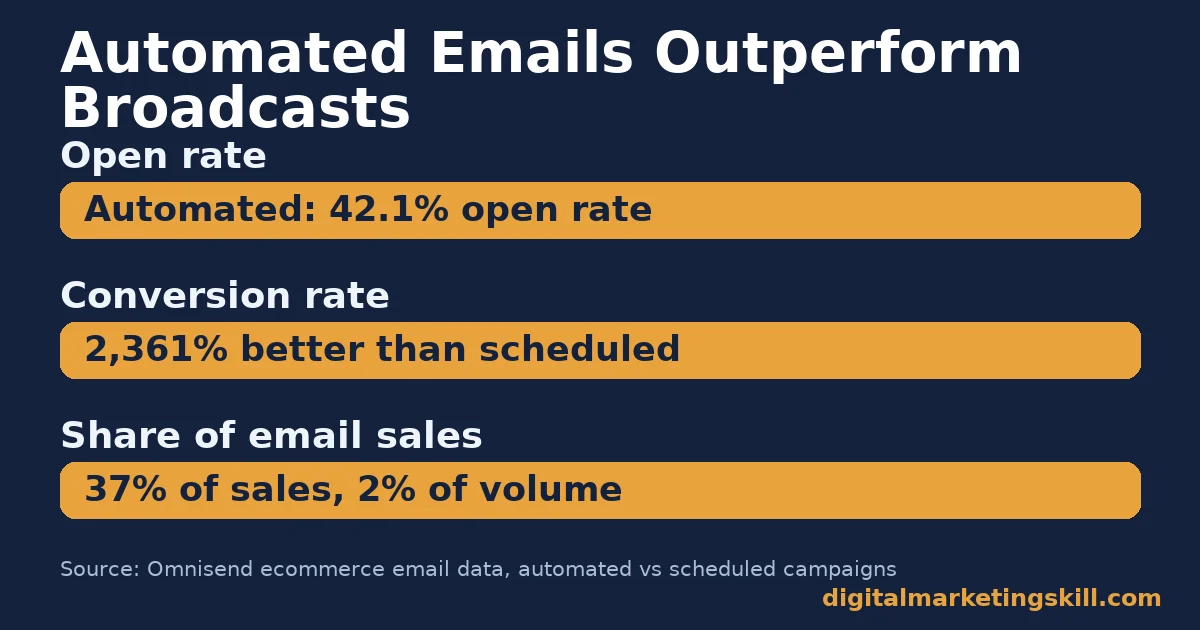
- Automation beats one-off blasts. Omnisend found automated emails had 52% higher open rates (42.1%) than scheduled campaigns, plus a 2,361% better conversion rate (1.9%). They drove 37% of all email-generated sales from just 2% of send volume.
- Average ROI assumes a healthy list. Litmus puts email’s average return at $36 for every $1 spent. That figure assumes an engaged, consenting, well-sent list, not a blast to old leads.
- Deliverability gates conversion before copy does. Google says Gmail blocks over 99.9% of spam and nearly 15 billion unwanted messages a day. Bulk senders must authenticate with SPF, DKIM and a one-click unsubscribe, or risk missing the inbox entirely.
- Benchmarks set the bar, not the ceiling. Mailchimp’s all-industry data puts average open rate at 35.63% and click rate at 2.62%. Sequence design decides who clears that bar, not list size.
- Consent law shapes who you can email. The US FTC’s CAN-SPAM rule and the UK ICO’s PECR guidance both require honouring opt-outs. PECR’s soft opt-in never covers a bought-in list.
In this guide
- What Most Email Marketing Lead Conversion Advice Misses
- How Email Marketing Lead Conversion Actually Works
- Three Sequences Power Email Marketing Lead Conversion
- How to Lead With Each Sequence
- Five Mistakes That Quietly Kill Email Marketing Lead Conversion
- Deliverability Decides Whether Any Sequence Can Convert
- How to Measure Whether a Sequence Is Converting
- The Email Marketing Lead Conversion Rule: Diagnose Before You Rewrite
- A One-Week Plan to Build Your First Sequence
- A Real Case: Email Flows Built Into a Freelance Income
- Frequently Asked Questions About Email Marketing Lead Conversion
- Build the Sequence, Then Measure It
What Most Email Marketing Lead Conversion Advice Misses
Most advice on converting leads with email repeats the same three lines. Send a newsletter. Offer a discount. Add a call to action. None of that is wrong. But it skips the two decisions that actually move a lead to a sale: which sequence to send, and whether the message even reaches the inbox.
This guide names both. It covers three sequence types that drive email marketing lead conversion. It covers the deliverability rules that now gate whether anyone sees the email at all. And it covers the metrics that show a sequence is working, not just sending.
A few ground rules first. The Omnisend and Litmus figures below come from each company’s own customer or merchant base, not an independent audit. So read them as a snapshot, not a settled ranking.
Mailchimp’s benchmarks cover its own wide customer range, from solo founders to large companies. The three-sequence framework in this guide is our own model. It is an informed inference drawn from that evidence, not a fixed law of email marketing.
How Email Marketing Lead Conversion Actually Works
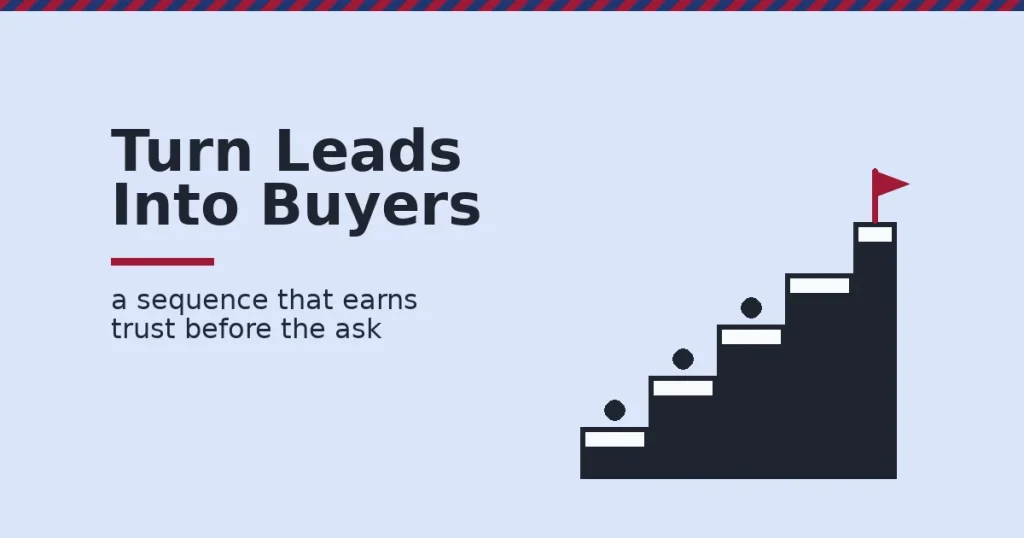
A lead rarely buys from the first email. Trust has to be built before money changes hands. Think of email marketing lead conversion as a short ladder. A stranger becomes a subscriber. A subscriber becomes an engaged reader. An engaged reader becomes a buyer. Skipping a rung, by pitching before trust exists, is why blasting offers to a whole list converts so poorly.
Automation closes that gap better than manual sending, because it reacts to behaviour instead of a calendar. Omnisend’s ecommerce email data found that automated, triggered emails had a 52% higher open rate than standard scheduled campaigns. Their click rate was 332% higher. Their conversion rate was 2,361% better. Despite being roughly 2% of total send volume, those automated emails drove 37% of all email-generated sales.
That gap exists for a simple reason. A triggered email arrives at the moment of intent, right after a sign-up, a download or an abandoned cart. A batch-and-blast email arrives whenever the sender happens to hit send. The lesson is not “send more automation.” It is that the sequence a lead receives should match where they sit on the trust ladder. The next section breaks that down.
Three Sequences Power Email Marketing Lead Conversion
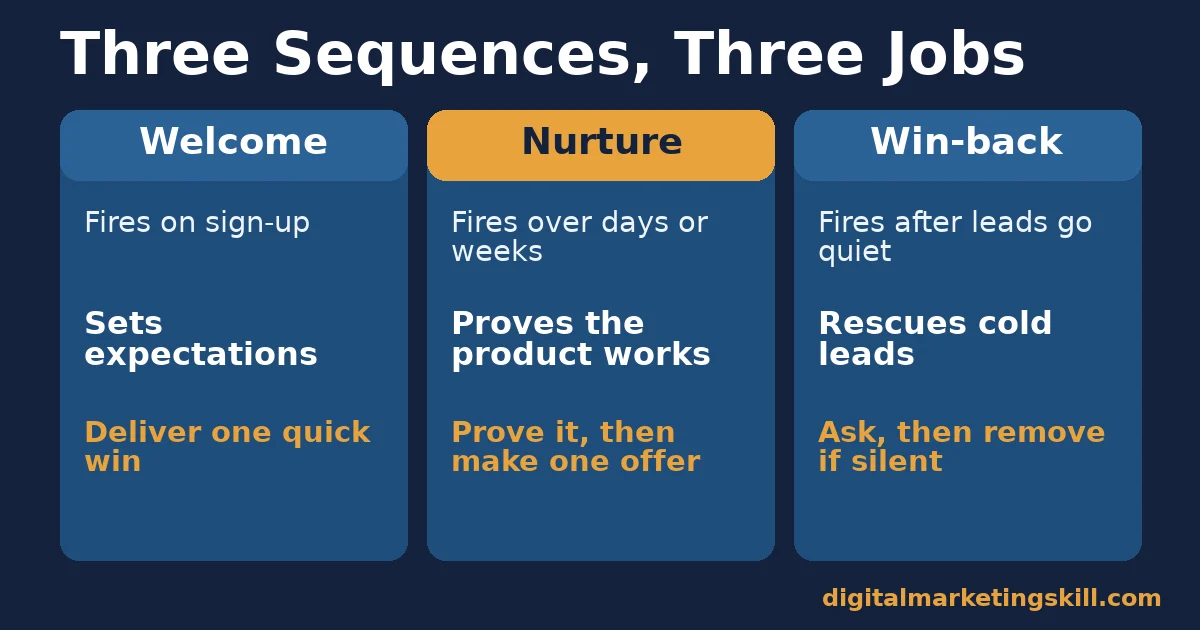
Not every lead needs the same email. A brand-new subscriber is different from a lead who has read several emails but never bought. Both differ from a lead who has gone quiet. Each one is solving a different problem on the way to becoming a customer.
Welcome Sequences: Built to Set Expectations
A welcome sequence fires the moment someone joins your list. Its job is narrow. Confirm what the subscriber signed up for. Deliver one quick win. Set the sending frequency they should expect. A new subscriber pays you the most attention they ever will, so never skip this sequence or replace it with a single confirmation email.
Nurture Sequences: Built to Prove Value Before the Ask
A nurture sequence runs over days or weeks. It exists to answer one question for the lead: can this product or service actually help me? It answers that with useful, specific content tied to what the lead showed interest in, not with recurring discount offers. This is the sequence most old-style email marketing lead conversion skips, jumping straight from welcome email to sales pitch.
Choosing what that content actually is, a guide, a webinar, a case study, matters too; our guide to lead generation content strategy covers which format fits which stage.
Win-Back Sequences: Built to Rescue Cold Leads
A win-back sequence targets leads who opened and clicked in the past but have gone quiet. Its job is to find out why, with one direct, low-pressure message. If they still do not respond, suppress them quietly. Sending promotions to a cold segment forever is what drags down deliverability for your whole list, as the next section explains.
How to Lead With Each Sequence
Each sequence above needs a different opening move. The three sections below mirror the three sequence types above, so you can match the fix to the right sequence instead of applying one tactic everywhere.
Welcome Sequences: Lead With a Clear First Win
Give the new subscriber something useful inside the very first email, before you ask for anything. Then tell them plainly how often you will send, and what each email will contain. A subscriber who gets real value immediately is far more likely to open the next email. That habit is what makes the later nurture sequence work.
Nurture Sequences: Lead With Proof, Then One Offer
Spend most of the sequence proving the product works. Share a short case. Explain the mechanism plainly. Walk through one worked example. Only introduce the offer once that proof has landed, and make it a single clear offer, not a rotating list of promotions. Email marketing lead conversion improves when the ask feels like the natural next step, not an interruption.
Win-Back Sequences: Lead With a Reason to Return
Open the win-back sequence by naming the gap honestly: “we noticed you haven’t opened our last few emails.” Offer a reason to return that is specific to what they originally signed up for. Then ask directly whether they still want to hear from you. Removing the uninterested, rather than emailing them forever, protects your sender reputation for every other sequence you run.
Five Mistakes That Quietly Kill Email Marketing Lead Conversion
Most sequences underperform for the same handful of reasons, not for lack of effort. Check your current welcome, nurture or win-back sequence against this list before you write a single new email.
- One sequence for every lead. A lead who downloaded a pricing guide is ready for a different message than one who only read a blog post. Route leads into a sequence based on what they actually did, not a single generic drip.
- No single, clear call to action. An email with three buttons and two links asks the reader to do your job for you. Pick one next step per email, and make every other link support that one goal.
- Offers sent on a fixed calendar, not on behaviour. Sending a promotion every Tuesday regardless of what a lead has done trains subscribers to tune you out. Trigger the offer from an action, a click, a page view, a cart, instead of the day of the week.
- Judging success by opens alone. A high open rate with no clicks and no sales means the subject line worked and nothing else did. Judge a sequence by click-to-open and conversion rate, not by how many people saw the subject line.
- Keeping cold leads on the active list forever. Leads who have not opened in months still count against your spam-complaint rate and your sender reputation. Move them into a win-back sequence, then remove anyone who still does not respond.
Deliverability Decides Whether Any Sequence Can Convert
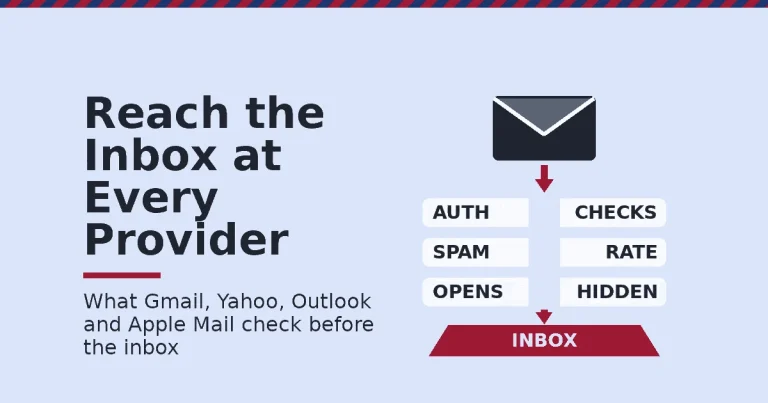
None of the sequences above matter if the email never reaches the inbox. Google says Gmail blocks more than 99.9% of spam, phishing and malware, and stops nearly 15 billion unwanted messages every day. Requiring authentication alone cut unauthenticated mail to Gmail users by 75%.
Google’s bulk sender guidelines require every sender to use SPF or DKIM, with valid forward and reverse DNS and TLS. Senders of 5,000 or more messages a day must add SPF, DKIM and DMARC. They must also keep their spam rate under 0.3% in Postmaster Tools, and offer one-click unsubscribe on every marketing message.
Microsoft’s Outlook sender requirements set a similar bar for high-volume senders. So non-compliant mail is routed to the junk folder first, and later mail risks outright rejection.
Consent law adds a second gate. The FTC’s CAN-SPAM compliance guide requires accurate headers and a non-deceptive subject line. It also requires a valid postal address and honouring an opt-out within 10 business days, with penalties that can run over $53,000 per email.
The UK ICO’s PECR guidance requires consent to email individuals. It allows a soft opt-in only for past customers of a similar product, with an opt-out offered at collection. But a soft opt-in never covers a bought-in list.
A Quick Deliverability Self-Check
Before you blame the sequence for weak email marketing lead conversion, rule out a sending problem. Check three things first.
Confirm SPF, DKIM and DMARC are all set up correctly for your sending domain, using your email platform’s own domain-authentication test. Check your spam-complaint rate inside your sender dashboard or Postmaster Tools, and keep it well under 0.3%. Then send a test email to a Gmail, Outlook and Yahoo address, and confirm it lands in the inbox, not a promotions tab or a junk folder.
One more wrinkle affects measurement, not sending. Apple’s Mail Privacy Protection guide explains that the feature hides a recipient’s IP address. It stops senders from seeing whether an email was opened, though it does not extend to clicks on links. That is why the measurement section below leans on click-based metrics rather than opens alone.
How to Measure Whether a Sequence Is Converting
Measure email marketing lead conversion by what a lead does, not by whether an email was sent. Each metric below is defined in one sentence, with a note on how to read it alongside the deliverability facts above.
Five Metrics That Show Real Conversion
- Open rate. The share of delivered emails recorded as opened. Treat it as directional only, since Apple’s Mail Privacy Protection inflates it for a large share of Apple Mail users.
- Click rate. The share of delivered emails that got at least one click. Mailchimp’s all-industry average sits at 2.62%, a fair baseline for a cold list before you have your own history.
- Click-to-open rate. Clicks divided by opens. This isolates whether the content itself persuades, once someone has actually opened the email.
- Conversion rate. The share of recipients who completed the goal action, a purchase, a booked call or a sign-up, after clicking through. This is the number that reflects real email marketing lead conversion, not just engagement.
- Unsubscribe and spam-complaint rate. The share of recipients who opted out or marked the email as spam. Google’s 0.3% spam-rate ceiling for bulk senders makes this a deliverability metric as much as a content one.
How to Read These Numbers Together
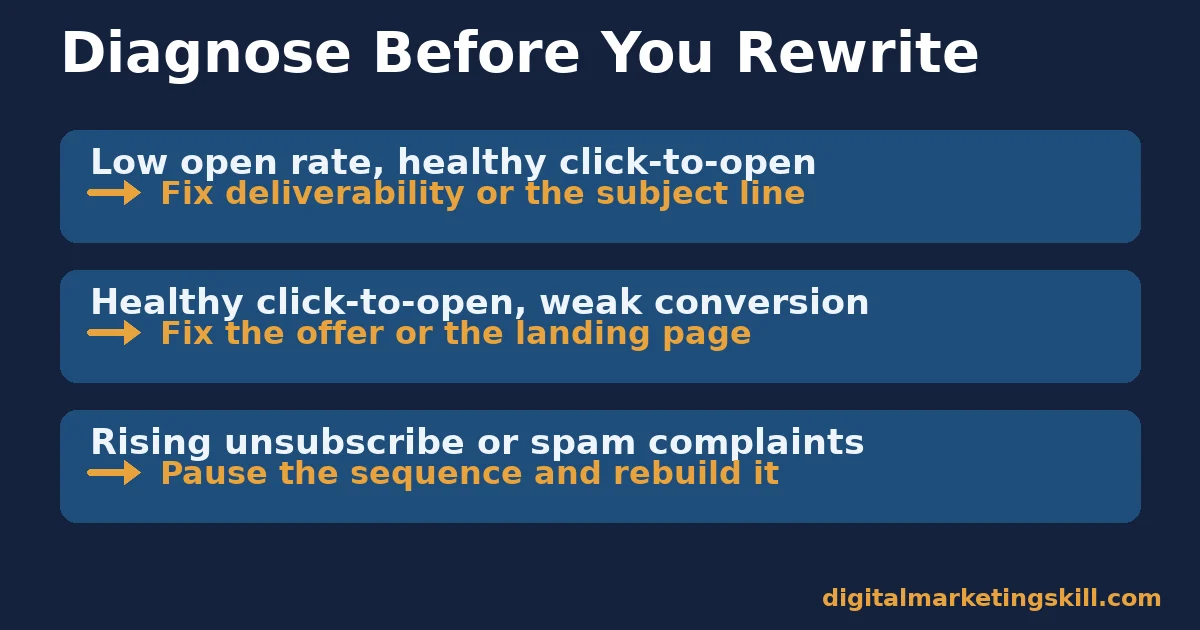
Read the five metrics as a chain. A low open rate with a healthy click-to-open rate usually points to a subject-line or deliverability problem, not a content problem.
The same honesty applies to revenue claims from any channel, not just email; our guide to content marketing ROI covers why naive attribution can make a channel look far better than it is.
A healthy click-to-open rate with a weak conversion rate usually means the offer or landing page is wrong, not the email. And a rising unsubscribe or spam-complaint rate on any sequence is a signal to pause. Rebuild it before it damages the sender reputation of every other sequence you run.
The Email Marketing Lead Conversion Rule: Diagnose Before You Rewrite
If you take one decision rule from this guide, make it this one. Never rewrite a sequence’s copy until you know which metric is actually failing. A weak click-to-open rate means fix the content. A weak conversion rate with a strong click-to-open rate means fix the offer, or the page the email sends people to, not the email itself.
Here is an illustrative example, with invented numbers. A small services business sends one nurture sequence to every lead. It gets a 38% open rate, a 22% click-to-open rate and a 0.4% conversion rate.
Click-to-open is healthy, so the team leaves the email copy alone. Instead, they rebuild the landing page the last email links to, adding a clearer offer and a shorter form. On the next sequence send, conversion rate rises to 1.6%, with no change to the email copy at all.
A One-Week Plan to Build Your First Sequence
You do not need new software to start improving email marketing lead conversion. Most email platforms already support the automation this plan needs. Spend about an hour a day for one week.
- Day one: pick one segment. Choose leads from a single source, a lead magnet, a webinar sign-up or a free trial, rather than your whole list.
- Day two: write the welcome email. Confirm what they signed up for, deliver one quick win, and say how often you will email them.
- Days three and four: write two proof emails. Cover one mechanism and one short case or example, each ending with a small, low-pressure next step.
- Day five: write one offer email. Make a single clear ask, with one call to action, tied directly to what the segment showed interest in.
- Day six: set the triggers. Connect each email to the action that should start it, not to a fixed send date.
- Day seven: set your baseline. Record open rate, click-to-open rate and conversion rate before you send, so you have something to compare against in a month.
A Real Case: Email Flows Built Into a Freelance Income
Olajire Jacob, a graduate of Digital Marketing Skill Institute featured on its reviews page, describes charging $500 to set up email marketing flows for clients in the US, UK and Canada. That work later scaled into $5K a month. The case shows the same principle this guide covers: a well-built sequence, not a single email, is what clients were willing to pay for.
Treat this as one published outcome, not a typical result. Email marketing lead conversion skills transfer well into freelance or agency work, but results depend on the client’s list, offer and market. The Institute’s earnings disclaimer applies to any income figure shared by a graduate.
Frequently Asked Questions About Email Marketing Lead Conversion
How long should a nurture sequence run before asking for the sale?
Long enough to answer the lead’s real objections with proof. That is usually several emails over one to three weeks, not a fixed number of days. Introduce the offer once the sequence has delivered a genuine first win and at least one piece of proof.
What is a good email conversion rate for turning leads into customers?
There is no single good figure, because it depends on price point, audience and offer. Mailchimp’s 2.62% click rate is a fair starting benchmark for engagement. Track your own conversion rate over time instead of chasing an industry number.
Does personalising emails with a first name actually help conversion?
Personalisation helps attention, but the bigger lever is relevance. Send content that matches what the lead actually showed interest in. A first name on an irrelevant offer will not fix a mismatched sequence.
How many promotional emails is too many?
As soon as unsubscribe or spam-complaint rates start climbing, you have sent too many. Google’s bulk sender guidelines treat a spam rate above 0.3% as a deliverability risk, a useful outside limit even for smaller senders.
What is the difference between a welcome sequence and a nurture sequence?
A welcome sequence sets expectations for a brand-new subscriber and delivers one quick win. A nurture sequence runs longer, and exists to prove the product works before any offer appears. Most leads need both, in that order, before they are ready to see an offer.
Should every lead go through the same three sequences?
No. Route each lead based on what they actually did, a sign-up, a download or a cart. A lead who already clicked an offer does not need another welcome sequence; they need the next step toward a decision.
Why do my emails end up in spam instead of the inbox?
Usually one of three causes: a missing or misconfigured SPF, DKIM or DMARC record; a spam-complaint rate above the threshold mailbox providers allow; or a list that was never properly opted in. Fix authentication first, then fix list quality.
Build the Sequence, Then Measure It
Email marketing lead conversion comes from matching the right sequence to where a lead actually is, not from sending more emails. Pick one segment of leads who have gone quiet. Build a short welcome, nurture or win-back sequence for them, using the structure above. Track click-to-open and conversion rate for one full cycle before you change anything else.
If you want to build this skill properly, Digital Marketing Skill Institute teaches it hands-on inside the Master Diploma in Digital & AI Marketing, which covers email automation alongside lead generation, Google Ads, and WordPress and SEO. It comes with unlimited 1-on-1 coaching and mentoring, plus real project work inside a U.S. partner company. The diploma is dual US and UK accredited, and recognised in more than 100 countries.
The programme is 100% online, so you can study from anywhere in your country. Explore more guides on the Digital Marketing Skill Institute blog, including our breakdowns of email deliverability, customer relationship management and fixing a leaking sales funnel. Or go straight to the Master Diploma application.
Every figure in this guide was checked against its original source before publication. Figures marked as illustrative are invented examples, not real results.
![9 Amazing Digital Marketing Skills to Make Money Online [With Proof]](https://digitalmarketingskill.com/wp-content/uploads/2019/07/9-Amazing-Digital-Marketing-Skills-to-Make-Money-Online-With-Proof-17.png)