
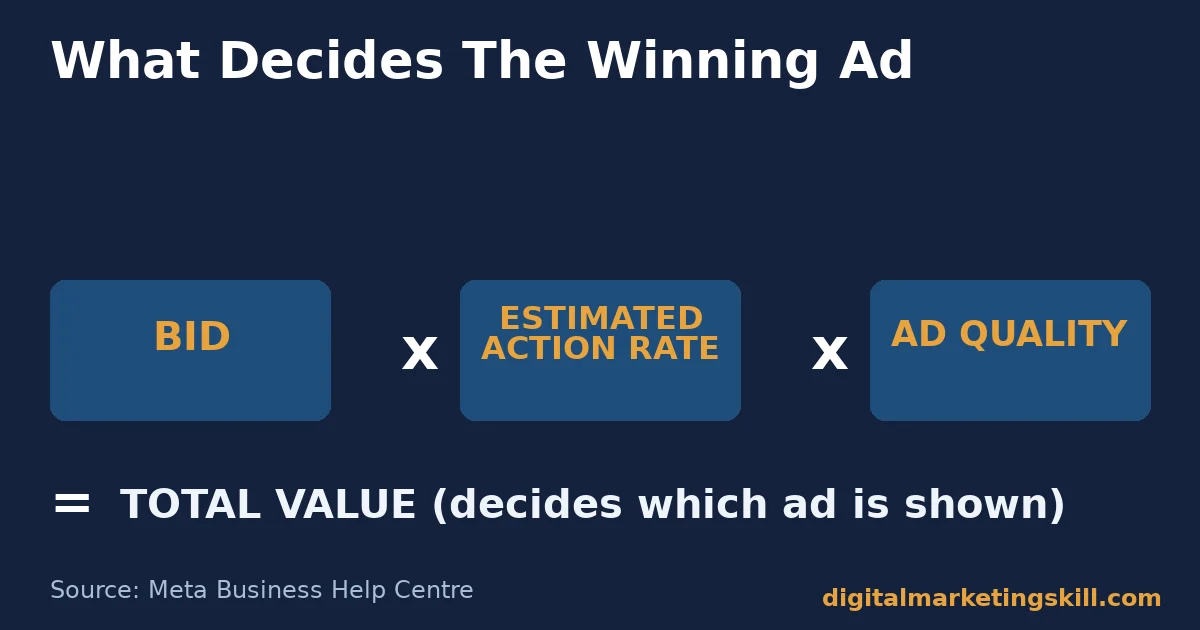
The Facebook ad auction does not hand the win to the highest bidder. It scores every ad on three things: bid, estimated action rate, and ad quality. Then it shows whichever ad creates the most value for the person and the advertiser. This guide breaks down how that scoring works. You also get the one setting that most often raises your cost, and a real case to learn from.
Key Takeaways
- The Facebook ad auction does not pick the highest bid. Meta scores every ad on bid, estimated action rate, and ad quality together (Meta Business Help Centre).
- Ad quality is partly judged on withheld information, sensationalised language, and engagement bait, not just how the creative looks (Meta).
- An ad set needs roughly 50 optimization events in the week after a significant edit to leave “Learning limited” status (Meta Business Help Centre).
- More than 3.6 billion people use Meta’s apps every day. That scale is also why a campaign built around one country’s currency or platforms quietly underperforms everywhere else (Meta investor relations).
- Meta’s own reporting shows average price per ad keeps moving. A fixed bid, set once and never revisited, slowly loses ground as a result (Meta investor relations).
In this guide
- The Gap: Why Most Facebook Ad Auction Explainers Miss The Point
- What The Facebook Ad Auction Actually Weighs
- What Differs By Campaign Goal
- How To Lead With Each Campaign Goal
- The Facebook Ad Auction In Practice
- The Three Controls That Shape Every Campaign
- Common Mistakes That Sink A Facebook Ad Auction Score
- Measuring Whether Your Campaign Is Working
- The One Decision Rule For Fixing A Weak Campaign
- A Real Case: Pricing Campaigns Around What The Auction Rewards
- Frequently Asked Questions About The Facebook Ad Auction
- Learn To Run Campaigns Like These With Expert Guidance
The Gap: Why Most Facebook Ad Auction Explainers Miss The Point
Most articles describe the Facebook ad auction as a popularity contest for your wallet. Spend more, win more, they imply. That framing is wrong. It also costs advertisers real money, because it pushes them to raise bids instead of fixing the two things Meta actually rewards.
The useful version of this topic names the real mechanism. Three inputs multiply together to decide the winner, and only one of them is money.
Two ground rules apply before the detail below. First, Meta has never published its exact internal weighting. What follows is the documented mechanism, not a reverse-engineered formula. Second, these are current, measured platform behaviours. They are not a permanent ranking, since Meta updates its systems often. Advertiser count and platform scale change constantly too, so treat any specific number here as a snapshot, not a fixed fact.
Scale matters here because the audience behind every auction is genuinely global. More than 6 billion people are online worldwide (DataReportal), so a campaign written for one country’s slang, currency, or platform habits quietly fails everywhere else, even though the auction itself runs the same way in every market.
What The Facebook Ad Auction Actually Weighs
Every time there is an opportunity to show someone an ad, Meta scores every eligible advertiser’s ad. It does not simply rank them by price. Meta names five inputs that advertisers control directly: objective, targeting, budget, duration, and creative quality.
Those five inputs feed three auction factors. Your bid is the amount you are willing to pay for the result you want. Estimated action rate is Meta’s prediction of how likely this specific person is to take that action after seeing your ad.
Ad quality is a separate score. Meta builds it from on-platform feedback and from signals such as withheld information, sensationalised language, and engagement bait. The ad with the strongest combination of these three factors wins the opportunity to be shown. The ad with the biggest budget does not automatically win.
Why Ad Quality Carries Real Weight
An advertiser with a smaller bid can still beat a bigger spender. This happens when their ad is more relevant and their creative avoids the penalised patterns Meta checks for. This design is deliberate. Meta is balancing two things at once: value for the advertiser, and a positive experience for the person scrolling past the ad.
For context on scale, Meta reported average price per ad rising alongside a 14% year-over-year increase in ad impressions across its apps in one recent quarter (Meta investor relations). More competition for the same opportunities is part of why quality matters more over time in the Facebook ad auction, not less.
This is also why two advertisers can run what looks like the same campaign and get very different results. The Facebook ad auction rewards the combination of signals, not the size of either advertiser’s company or budget alone.
What Differs By Campaign Goal
Not every campaign chases the same result. The best campaigns are built differently depending on which result they are chasing.
Awareness Campaigns: Built For Reach At Low Cost
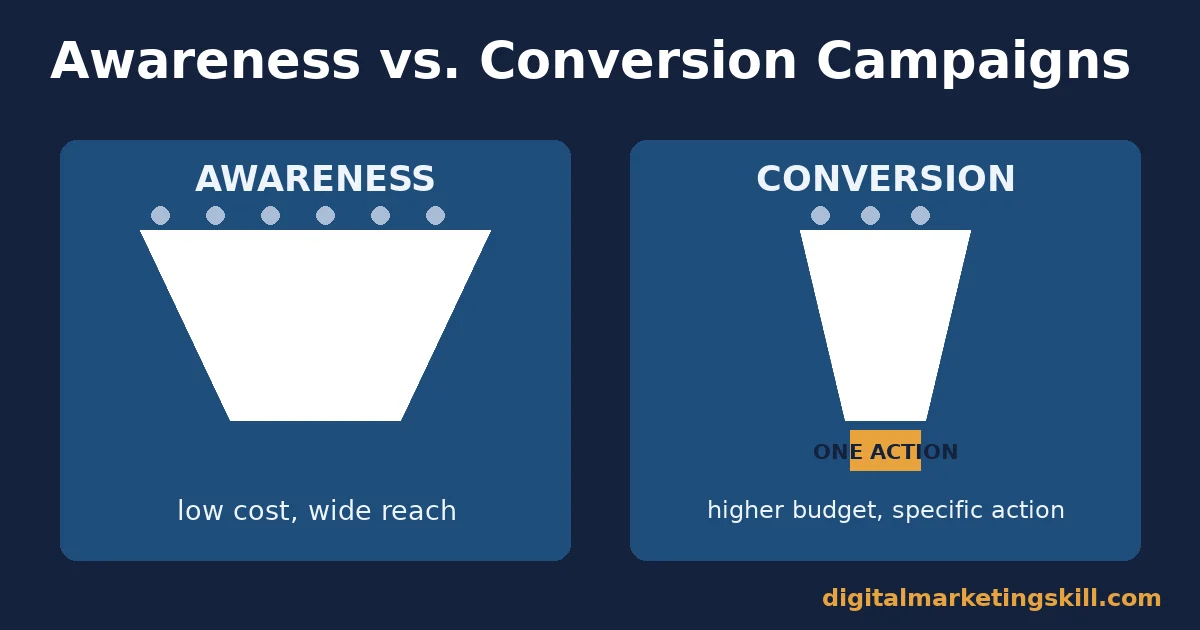
An awareness campaign is optimised to show your ad to as many relevant people as possible, as cheaply as possible. The estimated action rate here is based on attention and recall, not a purchase. Quality and relevance still matter, but the bar for “action” is lower.
Conversion Campaigns: Built For One Specific Action
A conversion campaign is optimised around a single, defined action: a purchase, a lead form, a sign-up. Meta needs enough signal about that exact action to predict who is likely to take it. This is why conversion campaigns typically need a higher budget before they stabilise.
How To Lead With Each Campaign Goal
Once you know which result you are chasing, the fix for a struggling campaign usually comes from the same short list.
Awareness Campaigns: Lead With Broad Targeting
Keep the audience wide enough that Meta has room to find the cheapest relevant impressions. A narrow audience forces repeated showings to the same small group. That repetition raises frequency, and rising frequency quietly raises your cost.
Conversion Campaigns: Lead With A Frequent Optimization Event
Choose an optimization event that happens often enough for Meta to learn from it quickly. A rare event, like a $2,000 purchase, gives the system too little signal. Campaigns built around a rare event often stay stuck in “Learning limited.”
Combining smaller ad sets into one, instead of splitting budget across many, is usually the fastest way to collect the roughly 50 optimization events needed to exit that status.
The Facebook Ad Auction In Practice
Naming the mechanism is useful. Seeing it applied is more useful. Three patterns show up again and again across campaigns that consistently win the Facebook ad auction at a reasonable cost, regardless of industry or budget size.
Pattern One: Creative Gets Tested, Not Guessed
Strong advertisers run two or three creative variations inside the same ad set and let the data decide. Since ad quality is measured from real responses, no amount of planning replaces watching how people actually react to a specific image or video.
Pattern Two: The Audience Is Sized To The Budget
A $20-a-day budget aimed at ten million people will struggle to find enough signal fast. A $20-a-day budget aimed at a focused 200,000 people has a far better chance of collecting optimization events quickly.
Matching audience size to budget, instead of maximising reach by default, is often the single biggest lever an advertiser can pull. A bigger audience sounds better on paper, but it only helps once the budget is large enough to reach a meaningful share of it.
Pattern Three: The First Week Is Treated As A Test, Not A Verdict
The learning phase needs roughly 50 optimization events. Judging a campaign on day two almost always reads noise as signal, not a real result.
Advertisers who wait out the full learning window before making changes end up with a lower, more stable cost per result. Those who panic and edit early, by contrast, tend to reset the clock on themselves over and over.
The Three Controls That Shape Every Campaign
Beyond objective and audience, two more advertiser controls change how the auction treats your campaign.
Budget And Bid Strategy
Your budget caps total spend. Your bid strategy controls how Meta spends it, either by capping your cost per result manually or by letting the system optimise automatically within your budget. A clear link exists between your bid strategy and your ROI in digital marketing, since the strategy you pick changes what you pay per result, not just how much you spend in total.
Placement
Placements are where your ad can appear: Facebook, Instagram, Audience Network, and Messenger. Automatic, Advantage+ placements let Meta choose the cheapest eligible spots for your goal. Manual placement gives you more control, but it usually narrows the pool of auctions your ad can enter, which can raise your cost.
Meta reports that ad sets using Advantage+ placements saw an average cost-per-action improvement of 11.7% compared with manually chosen placements, a figure worth weighing before narrowing your placement list by hand.
Common Mistakes That Sink A Facebook Ad Auction Score
Beyond the controls above, four smaller mistakes show up again and again in weak campaigns. Each one is easy to fix once you know to look for it, and none of them require a bigger budget.
Mistake One: Frequency Climbs While The Audience Stays Fixed
A campaign that never expands its audience eventually runs out of new people to show the ad to. As a result, the same people see it again and again. Frequency climbs, fatigue sets in, and the estimated action rate for that audience quietly drops, even though nothing about the ad itself changed.
Mistake Two: Constant Small Edits Reset The Learning Phase
Changing the budget, audience, or creative every day feels proactive, but each significant edit sends the ad set back into “Learning limited.” Consequently, the campaign never collects enough optimization events in one stretch to stabilise, and cost per result stays high indefinitely.
Mistake Three: The Objective Does Not Match The Real Goal
Choosing a traffic objective when the real goal is purchases asks Meta to optimise for the wrong estimated action rate. For instance, a campaign optimised for clicks can generate plenty of cheap traffic that never converts, because Meta was never asked to predict who would buy.
Mistake Four: The Same Creative Runs For Months Unchanged
Since ad quality is partly built from how people respond to a specific creative, a tired ad that nobody engages with any more drags the score down over time. Therefore, refreshing the creative every few weeks, even with small variations, keeps the quality signal from going stale.
Duration
Duration is how long your campaign runs. A very short duration gives the Facebook ad auction little time to gather optimization events, so it rarely leaves the learning phase before the campaign ends. A longer duration, paired with a steady budget, gives the system room to stabilise and then hold a lower cost per result.
Measuring Whether Your Campaign Is Working
Three numbers tell you most of what you need to know about a live campaign.
- Cost per result: total spend divided by completed optimization events. Watch the trend over at least a week, not a single day.
- Frequency: the average number of times one person has seen your ad. Rising frequency with falling results usually means your audience is too narrow.
- Learning status: shown directly in Ads Manager. “Learning limited” means the auction does not yet have enough signal to optimise your delivery well.
Check these three together. A low cost per result with rising frequency is often a warning sign, not good news. It usually means the same people are seeing the ad again, instead of new people discovering it.
Give A Campaign Enough Time Before Judging It
Give any one of these numbers at least a full learning window before judging it. A campaign can look weak on day two simply because it has not yet collected enough optimization events for the Facebook ad auction to settle into a stable pattern.
A short observation window reads that early noise as a verdict, which is misleading. Treat the first few days as a check for broken links and tracking issues, not as a final score for the campaign.
The One Decision Rule For Fixing A Weak Campaign
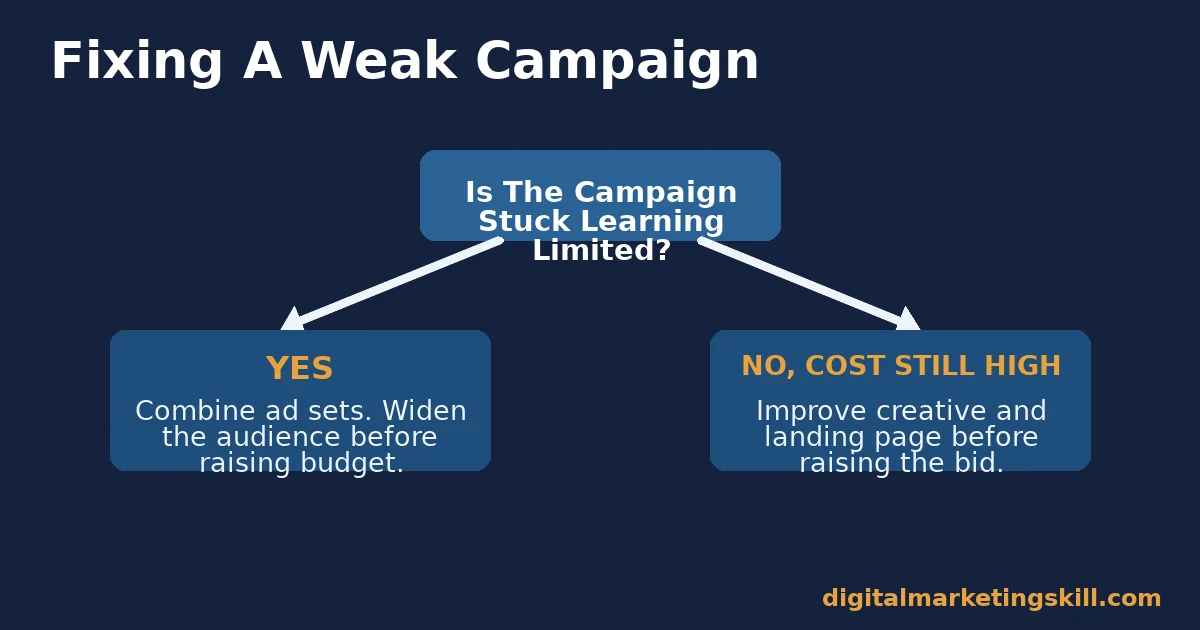
If your campaign is stuck “Learning limited,” combine ad sets and widen the audience before you raise the budget. If it has exited learning and cost per result is still high, improve the creative and the landing page before you raise the bid.
Raising the bid first treats a quality problem as a money problem. Ad quality and estimated action rate both multiply into the final score. A creative fix often lowers your cost more than a bigger bid ever would.
A Worked Example Of The Decision Rule
Illustrative, invented numbers help show the size of the effect. A campaign spending $500 a week sits in “Learning limited” with only 18 optimization events logged. Combining three narrow ad sets into one, with the same total budget, can plausibly reach the roughly 50 events needed within the same week. Every dollar now competes in one auction instead of three, which is the entire reason the number moves.
A Real Case: Pricing Campaigns Around What The Auction Rewards
Damola Akanbi, a student at the Digital Marketing Skill Institute, reported now averaging $1,500 per client to run digital marketing campaigns, as published on the Institute’s student reviews page. Campaign management work like this depends on understanding how the Facebook ad auction prices results. Knowing how to launch an ad is not enough on its own.
A few limits are worth stating plainly. This is one self-reported figure from one person’s client work. It is not a typical or guaranteed income, and results vary by niche, experience, and client base. Read the Institute’s earnings disclaimer for the full context.
Frequently Asked Questions About The Facebook Ad Auction
Does the highest bid always win the Facebook ad auction?
No. Meta combines your bid with estimated action rate and ad quality into a single score. A smaller bid with stronger quality and relevance can beat a larger bid with weaker quality.
What is ad quality in the Facebook ad auction?
Ad quality is Meta’s assessment of your creative. It is based on feedback from people who saw it, plus signals such as withheld information, sensationalised language, and engagement bait. Poor quality lowers your score even when your bid is high.
How many optimization events does an ad set need to exit the learning phase?
Roughly 50 optimization events in the week after a significant edit, according to Meta’s own documentation. Fewer than that, and the ad set risks staying in “Learning limited” status.
Why does a significant edit reset the learning phase?
A significant edit changes the signal Meta has been learning from, such as the audience, creative, or optimization event. The system treats this close to a fresh start. It then needs a new batch of optimization events to relearn what works.
Does a bigger budget guarantee a lower cost per result?
No. A bigger budget can help an ad set collect optimization events faster, which helps it exit the learning phase. It does not raise ad quality or estimated action rate on its own.
What is the difference between reach and conversion campaigns in the auction?
A reach campaign is scored on attention and recall at a low cost per impression. A conversion campaign is scored on a specific action, like a purchase. Conversion campaigns usually need more budget and more time to stabilise.
Can a new advertiser compete with a large existing advertiser in the auction?
Yes. Bid is only one of three multiplied factors. A new advertiser with a relevant, high-quality ad can out-score a larger competitor whose ad quality or estimated action rate is weaker.
How often should I check my Facebook ad auction performance?
Weekly is usually enough for a stable campaign. Daily checks during the first week after launch, or after a significant edit, help you catch a stuck learning phase early, before it wastes budget.
Should I always use automatic placements?
For most campaigns, yes. Automatic, Advantage+ placements let Meta enter your ad into more auctions, which generally lowers cost. Consider manual placement only when a specific platform, like Facebook retargeting, calls for it.
What are ad relevance diagnostics?
They are Meta’s tool for diagnosing an underperforming ad across three dimensions: quality, engagement, and conversion, according to Meta’s own documentation. The diagnostics need at least 500 impressions before they become reliable, so check them after your ad has run for a while, not on day one.
Can I pause and restart a campaign without losing its learning progress?
No, not reliably. Pausing for more than a short window, or making a significant edit when you restart, usually counts as a fresh start for the learning phase. Treat a long pause the same way you would treat launching a brand-new ad set.
Does the Facebook ad auction work the same way for small and large budgets?
Yes. The same three factors apply regardless of budget size. A small budget simply collects optimization events more slowly, so it takes longer to exit the learning phase and reach a stable cost per result. Patience, more than a bigger budget, is often what a small advertiser needs most.
Learn To Run Campaigns Like These With Expert Guidance
Do you want to plan, launch, and optimise campaigns that work with the Facebook ad auction instead of against it? The Master Diploma in Digital & AI Marketing covers this inside its AI-Powered Social Media Management and Advertising track. That track is one of four AI-powered tracks built from ten courses in total, with a Full Stack option for completing all four.
Every track includes unlimited one-on-one coaching and mentoring, plus a U.S. Project Internship with a verified U.S. Work Reference Letter. The diploma carries dual US and UK accreditation, recognised in more than 100 countries. The whole programme runs 100% online, so you can study from anywhere in your country.
Explore the full digital marketing blog for more practical breakdowns like this one, including how retargeting ads and digital advertising fit into the same auction. Read real outcomes on the reviews page, or go straight to the application page to start. Wherever you live, the programme is built so you can follow it online from day one. Learn more about the Institute at https://digitalmarketingskill.com/.
Every figure in this guide was checked against its original source before publication. Figures marked as illustrative are invented examples, not real results.
![9 Amazing Digital Marketing Skills to Make Money Online [With Proof]](https://digitalmarketingskill.com/wp-content/uploads/2019/07/9-Amazing-Digital-Marketing-Skills-to-Make-Money-Online-With-Proof-17.png)






