Most businesses generate leads the hard way: more traffic, more ads, more content, with no fix to the offer, the form or the follow-up. A real test by MarketingExperiments found that removing form friction alone lifted quote requests by 262.3%. This guide shows what to fix first, and how to measure it.
Key Takeaways
- Form friction costs leads. MarketingExperiments ran a multifactor landing page test for a B2B VoIP company and found that a shorter form, trust signals and plainer copy together lifted quote requests by 262.3%.
- Cost per lead varies a lot by channel. First Page Sage’s B2B benchmark data, drawn from more than 130 B2B clients, found an average cost per lead of $327 for organic channels and $458 for paid channels.
- Landing pages decide most of the outcome. Unbounce’s Conversion Benchmark Report, built from more than 57 million conversions across 41,000 landing pages, found a median conversion rate of 6.6%.
- A lead is not a sale. Someone who gives contact information has entered your funnel. They still need a reason, and a nudge, to become a customer.
- Alignment beats volume. More traffic to a weak offer or a long form wastes budget. Fixing the offer, the form or the follow-up usually beats simply buying more clicks.
In this guide
- What Most Advice on How to Generate Leads Skips
- How Businesses Actually Generate Leads
- What Differs Between a Weak and a Strong Way to Generate Leads
- How to Fix Each Part
- How to Measure Lead Generation
- The One Decision Rule: Fix the Leak Before You Add Traffic
- A Real Case: 262.3% More Leads From One Landing Page Test
- Frequently Asked Questions About How to Generate Leads
- Start With Your Weakest Point
What Most Advice on How to Generate Leads Skips
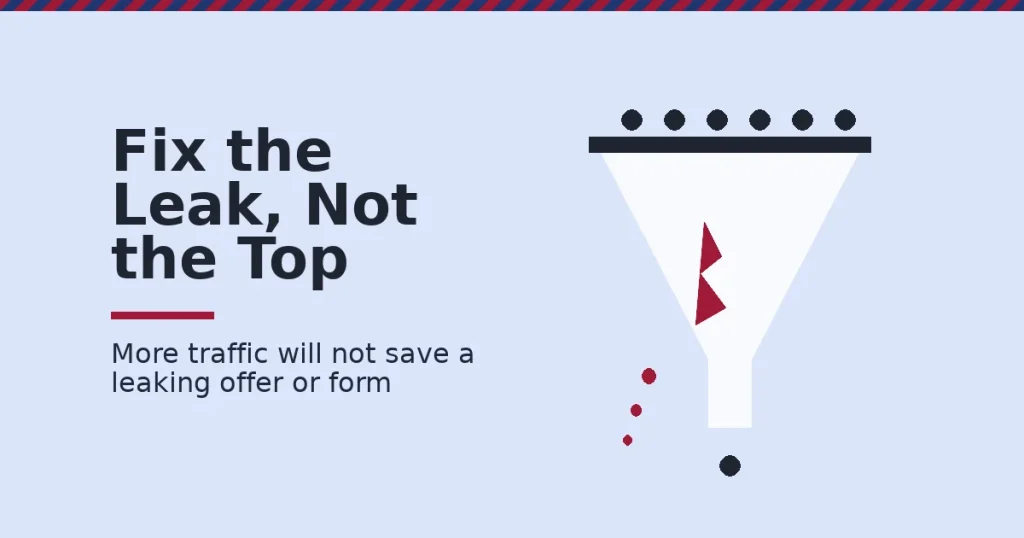
Most guides on how to generate leads list channels: run ads, start a blog, post on social media, send emails. None of that is wrong. But channels only fill the top of a leaky funnel. If the offer is weak, the form is long, or the follow-up is slow, more traffic just means more people falling through the same gaps.
This guide treats lead generation as three connected parts: the offer, the capture form and the follow-up. It names the gap, explains how the funnel works, then shows what to fix in each part and how to tell if the fix worked.
A quick ground rule. The MarketingExperiments case was a multifactor test, so several things changed at once; treat the 262.3% result as a strong signal, not proof that any single change caused it. The cost figures are benchmark averages, a useful baseline, not a guarantee for your own market.
How Businesses Actually Generate Leads
A lead generation funnel has three stages. Strangers become visitors. Visitors become leads. Leads become customers. Each stage needs a different fix, so it helps to be precise about where yours is weak.
The channel that brings the visitor matters less than most businesses assume. Search, social, email and referrals can all generate leads well, provided the offer, the form and the follow-up are solid once someone arrives. A business that fixes those three parts usually sees every channel improve at once, rather than needing a separate fix for each one.
What Counts as a Lead
A lead is someone who gave you a way to contact them. That could be an email for a guide, a sign-up for a webinar, or a form filled out to request a quote. Until someone hands over contact information, they are a visitor, not a lead.
This definition matters because it sets what you are actually measuring. A page view is not a lead. A click is not a lead. Only a captured contact, with permission to follow up, counts.
Not every lead is ready to buy. Marketing teams often split leads into two groups. A marketing-qualified lead has shown interest but is not yet ready for a sales conversation. A sales-qualified lead has been checked against your ideal customer profile and is ready to talk. Keeping this distinction stops a sales team from chasing people who are not actually ready, and stops marketing from being judged only on raw lead count.
The Three Parts That Decide Your Result
Three things decide how many leads a given amount of traffic produces.
- The offer decides whether a visitor thinks the trade is worth it.
- Next, the capture form decides how many of those interested visitors actually finish giving their details.
- The follow-up decides how many captured leads turn into real conversations and, eventually, customers. Speed matters more here than almost anywhere else in the funnel.
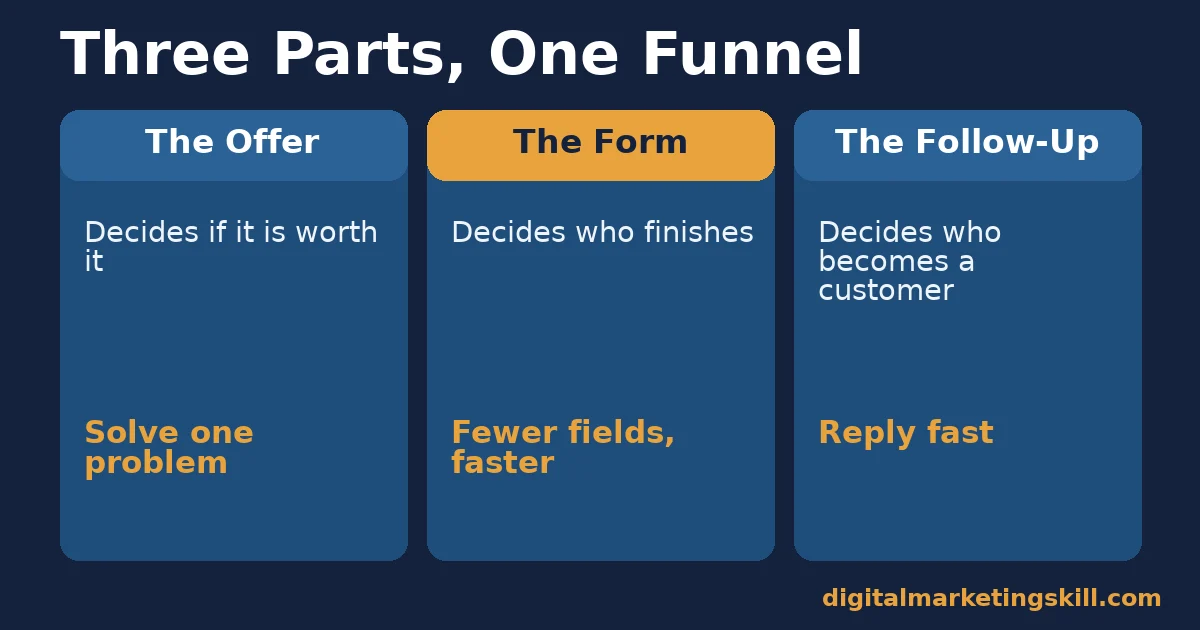
Most businesses that struggle to generate leads are strong in one part and weak in another. A generic offer, a 12-field form, or a three-day reply time can each quietly undo good traffic work.
What Differs Between a Weak and a Strong Way to Generate Leads
The three parts below are paired with their fix later in this guide. Use this section to diagnose which part is actually weak before changing anything.
The Offer: Built to Solve One Problem
A weak offer is vague: “sign up for updates” or “learn more about us.” It asks for contact information without giving a clear reason. A strong offer solves one specific problem for one specific person, right now, in exchange for their details.
The clearer the problem, the easier the offer is to write. A business that cannot describe its ideal customer’s biggest headache in one sentence will struggle to write an offer that makes someone stop and give up their email.
Test the offer itself before you spend heavily on traffic to promote it. A quick way to check: show the headline alone to a handful of people who match your ideal customer, and ask what they think it offers. If their answer does not match what you intended, the problem is the offer, not the channel bringing visitors to it.
The Capture Form: Built to Remove Friction
A weak form asks for everything at once: name, company, phone, budget, timeline, job title. Every extra field is a reason to leave. A strong form asks for the minimum needed to follow up, and nothing more.
This is not unique to lead forms. Baymard Institute’s checkout usability research, built from testing hundreds of ecommerce sites, found the average checkout flow carries 11.3 form fields, while most sites could function with as few as 8. The same principle holds for a lead form: every field beyond what you actually need gives a visitor one more reason to stop.
In the MarketingExperiments case, the treatment page cut the form down to a single field, email, and still generated far more qualified requests than the longer original. Fewer fields did not mean worse leads. It meant more of them.
The Follow-Up: Built on Speed
A weak follow-up treats a new lead like a task for later in the week. A strong follow-up treats it like a question someone just asked out loud. The lead is interested right now. That interest fades fast, especially if a competitor replies first.
Speed is not the only factor, but it compounds every other part of the funnel. A great offer and a short form both lose value if nobody follows up for days.
How to Fix Each Part
These three fixes mirror the three parts above. Start with the one your own numbers point to, not the one that feels easiest.
The Offer: Lead With One Clear Problem
Name the single biggest problem your ideal customer has right now, then build the offer around solving just that. A short guide, a calculator, a free audit or a real quote all work, as long as the headline promises one clear outcome.
Avoid stacking multiple offers on one page. A visitor choosing between three offers often chooses none. Our guide to building a sales funnel covers how to sequence offers across the buyer’s journey instead of cramming them into one page.
The Capture Form: Lead With Fewer Fields
Ask only for what you need to make the very next contact: usually just an email, or an email and a name. You can collect more details later, once trust is established, rather than demanding it all up front.
If you truly need more information to qualify a lead, split it across steps instead of one long form. People are more willing to answer a short question now and another short question next, than to fill in ten fields at once. Our landing page examples guide shows what a focused capture page looks like in practice.
The Follow-Up: Lead With a Fast First Response
Set up an automatic first reply the moment someone submits a form, then follow with a real, personal message as soon as possible. Even a simple confirmation email keeps the lead warm while a human responds.
Build a short nurture sequence for leads who are not ready to buy yet. Our email marketing checklist covers the deliverability and timing checks worth running before you send that sequence at scale.
How to Measure Lead Generation
Judge your ability to generate leads with a short chain of metrics, each defined in one sentence. Track them together in one simple spreadsheet or dashboard, updated at the same interval each time, so you are comparing like with like rather than guessing from memory.
Seven Metrics Defined
- Visitor-to-lead conversion rate. The share of visitors who become leads. Unbounce’s data puts the cross-industry median landing page rate at 6.6%, a useful line to compare your own page against.
- Engaged sessions. Google Analytics counts a session as engaged when it lasts longer than 10 seconds, includes a key event, or has two or more page views. A page that converts well but has few engaged sessions is a traffic problem, not a form problem.
- Cost per lead (CPL). What you spend to generate one lead. First Page Sage’s benchmark puts organic channels at $327 per lead and paid channels at $458, though your own figure depends heavily on industry and channel.
- Form completion rate. The share of people who start a form and actually finish it. A low rate, even with strong traffic, usually points to too many fields.
- Lead-to-customer rate. The share of leads who eventually buy. This is the number that tells you whether your leads are high quality, not just high volume.
- Time to first response. How long it takes your team to make the first contact after a lead comes in. Slower responses generally mean a colder, less interested lead by the time you reach them.
- Cost per customer. Total spend divided by new customers won. This is the number that actually proves whether a channel is profitable, not just whether it is cheap per lead.
Reading Them Together
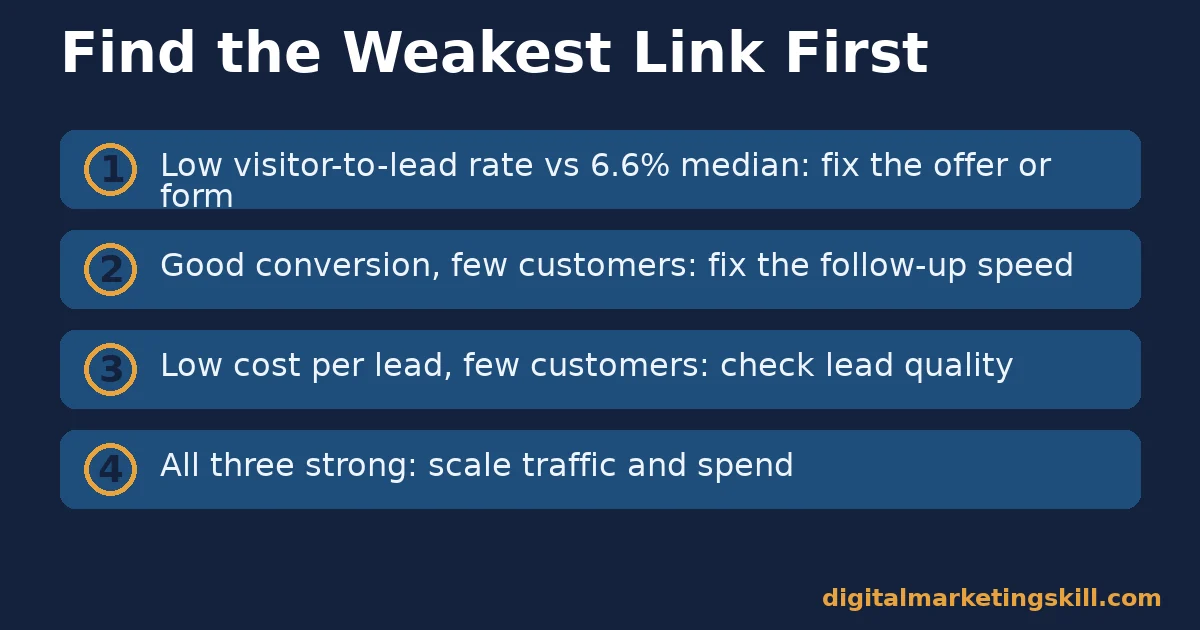
Read these numbers as a chain. A low visitor-to-lead rate against the 6.6% benchmark usually means the offer or the form is the problem. A healthy conversion rate but a weak lead-to-customer rate usually means the follow-up, or the lead quality, is the problem.
Check cost per lead and cost per customer together, not separately. A channel with a low cost per lead but a poor lead-to-customer rate can still be your most expensive source of actual sales, even though it looks cheap on the surface.
The One Decision Rule: Fix the Leak Before You Add Traffic
If you remember one rule, make it this one: find the weakest of the three parts, offer, form or follow-up, and fix only that one before spending more on traffic. More visitors to a leaking funnel just means more waste.
Here is an illustrative example, with invented numbers. A small consulting firm gets 1,000 visitors a month to its contact page, but its form converts at only 1.2%, well under the 6.6% median. The owner leaves the traffic spend untouched and cuts the form from nine fields to three. By the next month, the same 1,000 visitors produce 3.4% more leads, with no change in ad spend.
The lesson is about leverage. Because the traffic was already arriving, fixing the leak changed what every one of those visitors experienced. More ad spend would only have sent more people into the same leaking form.
A Real Case: 262.3% More Leads From One Landing Page Test
A B2B company selling business VoIP phone services ran a landing page test, as documented by MarketingExperiments. The original page asked for extensive contact details and used dense, text-heavy copy. The test page cut the form to a single field, added trust signals such as an industry award and a Better Business Bureau seal, and used plainer, reassuring copy about no contracts and no setup fees.
That combination produced a 262.3% increase in quote requests over the original. The research team attributed the lift to removing friction and reducing the visitor’s anxiety about committing.
Read the limits alongside the result. This was a multifactor test, meaning several elements changed together, so it is not possible to credit any single change alone. It was also one company in one industry, selling one kind of service. Treat it as strong evidence that friction matters, not a guarantee of a 262% lift for every form.
The pattern shows up elsewhere too. Meta’s own guidance on lookalike audiences makes a related point for paid traffic: a narrower, higher-quality source audience usually beats a broad one, the same way a focused offer usually beats a vague one. Whether the lead comes from a search visitor, a social click or a referral, the same three parts, offer, form and follow-up, decide what happens next.
Frequently Asked Questions About How to Generate Leads
What is the fastest way to generate leads for a new business?
Start with one clear offer that solves one problem for your ideal customer, paired with the shortest form you can justify. A focused offer on a simple page usually outperforms a broad campaign with a weak one.
What tools do small businesses use to generate leads?
Most small businesses can generate leads with a simple landing page builder, an email tool with an autoresponder, and a shared inbox or CRM to track follow-up. You do not need an expensive platform to start. You need the offer, the form and the follow-up to be solid before you add more tooling.
How many form fields should a lead generation form have?
As few as you can justify. The MarketingExperiments case cut a form down to a single email field and still produced significantly more qualified requests. Add fields back only if you genuinely need them to follow up well.
What is a good cost per lead?
It depends heavily on your industry and channel. First Page Sage’s benchmark data puts organic channels at an average of $327 per lead and paid channels at $458, so use your own historical numbers as the real baseline, not an outside average alone.
How quickly should I follow up with a new lead?
As fast as realistically possible. Interest fades quickly after someone submits a form, so set up an immediate automatic confirmation and aim for a real human follow-up the same day.
Is a lead magnet necessary to generate leads?
Not always, but it helps. A useful free resource, like a short guide or a calculator, gives a visitor a clear reason to trade their contact details, especially before they are ready to talk to sales.
Why am I getting traffic but not leads?
This usually means the offer, the form or both are the problem, not the traffic. Compare your visitor-to-lead rate against the 6.6% benchmark, and check whether your form asks for more than it needs.
Should I generate leads with paid ads or organic content?
Both have a place. Paid channels generate leads faster but typically cost more per lead; organic channels, such as search and content, usually cost less per lead but take longer to build. Most businesses need both, in different proportions depending on how fast they need results.
What is the difference between a marketing-qualified lead and a sales-qualified lead?
A marketing-qualified lead has shown genuine interest but has not been checked against your ideal customer profile yet. A sales-qualified lead has been checked and is considered ready for a real sales conversation. Tracking both separately stops raw lead count from hiding a quality problem.
Do multi-step forms generate more leads than single-step forms?
Often, yes, for forms that genuinely need more information. Splitting a long form into a few short steps tends to feel easier than one long page, even though the total number of fields is the same. Test it on your own form rather than assuming one approach always wins.
Start With Your Weakest Point
You generate leads fastest by fixing what is already broken, not by adding more traffic on top of it. Pull your visitor-to-lead rate, your form completion rate and your time to first response, compare each against the benchmarks in this guide, and fix the weakest one first. Revisit the same three numbers a month later, so you know whether the fix actually worked before you move on to the next one.
If you want structured, hands-on practice building offers, forms and follow-up systems that actually convert, Digital Marketing Skill Institute‘s Master Diploma in Digital & AI Marketing is built around four AI-powered tracks, including an AI-Powered Lead Generation and Email Automation track, drawn from ten execution-first courses in total, with a Full Stack option for completing all four tracks. It includes unlimited 1-on-1 coaching and mentoring and a U.S. Project Internship with a verified U.S. Work Reference Letter, and the diploma is dual US and UK accredited and recognised in more than 100 countries.
The programme is 100% online, so you can study and apply these lessons from anywhere in your country. Explore more guides on the Digital Marketing Skill Institute blog, browse student reviews, and when you are ready, apply for the Master Diploma or start from the Digital Marketing Skill Institute homepage.
Every figure in this guide was checked against its original source before publication. Figures marked as illustrative are invented examples, not real results.