
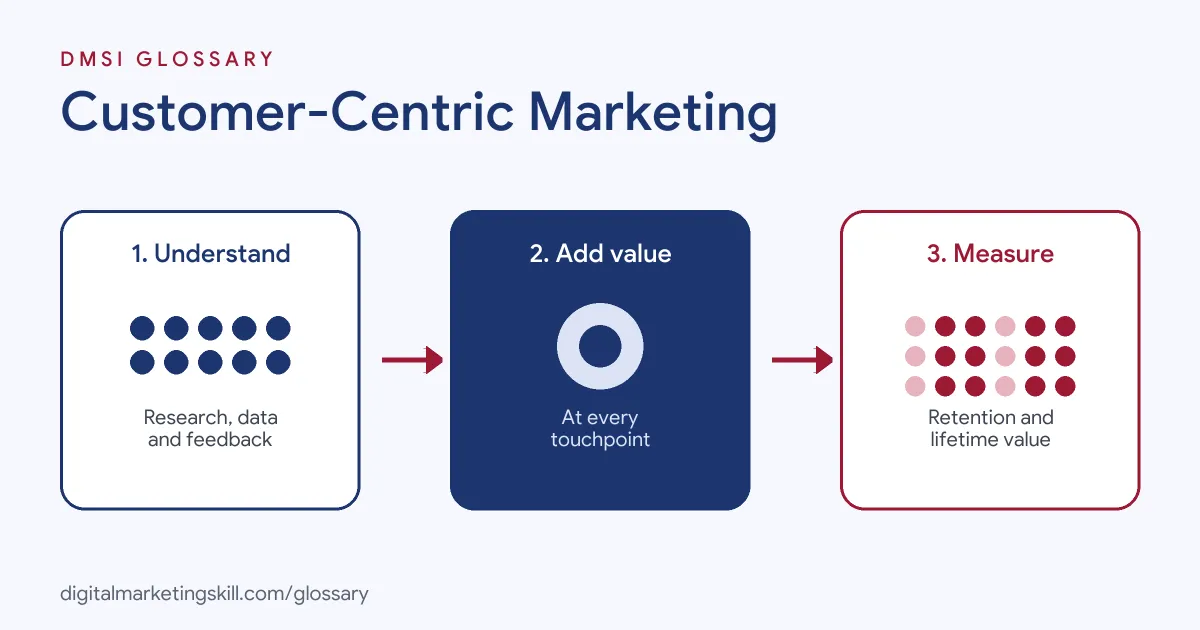
Customer-centric marketing is an approach that puts customers’ needs, preferences and long-term value at the centre of marketing decisions. Instead of starting with “what do we want to sell?”, it starts with “what does this customer need, and how can we help?”. In practice, it means understanding customers deeply through research and data, personalising messages and offers, creating a smooth experience at every touchpoint and measuring success by retention, satisfaction and customer lifetime value as well as new sales.
Key Takeaways
- Customer-centric marketing builds strategy around customer needs and long-term relationships rather than products or one-off sales.
- Amazon Ads recommends approaching the customer journey as a series of cycles, understanding your audience better, offering value at every interaction and measuring and optimising.
- Salesforce explains that customer-centric organisations design processes from the customer’s perspective outward.
- Bloomreach links the shift towards customer-centric marketing to rising customer acquisition costs, which make retention and loyalty more valuable.
- Customer-centric marketing works best when marketing, sales and customer service share data and goals.
What Is Customer-Centric Marketing?
Customer-centric marketing means making the customer, rather than the product, the starting point for marketing. It asks what customers are trying to achieve, what frustrates them, how they prefer to communicate and what would make them stay loyal, and then shapes messages, channels, offers and experiences around those answers.
It does not mean doing whatever every customer asks, or ignoring business goals. It means recognising that long-term profit comes from customers who are satisfied, return and recommend you. Customer-centric marketing therefore balances winning new customers with keeping and growing existing ones.
Customer-Centric vs Product-Centric Marketing
- Product-centric marketing starts with the product’s features and pushes them to as many people as possible. Success is measured mainly by sales volume.
- Customer-centric marketing starts with customer needs, chooses the right customers to serve and tailors the experience to them. Success is measured by customer value, satisfaction and retention as well as sales.
Many organisations combine the two: they build excellent products, but market them through a deep understanding of who they serve and why those customers care.
Why Customer-Centric Marketing Matters
- Retention and loyalty: customers who feel understood are more likely to keep buying and to choose you over competitors.
- Efficiency: as advertising costs rise, keeping and growing existing customers becomes more valuable, a point Bloomreach highlights.
- Relevance: messages based on real needs and behaviour are more likely to be opened, read and acted on.
- Differentiation: when products are similar, a better experience can be the reason customers choose one brand.
- Word of mouth: satisfied customers recommend brands to others, bringing new customers at low cost.
- Better decisions: customer insight helps product, pricing and service teams make better choices.
The Core Principles
Understand customers deeply
Use research, interviews, surveys, reviews, support conversations and behavioural data to understand customers’ goals, problems and language. Tools such as a buyer persona and customer segmentation help teams keep different customer groups in mind.
See the journey as a cycle
Amazon Ads suggests approaching the customer journey as a series of cycles rather than a straight line. Customers move between discovering, considering, buying, using and returning, often many times. Customer-centric marketing supports every stage, including after purchase.
Offer value at every interaction
Every touchpoint, from an ad or social post to a checkout page, onboarding email or support chat, should help the customer. Useful content, clear information, easy processes and helpful service all add value.
Personalise responsibly
Use first-party data, such as purchase history and stated preferences, to make messages and recommendations more relevant. Respect privacy, ask for consent where required and avoid personalisation that feels intrusive.
Listen and act on feedback
Collect customer feedback regularly, share it across teams and make visible improvements. Telling customers what you changed because of their feedback builds trust.
Align teams around the customer
Salesforce describes customer-centric organisations as designing processes from the customer’s perspective outward. Marketing, sales, service and product teams should share customer data and goals so customers do not have to repeat themselves or receive conflicting messages.
How to Build a Customer-Centric Marketing Strategy
- Define who you serve best. Identify your most valuable customer segments and what they need.
- Map the customer journey. List every touchpoint and note where customers get stuck, confused or frustrated. Fix the biggest friction points first.
- Connect your data. Bring together information from your website, CRM, email platform, ads and support tools to build a clearer view of each customer.
- Create relevant content and offers. Answer customers’ real questions and tailor messages to their stage and needs.
- Invest in retention. Use onboarding, loyalty programmes, helpful post-purchase emails and proactive service to keep customers.
- Measure and optimise. Amazon Ads recommends measuring and optimising continuously; track customer-focused metrics and adjust based on results.
Customer-Centric Marketing in B2B and B2C
The principles are the same in business-to-business and business-to-consumer marketing, but they play out differently. In B2C, there are usually many customers making quicker, more emotional decisions, so customer centricity often focuses on personalised recommendations, convenient shopping, fast delivery, easy returns and responsive service across social media, email and chat.
In B2B, there are fewer customers, larger purchases and several people involved in each decision, such as users, managers, finance and procurement. Customer-centric B2B marketing means understanding each person’s concerns, providing useful content for each stage of a long buying process, coordinating closely with sales and supporting customers after the contract is signed through onboarding, training and account management. Retention and expansion within existing accounts are often as important as winning new ones.
The Role of Technology
Technology makes customer centricity possible at scale. A customer relationship management system stores customer information and history; marketing automation sends timely, relevant messages; analytics tools reveal how customers behave across channels; and customer data platforms can combine data from many sources into a single profile. AI can help analyse large amounts of feedback, predict which customers may leave and suggest relevant products. However, technology only helps when the organisation has a clear understanding of its customers and the processes to act on what the data shows. Buying tools without changing how teams work rarely makes a business more customer-centric.
How to Measure Customer-Centric Marketing
Alongside standard marketing metrics such as traffic and conversions, track measures that reflect customer value and experience:
- Customer retention rate: the share of customers who keep buying over time.
- Customer lifetime value: the total value a customer brings over the relationship.
- Net Promoter Score: how likely customers are to recommend you.
- Customer satisfaction and effort scores: how satisfied customers are and how easy it is to do business with you.
- Repeat purchase rate and churn: how often customers return or leave.
Examples of Customer-Centric Marketing
- An online retailer sends replenishment reminders timed to when customers usually run out of a product.
- A software company creates onboarding emails and tutorials based on which features each new user has not tried yet.
- A local service business follows up after each job to ask for feedback and fixes problems quickly.
- A brand rewrites its website copy using the words customers use in reviews and support conversations.
Common Mistakes
- Saying “customer first” without changing processes. Customer centricity needs real changes in data, journeys and incentives.
- Over-personalising. Using personal data in ways customers do not expect can damage trust.
- Collecting feedback but not acting on it. Customers notice when nothing changes.
- Focusing only on acquisition. Ignoring existing customers wastes the value already created.
- Working in silos. Disconnected teams create inconsistent experiences.
Customer-Centric Marketing as a Career Skill
Employers value marketers who understand customers, use data responsibly and connect marketing to retention and lifetime value, not just clicks. Skills in research, customer journey mapping, CRM, email automation and analytics are central to customer-centric marketing. If you are building marketing skills in your country or anywhere else, practising these skills on real projects will make you more effective in almost any marketing role. For structured training in practical digital marketing, you can join our programme.
Frequently Asked Questions
What is customer-centric marketing in simple terms?
It is marketing that starts with what customers need and builds messages, offers and experiences around them, aiming for long-term relationships rather than one-off sales.
What is an example of customer-centric marketing?
A retailer that sends useful, personalised reminders and recommendations based on each customer’s purchase history, rather than the same promotion to everyone.
What is the difference between customer-centric and product-centric?
Product-centric marketing starts with the product’s features; customer-centric marketing starts with the customer’s needs and experience.
How do you measure customer centricity?
Common measures include retention rate, customer lifetime value, Net Promoter Score, satisfaction and effort scores, repeat purchase rate and churn.
Is customer-centric marketing only for large companies?
No. Small businesses can be very customer-centric by listening closely, personalising service and following up after purchases.
How does AI support customer-centric marketing?
AI can help analyse feedback, segment customers, personalise recommendations and answer common questions, as long as it is used responsibly and with human oversight.
Sources: Amazon Ads: Customer-centric marketing; Salesforce: What does customer centric mean?; Bloomreach: Customer-centric marketing.