
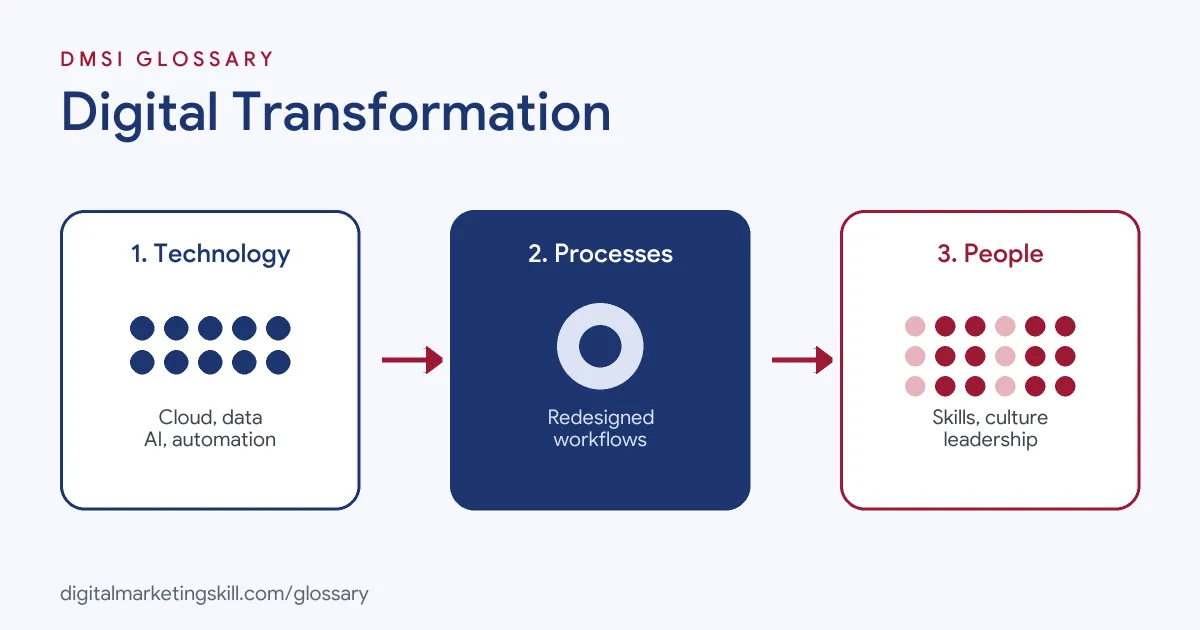
Digital transformation is the process of using digital technology to change how an organisation works, delivers value and serves customers. It goes beyond buying new software: it reshapes processes, business models, products, culture and customer experience so the organisation can compete in a digital economy. For marketers, digital transformation usually shows up as data-driven decision-making, connected customer journeys, marketing automation, e-commerce and the use of AI, all of which depend on people and processes changing alongside the technology.
Key Takeaways
- Digital transformation changes how an organisation operates and creates value, not just which tools it uses.
- IBM groups digital transformation into domains including business and operating models, processes, products, employee experience and customer experience.
- It differs from digitisation, which converts analogue information into digital form, and digitalisation, which uses digital data to improve existing processes.
- Common benefits include higher productivity, lower operating costs, better customer experience, faster innovation and flexibility to scale.
- Many programmes struggle because of culture, unclear goals, poor data and weak leadership, not because the technology fails.
What Is Digital Transformation?
Digital transformation is a long-term shift in how an organisation uses technology, data and new ways of working to meet customer expectations and compete. A bank moving customers from branches to a mobile app, a retailer building an online store linked to its stock system, a manufacturer using sensors to predict machine failures and a charity running fundraising through digital channels are all examples.
The key word is transformation. Installing a new tool on top of an old process often adds cost without much improvement. Transformation asks a bigger question: if we were designing this service today, with today’s technology and customer expectations, how would we do it? Answering that usually means changing processes, roles, skills and sometimes the business model itself.
Digitisation vs Digitalisation vs Digital Transformation
These three terms are often confused. They describe increasing levels of change:
- Digitisation: converting analogue information into digital form, such as scanning paper forms or moving customer records into a spreadsheet.
- Digitalisation: using digital data and tools to improve an existing process, such as replacing paper forms with an online form that feeds a database.
- Digital transformation: rethinking the wider business, customer experience and operating model around digital capabilities, such as offering a fully online service that lets customers sign up, buy, get support and manage accounts without contacting staff.
Most organisations do all three at once in different areas. Digitisation and digitalisation are steps; transformation is the broader change they contribute to.
The Main Areas of Digital Transformation
IBM describes several domains where transformation happens. Thinking in these areas helps organisations avoid treating transformation as an IT project only.
Business and operating models
Changing how the organisation makes money and delivers value, for example moving from one-off product sales to subscriptions, selling directly to consumers online or building a platform that connects buyers and sellers.
Processes
Redesigning workflows using automation, cloud systems and data, so tasks such as ordering, billing, reporting and approvals are faster, cheaper and less error-prone.
Products and services
Adding digital features to existing products, such as connected devices or apps, or creating new digital services altogether.
Employee experience
Giving staff the tools, data, skills and flexibility to work effectively, including collaboration tools, self-service systems and training.
Customer experience
Making it easier for customers to find, buy, use and get help with products across channels, with personalised and consistent experiences. This is the area where marketing plays the biggest role.
Types of Digital Transformation
Another common way to describe transformation is by type:
- Process transformation: changing how work gets done, often through automation and data.
- Business model transformation: changing how value is created and captured, such as moving from physical media to streaming.
- Domain transformation: using new technology to move into new markets or categories.
- Cultural or organisational transformation: changing mindsets, skills, leadership and ways of working so the organisation can keep adapting.
Cultural change is often the hardest and the most important, because new technology only delivers value when people use it well.
Technologies Behind Digital Transformation
Transformation is enabled by technologies including:
- Cloud computing: flexible, scalable infrastructure and software accessed online.
- Data and analytics: collecting, connecting and analysing data to make better decisions.
- Artificial intelligence and automation: automating tasks, predicting outcomes and personalising experiences, including generative AI for content and support.
- Mobile and web platforms: apps, websites and portals that let customers and staff self-serve.
- Customer relationship management and marketing technology: systems that store customer data and automate communication.
- Internet of Things: connected devices and sensors that generate real-time data.
- Cyber security: protecting systems and data as more of the business runs digitally.
The right mix depends on the problem being solved. Starting with technology rather than the customer or business problem is a common mistake.
Benefits of Digital Transformation
- Productivity and lower costs: automation and better systems reduce manual work and errors.
- Better customer experience: faster, more convenient and more personalised service across channels.
- Better decisions: connected data gives a clearer picture of customers, performance and risks.
- Faster innovation: digital tools make it quicker to test, launch and improve products and campaigns.
- Flexibility and scale: cloud systems and digital channels let organisations grow or adapt without proportional increases in cost.
- Resilience: digital operations can help organisations keep working when circumstances change, such as moving to remote work.
Why Digital Transformation Projects Fail
Studies and consultancies have long reported that many transformation programmes fall short of their goals. Figures vary by source and definition, but the reasons are consistent:
- Unclear goals: starting with technology rather than a specific customer or business outcome.
- Weak leadership support: transformation needs senior sponsorship and decisions across departments.
- Culture and resistance: people stick to old ways if they do not understand the change or have the skills for it.
- Poor data: disconnected or inaccurate data limits what new systems can do.
- Trying to change everything at once: huge programmes are hard to manage; smaller, measurable steps build momentum.
- Skills gaps: organisations lack people who can use and manage new tools and data.
How to Measure Digital Transformation
Because transformation is broad, it needs clear measures linked to the original goals. Useful measures include customer outcomes, such as satisfaction scores, retention, conversion rates and time to resolve support requests; operational outcomes, such as cost per transaction, process cycle times and error rates; financial outcomes, such as revenue from digital channels and cost savings; and adoption outcomes, such as the share of staff and customers actively using new tools. Track a baseline before changes begin, review progress regularly and be willing to stop initiatives that are not delivering. Measuring adoption matters as much as measuring launch dates: a new system that few people use has not transformed anything.
Digital Transformation in Marketing
Marketing is often one of the first functions to transform, because customer behaviour has moved online. Typical changes include:
- moving budget from traditional media to digital channels such as search, social media and email;
- building a single view of the customer by connecting website, CRM, email and advertising data;
- using marketing automation to send timely, personalised messages;
- measuring campaigns by revenue and customer value rather than reach alone;
- using AI for content creation, audience insights and campaign optimisation, with human review;
- creating seamless journeys between online and offline channels, often called omnichannel marketing.
Marketers also help drive transformation elsewhere, by bringing customer insight into product and service design and by communicating changes clearly to customers.
How to Approach Digital Transformation
- Start with the customer and business problem. Define what needs to improve, such as onboarding time, cost to serve or customer retention.
- Assess where you are. Review current processes, systems, data and skills.
- Prioritise a few high-value changes. Choose initiatives with clear benefits and measurable results.
- Involve people early. Include staff who use the processes and customers who experience them.
- Build skills. Train teams to use new tools and data, and hire where gaps are critical.
- Test, measure and scale. Pilot changes, measure results, learn and expand what works.
- Keep going. Transformation is continuous, as technology and customer expectations keep changing.
Digital Transformation as a Career Skill
Organisations need people who can connect technology to business results, including marketers who understand data, automation, customer experience and digital channels. These skills are valuable in roles such as digital marketing manager, marketing operations, CRM specialist and e-commerce manager. If you are building digital skills in your country or elsewhere, practical experience with analytics, automation tools and digital campaigns helps you contribute to transformation projects. For structured training in digital and AI marketing, you can join our programme.
Frequently Asked Questions
What is digital transformation in simple terms?
It is using digital technology to change how an organisation works and serves customers, not just adding new tools to old processes.
What is an example of digital transformation?
A business moving from paper-based ordering to an online store connected to its stock, delivery and customer service systems, so customers can buy and track orders themselves.
What are the four types of digital transformation?
A common framework lists process, business model, domain and cultural or organisational transformation.
What is the difference between digitalisation and digital transformation?
Digitalisation improves existing processes with digital tools. Digital transformation rethinks the wider business and customer experience around digital capabilities.
Why do digital transformations fail?
Common reasons include unclear goals, weak leadership support, resistance to change, poor data and skills gaps.
Is digital transformation only for large companies?
No. Small businesses transform too, for example by moving to cloud tools, selling online and automating customer communication.
Is digital transformation a good career?
Skills that connect technology, data and customer experience are in demand across industries, in roles from marketing to operations and consulting.
Sources: IBM: What is digital transformation?; McKinsey: What is digital transformation?; Google Cloud: What is digital transformation?; Adamo Software: Digital transformation benefits, challenges and examples.