
Lead generation is the process of attracting people who might buy from you and getting them to share their contact details. Once you have those details, you can follow up, build trust and turn some of those leads into paying customers. It matters because most people don’t buy on their first visit, so a lead gives you a second chance to win them over.
Key Takeaways
- A lead is anyone who shares their contact details in exchange for something of value, such as a guide, a trial or a quote.
- The process has five stages: attract, capture, nurture, qualify and convert.
- Not every lead is ready to buy. Marketing and sales teams sort them by how close they are to a decision.
- Lead quality matters more than lead volume. A few good leads beat hundreds of poor ones.
- In the UK, you usually need clear consent before you send marketing emails to a new lead.
What Is Lead Generation?
HubSpot defines a lead as “anyone who shares their contact information in exchange for something of value.” Lead generation, then, is the work of attracting the right people and giving them a good reason to share those details.
Think of it as the bridge between a stranger and a customer. For example, someone finds your blog post on how to plan a wedding budget. At the end, you offer a free budget template. They enter their email to get it. Now they are a lead, and you can follow up with useful emails and, later, an offer.
That’s why this work is central to B2B companies, service businesses, schools and anyone who sells something people think about before buying.
Inbound and Outbound
There are two broad ways to find leads. Inbound means people come to you, for example through a search result, a social post or a free guide. Outbound means you reach out first, for instance through cold email, calls or LinkedIn messages. Marketing teams tend to own inbound, while sales teams often own outbound. Many businesses use both. Still, the goal is the same: start a conversation with someone who has a real need.
How Lead Generation Works
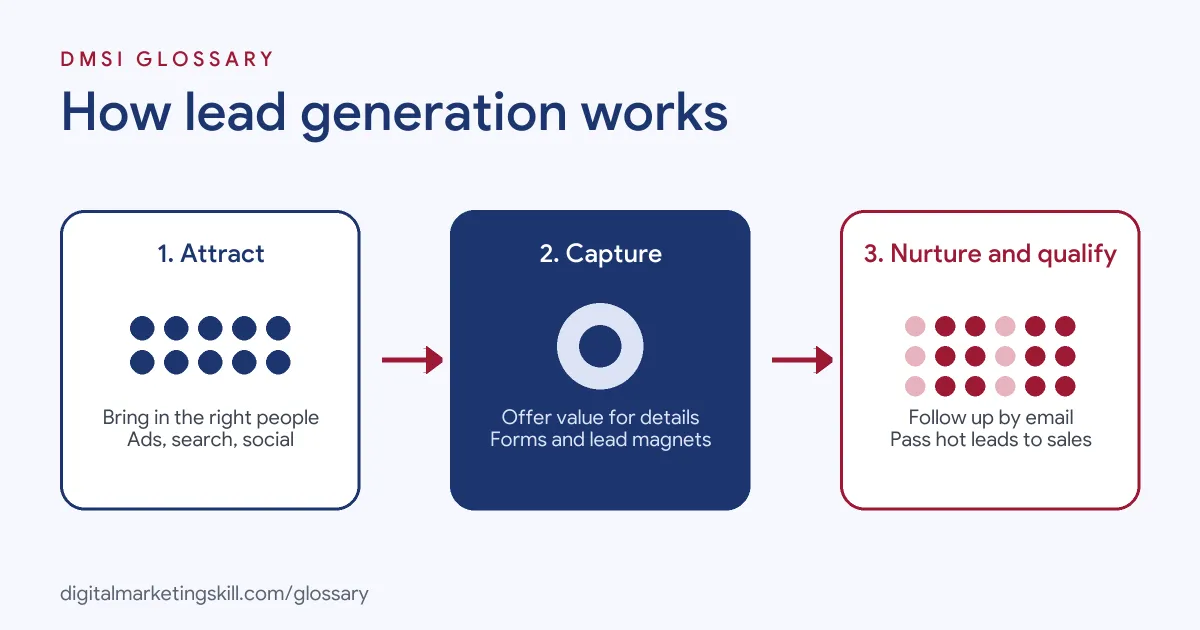
HubSpot breaks the process into five stages. First, you attract the right audience. Next, you capture their details. Then you nurture them with helpful follow-ups. After that, you qualify them to see who is ready. Finally, sales converts the best leads into customers.
Attract
You bring people in through search, social media, paid ads, events or referrals. The key word is “right”. In other words, the people you attract should match the customers you want to serve.
Capture
Next, you turn an anonymous visitor into a known contact. Usually this happens through a form on a landing page, a pop-up, a chatbot or a lead form inside an ad. For instance, Google Ads lead forms let “people submit their information in a form directly in your ad.” To use them, you must link to “a privacy policy for your business,” which shows at the bottom of the form.
Nurture and Qualify
Most new leads are not ready to talk to sales. So you send helpful emails, case studies or invites that build trust over time. Meanwhile, you watch for signs of interest. HubSpot explains that lead scoring “assigns a numerical value to each lead based on its qualification signals.” As a result, sales can focus on the leads most likely to buy.
Lead Generation Examples
Here are three common approaches:
- Software company: It offers a free trial. Users who try key features become product qualified leads, so sales reaches out to them first.
- Local service: A roofing firm runs a Search campaign with a lead form. People who need a quote fill it in without leaving Google.
- Online course: A training school offers a free career guide. It then sends a short email series and invites readers to a consultation.
In each case, the offer matches what the buyer needs at that moment.
Types of Leads Compared
Teams use different labels to show how ready a lead is. Here are the main ones HubSpot describes:
| Lead type | What it means | Next step |
|---|---|---|
| Marketing qualified lead (MQL) | Has engaged with your marketing but isn’t ready for a sales call | Keep nurturing with useful content |
| Sales qualified lead (SQL) | Has shown clear buying intent and sales has accepted it | Sales contacts them directly |
| Product qualified lead (PQL) | Has used your product and shown signs they may upgrade or buy | Offer a paid plan or demo |
| Service qualified lead | An existing contact who tells your service team they want more | Pass to sales for an upgrade |
In short, the label tells everyone who should act next and how.
How to Set Up Lead Generation
Use these steps to build a simple system that works:
- Define your ideal lead. Write down who they are, what problem they have and what makes them a good fit.
- Create an offer. Make something useful, such as a checklist, a template, a free trial or a quote.
- Build a landing page. Keep it focused on one offer, with a short form and a clear button.
- Get consent right. Ask clearly for permission to send marketing emails, and link to your privacy policy.
- Drive traffic. Promote the page through search, social, email or paid ads.
- Set up follow-up. Send an automated welcome email, then a short series that builds trust.
- Score and hand over. Agree with sales what a ready lead looks like, then pass those leads on fast.
Best Practices
- Ask for less. Short forms usually feel easier to fill in. Ask only for what you need now.
- Match the offer to the stage. A beginner’s guide suits new visitors, while a demo suits people close to buying.
- Follow up quickly. A lead goes cold if you wait too long.
- Connect your tools. Send leads straight into your CRM. Google Ads, for example, supports CSV downloads, the API, webhooks and Zapier.
- Measure cost per qualified lead. A cheap lead that never buys is not a good lead.
Common Mistakes to Avoid
Beginners often chase volume. They run broad ads, collect lots of emails and then wonder why sales stays flat. Another common error is buying email lists. Under the UK’s PECR rules, you can generally email a person only if “they have specifically consented to electronic mail from you.” The ICO also says you must give “a simple way to opt out” in every message. Some teams forget to download leads, too. Google Ads keeps lead form data for only a limited time, so it is safer to connect it to your CRM.
Where You’ll Use Lead Generation at Work
This skill shows up across marketing and sales roles. For example, recent remote job listings ask for:
- “Experience in lead generation, outbound prospecting, SDR/BDR work, or business development” (Business Development and Lead Generation Manager).
- A “proven track record in lead generation, appointment setting, or sales outreach” (Lead Generation Specialist).
- “Help with our lead generation forms and overall CRM organization” (a freelance project linking a WordPress site to a CRM).
So if you want to be a Lead Generation Specialist, Email Marketing Specialist or Marketing Automation Specialist, you will need to build forms, offers and follow-up flows. Above all, you will need to show how many good leads they produced.
Learn It in the Lead Generation Track
You can learn this skill in the AI-Powered Lead Generation and Email Automation track. It covers AI fundamentals, lead generation, and email marketing and automation. For your portfolio, you build a lead magnet and an automated email sequence that converts. You also join a U.S. Project Internship from day one, with unlimited 1-on-1 mentoring.
For more ideas, read our lead generation guide and our list of lead magnet ideas.
Frequently Asked Questions
What is lead generation in simple terms?
It is how you get interested people to share their contact details, so you can follow up and turn them into customers.
What is the difference between a lead and a prospect?
A lead has shared their details or shown interest. A prospect is usually a lead that sales has checked and sees as a good fit to buy.
What are the best lead generation channels?
It depends on your audience. Search, social media, email, content and paid ads all work well. Therefore, test a few and keep the ones that bring qualified leads.
Is lead generation the same as sales?
No. It creates the interest and collects the contacts. Sales then talks to the ready leads and closes the deal.
Do I need consent to email new leads?
In the UK, you generally need clear consent before you send marketing emails. There is a narrow “soft opt-in” exception for existing customers who bought something similar from you.
Sources: HubSpot: The beginner’s guide to lead generation; Google Ads Help: About lead form assets; ICO: Electronic mail marketing; remote job listings on Himalayas.