
You grow your email list by removing friction and matching every offer to why a visitor showed up. You also have to keep doing it. Industry analysis of over 11 billion addresses, from ZeroBounce’s Email List Decay Report, puts yearly list decay at roughly 23%. This guide shows the channels that grow your email list, the metrics that prove it, and one rule for picking the right offer.
Key Takeaways
- Your list shrinks on its own. ZeroBounce’s report, built from more than 11 billion verified addresses, found that roughly 23% of email contacts go bad each year.
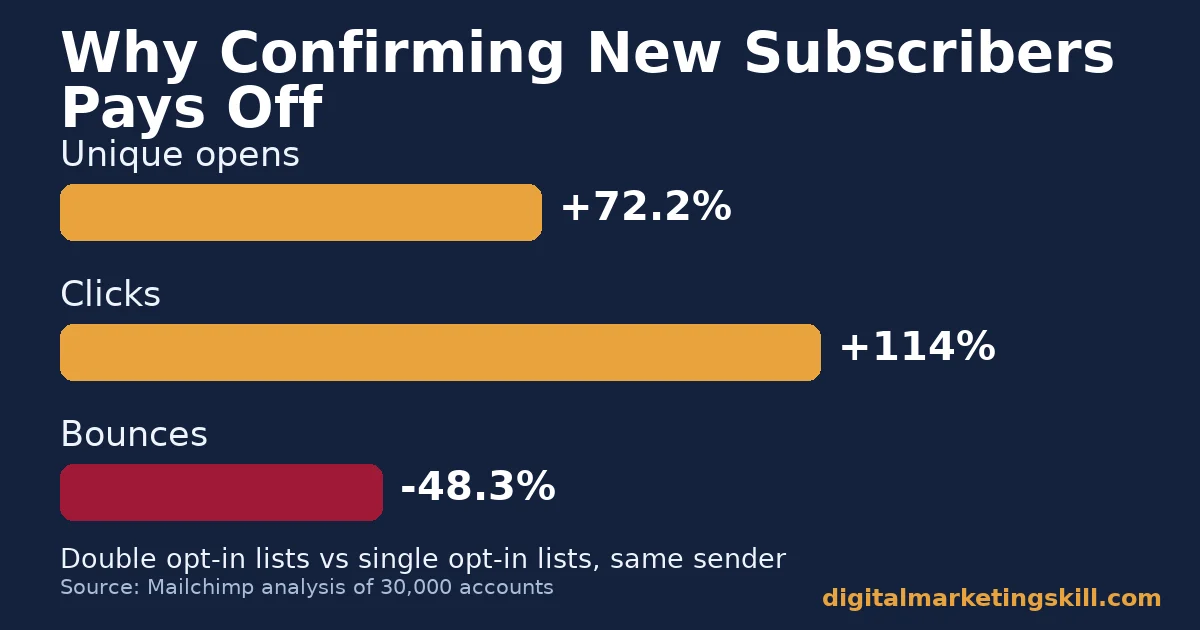
- Confirming new subscribers pays off. Mailchimp’s analysis of 30,000 accounts found double opt-in lists had 72.2% more unique opens, 114% more clicks and 48.3% fewer bounces than single opt-in lists.
- Most pages never get found. Ahrefs’ study of about 14 billion pages found 96.55% receive zero organic traffic from Google.
- Readers scan before they decide. Nielsen Norman Group’s eye-tracking study of 232 users found visitors scan web pages in an F-shaped pattern.
- Email still returns more than most channels. Litmus’ State of Email Survey found 35% of marketers report $10 to $36 back for every $1 spent, and 30% report $36 to $50.
In this guide
- Why You Must Keep Growing Your Email List
- What Makes Someone Sign Up
- How To Grow Your Email List By Channel
- How To Lead With The Right Offer On Each Channel
- Common Mistakes That Quietly Shrink Your List
- How To Measure Whether You Grow Your Email List
- The One Decision Rule: Match The Offer To The Reader’s Task
- A Real Case: How One Company Doubled Its Signups
- Frequently Asked Questions About How To Grow Your Email List
- Start With One Channel, Then Add The Next
Why You Must Keep Growing Your Email List
Most advice treats this like a one-time job. Add a popup. Run a contest. Promote a lead magnet. Done. None of that is wrong, but it skips the real reason you have to grow your email list every month: because once you stop, the list starts sliding backward on its own.
People change jobs. They close old inboxes. They quietly stop opening your emails. Your list shrinks on its own, even if nobody ever clicks unsubscribe.
ZeroBounce’s Email List Decay Report puts that natural loss at roughly 23% a year, based on over 11 billion addresses it verified. The figure has moved between 22% and 28% across recent years of its own reporting. Treat it as a typical range, not a fixed law for your list.
Here are the ground rules for this guide. Every statistic is attributed to a source we opened directly. Company case numbers describe what happened for that company, not a promise for yours. Any number that is only our own estimate is labelled illustrative.
Clean Your List Before You Grow It Further
Adding new subscribers to a list full of dead addresses hides your real progress. A bounced or inactive address drags down your engaged-subscriber rate and can hurt how inbox providers treat your next campaign. So before you chase a bigger number, remove addresses that have not opened or clicked in a long stretch, and verify any list you imported rather than collected yourself.
This matters because growth and hygiene work against each other if you ignore one. A list that adds 500 names a month but never removes a dead one will look healthy on a spreadsheet while quietly losing deliverability. Clean first, then grow your email list on top of a base that actually opens your mail.
What Makes Someone Sign Up
A visitor hands over their email address when two things are both true. First, the offer feels worth more than the small risk of extra email. Second, giving it up takes less effort than they expected. Miss either part, and the form sits there unused.
The Trade Behind Every Signup
Treat a signup form as a trade, not a request. A visitor is handing you a way to reach them again. So the offer should feel proportionate. A specific checklist for a two-minute problem works. A short course tied to a skill they are building works. Early access to content they already read works too.
Vague offers struggle because they ask for trust before they have earned any. “Sign up for updates” describes nothing a visitor can picture receiving. A narrow, named offer converts because the benefit is obvious before the click. If you have not sent a single email yet, read our guide to starting email marketing first, then come back here to grow your email list with intent.
Why Friction Beats A Weak Offer
Every extra field costs you signups. Every extra click does too. A single email field with one clear button almost always beats a form asking for a name, a company and a phone number. Each added field is a new place to quit.
Timing adds friction as well. A popup that interrupts someone mid-sentence feels like a tax on reading. The same offer shown after they finish a section feels like a helpful next step. The offer never changed. Only the moment did.
How To Grow Your Email List By Channel
Not every signup source works the same way. The visitor’s starting point is different each time. Someone reading your blog already trusts your content. Someone seeing a social ad has never heard of you. Treat both the same way, and you waste the channel that was already working for you.
On-Site Capture: Built For Interested Readers
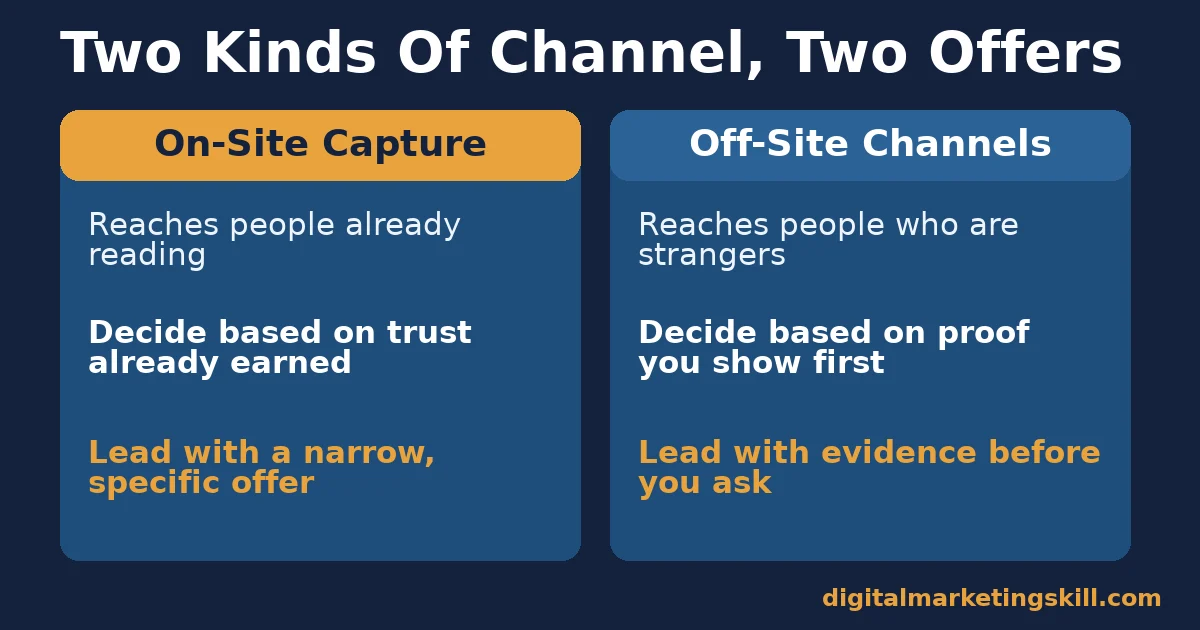
On-site capture includes inline forms, slide-ups and exit prompts. It reaches people already reading your content. Their presence alone shows interest. So the offer has one job: give them a reason to keep hearing from you, not a reason to trust you in the first place.
Small design choices matter most here, because the visitor is still deciding whether to stay. A form that appears after they scroll past the answer converts better than one that appears on arrival, before they know the page is useful.
Off-Site Channels: Built For Strangers
Off-site channels include video platforms, social ads and partner promotions. They reach people with zero history with your brand. YouTube alone now reaches well over 2 billion people worldwide every month. That scale is why creators who build a call-to-action into their videos can reach audiences a blog post never would.
Trust has not been built yet on these channels. So off-site traffic costs more to convert and gets wasted more easily. A visitor arriving from a stranger’s video needs proof before a request for their email address, not after. Pair this with a wider funnel; our breakdown of lead generation and customer acquisition strategies covers the channels that feed a signup form in the first place.
How To Lead With The Right Offer On Each Channel
The fix for each channel mirrors what made it different above. Start with whichever channel already brings you the most visitors. A small improvement there moves more subscribers than a big improvement on a channel nobody sees.
On-Site Capture: Lead With A Narrow, Low-Friction Offer
Match the offer to the exact page it sits on. A visitor reading about subject lines responds far better to a subject-line checklist than a generic “join our newsletter” box. The narrow offer continues a thought the reader already had.
Keep the form itself boring: one field, one button, and a single sentence describing what they get. Test where it sits, but do not test placement instead of testing the offer.
Popupsmart’s analysis of 28,674 campaigns and nearly 500 million popup displays found exit-intent prompts converted at 1.10%, against 0.78% for the same offer shown without exit intent. The same analysis found popups with a discount code converted at 1.46%, against 0.75% without one.
That exit-intent gap is small enough that the researchers call it close to chance, but the offer gap is consistent. So that is where to spend your testing time if you want to grow your email list faster.
Off-Site Channels: Lead With Proof First
Open with evidence the visitor can check in seconds. A specific result, a named source, or a short demonstration works well. Ask for an email address only after that proof lands. A cold visitor who sees proof first arrives at your signup form already partway convinced.
Keep the landing page narrow. Give it one offer and no other exits. A page built for one off-site campaign converts a cold audience better than sending that traffic to a general blog page with a dozen competing links. This single change is often the fastest way to grow your email list from paid or partner traffic.
Common Mistakes That Quietly Shrink Your List
Some habits undo your growth work without you noticing. Watch for these five before you add another channel.
- Buying a list. Purchased contacts never opted in, so they open and click far less than people who found you on their own. Many providers also treat bulk-bought lists as a spam signal, which can hurt delivery for your real subscribers too.
- One generic offer everywhere. The same “join our newsletter” box on every page ignores what each visitor was doing when they saw it, so it converts worse than a narrow offer tied to the page’s topic.
- No welcome email. A new subscriber’s first message sets the tone for every one after it. Skipping it wastes the moment when someone is most curious about what they just signed up for.
- Ignoring mobile forms. A form that is easy to fill on a laptop can be fiddly on a phone, where most traffic now arrives. Test every signup form on a small screen, not just a desktop browser.
- Never re-permissioning quiet subscribers. Contacts who stopped opening months ago are not helping your engaged-subscriber rate. A short “do you still want to hear from us” message, sent occasionally, recovers some and clears out the rest honestly.
How To Measure Whether You Grow Your Email List
Raw subscriber counts hide more than they show. A list can grow in headcount while shrinking in value. Track the four metrics below together, so a vanity win on one does not mask a real loss on another.
Four Metrics That Prove Real List Growth
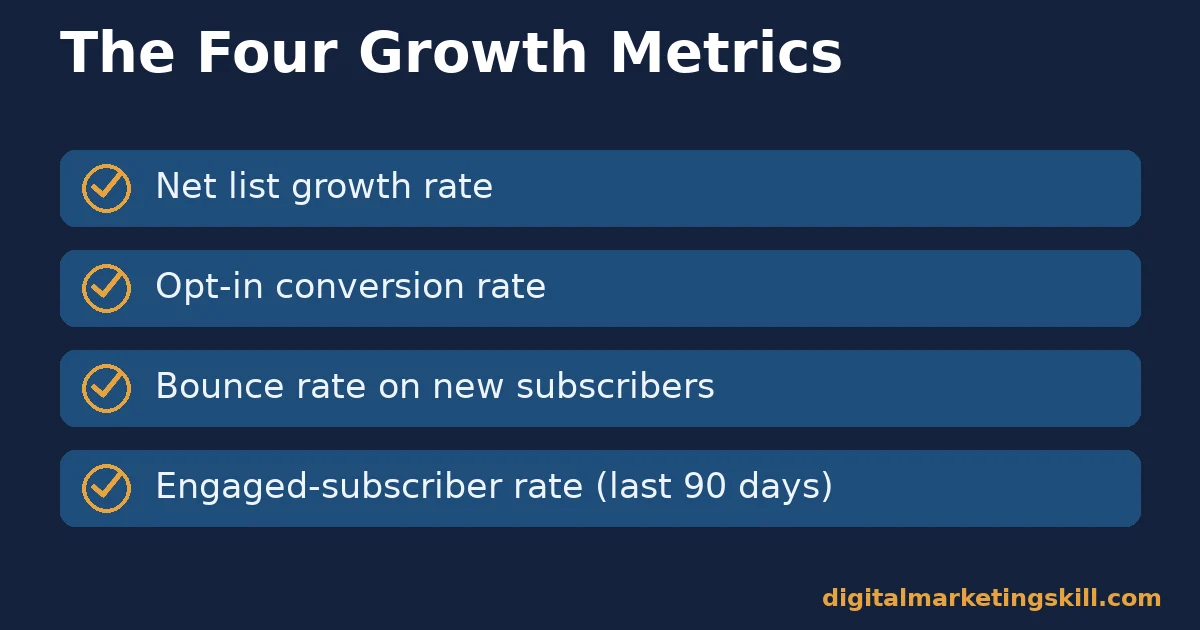
- Net list growth rate. Take new subscribers, subtract unsubscribes and hard bounces, then divide by your total list size. This shows whether you are actually ahead of natural decay, not just adding names on top of a shrinking base.
- Opt-in conversion rate. Divide signups by the visitors who saw the offer. This tells you whether the offer itself works, separate from how much traffic you send it.
- Bounce rate on new subscribers. A rising bounce rate among people who just joined usually means a channel is attracting bots, not real readers. Mailchimp’s double opt-in analysis found this bounce rate drops by 48.3% once a confirmation step is added. See our guide to email deliverability for what Gmail, Yahoo, Outlook and Apple check before they deliver your mail.
- Engaged-subscriber rate. This is the share of your list that opened or clicked in the last 90 days. It matters more than total size. Mailchimp’s own benchmark puts the all-industry average click rate at 2.62%, while open-rate accuracy is affected by Apple’s Mail Privacy Protection feature.
Read these four numbers together. A list growing in headcount but falling in engaged-subscriber rate is adding the wrong people. A list with a healthy opt-in conversion rate but a rising bounce rate is adding people through a leaky channel. Either pattern means you are not really able to grow your email list in any way that matters, even while the total count climbs.
The One Decision Rule: Match The Offer To The Reader’s Task
Before you add another signup box, ask what the visitor was doing the moment before they saw it. Make the offer the next obvious step in that task, not a separate request.
Here is an illustrative, invented example. A visitor reads a post about writing subject lines. Then they see a popup offering “50 subject line templates, sorted by goal.” That is the next step in their task, so it converts well. The same visitor shown a popup for “join our newsletter” sees an unrelated request. They are far more likely to close it.
Apply the rule by auditing every signup prompt on your site. Write down, in one sentence, what the visitor was doing right before they saw it. If you cannot finish that sentence specifically, rewrite the offer before you touch the placement. Do this well, and you grow your email list without adding a single new channel.
A Real Case: How One Company Doubled Its Signups
Buffer, the social media scheduling company, published the exact numbers behind one deliberate push to grow your email list using more than one channel at once. Average monthly signups went from 2,349 in the two prior months to 5,450 in the focus month. That is a 130% increase, reached by adding eight new ways to capture an email address instead of relying on a single slide-up box.
The breakdown shows why spreading capture across channels worked. The original slide-up box still brought in roughly 400 signups a week, while a site-wide bar added about 350 more. A quiz launched that same month brought in 345, and a one-time Twitter lead-generation card promotion added 182 more. No single new channel replaced the original one. Together, they compounded it.
The limits matter as much as the number. Buffer’s own writeup calls this a deliberate one-month push on an already-established blog with existing traffic. Not every new channel performed well, and a sidebar form underperformed due to banner blindness. Treat the 130% figure as what several channels can do together on top of existing traffic, not a guaranteed result for a brand-new site.
Frequently Asked Questions About How To Grow Your Email List
How fast can you grow your email list?
There is no universal rate. It depends on your existing traffic, offer quality and how many channels you run at once. Track your net list growth rate monthly, and judge yourself against your own prior months rather than an outside benchmark.
Is a pop-up still worth using to grow your email list?
Yes, used sparingly with a specific offer. Popupsmart’s analysis of popup campaigns found offer quality, such as a discount code, moved conversion more than the exit-intent trigger did. The offer inside the popup matters more than the popup format itself.
Should I use single or double opt-in?
Double opt-in asks a new subscriber to confirm their email address before joining your list. It adds one extra step, but Mailchimp’s analysis of 30,000 accounts found it produced far more opens and clicks, and far fewer bounces, than single opt-in. Choose it when engagement and deliverability matter more than raw signup speed.
What is a good email list growth rate?
A healthy net list growth rate stays positive after you account for natural decay, which industry analysis puts at roughly 20% to 28% a year. If your net growth rate sits below your decay rate, your list is shrinking even if raw signups look fine.
Do I need a different offer for social media traffic than for blog readers?
Yes. Blog readers already trust your content, so a narrow, related offer works well. Visitors from social platforms or ads usually have no history with you. They respond better to proof of a result before any request for their email address.
How do I know if my email list growth is actually healthy?
Look at net list growth rate, opt-in conversion rate, new-subscriber bounce rate and engaged-subscriber rate together. Growth in subscriber count alone can hide a falling engaged-subscriber rate, and that number predicts your future opens and clicks.
How often should I clean my email list?
Review it at least every few months, and sooner if your bounce rate or engaged-subscriber rate moves the wrong way. Remove or re-permission contacts who have not opened or clicked in a long stretch, since they drag down deliverability for everyone else on the list.
Can I grow your email list using only one channel?
You can, but it is riskier. A single channel can change overnight: a platform updates its algorithm, or a partner ends a promotion. Spreading signups across two or three channels, as Buffer’s case above shows, protects you if any one of them slows down.
Does the day or time I promote my signup form matter?
It can, but less than the offer itself. Visitors arriving through search or a direct link convert at roughly the same rate regardless of time of day, because they came looking for something specific.
Timing matters more for social and email promotions, where you are competing with whatever else is in someone’s feed or inbox at that moment. Test your own audience rather than copying a general rule, since attention patterns vary by platform and region.
Put This Into Practice
Growing your email list is a skill you can build on purpose, not guess at post by post. The Digital Marketing Skill Institute’s Master Diploma in Digital & AI Marketing includes an AI-Powered Lead Generation and Email Automation track inside its ten-course, four-track program.
It comes with a Full Stack option for completing all four tracks, unlimited 1-on-1 coaching and mentoring, a U.S. Project Internship with a verified U.S. Work Reference Letter, and dual US and UK accreditation recognised in more than 100 countries. It runs 100% online, wherever in your country you happen to be.
Explore more practical guides on the Digital Marketing Skill Institute blog, read real outcomes on the reviews page, or go straight to the application page to start. Learn more about the Institute and its full course catalogue at digitalmarketingskill.com, any time, from anywhere.
Next step: pick the one channel sending you the most traffic right now. Audit the offer sitting on it using the decision rule above. Fix that one offer before you add a second channel. Once it is in place, come back to digitalmarketingskill.com for the next guide on growing your email list further.
Every figure in this guide was checked against its original source before publication. Figures marked as illustrative are invented examples, not real results.
![9 Amazing Digital Marketing Skills to Make Money Online [With Proof]](https://digitalmarketingskill.com/wp-content/uploads/2019/07/9-Amazing-Digital-Marketing-Skills-to-Make-Money-Online-With-Proof-17.png)






