
A small business marketing budget is the amount of money you set aside for marketing over a set period, usually a quarter or a year. Most guidance puts it between 7% and 15% of revenue. But the right number depends heavily on your business model, your margins, and your growth stage. This guide shows how to set that number and where to spend it, step by step.
Key Takeaways
- The U.S. Small Business Administration’s long-standing baseline is 7-8% of gross revenue for firms under $5 million, assuming healthy profit margins (SBA, via Real Cost Report’s benchmark compilation).
- The CMO Survey found companies under $10 million in revenue allocate 15.6% of their total budget to marketing, more than twice the 6.4% reported by large B2B product companies.
- Business model predicts budget size better than revenue alone. B2C product companies reportedly spend around 15.5% of revenue on marketing, versus 6.4% for B2B product companies, a gap of more than double.
- 52% of pay-per-click advertising clicks happen on mobile devices, so a mobile-unfriendly site quietly wastes part of any paid budget (WebFX, cited by HubSpot).
- 36% of surveyed businesses treat 6-25% of total marketing budget as the right range for paid search specifically, within the larger small business marketing budget (WebFX survey of 350+ businesses).
In this guide
- The Real Gap In Most Small Business Marketing Budget Advice
- How To Set A Small Business Marketing Budget In Four Steps
- Small Business Marketing Budget: What Differs By Business Model
- How To Lead With Each Business Model’s Budget
- Common Small Business Marketing Budget Mistakes
- A Quick Budget-Setting Checklist
- Who Should Manage A Small Business Marketing Budget
- How To Measure A Small Business Marketing Budget’s Performance
- The One Decision Rule For Adjusting Your Budget
- A Short Glossary For Small Business Marketing Budget Terms
- A Worked Example: Splitting A Monthly Budget
- A Real Small Business Marketing Budget Case, And Its Limits
- Adjusting A Small Business Marketing Budget For Slow And Busy Seasons
- Frequently Asked Questions About Small Business Marketing Budgets
- Build Your Marketing Skills With Digital Marketing Skill Institute
The Real Gap In Most Small Business Marketing Budget Advice
Most articles on this topic give you one number, like “spend 7% of revenue,” and stop there. That number is a reasonable starting point. But it skips the part that actually matters: how that number changes by business model, and how to split it once you have it.
Two ground rules. Every percentage below is a benchmark, not a rule. Treat it as a starting point to test against your own results.
Most of the survey data below comes from the US. If you operate elsewhere, use the figures as a reference point, and adjust them for your own market.
How To Set A Small Business Marketing Budget In Four Steps
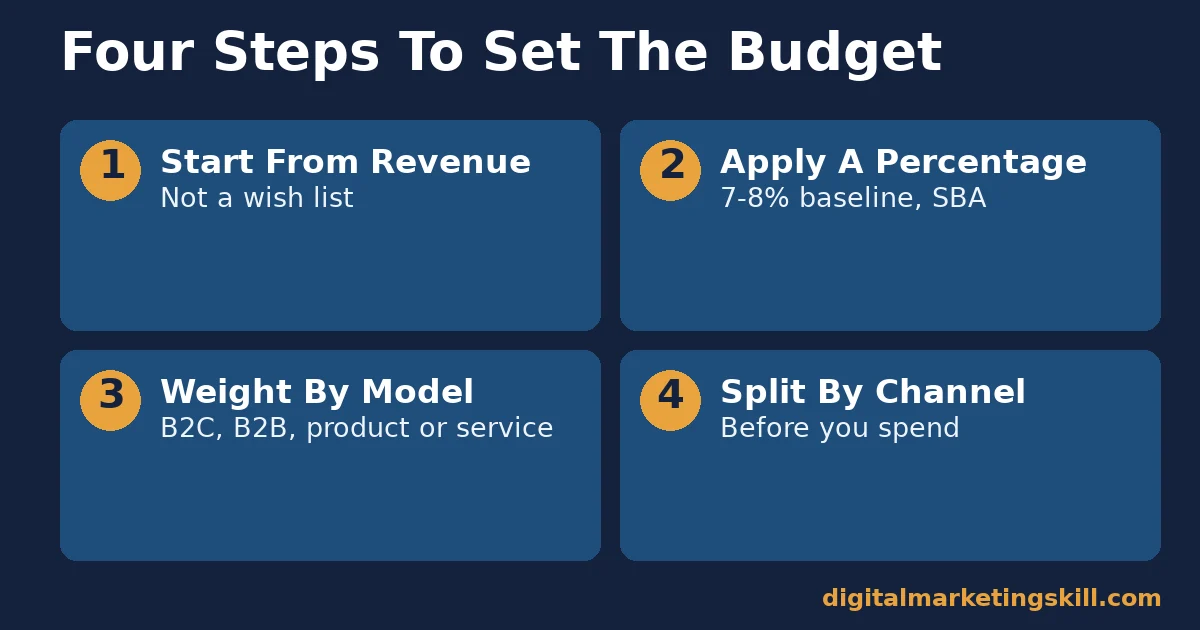
Setting the number does not need to be complicated. Four steps cover most small businesses.
Step 1: Start From Revenue, Not A Wish List
Begin with your actual or projected revenue for the period, not with a wish-list of channels. Instead of guessing a dollar figure first and working backward to justify it, start from a number you can defend.
Step 2: Apply A Percentage Range, Then Adjust
The U.S. Small Business Administration’s guidance and a compiled benchmark report put the baseline for small businesses under $5 million in revenue at 7-8% of gross revenue. That figure assumes healthy margins. Adjust downward if your margins are thin, and upward if you are in a launch phase and need visibility fast.
Step 3: Weight It By Your Business Model
Reported figures compiled from The CMO Survey put B2C product marketing spend around 15.5% of revenue, B2C services near 10%, B2B services around 9%, and B2B product closer to 6.4%. If you sell a physical product directly to consumers, expect to spend meaningfully more than a B2B software company earning the same revenue.
Step 4: Split It Between Channels Before You Spend
Decide your channel mix before the money goes out, not after that first payment clears. Our guide to digital marketing channels walks through how small businesses typically choose and combine channels.
Small Business Marketing Budget: What Differs By Business Model
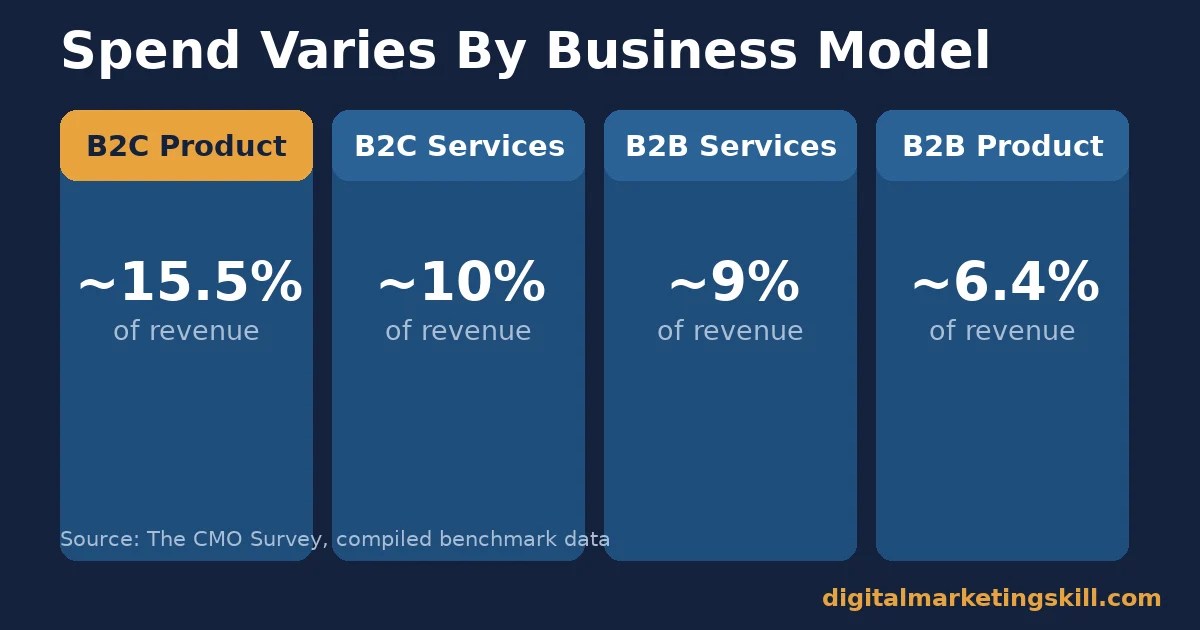
A single blended percentage hides more than it reveals. Here is what the data shows by model.
B2C Product: Built For Visibility And Volume
B2C product companies spend the most as a share of revenue, reportedly around 15.5%. In this model, visibility drives volume. So brand advertising, social content, and paid acquisition all compete for the same budget line.
B2C Services: Built For Local Trust
B2C service businesses sit closer to 10% of revenue. Here, trust signals matter more than reach. Google’s own guidance notes that customer reviews help a business stand out directly inside Search and Maps results, often outperforming broad brand advertising for the same spend.
B2B Services: Built For Relationship Pipeline
B2B services average around 9% of revenue. Because the sales cycle is longer here, budget tends to favor content, email nurture, and account-based outreach over one-off ad impressions.
B2B Product: Built For Qualified Demand
B2B product companies spend the least as a share of revenue, around 6.4%. Smaller, more technical buyer pools mean budget stretches further toward precisely targeted search and account-based campaigns, and less toward broad awareness.
How To Lead With Each Business Model’s Budget
Knowing the benchmark is only half the job. Here is where to put the money for each model.
B2C Product: Lead With Paid Social And Content
Put the largest share behind channels with visual reach, such as paid social and content. Pair that with conversion-focused pay-per-click advertising for the moments when a shopper is ready to buy.
B2C Services: Lead With Local Search And Reviews
Invest first in local search visibility and a steady review-generation process. A service business with strong reviews often needs a smaller paid budget to win the same customer.
B2B Services: Lead With Content And Email Nurture
Put the bulk of the budget into content that answers buyer questions. Then nurture those leads by email over weeks or months. Our content marketing budget guide covers setting that specific line item.
B2B Product: Lead With Precision Search And ABM
Keep spend concentrated on precisely targeted search campaigns and account-based marketing toward a defined buyer list. Google’s own guidance on cost-per-click bidding explains why a tighter audience often produces a lower effective cost than a broad one. Our Google Ads budget guide covers setting that number specifically for search spend.
Common Small Business Marketing Budget Mistakes
Most budget problems come from a short list of repeated habits, not bad luck. Check for these before you raise or cut any spending, since fixing a habit is usually faster than finding more money.
- Using one blended percentage for every channel. A single number hides which channels actually earn their keep. Track spend and return by channel, not just in total.
- Copying a competitor’s budget size. Their business model, margins, and goals are not yours. Use benchmarks as a reference point, not a target to match exactly.
- Spreading the budget across too many channels. A small budget split six ways rarely gives any one channel enough spend to produce a clear result.
- Ignoring mobile performance. 52% of pay-per-click advertising clicks happen on mobile devices, according to HubSpot’s PPC statistics roundup, citing WebFX. A separate WebFX survey of over 350 businesses found similar patterns in how paid budgets get wasted when the landing experience is weak. A slow mobile site quietly wastes that share of any paid budget.
- Reviewing performance too rarely. Waiting a full quarter to check results lets a weak channel drain the budget for months before anyone notices.
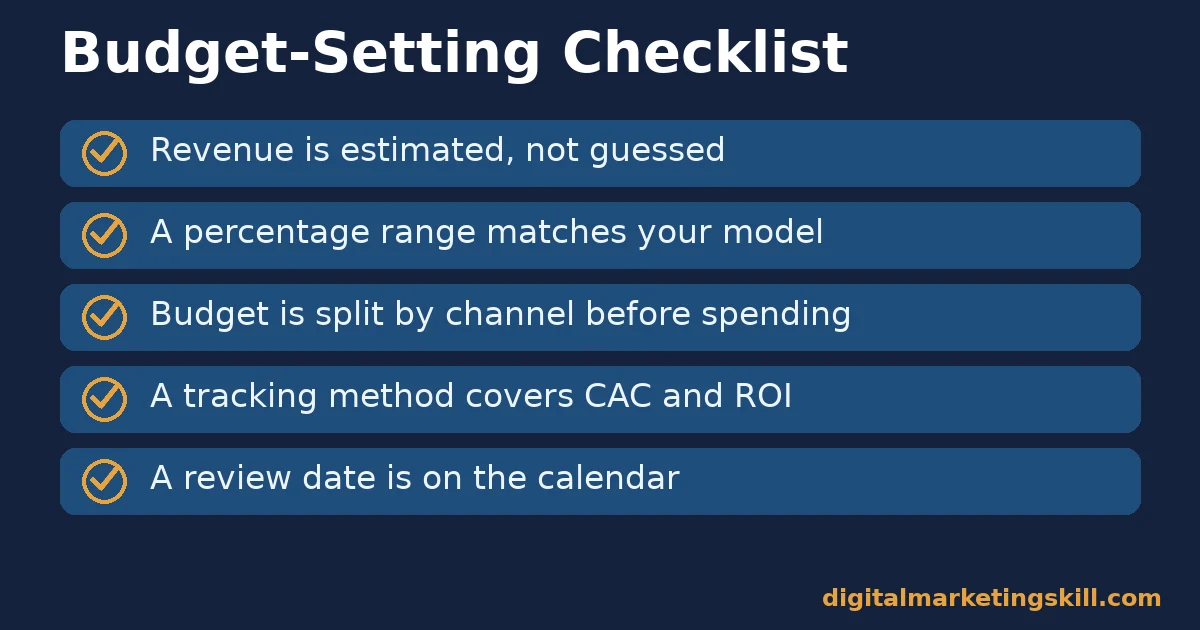
A Quick Budget-Setting Checklist
Run through this list once a quarter, or any time your revenue changes significantly.
- Revenue for the period is estimated, not guessed.
- A percentage range is chosen and matched to your business model.
- The budget is split across channels before any money is spent.
- A tracking method is in place for CAC and channel-level ROI.
- A review date is set on the calendar, not left open-ended.
Who Should Manage A Small Business Marketing Budget
Many small businesses never decide clearly who owns the budget. As a result, spending drifts, and nobody feels responsible when a channel underperforms. This section covers the three common setups, so you can choose one deliberately instead of by accident.
Owner-Managed: Best For The Smallest Teams
In the smallest businesses, the owner typically manages the budget directly. This works well when spend is simple and the owner already understands the channels in use. However, it becomes a bottleneck once the business adds more than two or three active channels at the same time.
In-House Hire: Best Once Spend Justifies A Salary
Once monthly marketing spend is large enough, a dedicated in-house hire usually pays for themselves through better channel management. A rough rule of thumb is to consider this once ad spend alone exceeds the cost of a junior marketing salary each month, since that is roughly the point where tighter, hands-on management starts to outweigh the cost of the hire.
Agency Or Freelancer: Best For Specialized Skills
Agencies and freelancers work well for specialized skills you do not need full-time, such as advanced analytics or one-off campaign launches. For example, Chinelo E.’s case below shows a freelancer managing a meaningful monthly budget for a single client, rather than an in-house team.
This arrangement often suits a small business well. It buys specialist skill without the fixed cost of a full salary, benefits, and the management overhead that an in-house hire would require.
How To Measure A Small Business Marketing Budget’s Performance
Four numbers show whether the budget is working. None of them means much read alone.
Customer Acquisition Cost (CAC): total marketing and sales spend divided by new customers gained. Rising CAC with flat revenue is an early warning sign.
Customer Lifetime Value (LTV): the total revenue one customer brings over the relationship, not just their first purchase. Compare it against CAC, not against spend alone.
Marketing-To-Revenue Ratio: your actual marketing spend divided by revenue for the same period. Compare it against the benchmark percentage for your business model, not a generic average.
Channel-Level ROI: revenue attributed to a channel, divided by what you spent on it. Track this separately for each channel, because a strong blended number can hide one channel quietly losing money.
Review these monthly, not weekly. A small business marketing budget needs at least a few weeks of spend before the numbers are stable enough to trust, and checking too often tends to produce reactions to noise rather than to real signal.
The One Decision Rule For Adjusting Your Budget
Decision rule: only shift budget between channels after a full month of data, and only move an amount you are prepared to lose if the new channel underperforms. Chasing single-week spikes usually destroys more value than it creates.
Illustrative, invented numbers: suppose your small business marketing budget is $4,000 a month, split evenly between two channels. After one month, Channel A shows a CAC of $40, and Channel B shows a CAC of $90.
Move roughly 20% of Channel B’s share into Channel A, then measure again before moving more. Do not move the full amount at once. A channel can look weak for reasons unrelated to its real potential, such as a slow month, a tracking gap, or a one-off seasonal dip in demand.
A Short Glossary For Small Business Marketing Budget Terms
These terms come up constantly once you start tracking a budget seriously. Keep this list nearby.
- CAC. Customer Acquisition Cost. What it costs, on average, to gain one new customer.
- LTV. Customer Lifetime Value. The total revenue one customer is expected to bring over time.
- ABM. Account-Based Marketing. A targeted approach aimed at a defined list of accounts, rather than a broad audience.
- Attribution. The method used to credit a sale or lead to the channel that produced it.
- Contingency Budget. Money set aside, separate from planned spend, for unexpected costs or opportunities.
You do not need to master every term before you set your first budget. Instead, learn each one as it becomes relevant to a real decision you are making. For example, CAC and LTV only matter once you have enough customers to compare them meaningfully, so a brand-new business can safely set those two aside for the first month or two.
A Worked Example: Splitting A Monthly Budget
Illustrative, invented numbers: imagine a small B2C service business earning $40,000 a month in revenue. Using the 10% baseline for B2C services, that gives a small business marketing budget of roughly $4,000 a month.
A reasonable first split might look like this: $1,500 toward local search and review generation, $1,200 toward paid social, $800 toward email marketing to existing customers, and $500 held back as a contingency buffer. None of these numbers are fixed. They simply give a new owner a concrete starting point to test and adjust, rather than an empty spreadsheet and a guess.
After the first month, compare each channel’s CAC against the others. Then apply the decision rule above: move a small, deliberate share toward whichever channel performed best, and never move it all at once.
A Real Small Business Marketing Budget Case, And Its Limits
Chinelo E., a Digital Marketing Skill Institute student, now manages a $7,000 monthly ad budget for a U.S. client, as published on the Institute’s reviews page.
This case has real limits worth naming. It describes one person’s client work, not a controlled study. The result reflects that specific client’s budget and market, not a typical outcome. It is self-reported, and results like this are not guaranteed. Read the earnings disclaimer before treating any single case as a forecast for your own business.
Adjusting A Small Business Marketing Budget For Slow And Busy Seasons
Most small businesses see demand rise and fall across the year. Because of this, a flat monthly budget rarely fits every month equally well.
During a known busy season, it often makes sense to shift a larger share of the annual budget into that window, since the same dollar tends to produce more customers when demand is already high. During a known slow season, instead of cutting spend evenly across every channel, cut the weakest-performing channel first and protect the one with the best CAC.
Plan this shift in advance, not in the middle of the season. A budget decided calmly in a quiet month is usually better than one decided under pressure during a busy one. Write the seasonal plan down once a year, including the exact months it applies to and the channels it affects, so the decision does not have to be remade from scratch every single cycle.
Frequently Asked Questions About Small Business Marketing Budgets
What percentage of revenue should a small business spend on marketing?
A common baseline is 7-8% of gross revenue, from the US Small Business Administration, for firms under $5 million with healthy margins. Adjust up or down based on your business model and growth stage.
How much should a brand-new small business spend on marketing?
New businesses often spend more than the baseline, since they need visibility before revenue exists to spend a percentage of. Many plan around a fixed launch budget first, then shift to a revenue-based percentage once sales are steady.
Does a small business marketing budget differ by industry?
Yes, business model affects it more than industry label alone. Reported figures put B2C product spend around 15.5% of revenue, against roughly 6.4% for B2B product companies. A retailer and a software company should not use the same percentage.
Should a small business marketing budget include staff costs?
Most frameworks say yes. In-house marketing salaries, freelancer fees, and agency retainers typically count as part of the total marketing budget, alongside media spend and tools.
How often should a small business marketing budget be reviewed?
Monthly is a practical rhythm for most small businesses. Weekly reviews are usually too noisy to act on, while quarterly reviews can let an underperforming channel drain the budget for too long.
What is the biggest mistake small businesses make with their marketing budget?
Spreading the budget too thin across too many channels. A small budget split six ways rarely gives any single channel enough spend to produce a clear, measurable result.
Can a small business marketing budget work with no paid advertising at all?
Yes, especially for B2C and B2B services models, where reviews, local search, and content can carry much of the weight. Most businesses still benefit from a small, clearly measured test of paid channels before ruling them out.
What should a complete beginner track in the first month of a new budget?
Track just total spend, new customers, and CAC. Once those three feel familiar, add LTV and channel-level ROI. Trying to track everything at once usually slows a beginner down rather than helping.
Should a small business marketing budget change every year?
Yes, typically. As revenue grows, the dollar amount tied to your percentage grows with it, even if the percentage itself stays the same. Review the percentage itself once a year, since your business model, margins, and competitive landscape can all shift that baseline over time.
Build Your Marketing Skills With Digital Marketing Skill Institute
Setting a small business marketing budget is only useful if you also know how to spend it well across channels. A number on a spreadsheet does not generate customers by itself; the skill to apply it does.
The Master Diploma in Digital & AI Marketing at Digital Marketing Skill Institute is built around four AI-powered tracks covering ten courses in total: AI-Powered Social Media Management and Advertising, AI-Powered Lead Generation and Email Automation, AI-Powered Google Specialist, and AI-Powered WordPress and SEO Specialist. A Full Stack option lets you complete all four tracks for a broader skill set across the exact channels this guide covers.
Every path includes unlimited 1-on-1 coaching and mentoring, a U.S. Project Internship with a verified U.S. Work Reference Letter, and dual US and UK accreditation recognised in more than 100 countries. The program runs 100% online, so you can study from anywhere in your country, while still applying what you learn directly to your own small business marketing budget as you go.
Explore the digital marketing blog for more practical guides, browse real student reviews, or go straight to the application page to get started today. Wherever you live, Digital Marketing Skill Institute trains students worldwide, and you can learn more at digitalmarketingskill.com.
Every figure in this guide was checked against its original source before publication. Figures marked as illustrative are invented examples, not real results.
![9 Amazing Digital Marketing Skills to Make Money Online [With Proof]](https://digitalmarketingskill.com/wp-content/uploads/2019/07/9-Amazing-Digital-Marketing-Skills-to-Make-Money-Online-With-Proof-17.png)






